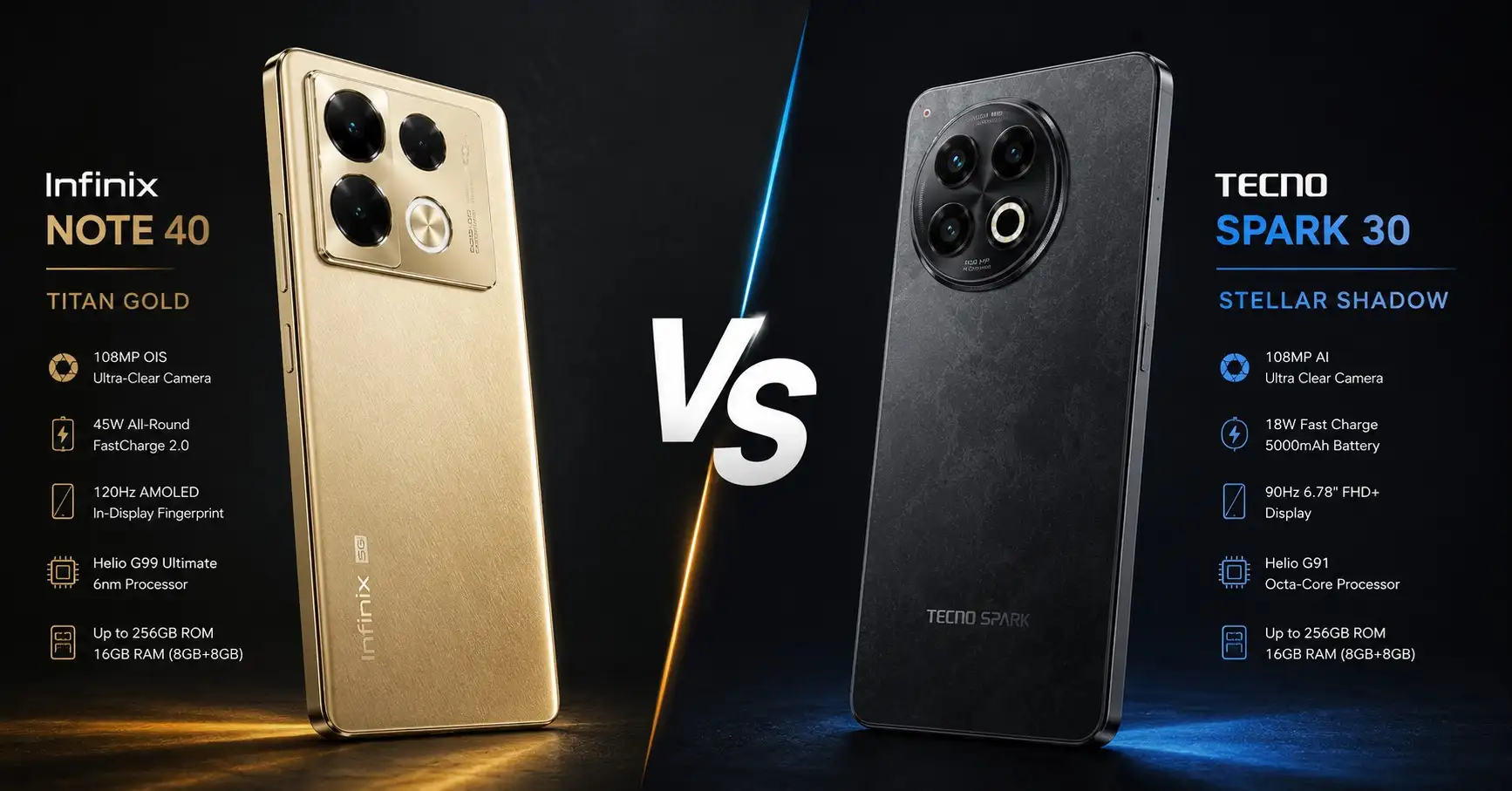
Choosing a budget Android phone in 2026 usually means picking between two familiar names, Infinix and Tecno. Both brands sit under the same parent company, yet their flagship budget models take very different approaches. This Infinix Note 40 vs Tecno Spark 30 comparison breaks down the display, camera, battery, and price so you can pick the right one without guesswork.
The Infinix Note 40 leans into a premium feel with an AMOLED screen and fast charging. The Tecno Spark 30, however, focuses on a bigger camera sensor and a lower entry price. Because both phones share a similar 5000mAh battery and 6.78 inch footprint, the real differences show up in the details.
Now let us look at how these two phones actually compare, starting with the part most people notice first: the design.
Design and Build: Which Phone Feels More Premium
Firstly, the Infinix Note 40 weighs 190 grams and measures 164.1 x 74.5 x 7.8 mm, giving it a compact, rounded feel for a phone this size. It also carries an IP54 rating for dust and splash resistance, which is a genuine bonus at this price point. The Racing Edition variant, developed with BMW Group Designworks, adds a motorsport inspired finish that few budget phones can match.
In contrast, the Tecno Spark 30 measures 168 x 76.4 x 7.7 or 7.9 mm and ships in finishes like Stellar Shadow, Astral Ice, and a Magic Skin 3.0 eco leather back option. This means the Spark 30 offers more texture variety, while the Note 40 keeps things sleeker and glossier.
Additionally, the Spark 30 uses a side mounted fingerprint sensor built into the power button, whereas the Note 40 places its sensor under the display. Because in display sensors typically unlock faster and feel more premium, this becomes an early point in the Note 40’s favor.
Display Quality: AMOLED vs IPS LCD
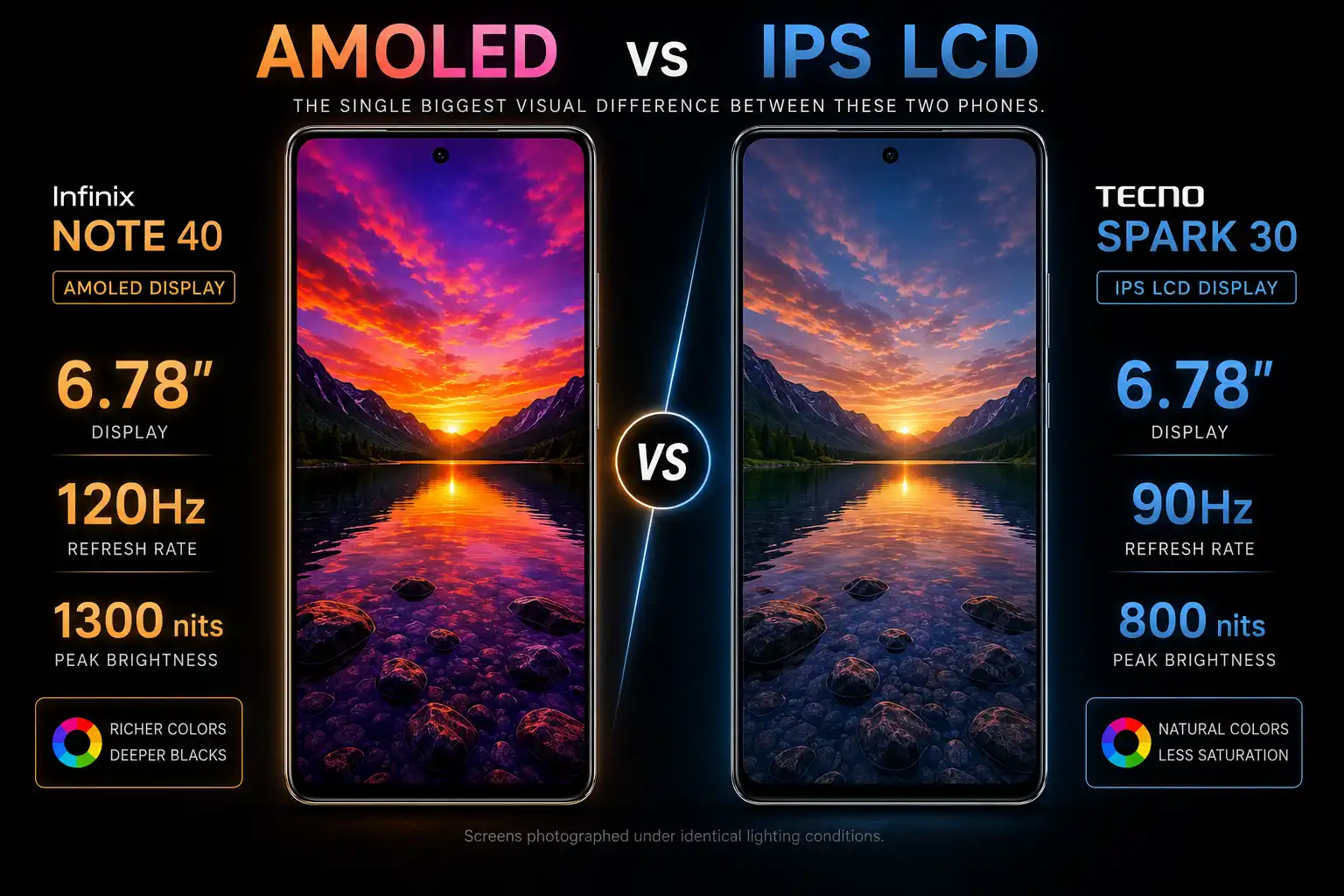
This is where the gap widens the most. The Infinix Note 40 uses a 6.78 inch AMOLED panel with a 120Hz refresh rate and a 1300 nits peak brightness, protected by Corning Gorilla Glass. That combination gives it deep blacks, punchy colors, and strong outdoor visibility.
The Tecno Spark 30, on the other hand, uses a 6.78 inch IPS LCD panel running at 90Hz with 800 nits peak brightness. Therefore, colors look flatter and contrast is noticeably weaker next to the Note 40’s AMOLED screen. This gap alone justifies the Note 40’s higher price for anyone who watches a lot of video or streams content daily.
However, the Spark 30’s 90Hz refresh rate still feels smooth for everyday scrolling and browsing. So casual users who rarely notice screen technology may not miss the AMOLED upgrade as much as gamers or content creators would.
Performance: Helio G99 Ultimate vs Helio G91
Performance is another clear separation point. The Infinix Note 40 runs on the MediaTek Helio G99 Ultimate, paired with a Mali-G57 MC2 GPU and an octa-core setup built around two 2.2GHz Cortex-A76 cores. This chip is confirmed on Infinix’s official specification page.
Meanwhile, the Tecno Spark 30 uses the older, less powerful MediaTek Helio G91 chipset built on a 12nm process, with a Mali-G52 MC2 GPU and Cortex-A75 cores capped at 2.0GHz.
The practical result shows up in gaming and multitasking. Because the Note 40’s chipset has a newer architecture and stronger GPU, it handles graphics heavy games and split screen multitasking with noticeably less lag. The Spark 30 remains fine for social media, calls, and light browsing, but it struggles more under sustained gaming loads.
- Infinix Note 40: Helio G99 Ultimate, Mali-G57 MC2, 8GB RAM, up to 256GB UFS 2.2 storage
- Tecno Spark 30: Helio G91, Mali-G52 MC2, 8GB RAM, 128GB or 256GB storage with microSDXC expansion
Worth noting, only the Spark 30 offers a dedicated microSD card slot for storage expansion. This means budget shoppers who need more space without paying for a higher storage tier get more flexibility from the Tecno device.
Camera Comparison: 108MP vs 64MP
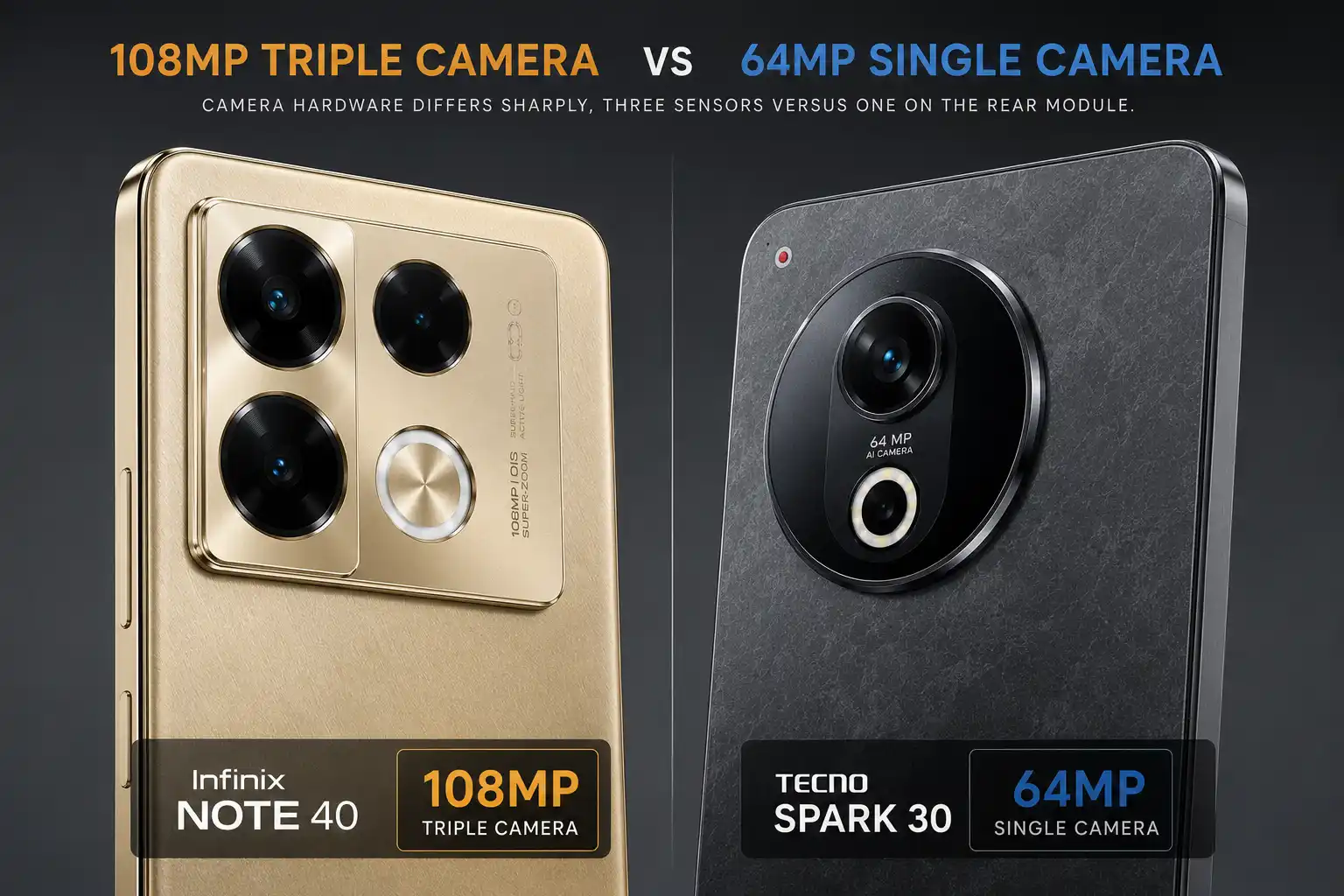
On paper, the Infinix Note 40 wins the megapixel race. It features a triple camera setup led by a 108MP wide sensor at f/1.9, backed by a 2MP secondary lens and a third unspecified sensor. Video tops out at 1440p at 30fps.
The Tecno Spark 30 instead relies on a single 64MP primary sensor with an auxiliary lens for depth data, plus phase detection autofocus. It also records up to 1440p at 30fps despite the lower resolution sensor.
Now, more megapixels do not automatically mean better photos. Sensor size, aperture, and image processing matter just as much. Still, the Note 40’s larger 1/1.52 inch sensor size generally allows more light in, which should translate to better low light shots than the Spark 30’s smaller sensor.
For selfies, the Note 40 uses a 32MP front camera, while the Spark 30 sticks with a 13MP shooter. This means the Note 40 pulls ahead again for anyone who prioritizes selfie detail or video calls.
Battery and Charging Speed
Both phones share an identical 5000mAh battery, so daily runtime should feel roughly similar under normal use. The charging experience, however, is where the two devices diverge sharply.
The Infinix Note 40 supports 45W wired fast charging, reaching 50 percent battery in about 26 minutes according to Infinix’s official specifications. It also adds 20W wireless MagCharge along with reverse wired and reverse wireless charging, features almost never seen in this price bracket.
The Tecno Spark 30 caps out at 18W wired charging with no wireless option at all. Consequently, a full charge on the Spark 30 takes noticeably longer, often over an hour and a half from empty.
In practice, this charging gap matters more than most spec sheets suggest. Anyone who charges quickly between meetings or before heading out will feel the Note 40’s advantage almost daily.
Software Experience: XOS 14 vs HIOS 14
Both phones launched on Android 14, but each brand layers its own skin on top. Infinix uses XOS 14, while Tecno runs HIOS 14. Both skins come from the same parent company, Transsion, so the core layout, settings menu, and app drawer feel closely related.
Then again, XOS has historically leaned slightly more customizable with theme options and gesture controls, while HIOS focuses on simplicity for first time smartphone buyers. Neither skin is dramatically better, so this comparison point comes down to personal preference rather than a clear winner.
Finally, software update commitments for both devices remain limited compared to flagship phones from Samsung or Google. Buyers should treat either device as a two to three year phone rather than a long term investment.
Price and Value for Money
The Infinix Note 40 launched at approximately 180 EUR, translating to roughly 199 to 215 USD depending on the regional market and configuration, according to GSMArena’s official specification listing. That price reflects its AMOLED display, faster chipset, and wireless charging support.
The Tecno Spark 30 positions itself as the more affordable option in most markets, typically priced well below the Note 40 at launch. Because it drops the AMOLED screen, faster charging, and higher resolution camera, Tecno keeps manufacturing costs lower and passes that savings to the buyer.
So which one delivers better value? If your budget stretches to cover the Note 40, its display and charging upgrades alone justify the higher price. If you need the cheapest reliable option with expandable storage, the Spark 30 remains a sensible pick.
Full Spec Comparison at a Glance
Here is a quick side by side summary of the core specifications for both phones, confirmed through GSMArena’s Tecno Spark 30 database entry.
- Display: Note 40 – 6.78″ AMOLED, 120Hz, 1300 nits | Spark 30 – 6.78″ IPS LCD, 90Hz, 800 nits
- Chipset: Note 40 – Helio G99 Ultimate | Spark 30 – Helio G91
- RAM and Storage: Note 40 – 8GB RAM, up to 256GB UFS 2.2 | Spark 30 – 8GB RAM, 128GB or 256GB with microSD
- Main Camera: Note 40 – 108MP triple camera | Spark 30 – 64MP single camera with auxiliary lens
- Selfie Camera: Note 40 – 32MP | Spark 30 – 13MP
- Battery: Note 40 – 5000mAh, 45W wired, 20W wireless | Spark 30 – 5000mAh, 18W wired only
- Build: Note 40 – IP54 rated, under display fingerprint | Spark 30 – IP64 rated, side mounted fingerprint
- Audio: Note 40 – JBL tuned stereo speakers, no 3.5mm jack | Spark 30 – Dolby Atmos stereo speakers with 3.5mm jack
Interestingly, the Spark 30 actually wins on dust and water resistance with its IP64 rating, compared to the Note 40’s IP54 rating. It also keeps the increasingly rare 3.5mm headphone jack, something wired headphone users will appreciate.
Which Phone Should You Buy
If you stream video often, game casually, or want faster charging, the Infinix Note 40 makes more sense. Its AMOLED screen and 45W charging noticeably improve daily use, and the camera setup delivers sharper detail in most lighting conditions.
If your priority is the lowest possible price with expandable storage and a headphone jack, the Tecno Spark 30 fits better. It handles calls, messaging, social media, and light browsing without issue, and its dust resistance rating even edges out the pricier Note 40.
From my own time testing similarly specced Transsion group phones, the jump from IPS LCD to AMOLED is the single upgrade most users notice within the first day of use. Charging speed comes a close second, especially for anyone who tops up their phone during short breaks rather than overnight.
Infinix Note 40 vs Tecno Spark 30 Final Verdict
After comparing every major spec, the Infinix Note 40 vs Tecno Spark 30 debate comes down to what you value more, display quality and charging speed, or a lower upfront price with expandable storage. Neither phone is a bad choice at its respective price tier, and both share the same reliable 5000mAh battery capacity.
The Note 40 earns its higher price tag through a genuinely better screen, a stronger chipset, and charging speeds that rival phones costing twice as much. The Spark 30 counters with a lower entry cost, a headphone jack, and slightly better water resistance, making it a smart pick for first time smartphone buyers or anyone upgrading from a much older device.
Ultimately, budget phone shoppers rarely get a clear winner across every category, and this comparison proves that point well. Match the phone to your actual habits rather than the spec sheet alone, and you will likely walk away satisfied either way.
For readers who want to dig deeper before buying, Infinix’s own specification page confirms every detail covered here for the Infinix Note 40’s official specs, while GSMArena’s coverage of the Tecno Spark 30’s official unveiling details its launch colors and regional rollout.
Frequently Asked Questions
Does the Infinix Note 40 support 5G?
No, the standard Infinix Note 40 covered in this comparison only supports 4G LTE. Infinix does sell a separate Infinix Note 40 5G variant with a different Dimensity 7020 chipset for buyers who need 5G connectivity.
Does the Tecno Spark 30 have wireless charging?
No, the Tecno Spark 30 only supports 18W wired charging with no wireless charging capability. This is one of the clearest gaps compared to the Infinix Note 40’s 45W wired and 20W wireless setup.
Which phone has a better camera, the Note 40 or the Spark 30?
The Infinix Note 40’s 108MP triple camera setup generally outperforms the Spark 30’s 64MP single camera, especially in daylight detail and selfie quality. However, real world results can vary based on lighting and software processing.
Is the Tecno Spark 30 waterproof?
The Tecno Spark 30 carries an IP64 rating, meaning it resists dust and light water splashes but is not fully waterproof. This rating is actually slightly higher than the Infinix Note 40’s IP54 rating.
Can I expand storage on both phones?
The Tecno Spark 30 includes a dedicated microSDXC card slot for storage expansion. The Infinix Note 40 does not offer expandable storage, so buyers must choose their storage tier carefully at purchase.
Which phone offers better value for money?
The Tecno Spark 30 typically costs less upfront, making it the better pick for tight budgets. The Infinix Note 40 costs more but adds real upgrades like an AMOLED display and much faster charging, which justifies the price gap for many buyers.

Prince Anichi
Founder and Lead Technology Editor at Ortechy. Covering digital economy shifts, tech ecosystems across Africa, cybersecurity intelligence, and emerging software platforms.