Biggest Tech News of April 2026: Apple’s New CEO, AI Breakthroughs, and the Stories That Changed Everything
INTRODUCTION
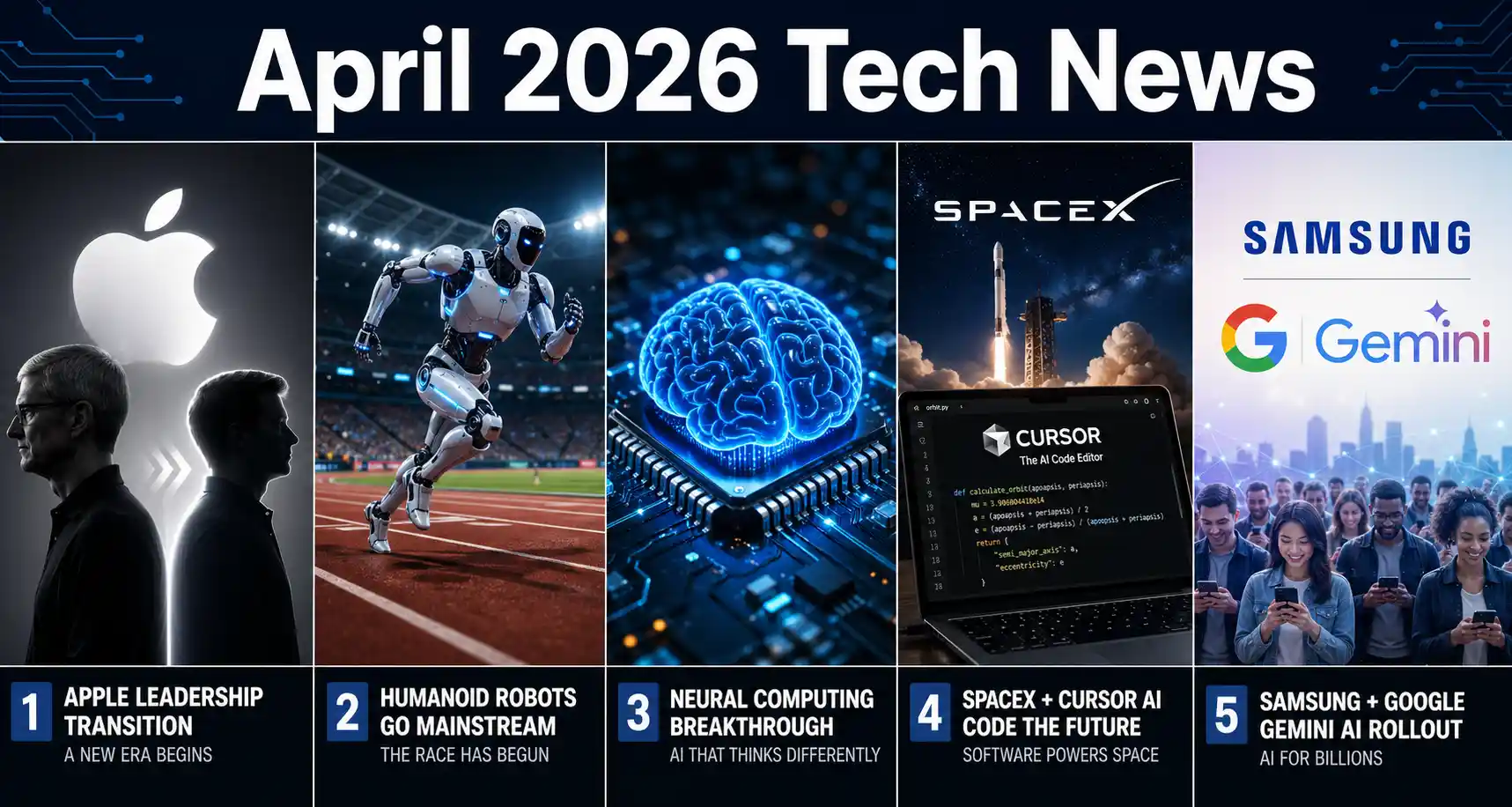
The biggest tech news of April 2026 came fast and kept coming. Apple made a leadership announcement that shocked the industry. A humanoid robot broke a human athletic record in front of a live crowd. Researchers at Cambridge revealed a brain-like chip that slashes AI energy consumption by 70 percent. SpaceX placed a $60 billion bet on the future of AI coding tools. And Samsung committed to putting Google Gemini into 800 million devices before the year ends.
This month delivered more consequential technology stories than most years manage combined. Each story carries implications that will ripple through the industry, through your workplace, and through your daily life for years ahead.
Here is every major story you need to understand, explained clearly and completely.
Story 1: Apple Announces John Ternus as New CEO, Ending Tim Cook’s 15-Year Era
Apple announced on April 21, 2026 that Tim Cook will step down as CEO on September 1, 2026. John Ternus, Apple’s current Senior Vice President of Hardware Engineering, will take over as only the third CEO in Apple’s history. Cook will remain as Executive Chairman of the Board.
The announcement arrived quietly on a Monday morning and immediately dominated global headlines. Cook has led Apple since Steve Jobs died in October 2011, a tenure that saw the company grow from a successful consumer electronics maker into a $4 trillion corporation, the most valuable company in human history by market capitalisation.
Who Is John Ternus and What Does His Appointment Signal
Ternus joined Apple in 2001 as a product design engineer and spent 25 years climbing through the hardware division. He oversaw some of Apple’s most celebrated recent products, including the iPhone Air, the MacBook Neo which launched in March 2026, and the foldable iPhone expected this September. He was one of the key architects of Apple Silicon, the custom chip strategy that broke Apple’s dependence on Intel and dramatically improved the performance and battery life of every Mac and iPhone.
His appointment signals something important about where Apple believes the future lies. While competitors like Microsoft, Google, Amazon, and Meta are committing hundreds of billions of dollars to data centres and cloud AI infrastructure, Apple is betting that AI will ultimately flow through tightly integrated hardware. Ternus’s deep hardware expertise makes him the right leader for that specific thesis.
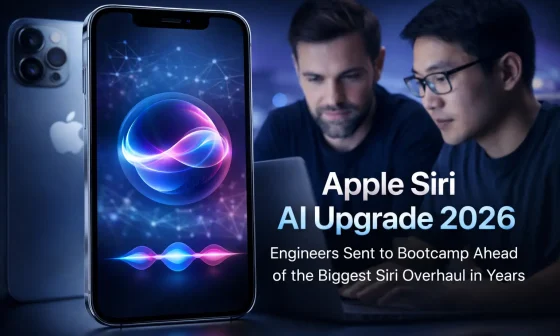
The AI challenge Ternus inherits is real and urgent. Apple has lagged behind its megacap peers in AI for two consecutive years. It delayed its most significant Siri upgrade twice. ChatGPT and Claude currently rank as the two most downloaded free apps on the iPhone App Store, meaning Apple’s users are reaching for competitors’ AI tools rather than Apple’s own. Ternus will need to demonstrate a credible AI hardware strategy, likely centred on wearables, smart glasses, and on-device AI processing, within his first twelve months.
Analysts at Wedbush Securities called hardware innovation the “heart and lungs” of Apple’s success moving forward. Analyst Gil Luria of D.A. Davidson told CNBC: “The AI models will flow through their market-leading, premium hardware.” Whether that thesis proves correct will define Ternus’s legacy. Read the full analysis at
CNBC’s in-depth report on Apple’s new CEO John Ternus and the AI challenge he inherits.
Story 2: A Humanoid Robot Just Beat Humans in a Half Marathon and the World Noticed
A humanoid robot completed a half marathon in Beijing in April 2026, finishing faster than the majority of the human runners in the same race. The achievement marked the first time a bipedal robot has competed against humans in an open endurance event and outperformed them.
The winning robot was equipped with advanced AI navigation systems, sensor fusion for terrain adaptation, and a mechanical design optimised for sustained bipedal locomotion. It maintained a consistent pace across 21 kilometres of variable urban terrain, adjusting gait in real time to handle inclines, corners, and surface changes without human intervention.
Why This Moment Matters Beyond the Race
The significance of this story goes far beyond athletic competition. Every capability that allows a humanoid robot to complete a half marathon, sustained balance, energy management, real-time environment parsing, autonomous decision-making under physical stress, also applies directly to real-world deployment scenarios.
Robots that can navigate varied physical environments reliably for hours at a time become viable for logistics, warehouse automation, last-mile delivery, search and rescue, and elder care. The half marathon was effectively a real-world stress test of exactly the capabilities that make humanoid robots commercially useful, run in front of a public audience with live verification of the results.
Hyundai’s AI plus Robotics roadmap, announced at CES 2026, and Apple’s newly revealed secret robotics unit both become significantly more credible when viewed alongside this demonstration. The race confirmed that humanoid robot locomotion has crossed a threshold from impressive laboratory demonstration to competitive real-world performance.
The ethical questions this performance raises are also substantial. If robots can outperform humans in endurance physical tasks, the timeline for meaningful automation in physically demanding industries compresses significantly. Logistics, construction, and field service jobs that were considered automation-resistant because they required human mobility and adaptability now look considerably more vulnerable than they did before this race.

marathon, finishing ahead of most human participants.
The achievement demonstrated that bipedal robot
locomotion has crossed from laboratory performance
into real-world competitive capability.
Story 3: Cambridge Researchers Build a Brain-Like Chip That Slashes AI Energy Use by 70 Percent
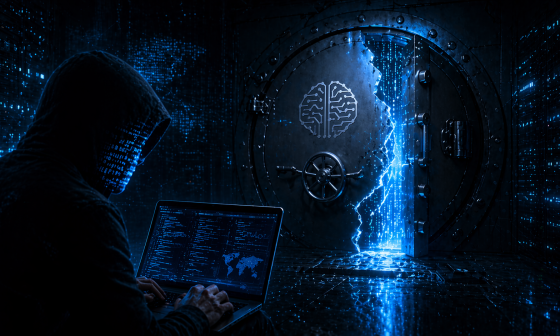
University of Cambridge researchers published results in April 2026 showing they had developed a neuromorphic chip, a processor modelled on the biological structure of the human brain, that reduces the energy consumption of AI workloads by up to 70 percent compared to conventional GPU-based processing.
The chip uses hafnium oxide-based memristive synapses, components that mimic the way biological neurons store and transmit information through adjustable electrical resistance rather than switching between binary on and off states. This architecture allows the chip to perform AI inference tasks with a fraction of the energy that standard digital chips require.
Why This Breakthrough Matters for the AI Energy Crisis
The timing of this research could not be more critical. AI computing now consumes a growing fraction of global electricity output and that fraction is accelerating rapidly. Data centres with more than 25 gigawatts of new capacity are currently under construction in the United States alone. Power grid operators in major tech hubs are warning they cannot connect new data centres fast enough to meet demand.
A chip that performs the same AI inference tasks at 30 percent of the energy cost does not just save money. It changes the economics of AI deployment fundamentally, it makes AI viable at the edge, in devices that cannot be connected to data centre power, in wearables, implantable medical devices, autonomous vehicles, and remote sensing equipment, it reduces the carbon footprint of running billions of AI queries per day. And it may extend the battery life of AI-enabled consumer devices dramatically.
The Cambridge result follows similar research directions from IBM, Intel, and a wave of neuromorphic computing startups that have been working toward brain-inspired processors for over a decade. This publication is notable because it achieves the 70 percent energy reduction on actual hardware rather than in simulation, using materials and processes compatible with existing semiconductor fabrication techniques.
As ScienceDaily reported, the research was published in Science Advances, one of the highest-impact peer-reviewed journals in materials science. The research team described the result as a potential foundation for “highly energy-efficient neuromorphic hardware” that scales toward commercial viability. Full details are available at
ScienceDaily’s full report on the Cambridge brain-like chip that could slash AI energy use by 70 percent.
Story 4: SpaceX Makes a $60 Billion Bid to Acquire AI Coding Tool Cursor
SpaceX announced in April 2026 that it is pursuing the acquisition of Cursor, the AI-powered coding assistant startup, in a deal reportedly valued at $60 billion. The announcement made headlines immediately because it represents one of the largest proposed acquisitions of an AI startup in history and because the acquirer is a space and rocket company rather than a traditional software firm.
Cursor became one of the most widely used AI development tools among professional software engineers within eighteen months of its launch. The tool uses large language models to write, debug, refactor, and explain code in real time inside developers’ existing code editors. Its user base grew explosively as software teams discovered it could dramatically compress the time required to build and ship features.
Why SpaceX Wants an AI Coding Tool
The strategic logic behind this acquisition connects directly to SpaceX’s long-term ambitions. SpaceX has recently merged its operations with Elon Musk’s AI company xAI, embedding Grok AI models into its engineering and mission control workflows. The company is simultaneously pursuing the development of fully autonomous spacecraft, robotic Mars colony infrastructure, and the Starship megarocket programme, all of which require enormous amounts of bespoke software written and maintained at machine speed.
An AI coding tool that accelerates software development by an order of magnitude is not just a productivity tool for SpaceX. It is a strategic capability that could compress the timelines of its most ambitious engineering programmes. If Cursor’s AI can help SpaceX engineers write and verify autonomous spacecraft control code faster than any competitor, the $60 billion acquisition price becomes an investment in mission velocity rather than just a software product purchase.
The acquisition also signals something broader about the AI development tools market. When a company valued at the scale of SpaceX decides that an AI coding assistant is worth $60 billion, it tells the entire software industry how seriously to take these tools. The era of AI coding assistants as novelty features or productivity conveniences appears to be over. They are now strategic assets commanding strategic-scale valuations.
The full SpaceX and Cursor story was first reported by Fortune Tech and is available at
Fortune’s original report on SpaceX striking a $60 billion deal for Cursor.
merges aerospace ambition with AI software capability.
The deal signals that AI coding tools have crossed from
productivity features to strategic assets commanding
aerospace-scale valuations.
Story 5: Samsung Plans to Put Google Gemini AI into 800 Million Devices by End of 2026
Samsung Electronics announced in April 2026 that it aims to expand its deployment of Google Gemini AI to 800 million devices before December 31. The target represents a dramatic scale-up from the flagship-only Gemini integration Samsung launched in 2025, pushing advanced generative AI features into mid-range and budget smartphone and tablet lines across the global Android ecosystem.
The move directly reflects the deep strategic partnership between Samsung and Google as both companies compete to establish themselves as the default AI experience on Android devices worldwide. The features Samsung plans to push to this expanded device base include real-time language translation, AI-assisted camera processing, generative image editing, proactive digital assistance, and on-device summarisation of messages and notifications.
What 800 Million AI Devices Means for the Industry
The scale of this commitment is genuinely historic. If Samsung achieves its target, Gemini AI will run on more devices by the end of 2026 than any AI assistant has ever been deployed on in a twelve-month period. For context, the entire global smartphone market ships approximately 1.2 billion devices per year. Samsung putting Gemini on 800 million of its devices means that a significant fraction of every Android phone in active use globally will carry this AI capability.
For Google, the Samsung partnership addresses a critical distribution challenge. Google’s Gemini app competes directly with ChatGPT and Claude for user mindshare. Having Gemini built into hundreds of millions of Samsung devices as the default AI assistant rather than requiring a separate app download gives it a distribution advantage that no competitor can easily replicate through organic user acquisition.
For Samsung, the partnership accelerates its AI feature roadmap without requiring it to build and maintain its own frontier AI models, a challenge that requires billions of dollars in investment and teams of thousands of researchers. Samsung gets world-class AI capability by integrating Google’s models, while Google gets Samsung’s unmatched hardware distribution across every price tier of the Android market.
The Samsung and Google Gemini expansion story was reported as part of the broader AI industry acceleration coverage tracked by TechCrunch. Full ongoing coverage is available at
TechCrunch’s AI news section
which tracks the Samsung, Google, Apple, and all major AI deployment partnerships in real time.
Bonus Story: Google Signs a Multi-Billion Dollar Deal with Mira Murati’s AI Startup
TechCrunch exclusively reported in April 2026 that Google has signed a new multi-billion dollar cloud infrastructure deal with Thinking Machines Lab, the AI startup founded by Mira Murati, the former Chief Technology Officer of OpenAI who departed in 2024.
The deal gives Thinking Machines Lab access to Google Cloud’s most advanced AI infrastructure including systems built on NVIDIA’s latest GB300 GPUs alongside storage, database, and Kubernetes services.
The arrangement is valued in the single-digit billions and positions Google Cloud as the primary compute provider for one of the most closely watched new AI labs in the world.
Murati left OpenAI in September 2024 after a tumultuous period at the company and has kept a low profile since. Thinking Machines Lab’s specific product focus has not been publicly disclosed, but Google’s willingness to commit billions to support the company’s infrastructure needs signals strong confidence in Murati’s technical vision and the lab’s commercial potential.
For Google Cloud, this deal is part of a broader strategy to lock in the most promising AI startups as long-term cloud computing customers. Google has been aggressively competing with AWS and Microsoft Azure for AI workload business, recognising that the AI startup ecosystem will generate enormous cloud compute revenue over the coming decade and that winning those relationships now creates durable commercial advantages. The exclusive report is available at
TechCrunch’s exclusive report on Google’s multi-billion dollar Thinking Machines Lab deal.
Frequently Asked Questions About the Biggest Tech News of April 2026
Who is Apple’s new CEO replacing Tim Cook?
John Ternus will become Apple’s new CEO on September 1, 2026, replacing Tim Cook who will move to the role of Executive Chairman of the Board. Ternus is Apple’s current Senior Vice President of Hardware Engineering and has been with the company since 2001. He oversaw the iPhone Air, MacBook Neo, and the Apple Silicon transition, and is expected to lead Apple’s push into AI-enabled hardware including smart glasses, a Siri pendant, and a foldable iPhone.
Did a robot really beat humans in a half marathon in 2026?
Yes. A humanoid robot competed in and outpaced the majority of human runners in a half marathon race in Beijing in April 2026. The robot used advanced AI locomotion systems, sensor fusion, and real-time gait adaptation to complete the 21-kilometre course autonomously. The achievement is the first confirmed instance of a bipedal robot outperforming humans in an open competitive endurance running event.
What is the brain-like chip that reduces AI energy use by 70 percent?
University of Cambridge researchers developed a neuromorphic chip using hafnium oxide-based memristive synapses that mimic the architecture of biological neurons. The chip performs AI inference tasks at approximately 30 percent of the energy consumed by conventional GPU-based processing, a 70 percent reduction. The research was published in Science Advances in April 2026 and represents a potential foundation for energy-efficient on-device AI in wearables, medical devices, and autonomous systems.
Why is SpaceX buying an AI coding company?
SpaceX is pursuing the acquisition of Cursor for $60 billion because the AI coding assistant accelerates software development at exactly the scale SpaceX needs for its autonomous spacecraft programmes, Mars colony infrastructure planning, and Starship development. The company has merged with xAI and is embedding AI deeply into its engineering workflows. An AI tool that compresses software development timelines is a strategic mission-enabling capability for SpaceX, not just a productivity benefit.
How many devices will Samsung put Google Gemini on in 2026?
Samsung has targeted 800 million devices for Google Gemini AI integration by the end of 2026. This represents an expansion from flagship-only integration to mid-range and budget Android smartphones and tablets across Samsung’s global product line. The partnership strengthens both Google’s AI distribution reach and Samsung’s ability to offer competitive generative AI features without building its own frontier AI models.
CONCLUSION
April 2026 Delivered Some of the Most Consequential Tech Stories in Years
The biggest tech news of April 2026 tells a coherent story about where the technology industry is headed and what it means for all of us. Apple’s leadership transition signals that the next era of computing will run through hardware as much as software. The humanoid robot half marathon confirms that physical AI has crossed a meaningful performance threshold. The Cambridge brain-like chip points toward a future where AI is not limited by power constraints. SpaceX’s Cursor acquisition reveals that AI coding tools are now valued at strategic rather than product-scale. And Samsung’s 800 million device Gemini rollout demonstrates the speed at which AI is spreading from flagship devices to the mass market.
Each of these stories is moving fast and each one connects to the others. Hardware and AI are converging at a pace that consistently surprises even the most optimistic analysts. The companies and individuals who understand these shifts early hold a significant advantage over those who catch up later.
Bookmark this page and check back each month for our next tech news roundup. The pace of change in 2026 demands regular attention, and missing even one month of major announcements can leave you significantly behind the curve.
For real-time tracking of every major tech story as it breaks, follow
TechCrunch’s AI coverage
which provides the most comprehensive and timely reporting on the technology stories shaping 2026 and beyond.