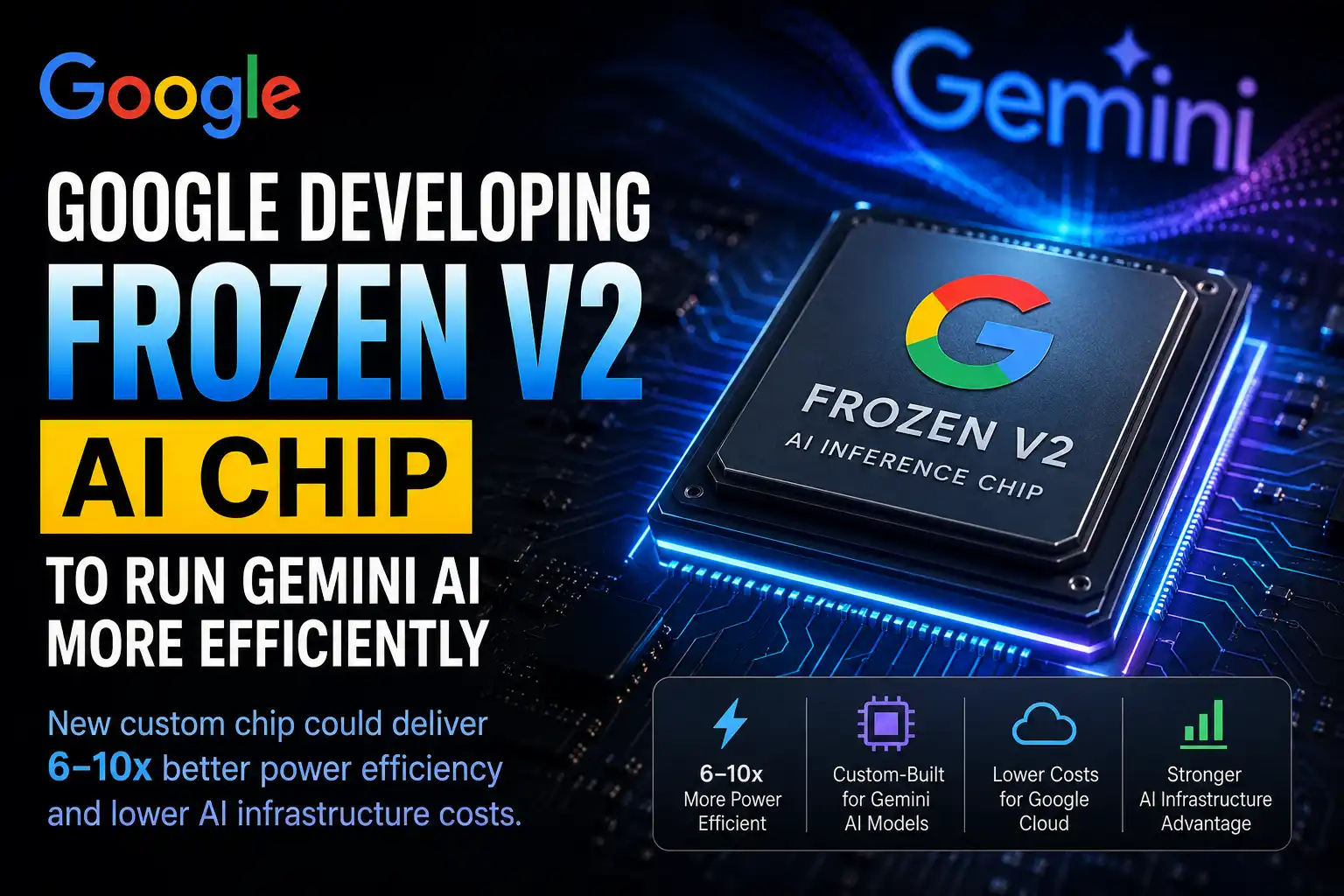
Google is reportedly working on a new custom AI inference chip, internally codenamed Frozen v2, designed to run its Gemini AI models with significantly greater efficiency. According to a report from The Information, which cites two people familiar with the matter, the chip would embed elements of Gemini’s model architecture directly into silicon rather than relying solely on general-purpose accelerators.
It is important to note that Google has not publicly confirmed the project, and details remain based on sourced reporting rather than an official announcement. As with any early-stage hardware initiative, specifications, timelines, and deployment plans could change before Frozen v2 — if it exists as described — ever reaches production.
What Is Frozen v2?
Frozen v2 is reportedly a specialized AI inference chip built specifically to run Google’s Gemini AI models rather than serving as a flexible, general-purpose accelerator. Sources describe the approach as “hardwiring” portions of Gemini’s architecture — such as certain layer configurations — directly into the chip’s design, rather than treating the model as software running on interchangeable hardware.
This differs from Google’s existing Tensor Processing Units (TPUs), including recent generations such as TPU 8t for training and TPU 8i for inference, which are built to handle a wide range of AI workloads. Frozen v2 is reportedly not intended to replace TPUs but to operate alongside them as a specialized, Gemini-specific option. The project is said to have evolved from an earlier internal concept associated with Google AI leader Jeff Dean.
Reports indicate Google’s engineers are still finalizing how much of Gemini’s architecture will be embedded into the hardware, using what has been described as a “flexible hardwiring” strategy intended to balance efficiency gains against the risk of the chip becoming outdated if Gemini’s underlying architecture changes substantially.
Why AI Inference Chips Matter
Training an AI model and running it in production (known as inference) place very different demands on hardware. Inference — generating responses for actual users, day after day, at massive scale — is where most of the ongoing computing cost of AI services accumulates over time.
As a result, AI inference chips have become a central battleground in enterprise computing. Improvements here directly affect:
- How much it costs a company to serve each AI response
- How quickly a model can respond to user queries
- How much electricity and cooling a data center requires
- How many customers a cloud provider can support with existing infrastructure
For a company operating AI products at Google’s scale, even modest efficiency gains in inference can translate into substantial savings — or, alternatively, into serving many more users without adding proportional hardware.
How This Could Improve Gemini
According to the report, Frozen v2 could process significantly more AI tokens per unit of power than Google’s current generation of custom chips — with early estimates suggesting a six to ten times improvement in power efficiency. If accurate, that would mark a substantial leap even by the standards of an industry accustomed to rapid hardware iteration.
Sources say the project is directly tied to an internal shortage of AI computing capacity at Google, which has reportedly created internal resource tension and, in some cases, limited Google Cloud’s ability to accept new external customer workloads. A more efficient, purpose-built inference chip could help ease that bottleneck by allowing Google to serve more Gemini queries using the same power and data center footprint.
The core trade-off is flexibility for efficiency: a chip built around one model’s architecture can be dramatically faster and cheaper to run, but it is far less adaptable if that architecture changes significantly down the line.
Potential Impact on Google Cloud and AI Infrastructure Costs
If Frozen v2 delivers on its reported efficiency targets, the implications would extend well beyond Gemini’s own performance. Google Cloud has faced growing demand for AI compute capacity, and analysts have pointed to compute shortages as a limiting factor for cloud providers across the industry.
A more efficient inference chip could allow Google to:
- Offer more competitive pricing for AI-powered cloud services
- Free up capacity previously constrained by compute shortages
- Reduce the capital and operating costs tied to expanding AI infrastructure
- Improve profit margins on AI products, which remain a closely watched metric for investors
Power Efficiency as a Strategic Priority
Data center power consumption has become one of the industry’s most pressing constraints, with electricity availability — not just chip supply — increasingly limiting how quickly AI infrastructure can scale. A chip that meaningfully improves tokens-processed-per-watt would address this constraint directly, rather than simply adding more hardware to solve a power problem.
Competition With Nvidia, OpenAI, Microsoft, Meta, Amazon, and Anthropic
Frozen v2 arrives amid an intensifying race among major technology companies to reduce dependence on Nvidia’s GPUs by building custom AI silicon. Notable examples include:
- Amazon, which has developed its Trainium and Inferentia chip families for AWS
- Microsoft, which has deployed its Maia AI accelerator in select data centers
- Meta, which has been building custom silicon for its own AI workloads
Nvidia remains dominant in general-purpose AI training hardware, and that is unlikely to change in the near term. But the shift toward specialized inference silicon suggests hyperscalers increasingly see custom chips as essential to controlling long-term costs, rather than a purely experimental side project.
For OpenAI and Anthropic, which rely heavily on partner cloud infrastructure and third-party chips to serve their models, a substantial efficiency advantage at Google could sharpen competitive pressure on inference pricing across the industry. Lower inference costs often translate into more competitive per-token pricing for enterprise customers, an area where margins are already tight across the sector.
The Broader Race to Build Custom AI Hardware
Google has invested in custom AI silicon since the mid-2010s, with its first publicly disclosed TPU arriving in 2018 and subsequent generations — including chips codenamed Ironwood and Trillium — expanding to handle both training and inference at scale. Frozen v2 would represent a further step in that trajectory: a chip designed around a specific model rather than general-purpose flexibility.
This approach echoes strategies pursued by AI chip startups such as Groq and Taalas, which have also explored more specialized silicon designs to maximize inference speed and efficiency. It reflects a broader industry pattern in which custom AI chips are increasingly viewed not as a hedge against Nvidia’s pricing and supply constraints, but as a genuine architectural strategy for the next phase of AI deployment.
What to Watch Next
Frozen v2 remains, at this stage, a reported internal project rather than a confirmed product. Google has not detailed a launch timeline, though sourced reporting points to a possible deployment window around 2028 — several years out, and subject to the usual uncertainties of early-stage chip development.
Readers following this story should watch for:
- Any official confirmation or comment from Google regarding the project
- Additional reporting detailing technical specifications or performance benchmarks
- Signs of the chip appearing in Google’s data center supply chain or hiring patterns
- Competitive responses from Nvidia, Amazon, Microsoft, and Meta
- Any effect on Google Cloud’s pricing or capacity commitments to enterprise customers
Until Google addresses the reports directly, Frozen v2 should be treated as an early but credible signal of the company’s long-term AI hardware strategy — not a finalized product roadmap.

Prince Anichi
Founder and Lead Technology Editor at Ortechy. Covering digital economy shifts, tech ecosystems across Africa, cybersecurity intelligence, and emerging software platforms.