How Nigerian Tech Startups Validate Business Ideas Before Building a Product
Building a product nobody wants is the fastest way to lose money in Nigeria’s tech ecosystem. According to CB Insights, 42% of startups globally fail because they build something the market does not need, and Nigerian founders are not immune to this trap. With over 3,360 startups operating in Nigeria as of 2024, the most of any country in Africa, the pressure to move fast is real. But the smartest founders know that speed without validation is just expensive guessing. Learning how Nigerian tech startups validate business ideas before building a product is now one of the most critical skills a founder can develop.
The Nigerian market is unforgiving. Infrastructure challenges, currency volatility, and cautious consumers mean that a product with no proven demand will drain resources quickly. As Tech In Africa’s analysis of African startup failures shows, 42% of startups on the continent collapse because of market misalignment, often the result of skipping the validation step entirely. Founders who build first and ask questions later tend to build for themselves, not for real customers.
This guide breaks down the specific methods Nigerian tech founders use to test their ideas before writing a single line of code. From customer interviews in Lagos markets to no-code landing pages and WhatsApp community testing, these are the approaches that separate products that grow from products that quietly disappear.
Why Idea Validation Is Non-Negotiable for Nigerian Tech Startups
Nigeria’s startup environment has changed sharply over the past few years. Funding fell from $332 million in 2024 to approximately $163 million through September 2025, a steep decline that has forced founders to become more disciplined. Investors are no longer backing hype. They want evidence that real people have a real problem and that they will pay to solve it.
This shift has made startup idea validation in Nigeria not just a best practice but a survival requirement. The days of raising money on a pitch deck alone are largely over. Today’s investors at seed and pre-seed stage want to see proof of demand before they commit capital. This changes how founders approach the early stage entirely.
Additionally, the cost of being wrong is higher in Nigeria than in many other markets. A founder in Silicon Valley can spend six months building a product, fail, and pivot because the funding ecosystem gives them another shot. In Lagos, Abuja, or Port Harcourt, that same six months might exhaust an entire personal savings or a small friends-and-family round with no clear path to recovery.
The Opportunity Hiding in Validation
Beyond reducing risk, validation creates something valuable in itself. When a founder speaks to 50 potential customers before building, they gather language, motivations, and objections that make their eventual product sharper. They understand what feature to build first. They know how much someone will pay. They have early adopters ready the moment the product is live.
Founders who validate early tend to build better products, close funding rounds faster, and reach profitability sooner. This is not theory. It is the pattern visible across Nigeria’s most successful tech companies, from PiggyVest to Moniepoint to Flutterwave.
Step One: Define the Problem Before You Define the Solution
The first mistake most early-stage Nigerian founders make is falling in love with a solution before they fully understand the problem. A founder might notice that delivery times in their city are slow and immediately start designing a logistics app. The better move is to pause and investigate whether slow delivery is actually the core pain, or whether it is really a symptom of something else such as unreliable drivers, poor address systems, or payment friction.
Problem definition is the foundation of the entire validation process. Nigerian founders who skip this step often build technically impressive products that solve the wrong problem. They might eliminate one pain point while ignoring the three others that actually drive customer decisions.
How to Define the Problem Precisely
The best approach here is to write a problem statement that answers three questions clearly: Who exactly experiences this problem? How often do they experience it? What do they currently do to cope with it? If a founder cannot answer all three with specific answers, they do not understand the problem well enough to build a solution yet.
Effective problem definition in Nigerian startups often involves sitting inside the world of the target customer. This might mean spending time at an Alaba market watching how traders manage supplier payments, or observing how small clinic owners in Ogun State track patient records. The insight that drives a fundable product rarely comes from a spreadsheet. It comes from close observation.
Customer Discovery: Talking to Real People in Real Contexts
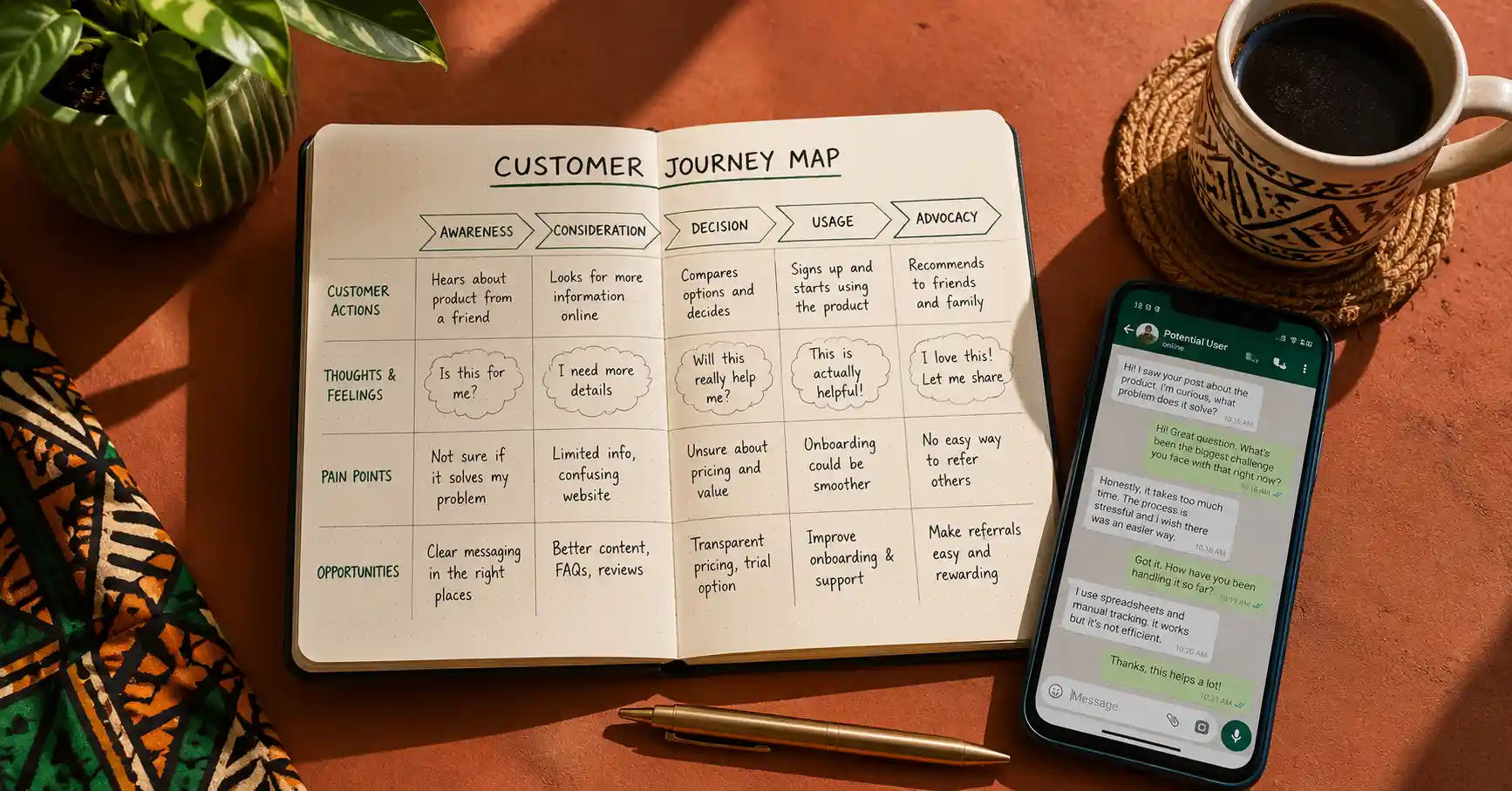
Customer discovery is the process of speaking directly with potential users to understand their needs, frustrations, and behavior before assuming what to build. It is one of the most powerful validation tools available to Nigerian founders, and one of the most underused. Many founders avoid it because it feels uncomfortable. Talking to strangers about unbuilt ideas requires vulnerability. But the discomfort of 20 honest conversations is far cheaper than six months of wasted development.
The method, popularized through Steve Blank’s work and later adapted into the lean startup framework, asks founders to stop pitching and start listening. The goal of a customer discovery interview is not to sell the idea. It is to understand whether the person in front of you genuinely has the problem you think they have, and what their life looks like as a result of it.
What Good Customer Discovery Looks Like in Nigeria
Nigerian founders doing customer discovery well tend to follow a few clear patterns. First, they target specific segments rather than general populations. “Nigerian millennials” is not a segment. “Salaried workers in Lagos earning between 150,000 and 400,000 naira monthly who currently save using ajo groups” is a segment. The more specific the target, the more useful the interview data.
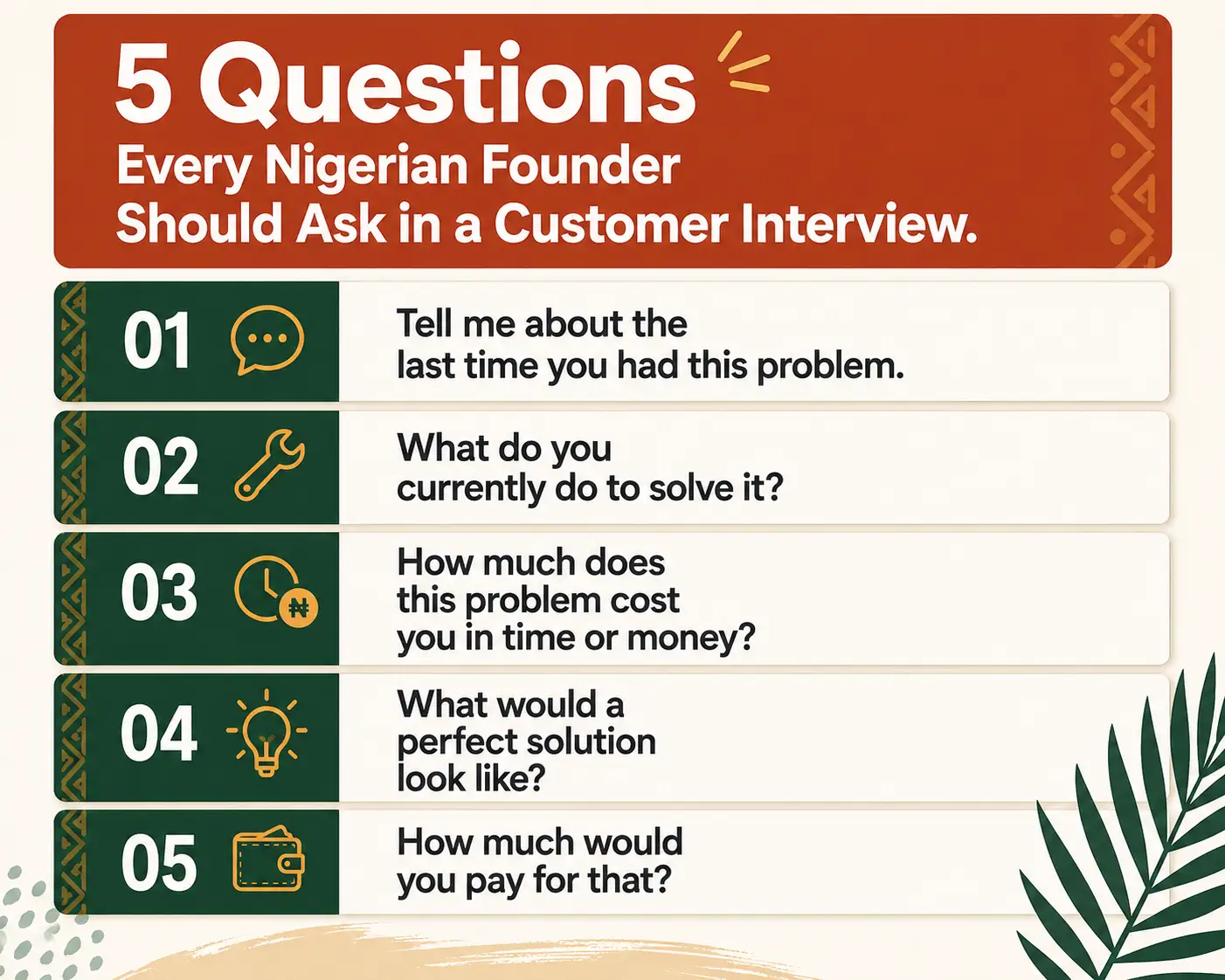
Second, they ask about past behavior rather than future intentions. Asking someone “would you use an app that did X” produces optimistic answers that rarely translate to actual usage. Asking “tell me about the last time you tried to solve this problem” produces real stories that reveal genuine pain and real workarounds. Behavior tells you what people actually do. Intentions tell you what they think you want to hear.
Third, they aim for at least 15 to 20 interviews before drawing conclusions. A sample of five friends is not discovery. It is confirmation bias. Founders need to talk to people across different income levels, geographies, and usage patterns to surface real insights rather than convenient ones.
How PiggyVest Validated Demand Before Building
PiggyVest, Nigeria’s largest digital savings and investment platform, is one of the clearest examples of idea validation done right. When co-founders Odunayo Eweniyi, Joshua Chibueze, and Somto Ifezue launched the product in 2016 as Piggybank.ng, they did not spend months building a complex platform. They started with a simple observation: millions of Nigerians were still saving using physical wooden boxes called Kolos, and the behavior proved that people wanted to save but lacked a reliable digital tool to do it.
Their validation was lean and direct. The very first tweet announcing Piggybank.ng generated over 300 sign-ups within 48 hours, confirming that the demand was both real and immediately responsive. That early signal was not just motivating. It was data. It told the team that the idea resonated with actual users before any serious engineering resources had been committed.
In its first year, Piggybank.ng helped approximately 700 users save 21 million naira. That number was small in absolute terms but enormous as a validation signal. It proved willingness to pay, consistent engagement, and word-of-mouth growth. By the time the company rebranded to PiggyVest in 2019 and introduced new features like Safelock, it already had a loyal user base to build on, as detailed in this case study on PiggyVest’s product-led growth strategy.
Using Landing Pages and Waitlists to Test Demand
One of the most practical validation methods available to Nigerian founders today is the pre-launch landing page. The concept is straightforward: build a simple page that describes the product, the problem it solves, and who it is for. Then drive traffic to it using social media and see whether people sign up. No product, no code, no backend. Just a clear offer and a sign-up form.
This approach works particularly well in Nigeria because social media penetration is high, especially among the demographics that most Nigerian tech products target. A founder testing a B2C app idea can run a targeted Instagram or Twitter campaign for under 50,000 naira and collect several hundred leads within a week. Those leads are real people who have raised their hand to say they are interested. That is meaningful validation data.
What to Measure on a Validation Landing Page
The metrics that matter are not vanity numbers. A founder should track the conversion rate from visitor to sign-up, not just the total number of sign-ups. If 500 people visit the page and only two sign up, that is a signal worth examining. Either the messaging is unclear, the problem is not painful enough, or the target audience is not the right one.
Additionally, the quality of sign-ups matters. A founder who collects email addresses and then sends a follow-up message asking for a 15-minute call gets far more useful data from the people who respond than from the people who do not. Those who engage further are the early adopters who will shape the first version of the product. Their input is worth more than any survey result.
Minimum Viable Products: Build the Least to Learn the Most
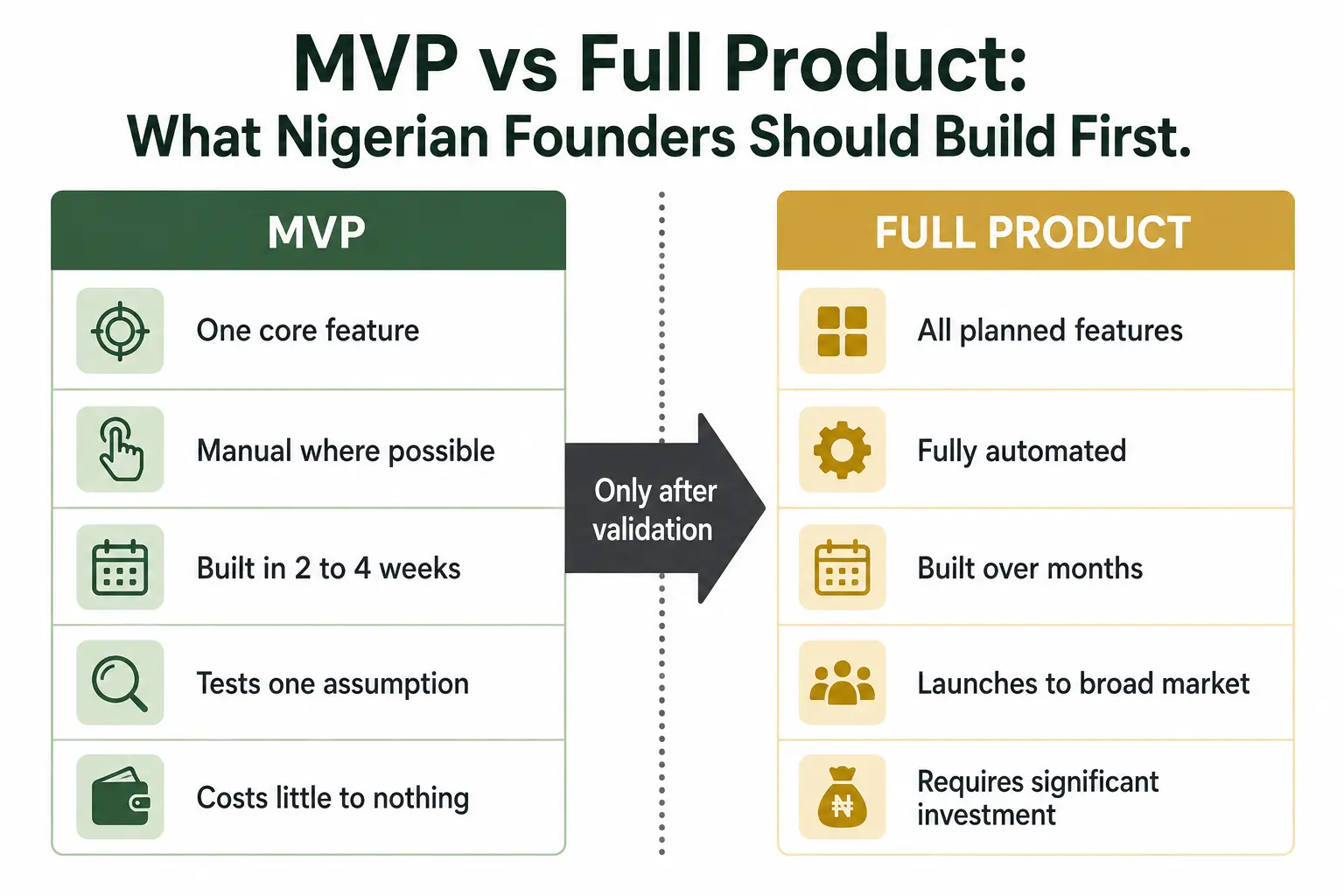
A minimum viable product, or MVP, is the simplest version of a product that delivers enough value to test a core assumption. The concept is widely discussed but frequently misunderstood. An MVP is not a half-built version of the full product. It is a focused test of one specific hypothesis. Nigerian founders who understand this build faster, spend less, and learn more in early stage.
The goal of an MVP is not to impress investors or users with features. It is to answer one question: will people use this and will they pay for it? Everything that does not help answer that question is scope creep. According to the Founders Forum startup guide, successful startups typically define clear success metrics before building, ensuring that the MVP produces actionable data rather than noise.
MVP Examples from the Nigerian Tech Context
Some of the most effective MVPs in Nigerian tech have been surprisingly manual. A founder building a logistics aggregator might start by personally coordinating deliveries over WhatsApp before building any technology. A healthtech founder might manually match patients to clinics using a spreadsheet and a phone before writing code. This approach, often called a concierge MVP, lets founders test whether the service has demand before spending money on development.
Farmcrowdy, the Nigerian agritech startup, validated its idea by connecting investors to farmers manually before building the full platform. They proved that people were willing to invest in agriculture digitally, and that farmers would participate in the model. Only after testing those two assumptions did they invest in the technology to scale. This sequencing, proof first then product, is the hallmark of disciplined Nigerian startup validation.
WhatsApp and Social Media as Fast Validation Tools
Nigeria has one of the highest WhatsApp usage rates in the world. For early-stage founders, this is not just a communication fact. It is a validation asset. WhatsApp groups, broadcast lists, and community channels give founders direct access to densely connected networks of potential customers without any advertising budget.
Smart Nigerian founders use WhatsApp in the validation phase to test messaging, gauge interest, and run informal surveys. A founder testing a payment solution for SMEs might post a clear problem description in several business owner WhatsApp groups and ask who relates to it. The responses, both in volume and tone, tell a story. If group members start tagging friends and adding their own experiences, the problem is real and felt. If the post gets a few polite replies and nothing more, the signal is weak.
Building in Public as a Validation Strategy
A growing number of Nigerian founders are embracing the practice of building in public, sharing their progress, challenges, and early versions openly on Twitter or LinkedIn. This approach has a dual benefit. It builds an audience before the product launches, and it generates honest feedback from people who have no obligation to be kind. Critics who engage with a public build post are often the most useful early users because they surface real objections before launch.
Founders with niche B2B products have used LinkedIn particularly effectively for this. A founder building a human resource software product for Nigerian SMEs can post about the pain points they are solving, share early mockups, and ask specific questions. The engagement they receive functions as a running validation exercise that also builds the early customer pipeline simultaneously.
Accelerators and Validation Support in the Nigerian Ecosystem
Nigeria’s startup support ecosystem provides structured environments where founders can validate ideas with guidance and accountability. Programs like those run by the Africa Fintech Foundry in Lagos offer early-stage startups access to product refinement support, customer discovery guidance, and regulatory expertise. These programs are valuable not just for the capital or mentorship they provide but because they impose the validation discipline that many solo founders skip when working alone.
Hackathons also play a meaningful validation role. As Techloy reports, events like the Startup Abuja Challenge offer founders more than prizes. They create pressure-tested environments where ideas get stress-tested by judges, peers, and potential users within a short timeframe. Founders who participate in hackathons often emerge with sharper problem definitions and clearer value propositions than they started with.
Additionally, programs like Y Combinator have Nigerian alumni who have gone on to build significant companies. The validation rigor that YC instills, particularly around talking to users and iterating rapidly on evidence, has influenced how a generation of Nigerian founders approach the early stage.
Competitive Analysis as Part of the Validation Process
Understanding what else exists in a market is a core part of validating a startup idea. Many Nigerian founders make the mistake of viewing competitor research as a discouraging exercise. If someone else is doing it, they think, maybe the opportunity is gone. The opposite is usually true. Competitors doing something similar confirm that the market exists and that people are willing to pay. The question becomes whether the new product can do it better, cheaper, or for a different segment.
Effective competitive analysis in the Nigerian startup context means mapping out direct competitors, indirect competitors, and the workarounds customers currently use. That last category is especially important. In many Nigerian markets, the biggest competitor is not another app but a manual process, an informal system, or human labor. Understanding why customers are willing to tolerate those workarounds tells a founder a great deal about what the product needs to offer to displace them.
Nigerian founders should also look at what has failed in their space and understand why. A product that tried to solve the same problem three years ago and shut down is not evidence that the problem is unsolvable. It may be evidence of bad timing, poor execution, or a missing enabling technology that now exists. That history is a research asset, not a warning sign to walk away.
Pricing Tests: Validating Willingness to Pay
One of the most overlooked dimensions of idea validation is pricing. Many Nigerian founders get early signals of interest and assume that demand equals willingness to pay. These are different things. Users will enthusiastically say yes to a free product. Far fewer will maintain that enthusiasm when a price tag enters the equation.
Testing price before building the full product is both practical and revealing. A founder can present a problem description and a proposed solution to 20 potential customers, explain what it would cost, and observe the reaction. If the conversation stops at the price, the founder has learned something critical. Either the value proposition needs to be stronger, the price needs to change, or the target customer segment is wrong.
Founders targeting Nigerian small and medium enterprises need to be particularly thoughtful about pricing because SME owners face real cash flow pressures. A subscription model that feels reasonable to a tech-educated founder may look like an unaffordable overhead to a kiosk owner in Ikeja. Bridging that gap requires pricing research that is grounded in the actual financial reality of the target customer.
Frequently Asked Questions
What is business idea validation and why do Nigerian startups need it?
Business idea validation is the process of testing whether a startup concept has real demand before building the product. Nigerian startups need it because the local market is highly competitive, funding is limited, and the cost of building something people do not want can end a company before it scales. Validation saves time, money, and focus.
How many customer interviews should a Nigerian founder do before building?
Most startup frameworks recommend at least 15 to 20 interviews with potential customers before drawing firm conclusions. Fewer than that risks confirmation bias, where a founder hears what they want to hear from a small, non-representative group. The interviews should cover different demographics, income levels, and usage contexts to surface genuine patterns.
What is a minimum viable product and how is it different from a beta product?
An MVP is the simplest version of a product that tests one core hypothesis about demand or user behavior. A beta product is a more developed version released for broader testing before a full public launch. An MVP can be as simple as a manual process or a landing page, while a beta typically involves working software with real functionality.
Can Nigerian startups validate ideas without a technology budget?
Yes. Many effective validation methods require little or no technology spend. Customer interviews, WhatsApp community testing, social media polls, and manual concierge MVPs can all be run with almost no budget. The most valuable resource in validation is time and the willingness to have honest conversations with potential users.
What role do Nigerian startup accelerators play in idea validation?
Accelerators like the Africa Fintech Foundry and programs run by Nailab provide structured guidance on customer discovery, go-to-market strategy, and product refinement. They help founders validate with accountability and access to experienced mentors who can challenge weak assumptions early. Some accelerators also connect founders to their first real customers through their corporate networks.
How do Nigerian founders know when their idea is validated enough to start building?
A well-validated idea typically shows three clear signals: a specific target customer segment is confirmed, multiple people have expressed willingness to pay an actual price, and the founder understands what feature to build first because users have described their core need clearly. If any of these signals are missing, more discovery is needed before development begins.
Start Before You Build: The Validation Mindset That Drives Nigerian Startup Success
The founders who build the most enduring Nigerian tech companies share a common habit. They resist the urge to code until they understand the customer deeply. PiggyVest proved demand with a tweet before it proved anything with technology. Farmcrowdy tested investment appetite manually before building a platform. Moniepoint focused on unit economics and profitability before raising its landmark funding round. These are not coincidences. They are the result of deliberate validation discipline applied early.
The methods in this guide are not complicated. Customer interviews, landing page tests, WhatsApp communities, competitive research, pricing conversations, and lean MVPs are all accessible to any founder regardless of technical background or budget. What separates founders who use them from those who do not is the willingness to sit with uncertainty long enough to gather real evidence. That patience is not passivity. It is one of the most active and important things a founder can do.
Nigerian tech startups that validate their business ideas before building consistently waste less capital, reach product-market fit faster, and build products that users genuinely recommend to others. In a funding environment that rewards demonstrated traction over compelling storytelling, this approach is not just strategic. It is essential. The market has no interest in ideas that were never tested. It rewards products built on evidence.
For founders ready to go deeper on validation frameworks, Business Day’s analysis of why African startups fail is a useful starting point for understanding what is at stake when validation is skipped. Build with evidence, move with intention, and let the customer’s voice shape the product from the very first day.

Prince Anichi
Founder and Lead Technology Editor at Ortechy. Covering digital economy shifts, tech ecosystems across Africa, cybersecurity intelligence, and emerging software platforms.