Nigerian regulators have granted conditional approval for MTN Group’s $2.2 billion acquisition of the remaining stake in IHS Towers, clearing one of the last major hurdles before the deal can close. The Federal Competition and Consumer Protection Commission (FCCPC) and the Nigerian Communications Commission (NCC) signed off on the transaction on the condition that MTN sell down up to 30 percent of IHS Nigeria to local investors.
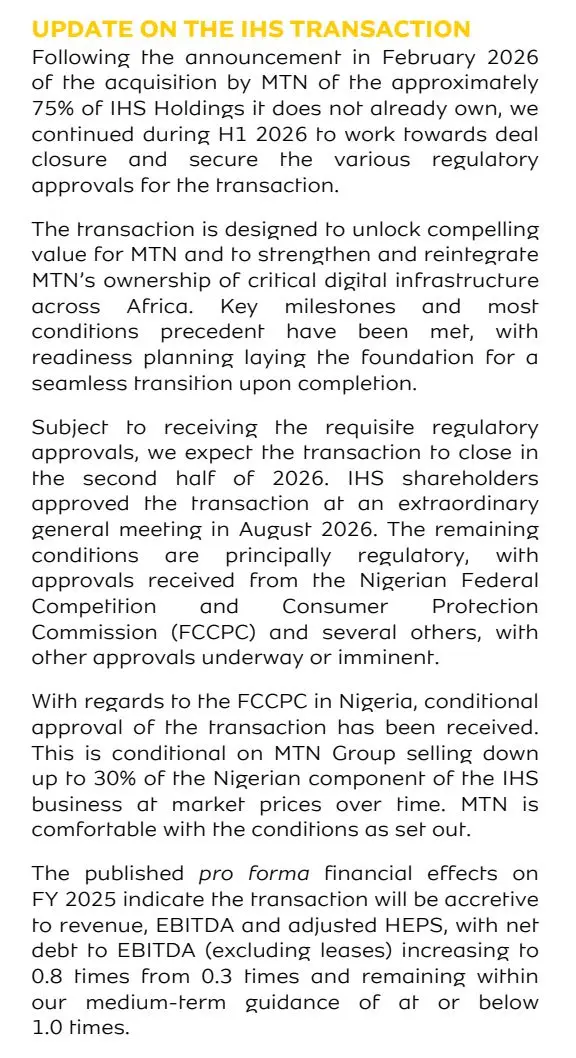
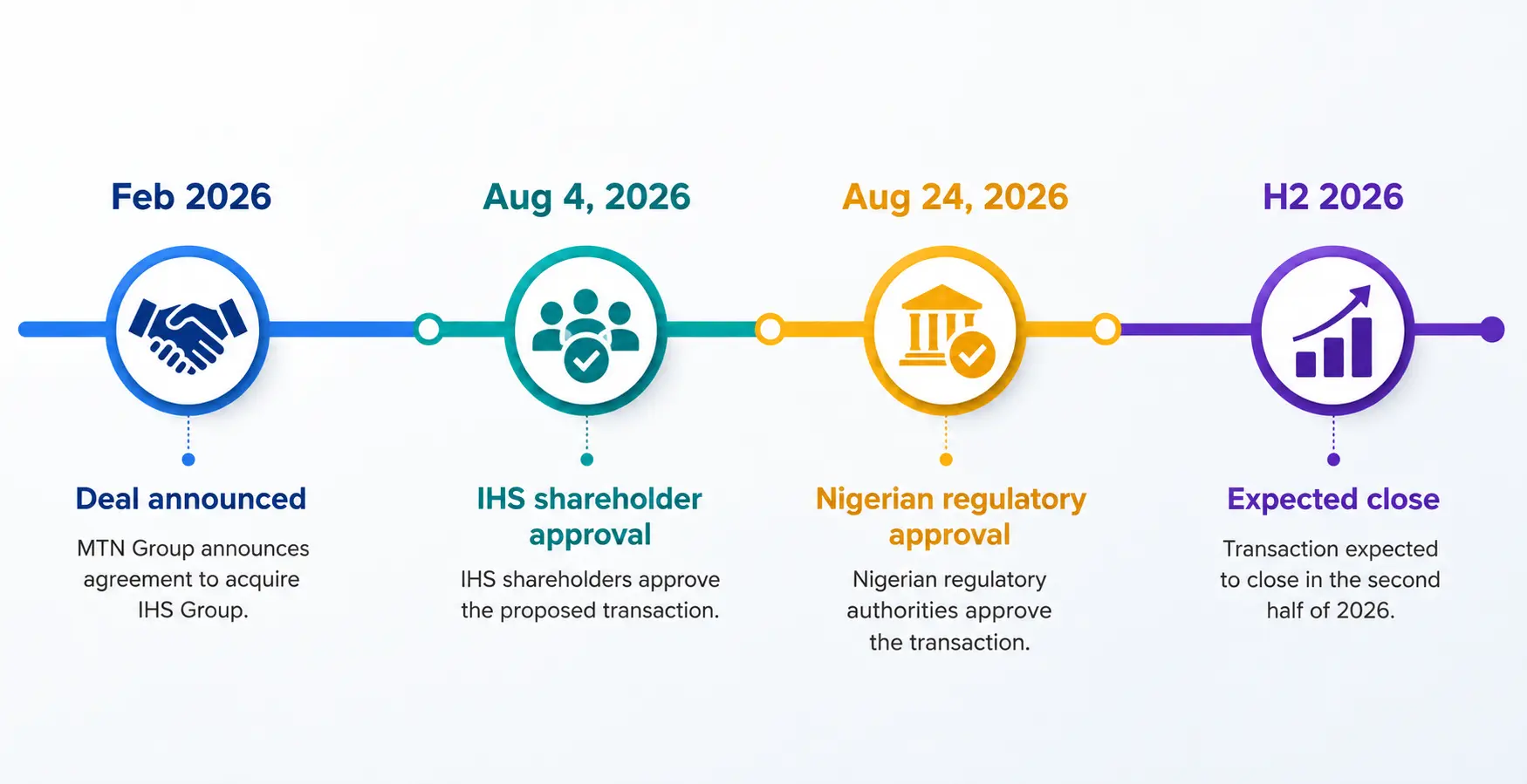
MTN disclosed the approval on August 24, 2026, as part of its financial results for the six months ended June 30, 2026. The company said it is “comfortable with the conditions as set out,” and confirmed it expects the wider transaction to close in the second half of 2026, subject to any remaining regulatory sign-offs.
The clearance is a pivotal moment in a deal that has been under Nigerian regulatory review since MTN and IHS Towers first announced it in February 2026. It also settles, at least for Nigeria, a competition question that had followed the transaction for months: whether Africa’s largest mobile operator should be allowed to own the tower infrastructure that its rivals depend on.
The Deal MTN Is Completing
MTN agreed in February 2026 to acquire the roughly 75 percent of IHS Holding Limited that it did not already own, at $8.50 per share in an all-cash transaction. The deal values IHS at an enterprise value of approximately $6.2 billion, with MTN’s cash outlay to non-MTN shareholders coming to about $2.2 billion. MTN is rolling over its existing roughly 24.7 percent stake in IHS as part of the consideration.
IHS shareholders approved the transaction with the required two-thirds majority at an extraordinary general meeting on August 4, 2026. Once completed, IHS will be taken private and delisted from the New York Stock Exchange, becoming a subsidiary of MTN Group rather than an independently listed tower company.
IHS operates close to 29,000 towers globally, but Nigeria is by far its most important market. IHS Nigeria alone accounts for nearly 16,000 of those sites, hosting equipment for MTN Nigeria as well as competitors including Airtel Nigeria and T2 Mobile, the operator formerly known as 9mobile.
What Nigerian Regulators Are Requiring
The FCCPC’s approval is conditional on MTN selling down up to 30 percent of IHS Nigeria to Nigerian investors, on what MTN describes as “an arm’s-length commercial basis and subject to market conditions.” The company has not yet named which investors would take up the stake or set a firm timeline for the sale.
The requirement effectively caps how much of Nigeria’s largest tower portfolio MTN can hold outright, even after it becomes IHS Towers’ global parent company. According to Businessday NG, the condition is specifically designed to limit MTN’s control over infrastructure that rival networks rely on.
Why Regulators Attached the Condition
The concern behind the sell-down requirement is what competition economists call vertical foreclosure: a dominant operator gaining control of infrastructure that its competitors need to function. IHS Nigeria is not just MTN’s landlord, it also hosts Airtel Nigeria and T2 Mobile, meaning full MTN ownership would have put a direct competitor in charge of the towers those rivals depend on.
Nigeria’s communications minister, Bosun Tijani, flagged this risk when the deal was first announced, indicating that the government intended to examine whether the transaction would undermine competition or consumer protection in the telecoms sector. Industry watchers had similarly warned that unchecked consolidation of tower ownership could affect colocation pricing, contract terms, and network expansion approvals for operators that do not own their own towers.
Not every rival views the deal as an urgent threat. Globacom, Nigeria’s only major operator that owns and manages its own tower network, has indicated through an unnamed representative that the acquisition has limited bearing on its operations, since it does not lease space from IHS.
What MTN Has Said
MTN’s public commentary on the approval has been brief and measured. In its half-year results statement, the company confirmed that “the transaction has received approval from various regulators, including Nigeria’s Federal Competition and Consumer Protection Commission,” and that it will “sell-down 30% of IHS Nigeria to local Nigerian investors” as a condition of that approval.
MTN Group president and CEO Ralph Mupita has previously called the broader IHS shareholder approval “an important step towards the completion of the transaction,” framing tower ownership as central to the group’s Ambition 2030 strategy. The company has also said IHS will keep operating on an open-access basis, continuing to serve all its existing tenants under current commercial agreements once the deal closes.
The Numbers Behind the Deal
| Detail | Figure |
|---|---|
| Stake MTN is acquiring | ~75% of IHS Holding Limited |
| Price per share | $8.50 (all-cash) |
| Cash consideration to non-MTN shareholders | ~$2.2 billion |
| Total enterprise value of IHS | ~$6.2 billion |
| MTN’s existing IHS stake being rolled over | ~24.7% |
| IHS towers in Nigeria | ~16,000 |
| Required Nigerian local sell-down | Up to 30% of IHS Nigeria |
MTN’s Reversal on Tower Ownership
The acquisition marks a reversal of a strategy MTN pursued for more than a decade. Starting in 2014 and accelerating through 2021, MTN sold large portions of its Nigerian and Ghanaian tower portfolios to IHS in sale-and-leaseback arrangements, freeing up capital while continuing to use the sites as a paying tenant. That earlier disposal, reported at roughly $3.2 billion for the Nigerian and Ghanaian assets, helped fund network expansion at a time when MTN wanted to hold less capital-intensive infrastructure on its balance sheet.
MTN has since taken a similar approach elsewhere. In 2022, it sold thousands of South African tower sites to IHS, a deal that left 30 percent of that structure with a Black economic empowerment consortium, a template that echoes the local-ownership condition Nigerian regulators have now imposed. The IHS transaction, by contrast, brings a large share of MTN’s passive network infrastructure back under its direct control, reflecting a broader industry view that owning towers outright can matter more as networks densify for 5G.
What Happens Next
With Nigerian shareholder and competition approvals secured, the transaction still needs any remaining regulatory clearances in other jurisdictions where IHS operates before it can formally close. MTN has told investors it expects completion in the second half of 2026.
Once the deal closes, attention will shift to how MTN executes the mandated Nigerian sell-down, including which local investors take up the stake and at what valuation, as well as how NCC oversight of tower pricing and service terms plays out in practice for rival operators leasing space from the newly MTN-controlled infrastructure.
Why This Approval Matters
For MTN, the conditional approval removes one of the biggest points of uncertainty hanging over a deal that reshapes its balance sheet and its relationship with the infrastructure carrying its Nigerian network, its largest and fastest-growing market by capital investment. For Nigeria’s telecoms sector, the 30 percent local ownership condition sets a marker for how regulators intend to handle infrastructure consolidation going forward, balancing MTN’s ambition to own more of its network with a requirement that Nigerian capital retain a stake in assets rivals depend on to compete.

Prince Anichi
Founder and Lead Technology Editor at Ortechy. Covering digital economy shifts, tech ecosystems across Africa, cybersecurity intelligence, and emerging software platforms.