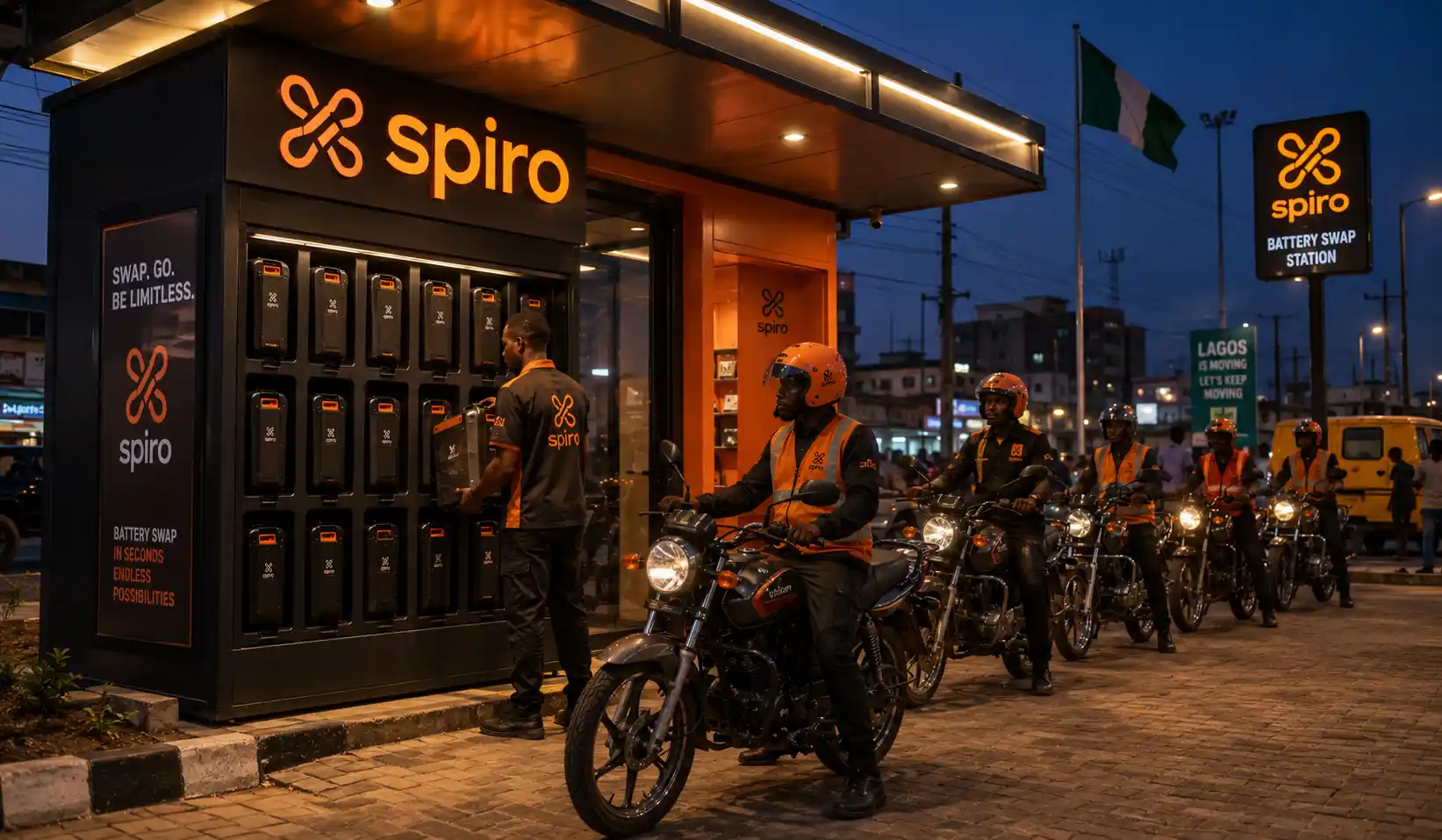
Africa’s electric vehicle sector just recorded one of its biggest financial milestones yet. Spiro, the continent’s leading electric mobility and clean energy infrastructure platform, has announced the successful close of a $270 million funding round — a figure that places it among the most heavily capitalised tech startups on the continent. The final piece of this round was a $55 million injection from NewTrails Capital, a Chinese growth-stage investment fund with offices in Shanghai, Shenzhen, and Nigeria.
The announcement, made on Monday June 23, 2026, caps what has been a sustained and deliberate fundraising campaign. Spiro has now raised more than $415 million since its founding in 2022, a total that no other electric two-wheeler company in Africa comes close to matching. The money will go toward expanding the company’s battery-swapping network, scaling manufacturing operations, and deepening its energy infrastructure across seven active African markets.
This is not simply a story about a startup raising money. It is a signal that global investors — from European pension funds to Chinese growth capital — are treating Africa’s EV infrastructure as a serious long-term asset class, not a development finance experiment.
How the $270 Million Round Came Together
The $270 million did not arrive in a single cheque. It represents the closing total of Spiro’s most recent equity round, which began building momentum weeks before Monday’s announcement.
The round was anchored by a $215 million equity raise that attracted participation from Impact Fund Denmark, Equitane, the Fund for Export Development in Africa (FEDA), Nithio, and the Africa Go Green Fund. That earlier tranche was described at the time as one of the largest investments ever made in Africa’s electric mobility sector. Then came the additional $55 million from NewTrails Capital, sealing the round at $270 million.
NewTrails Capital is a growth-stage fund focused on emerging markets across Africa, the Middle East, Southeast Asia, and Latin America. Its backing of Spiro is its most high-profile African commitment to date and reflects a broader trend of Chinese capital finding its way into African clean-energy plays. The fund’s presence in Nigeria also suggests an interest in Spiro’s operations there specifically, where motorcycle transport is deeply embedded in urban life.
Also worth noting: this round deepens a supply-side relationship between Spiro and Chinese industry that already existed. As TechCabal reported, Spiro has previously sourced batteries from Chinese manufacturers, including an $11.6 million supply agreement with CBAK Energy Technology. The NewTrails deal makes that China connection more strategic and less transactional.
What the Founder and Leadership Said
Gagan Gupta, founder of Spiro and chairman of Equitane, was direct in his statement on the round’s close. He did not reach for cautious language.
“I would like to thank NewTrails Capital for believing in Spiro’s model and supporting our unique tech, energy and innovation journey,” Gupta said. “Having deployed 100,000 electric vehicles and 2,500 smart-swap stations across seven active markets, Spiro has firmly moved past the proof-of-concept phase. Partnering with NewTrails Capital’s deeply experienced team marks a powerful new chapter for Spiro as we prepare for the next steps of our pan-African and international expansion.”
That last phrase is worth pausing on. “International expansion” is not language a company uses when it is still figuring out its home market. Gupta is signalling that Africa is now the base, not the ceiling.
Yufan Zhang, founding partner of NewTrails Capital, framed the investment in terms that go well beyond conventional venture return language. “We believe Spiro is driving a profound energy revolution across mobility use cases in Africa,” Zhang said. “This represents not only a vast and highly imaginative market opportunity, but also the potential to grow into an infrastructure-like business that creates meaningful commercial, social, and environmental value.”
Zhang also pointed to the structural reasons behind NewTrails’ conviction. “In our view, Spiro’s core strengths lie in its deeply localised operating capabilities, vertically integrated supply chain, digitally enabled ecosystem, sound unit economics, and strong ability to scale rapidly. More importantly, Spiro has systematically integrated vehicles, batteries, energy replenishment, payments, and service networks into a solution that is truly tailored to the African market.”
“Spiro is still a young company, and everything today is only the beginning,” Zhang added. “We look forward to continuing to fulfil our role as a long-term investor, contributing our resources and experience, growing together with Spiro, and helping accelerate Africa’s new energy transition.”
A New Group CEO Joins at a Critical Moment
The funding close arrives less than two weeks after Spiro made another significant move: appointing Anant Badjatya as Group Chief Executive Officer. Badjatya steps in from Indofast Energy, the joint venture between IndianOil and SUN Mobility, where he led the development of one of India’s largest battery-swapping networks — more than 1,800 stations serving nearly 90,000 vehicles daily.
His background is directly relevant. India is widely regarded as one of the world’s most advanced markets for battery-swapping technology at scale. Bringing someone with hands-on operational experience at that level into Spiro’s top seat is a clear statement about where the company is headed: past the early-adopter phase and into the hard work of dense, efficient, city-wide infrastructure deployment.
Kaushik Burman, who previously served as CEO, now leads as CEO of Mobility. Burman joined Spiro in 2023 after a stint as Regional Managing Director at Gogoro, the Taiwanese battery-swapping pioneer, where he drove expansion into Indonesia, India, the Philippines, and South Korea. His continued presence in a focused mobility leadership role suggests Spiro is deliberately separating the complexity of group strategy from the operational intensity of fleet and market growth.
What Spiro Has Built So Far
Numbers tell one part of the Spiro story. The company has deployed more than 100,000 electric vehicles and built over 2,500 battery-swapping stations across seven countries, completing more than 30 million battery swaps in total. It operates in Kenya, Rwanda, Uganda, Nigeria, Togo, Benin, and Cameroon.
Assembly plants are running in Kenya, Rwanda, and Uganda. A battery recycling facility operates in Nigeria. The company also runs technology hubs in Pune, India — focused on EV powertrain design and battery management systems — and in Bengaluru, where the team develops IoT-enabled cloud platforms. This is not a company that just sells electric motorcycles. It controls the design, manufacturing, deployment, swapping, software, and recycling chain end to end.
That vertical integration is deliberate. In a continent where supply chains are fragmented, logistics are unreliable, and imported components are expensive, owning as much of the stack as possible reduces the number of failure points. According to Spiro’s company profile, the company was founded in 2022 with initial backing from Gagan Gupta’s Equitane Group, formerly the Africa Transformation and Industrialisation Fund. It assembled its capacity quickly — twin plants launched in Benin and Togo in August 2023, a manufacturing centre opened on Old Mombasa Road in Nairobi in September 2024.
In May 2024, Spiro was included in TIME’s 100 Most Influential Companies list — an acknowledgement that the company’s model had captured global attention well before this latest funding round.
Spiro’s Funding History: A Capital Stack Built in Layers
The $270 million round did not materialise out of nowhere. Spiro has been raising capital consistently since 2022 and has structured its capital stack with a mix of equity, debt, and multilateral backing.
- 2022: Initial equity from Equitane Group — $85 million to establish and launch operations
- May 2023: $63 million debt package from Société Générale to fund Kenya and Uganda expansion
- 2024: $50 million loan from Afreximbank to grow the battery-swapping network
- February 2026: $50 million debt facility to support manufacturing and logistics
- October 2025: $100 million equity round led by FEDA, Afreximbank’s impact investment arm — the largest EV funding ever seen in Africa at that time
- June 2026: $270 million round closed, sealed by $55 million from NewTrails Capital
The cumulative total now exceeds $415 million, raised across multiple instruments and investor types. That diversity matters. Multilateral lenders like Afreximbank provide concessional terms and development credibility. Impact funds bring patient capital and climate mandates. Commercial growth funds like NewTrails bring market-rate discipline and supply-chain networks. The blend gives Spiro access to capital at different costs and with different strings attached — which is how large infrastructure plays get built without becoming entirely dependent on any single source.
Why Africa’s EV Market Is Attracting This Level of Capital
The numbers backing Spiro’s ambitions are not arbitrary. Africa’s electric two-wheeler market was valued at approximately $441 million in 2023 and is projected to exceed $2.6 billion by 2031, according to industry data. Electric two-wheeler sales across the continent grew by nearly 40 percent in 2024 alone.
Kenya offers the sharpest case study. Electric motorcycles accounted for 15.3 percent of new registrations in the country in 2025 — up from just 0.5 percent in 2021. That is a four-year shift that would have seemed implausible to most analysts at the start of that period. It happened because the economics work: fuel savings for boda-boda riders are significant, battery swapping removes range anxiety, and companies like Spiro made the vehicles accessible through asset financing partnerships.
The broader structural case is even more compelling. Africa has approximately 25 million motorcycles on its roads. India, with a comparable population, has around 320 million. That gap represents an enormous latent market waiting to motorise — and whoever owns the charging and swapping infrastructure when that motorisation happens owns a critical piece of urban energy distribution across the continent.
Lars Bo Bertram, CEO of Impact Fund Denmark, articulated the investor case plainly when the $215 million raise was announced. “We are investing in Spiro and bringing Danish pension capital into one of Africa’s most promising growth markets because we see potential for significant commercial growth in Spiro and electric mobility across Africa, as well as measurable climate impact,” Bertram said. “That is exactly the type of investment we want to make.”
Battery Swapping as Infrastructure, Not Just a Feature
Most conversations about electric vehicles focus on the vehicles themselves. Spiro’s real competitive position is not the motorcycles — it is the battery-swapping stations.
Battery swapping solves the single biggest barrier to EV adoption in markets where electricity access is inconsistent and riders cannot afford to wait hours for a charge. A Spiro rider swaps a depleted battery for a fully charged one in under two minutes, pays for the energy consumed, and gets back on the road. The battery never leaves Spiro’s custody. Riders do not need to own or maintain the most expensive component of the vehicle. It functions more like a fuel station than a charging point.
The company plans to use the new funding to build more swap stations, develop next-generation technology for the network, and add solar-powered infrastructure to the mix. Solar-powered swap stations are particularly significant because they decouple the network from the grid in markets where grid reliability is low. In practical terms, this means a Spiro station in rural Nigeria or northern Uganda can operate on its own energy supply, making the network far more resilient than one dependent on utility power.
Spiro also intends to expand into Ethiopia and the Democratic Republic of Congo, two markets that would significantly deepen its African footprint but also introduce new operational complexity. Ethiopia’s large urban population and the DRC’s size both represent substantial opportunities. Neither market is simple. But Spiro’s experience navigating regulatory environments across seven countries suggests it has built at least some institutional capacity for that kind of complexity.
Chinese Capital Enters Africa’s EV Race
The NewTrails Capital investment is notable not just for its size but for what it represents geopolitically. Chinese investors have long been active in African infrastructure — roads, ports, telecoms — but direct participation in African EV equity rounds at growth stage is a newer development.
NewTrails has strategic presence in Shanghai, Shenzhen, and Nigeria. Shenzhen is the global epicentre of EV manufacturing, home to BYD, CATL, and dozens of battery and powertrain suppliers. A fund with roots in that ecosystem brings more than money. It brings supply-chain relationships, manufacturing knowledge, and the ability to connect African operators to the world’s most advanced EV production base at competitive cost.
As TechBuild Africa noted, Spiro already has a working relationship with Chinese battery suppliers through the CBAK Energy Technology deal. The NewTrails investment formalises and deepens that connection at the strategic level. It also signals that Chinese growth capital is beginning to treat Africa’s clean-energy infrastructure as a viable asset class, not just a recipient of development loans.
What This Means for Africa’s Energy Transition
Spiro’s ambitions now reach well beyond motorcycle transport. The company describes itself as a clean energy infrastructure platform, not just an EV company. The distinction matters.
Battery-swapping stations that run on solar power are, in effect, distributed energy assets. They store energy, discharge it on demand, and can in principle integrate with broader grid management systems. As battery costs fall and the network scales, those stations become part of the energy infrastructure of the cities and towns they operate in — not just a convenience for riders, but a node in a local energy system.
This is the long game that Spiro appears to be playing. The motorcycles are the entry point. The swap stations are the network. And the network, at sufficient scale, is something that African governments, utilities, and development institutions will want to integrate with their own energy planning. That is when Spiro stops being a startup and starts being infrastructure.
African economies are simultaneously dealing with rising fuel import costs, growing urban populations, and pressure to meet climate commitments. A company that can offer affordable transport, reduce fuel dependency, and contribute to renewable energy storage addresses three national priorities at once. That is why institutions like FEDA, the Africa Go Green Fund, and Impact Fund Denmark are sitting at the same table as Chinese growth capital. They are backing different versions of the same thesis.
The Road Ahead
With $270 million secured and a new Group CEO in place, Spiro enters the second half of 2026 with more capital, more leadership firepower, and a clearer continental mandate than it has had at any point in its short history.
The company says it will deploy the capital across four main areas: expanding the battery-swap station network, growing manufacturing capacity, deepening supply chain localisation, and accelerating rollout of energy infrastructure across existing markets. New market entries into Ethiopia and the DRC are on the horizon, though no timelines have been confirmed.
The appointment of Anant Badjatya as Group CEO adds a layer of operational seriousness that a company at this scale now requires. Managing 100,000 deployed vehicles, 2,500 swap stations, manufacturing plants in three countries, and a recycling facility in a fourth is not a startup exercise. It demands the kind of systems-level thinking that Badjatya applied in India, where he scaled a battery-swapping network to comparable density in a market with its own fierce complexity.
Gagan Gupta’s signal of “pan-African and international expansion” is the headline for what comes next. If Spiro can replicate what it has built in Kenya and Rwanda across Ethiopia, the DRC, and potentially markets further afield, the $415 million it has raised starts to look like the foundation of something much larger. The company that builds Africa’s EV infrastructure in the next decade will not be a motorcycle brand. It will be an energy company that started with motorcycles. Spiro is making a credible case that it intends to be that company.

Prince Anichi
Founder and Lead Technology Editor at Ortechy. Covering digital economy shifts, tech ecosystems across Africa, cybersecurity intelligence, and emerging software platforms.