
What Is Prompt Fatigue in Artificial Intelligence? Causes, Effects, and Solutions
Prompt fatigue in artificial intelligence is quietly draining productivity across workplaces around the world. It describes the cognitive and emotional exhaustion that builds up when users repeatedly craft, test, and rework prompts to get useful responses from AI tools like ChatGPT, Claude, or Gemini. Half of senior business leaders now report declining company-wide enthusiasm for AI adoption, according to the EY AI Pulse Survey conducted in late 2024. That figure tells a story far bigger than simple frustration.
The problem runs deeper than a bad experience with a chatbot. When AI tools consistently require more mental effort than they save, workers start to disengage. The technology that was supposed to streamline everything becomes another source of workplace stress. Understanding why this happens, and what to do about it, is now a real business priority.
This guide covers what prompt fatigue is, what causes it, how it affects teams and individuals, and the practical steps you can take to reduce it. Whether you use AI daily or manage a team that does, the insights here will help you work with these tools more effectively.
What Is Prompt Fatigue in AI?
Prompt fatigue is the mental exhaustion that comes from repeatedly writing, refining, and reworking instructions to get a useful output from a large language model (LLM). An LLM is an AI system, such as ChatGPT or Claude, trained on vast amounts of text to generate human-like responses. The fatigue sets in when that process of trial and error feels more like a burden than a shortcut.
The term entered mainstream tech vocabulary in September 2024, when Google Cloud used it explicitly when announcing its Vertex AI Prompt Optimizer, a tool designed specifically to reduce the manual effort users face when building AI applications. That product launch was a public acknowledgment from one of the largest AI providers in the world that the problem was real and widespread.
The Shift From Search to Prompting
Traditional search engines trained users to think in keywords. You typed a few words, scanned results, and clicked. The effort was minimal. AI assistants changed that dynamic entirely. Now, users must write coherent instructions, specify context, define output formats, and often repeat the whole process when the result misses the mark.
Computerworld describes this shift as moving from a simple “search and find” model to a more demanding “query and refine” cycle. Users must constantly re-architect their prompts and probe the AI from multiple angles, which breaks the focused mental state needed for deep, productive work. For many people, this back-and-forth feels less like using a tool and more like managing a difficult conversation.
How It Differs From General AI Fatigue
General AI fatigue refers to a broader weariness with AI as a concept, including concerns about job displacement, information overload, and the relentless pace of new product launches. Prompt fatigue is more specific. It targets the actual interaction moment, the point where a user sits down, types a request, and discovers the result is off. Then tries again. Then again.
Both phenomena can coexist. However, prompt fatigue is something you can address directly with better habits, tools, and workflows. That makes it more actionable than the broader cultural anxieties surrounding AI.
The Main Causes of Prompt Fatigue in AI Systems
Several factors drive prompt fatigue, and most of them are structural. They are built into the way current AI tools work, not just a matter of user error or inexperience.
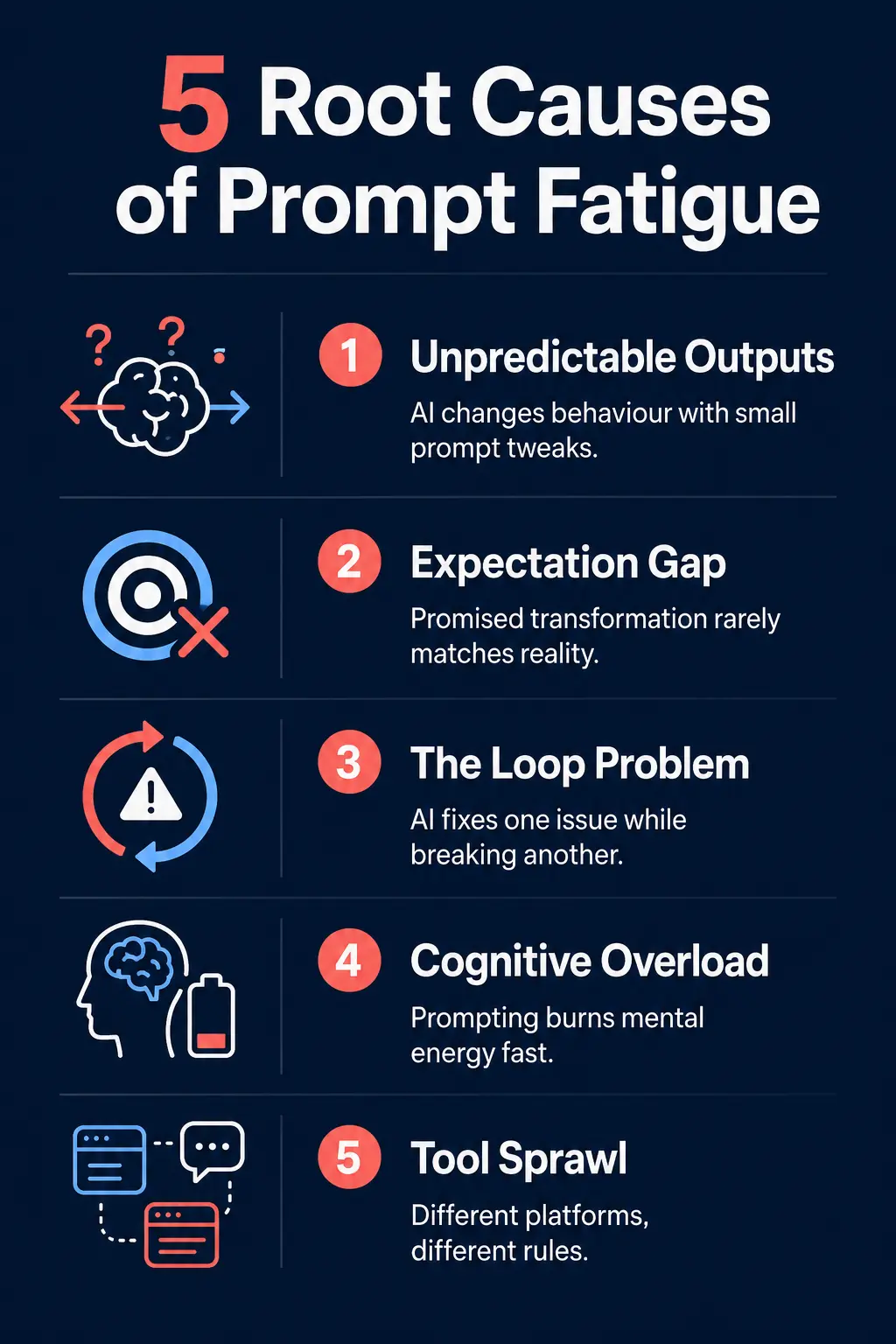
Unpredictable Model Outputs
LLMs are sensitive to small changes in phrasing. Research published in 2024 shows that modest prompt edits, including minor surface-form changes or shifts in word choice, can meaningfully alter a model’s behaviour and downstream performance. This means a prompt that worked perfectly yesterday may produce a different result today, even if you changed nothing significant.
This unpredictability forces users into a cycle of constant experimentation. Instead of building on past success, they must treat each session as uncertain. Over time, that uncertainty becomes exhausting.
The Gap Between Expectation and Reality
AI vendors have consistently framed their tools as transformative solutions that will revolutionise business processes. In practice, the integration process often proves more time-consuming and expensive than anticipated. 77% of employees in one 2024 survey said AI had actually hurt their productivity, as reported by Inc. Magazine. In software development specifically, workers using AI coding assistants took 19% longer to complete tasks compared to working without them, according to Business Insider research from 2025.
When a tool promises speed but delivers friction, users lose confidence quickly. That gap between expectation and experience is one of the most reliable predictors of prompt fatigue.
The “One Step Forward, Two Steps Back” Problem
Generative AI tools can create a misleading sense of momentum. Unlike traditional software workflows, which tend to be linear and predictable, AI tools often produce rapid early acceleration. This can make a task feel nearly complete, pushing users to move forward before the output is actually reliable.
Binny Gill, founder and CEO of business process automation vendor Kognitos, described this experience to Computerworld’s coverage of prompt fatigue in the workplace: the AI fixes one thing while quietly breaking something it had already done correctly. The result is a frustrating loop where progress never feels stable. That instability, repeated across dozens of sessions, wears people down.
Cognitive Load and Decision Fatigue
Cognitive load refers to the total mental effort required to complete a task. Writing effective prompts adds significant cognitive load because users must simultaneously think about their goal, how to phrase it clearly, what context the AI needs, and how to evaluate whether the output is correct. That is a lot to manage alongside the actual work they were trying to do.
Research reviewed in a ScienceDirect study on LLMs and design found that excessive AI interactions create psychological strain and decrease user engagement over time. This is the mechanism behind prompt fatigue at its most fundamental level. The brain has a limited capacity for complex decision-making, and prompting burns through that capacity quickly.
Tool Sprawl and Platform Switching
Most organisations now use multiple AI platforms, and that number is growing. Each tool has its own prompting conventions, strengths, and quirks. A prompt structure that works in one tool may produce poor results in another. Users who switch between platforms throughout the day face an additional layer of mental overhead, learning and relearning the preferences of each system.
AI adoption across businesses climbed from 55% to 78% between 2024 and late 2025, according to Stanford HAI’s annual AI Index. More tools entering the workplace means more prompting contexts to navigate, which compounds fatigue rather than reducing it.
Who Is Most Affected by Prompt Fatigue?
Prompt fatigue does not affect everyone equally. Certain roles, skill levels, and work patterns make some users far more vulnerable than others.
Knowledge Workers and Developers
Software engineers and knowledge workers represent the groups where prompt fatigue has been most clearly documented. These roles involve complex, multi-step tasks where AI outputs need to be precise. Any inaccuracy requires debugging, which means more prompting, more iteration, and more time spent managing the AI rather than completing the underlying work.
The frustration observed in software engineers is particularly pronounced because their workflows already require deep focus. Interrupting that focus to rework a prompt breaks the mental state that enables high-quality output. The AI designed to help them ends up costing them more of the concentration they need most.
Newer AI Users
People who are still learning how to use AI tools face a steeper learning curve and therefore higher rates of fatigue. 47% of workers say they feel unprepared for widespread AI adoption, according to the Society for Human Resource Management. A further 47% say they are unsure how to achieve the productivity gains their employers expect from AI, based on McKinsey research from 2025. When workers do not yet know what a good prompt looks like, every interaction becomes a lesson with no guarantee of a passing grade.
Younger Workers Under Workplace Pressure
Pew Research Center data from 2025 found that workers aged 18 to 29 are more likely than older cohorts to feel overwhelmed by AI. This is counterintuitive given that younger workers tend to be more comfortable with technology. The likely explanation is that younger employees face more pressure to demonstrate AI proficiency as a workplace expectation, creating a performance anxiety layer on top of the cognitive demands already involved in prompting.
The Real Effects of Prompt Fatigue on Productivity
The consequences of prompt fatigue extend well beyond personal frustration. They show up in measurable ways across team output, decision quality, and organisational ROI.
Productivity Losses That Negate the AI Advantage
The central irony of prompt fatigue is that it turns a productivity tool into a productivity drain. When someone spends 20 minutes crafting and refining a prompt for a task that would have taken 15 minutes to complete manually, the AI has made things worse. This is not a theoretical concern. A recent MIT report found that 95% of organisations have seen no measurable return on their AI investment, according to Harvard Business Review data from 2026.
The productivity paradox, where technology introduces friction before it delivers gains, is well established in economic research. AI is now living through its own version of this paradox, and prompt fatigue is one of its clearest expressions.
Errors From Rushed or Lazy Prompting
Fatigued users tend to stop investing effort in prompt quality. They accept mediocre outputs, skip verification steps, or use vague instructions just to get something done. This creates a downstream risk: outputs that look plausible but contain errors, which then need to be corrected later at greater cost.
In high-stakes fields like healthcare and law, this risk is especially serious. A narrative review published in Frontiers in Artificial Intelligence in 2025 identified “prompting bias” as a factor that can invalidate research conclusions in medical AI, and flagged the dangerous gap between expert-crafted prompts and the casual queries used by the general public. The quality of the prompt directly shapes the safety of the output.
Erosion of Trust in AI Tools
Repeated negative experiences with AI reduce user trust over time. When workers associate AI tools with extra effort and inconsistent results, they start to avoid those tools or use them minimally. This defeats the purpose of the investment and can create cultural resistance that makes future AI adoption harder within an organisation.
The EY AI Pulse Survey found that 54% of senior leaders feel they are failing as leaders amid AI’s rapid growth. That sense of falling behind, despite significant AI investment, points directly to a breakdown in confidence that prompt fatigue helps create.
Practical Solutions to Reduce Prompt Fatigue
The good news is that prompt fatigue is not inevitable. A combination of better habits, smarter tools, and organisational support can significantly reduce its impact.
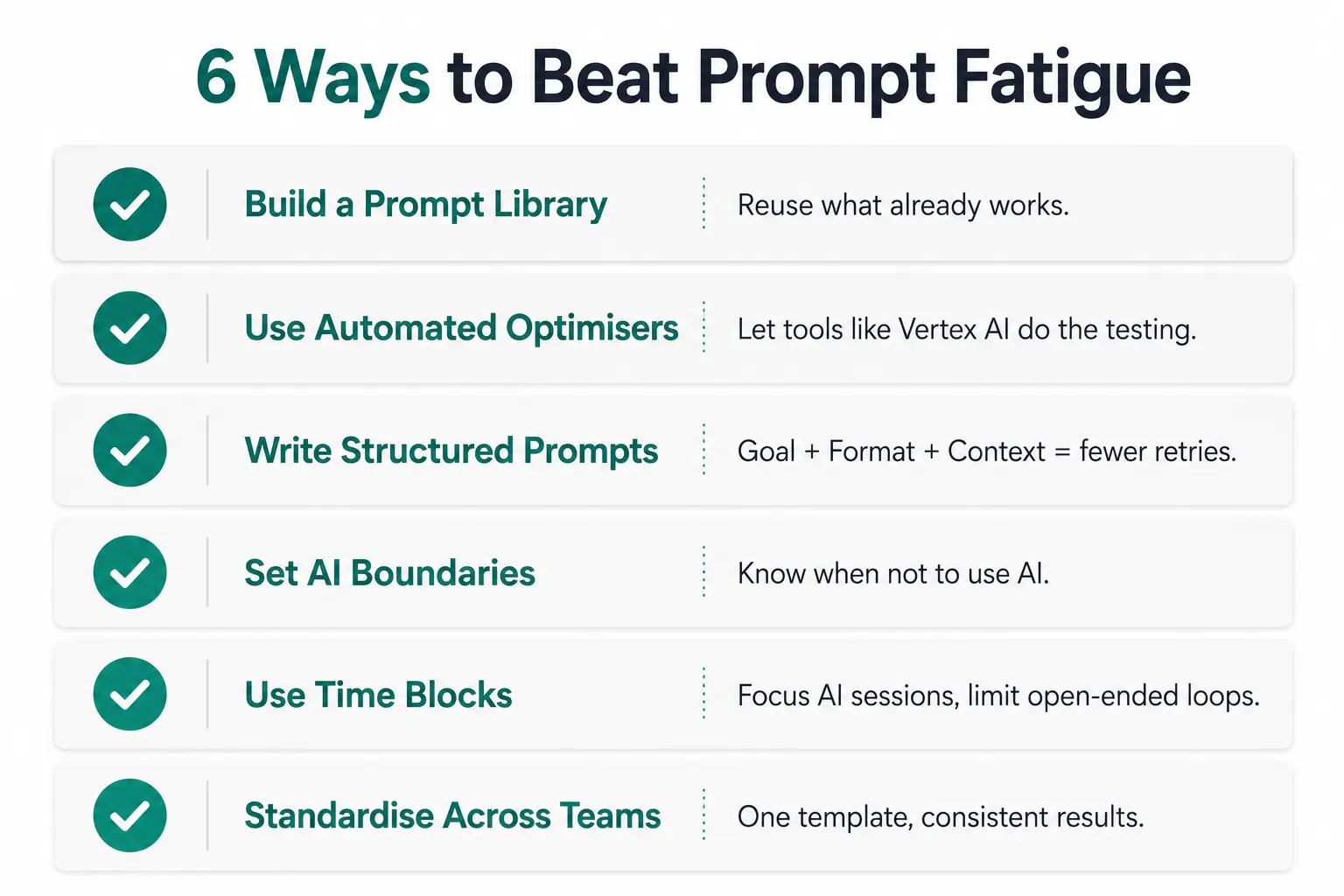
Build and Maintain a Prompt Library
One of the most effective ways to reduce prompt fatigue is to stop reinventing the wheel. A prompt library is a shared collection of tested, high-performing prompts that teams can reuse and adapt. Instead of starting from scratch each time, users pull a proven template and modify it for their specific need. This cuts down experimentation time and reduces the cognitive load of prompting considerably.
Prompt libraries work best when they are organised by task type, regularly updated as models evolve, and accessible to everyone on the team. Tools like Notion, Confluence, or dedicated AI platforms can host these libraries effectively. The investment in building one pays back quickly in time saved and frustration avoided.
Use Automated Prompt Optimisation Tools
Several platforms now automate the process of improving prompts. Google Cloud’s Vertex AI Prompt Optimizer uses an iterative algorithm where one model generates candidate prompt variations and another evaluates them against defined quality metrics. The result is a best-performing prompt that the user would not have found through manual trial and error alone.
These tools are especially valuable for developers building LLM-based applications, where manual prompt experimentation can consume enormous amounts of time. Automating the optimisation process removes a major source of prompt fatigue at the developer level and improves output quality at the same time.
Write Clearer, More Structured Prompts From the Start
Many users experience prompt fatigue partly because their initial prompts are too vague. A prompt like “write me a summary” gives the AI almost nothing to work with. A prompt that specifies the topic, the intended audience, the desired length, and the preferred tone will produce a usable output far more often on the first attempt. Fewer retries means less fatigue.
Prompt engineering best practices consistently recommend including four key elements: a clear goal, a defined output format, explicit constraints, and any relevant context. Prompts that include all four elements consistently outperform those that include only one or two. TechTarget’s prompt engineering guidance highlights this structure as a reliable baseline for getting better results with less effort.
Set Realistic Expectations and Boundaries
Part of managing prompt fatigue is reframing what AI tools are actually good for. These systems excel at tasks involving pattern recognition, summarisation, drafting, and ideation. They are less reliable for tasks requiring precise factual accuracy, nuanced judgment, or deep domain knowledge without expert verification.
When workers understand which tasks benefit from AI and which do not, they stop applying AI to everything indiscriminately. That selectivity reduces the number of frustrating interactions and preserves mental energy for the cases where AI genuinely helps. Training teams to think critically about when to use AI is as important as training them how to use it.
Limit Daily Prompting Sessions and Use Time Blocks
Just as professionals block time for focused work, they can also schedule their AI interactions. Dedicating specific time blocks to AI-assisted tasks, rather than switching to AI tools constantly throughout the day, reduces the context-switching overhead that amplifies fatigue. It also creates a natural endpoint, so users are not stuck in an open-ended loop of revision with no time pressure to stop.
Short, focused AI sessions of 20 to 30 minutes tend to produce better outputs than long, unfocused sessions. The quality of prompts degrades as mental energy drops, so working with AI when your concentration is highest produces more useful results with less effort overall.
Standardise Prompts Across Your Organisation
Organisations that allow every team member to develop their own prompting approach end up with inconsistent results and duplicated effort. Standardising prompt templates for common use cases, performance reviews, customer emails, market summaries, and report drafts, creates predictability and reduces the learning curve for new users.
Standardisation also makes quality improvement easier. When teams use the same template, they can track which versions produce the best results and update the shared version accordingly. This turns prompt improvement into a collective effort rather than a private struggle.
The Role of AI Tool Design in Reducing Prompt Fatigue
Prompt fatigue is not only a user problem. It is also a product design problem. How AI tools are built has a direct impact on how much effort users need to invest to get good results.
Better Context Retention Between Sessions
One of the most common frustrations with current AI tools is the loss of context between sessions. Users must re-explain their situation, preferences, and goals every time they start a new conversation. This repetition adds up quickly and is a significant contributor to fatigue. Tools that retain user context across sessions, or that allow users to save and reload context profiles, remove this burden substantially.
The concept of “context engineering” is gaining traction among AI developers as a more accurate description of the work involved in effective AI use. Rather than just writing prompts, users are managing the information environment the model works within. Tools designed with this in mind give users better controls for doing that efficiently.
Smarter Default Behaviours
AI tools that require minimal instruction to produce useful outputs reduce the baseline effort of prompting. Models that ask clarifying questions when a prompt is ambiguous, rather than guessing and producing an off-target response, save users the effort of multiple revision cycles. These design choices have a real impact on how much prompting effort is required per task.
Frequently Asked Questions About Prompt Fatigue
What exactly causes prompt fatigue in AI users?
Prompt fatigue is caused by the repeated mental effort of writing, evaluating, and reworking prompts to get useful AI outputs. Unpredictable model behaviour, vague initial prompts, the gap between AI promises and actual results, and the cognitive load of constant decision-making all contribute. Over time, this accumulated effort leads to exhaustion, disengagement, and a drop in output quality.
Is prompt fatigue the same as AI fatigue?
They are related but distinct. AI fatigue is a broader term covering the general weariness with AI adoption, including concerns about job displacement and tool overload. Prompt fatigue is specifically about the exhaustion that comes from the act of prompting AI tools repeatedly. Prompt fatigue is more targeted and more actionable because it can be reduced through better prompting habits and tool choices.
Which workers are most at risk of prompt fatigue?
Software engineers, knowledge workers, and newer AI users tend to experience prompt fatigue most acutely. Workers in roles that require precision, multi-step tasks, or constant AI interaction throughout the day are particularly vulnerable. Younger workers facing performance pressure around AI proficiency also show higher rates of feeling overwhelmed, according to Pew Research Center data from 2025.
Can prompt fatigue affect AI output quality?
Yes, significantly. Fatigued users write less careful prompts, skip verification steps, and accept mediocre outputs rather than continuing to iterate. This creates a feedback loop where declining prompt quality leads to declining output quality, which in turn increases frustration and deepens fatigue. In fields like healthcare or legal research, poor-quality prompts driven by fatigue can lead to genuinely harmful errors.
What is the fastest way to reduce prompt fatigue?
Building a shared prompt library is one of the fastest and highest-impact steps. Reusing tested prompts eliminates the effort of starting from scratch and dramatically reduces the number of failed attempts. Pairing this with automated prompt optimisation tools and structured prompting templates addresses fatigue at both the individual and organisational level.
Will AI models improve to the point where prompt fatigue disappears?
Model improvements are already reducing some of the friction. Newer models are better at inferring intent from minimal context, which lowers the baseline effort required. However, as long as users need to specify goals, formats, and constraints to get reliable outputs, some level of prompting effort will remain. The goal is to make that effort manageable rather than eliminate it entirely.
How to Build Long-Term Habits That Prevent Prompt Fatigue
Reducing prompt fatigue is not a one-time fix. It requires consistent habits that make prompting more efficient over time.
1. Review and Refine Prompts Regularly
Prompts that worked well six months ago may not work as well today. Models are updated frequently, and the conventions that produce good results shift with those updates. Building a regular habit of reviewing your most-used prompts, testing them, and updating them as needed keeps your prompt library current and your results consistent.
For teams, a monthly prompt review process attached to an existing workflow review makes this sustainable without adding significant overhead. The time invested in maintenance pays back in reduced frustration during daily use.
2. Invest in Prompt Engineering Skills
Prompt engineering, the skill of writing effective AI instructions, has moved from a niche developer capability to a core professional skill. Workers who understand how to structure prompts clearly, use role framing, include examples, and specify output formats get better results with less effort. That competency gap explains much of the variance in who experiences prompt fatigue and who does not.
Organisations that invest in training their teams in basic prompt engineering see measurable improvements in AI output quality and reductions in time spent on revision. The investment does not need to be large. Even a short, practical session covering the fundamentals of prompt structure can produce immediate improvements for most users.
Turning Prompt Fatigue Into a Competitive Advantage
There is a counterintuitive opportunity buried in the problem of prompt fatigue. Organisations that take it seriously, build better systems around it, and develop their teams’ prompting skills gain an advantage over competitors who treat AI adoption as simply a matter of access. Having the tools is not enough. Knowing how to use them without burning out is the actual differentiator.
The 95% of organisations seeing no measurable AI ROI have something in common: they invested in technology without investing in the human and operational systems needed to use it well. Prompt fatigue is often a symptom of that gap. Addressing it directly, through prompt libraries, training, standardisation, and smarter tool selection, moves an organisation from that majority into the minority that actually captures AI’s productivity potential.
Managing Prompt Fatigue for Sustainable AI Use
Prompt fatigue in artificial intelligence is a real and measurable problem. It affects individual productivity, team output, and the overall return organisations get from their AI investments. The frustration of repeated prompt cycles, unpredictable outputs, and the cognitive load of constant AI management is not a sign that AI does not work. It is a sign that the way most people use AI right now is not sustainable without better systems around it.
The solutions are practical and available today. Building prompt libraries, using automated optimisation tools like those offered by Google Cloud, structuring prompts more clearly, and setting realistic boundaries around AI use all reduce fatigue significantly. These are not complex interventions. They are habits and systems that, once in place, make AI work the way it was supposed to work all along.
The trajectory of AI development is toward tools that require less effort to use well. Models are improving, interfaces are getting smarter, and the industry is paying attention to the fatigue problem in ways it was not two years ago. In the meantime, the users and organisations that invest in understanding prompt fatigue and managing it proactively will outperform those who simply push through the frustration and hope things improve on their own.
For further reading on effective AI interaction and prompt engineering fundamentals, the Stanford HAI AI Index offers the most comprehensive annual overview of AI adoption trends and workforce impacts available.

Prince Anichi
Founder and Lead Technology Editor at Ortechy. Covering digital economy shifts, tech ecosystems across Africa, cybersecurity intelligence, and emerging software platforms.