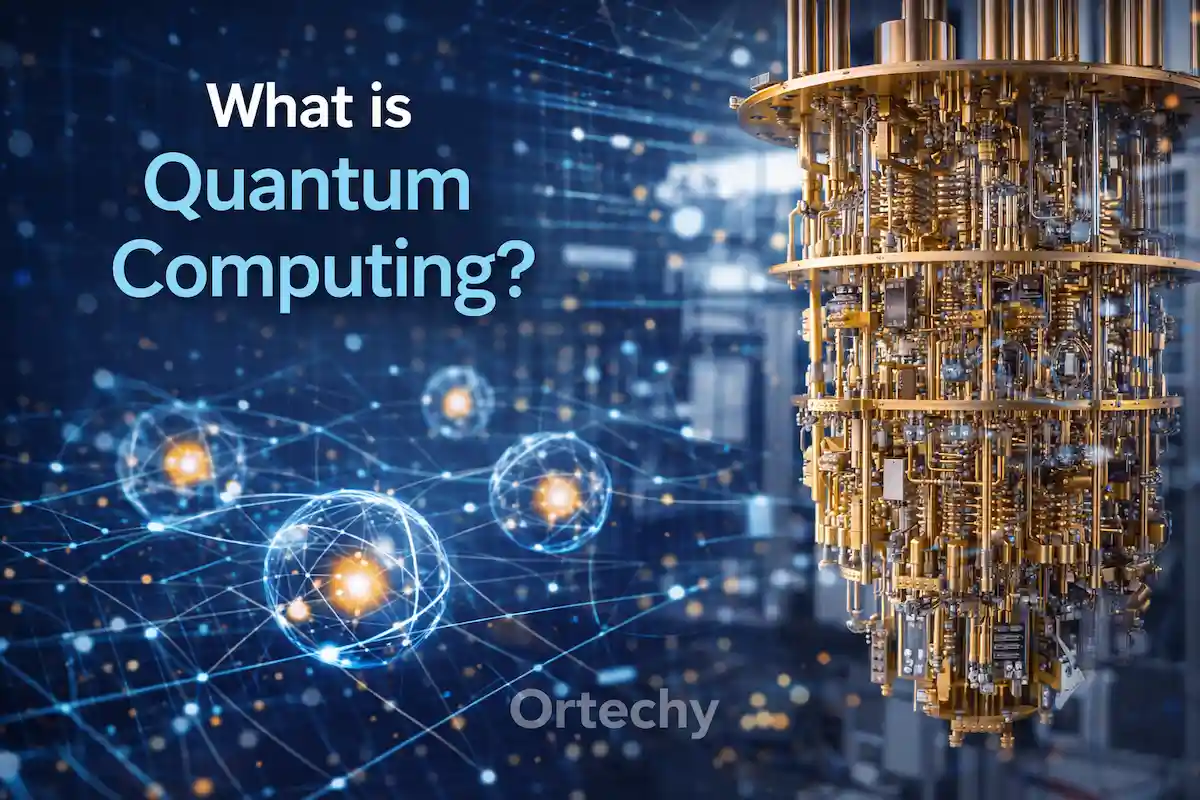
What Is Quantum Computing and How Does It Work?
INTRODUCTION
What is quantum computing? It’s one of the most searched technology questions of 2026, and for very good reason. After decades of living mostly inside university laboratories and the pages of science fiction novels, quantum computing is finally stepping into the real world. Governments are pouring billions of dollars into it. Tech giants like Google, IBM, and Microsoft are racing to build the most powerful quantum machines ever created.
And entire industries from medicine to finance to national security are bracing for the moment quantum computers become powerful enough to change everything.
But here’s the problem: most explanations of quantum computing are either so technical they lose you in the first paragraph, or so vague they leave you knowing nothing at all.
But tis guide is different, by the time you finish reading, you will have a clear, honest, and thorough understanding of what quantum computing is, how it works, why it matters, and what it means for your life and career, explained in plain everyday language, with zero assumptions about your technical background.
Let’s start from the very beginning.
What Is Quantum Computing? The Simple Answer
Quantum computing is a type of computing that uses the principles of quantum physics to process information in ways that classical computers like the laptop or smartphone you’re using right now simply cannot.
To understand what makes it different, you first need to understand how normal computers work.
Every piece of information in a classical computer is stored as a bit — a tiny switch that is either OFF (0) or ON (1), everything your computer does from displaying this webpage to running a video game to processing a bank transaction is ultimately built on billions of these bits flipping between 0 and 1 at extraordinary speed.
Quantum computers are built on a completely different foundation. Instead of bits, they use qubits (quantum bits), and here is where things get fascinating: thanks to the strange laws of quantum physics, a qubit doesn’t have to be just 0 or just 1. It can exist in a state called superposition where it is effectively both 0 and 1 at the same time, until it is measured.
Think of it this way – classical bit is like a light switch that’s either up or down while A qubit is like a spinning coin, while it’s spinning, it’s neither heads nor tails. It’s both. Only when it lands (when you measure it) does it commit to one state. This property allows quantum computers to explore a massive number of possible solutions to a problem simultaneously, rather than testing them one by one.
The result? For certain types of extremely complex problems, quantum computers can find answers millions of times faster than the most powerful classical supercomputers on Earth.
The Core Principles Behind Quantum Computing
To truly understand what is quantum computing, it helps to get familiar with the three core quantum physics principles that make it all possible. Don’t worry we’re keeping it simple.
1. Superposition
As introduced above, superposition is the ability of a qubit to exist in multiple states at the same time. While a classical bit is always either 0 or 1, a qubit in superposition is both simultaneously. When you scale this up to many qubits working together, a quantum computer can represent and process an astronomically large number of possible combinations all at once. A system of just 300 qubits in superposition can represent more states simultaneously than there are atoms in the observable universe.
2. Entanglement
Quantum entanglement is one of the most mind-bending phenomena in all of physics, even Einstein famously called it “spooky action at a distance.”
When two qubits become entangled, the state of one instantly influences the state of the other, no matter how far apart they are. In a quantum computer, entanglement allows qubits to work as a deeply coordinated team, sharing information in ways that have no equivalent in classical computing and this dramatically amplifies the computing power available, because changing one qubit instantly affects its entangled partners.
3. Interference
Quantum interference is the mechanism that quantum computers use to steer their calculations toward the right answer. Because quantum systems explore many paths simultaneously, interference is used to amplify paths that lead to correct solutions and cancel out paths that lead to wrong ones like noise-cancelling headphones, but for mathematical errors.
Without interference, a quantum computer would just generate random results, but with it, the correct answer emerges with high probability.
Together, superposition, entanglement, and interference are the three pillars that give quantum computing its extraordinary power.
How Is a Quantum Computer Actually Built?
Building a quantum computer is one of the most technically challenging engineering tasks in human history. Here is a simplified look at how these remarkable machines are constructed and operated.
Qubits Need Extreme Conditions
Qubits are extraordinarily fragile. The quantum states that make them useful, superposition and entanglement are destroyed almost instantly by any outside interference, including heat, vibration, electromagnetic noise, or even a stray air molecule. This sensitivity is called decoherence, and it is the central engineering challenge of quantum computing.
To protect qubits from decoherence, most quantum computers today must be operated inside dilution refrigerators that cool the qubits to temperatures near absolute zero colder than outer space. We’re talking about temperatures around 0.015 Kelvin, or roughly -273 degrees Celsius. This extreme cooling slows molecular motion to near-stillness and gives qubits the stable environment they need to maintain their quantum states long enough to be useful.
Different Types of Qubits
Different companies and research groups are pursuing different physical approaches to building qubits:
- Superconducting qubits — Used by Google and IBM. These are tiny circuits made of superconducting materials that carry electrical current with zero resistance at very low temperatures. They are currently the most advanced and widely used approach.
- Trapped ion qubits — Used by IonQ and Honeywell. Individual atoms are suspended in electromagnetic fields and manipulated using lasers. These qubits have longer coherence times but are harder to scale.
- Photonic qubits — Use individual particles of light (photons) as qubits. These can operate at room temperature and are being explored by companies like PsiQuantum.
- Topological qubits — Microsoft’s bet on the future. These use exotic quantum states of matter to create qubits that are inherently more resistant to decoherence, but they are the furthest from practical deployment.
Quantum Error Correction
Because qubits are so fragile and errors occur frequently, quantum computers require sophisticated error correction systems. Current quantum machines are often described as NISQ devices — Noisy Intermediate-Scale Quantum — meaning they are powerful enough to do interesting things but still produce too many errors for many real-world applications. The race to build fault-tolerant quantum computers — machines that can detect and correct their own errors in real time — is one of the defining technology challenges of this decade.
What Can Quantum Computing Actually Do? Real-World Applications
Understanding what is quantum computing only goes so far without knowing what problems it can actually solve. Quantum computers are not going to replace your laptop for everyday tasks like email, spreadsheets, or streaming video. Classical computers handle those perfectly well. Instead, quantum computing excels at a specific class of problems that are so complex they are effectively unsolvable by classical machines, even the most powerful supercomputers.
Drug Discovery and Medicine
This is arguably the most life-changing application of quantum computing. Designing new drugs requires understanding how molecules interact at the quantum level — how electrons are arranged, how proteins fold, how a drug molecule will bind to a target in the human body. These molecular simulations are so complex that even the world’s most powerful classical supercomputers can only approximate the behavior of relatively simple molecules. A powerful quantum computer could simulate molecular interactions with perfect accuracy, dramatically accelerating the discovery of new drugs for cancer, Alzheimer’s, antibiotic-resistant bacteria, and countless other diseases.
Breaking and Building Cryptography
This is the application that keeps cybersecurity experts up at night. Most of the encryption that protects your online banking, private messages, and sensitive government communications is based on a mathematical problem called prime factorization breaking a very large number down into the prime numbers that multiply to create it. Classical computers would take billions of years to crack modern encryption this way. A sufficiently powerful quantum computer running an algorithm called Shor’s Algorithm could crack the same encryption in hours or even minutes.
This is why governments and security agencies worldwide are already working on post-quantum cryptography — new encryption methods that even quantum computers cannot break. The US National Institute of Standards and Technology (NIST) finalized its first set of post-quantum cryptographic standards in 2024, and organizations are already beginning the long process of upgrading their security systems.
Climate Change and Materials Science
Quantum computing could unlock breakthroughs in clean energy and climate solutions. For example, understanding the quantum chemistry of nitrogen fixation — the process by which plants convert nitrogen from the air into fertilizer — could lead to the design of far more efficient fertilizer production processes, which currently consume about 1-2% of all global energy. Similarly, quantum simulations could help scientists design better solar panels, higher-capacity batteries, and new materials for carbon capture.
Financial Modeling and Optimization
The financial industry deals with optimization problems of breathtaking complexity, finding the best portfolio of thousands of assets, modeling risk across millions of scenarios, detecting fraud patterns in real-time transaction data. Quantum algorithms can evaluate vastly more scenarios simultaneously than classical methods, potentially delivering far more accurate risk models and investment strategies. Major banks including Goldman Sachs and JPMorgan are actively investing in quantum computing research for exactly this reason.
Artificial Intelligence and Machine Learning
Quantum computers may be able to dramatically accelerate certain machine learning tasks — particularly the training of large AI models, optimization of neural network architectures, and pattern recognition in huge datasets. While this is one of the less certain application areas (quantum advantage in AI is still being actively researched), the potential is significant enough that every major AI lab is paying close attention to quantum developments.
Logistics and Supply Chain Optimization
Finding the most efficient route for thousands of delivery trucks, optimizing the scheduling of a global airline network, or managing the supply chain for a multinational manufacturer — these are all examples of combinatorial optimization problems that grow exponentially harder as the number of variables increases. Quantum computers are naturally well-suited to these problems, and companies like Volkswagen have already run early quantum optimization experiments for traffic routing.
Where Is Quantum Computing Right Now in 2026?
Now that you understand what is quantum computing in theory, let’s look at where the technology actually stands today because the gap between the promise and the reality is still significant, and it’s important to have an honest picture.
The good news: Progress has been remarkable. Google’s quantum team achieved a landmark result in 2023 when their quantum processor completed a specific calculation that would have taken a classical supercomputer an estimated 47 years, in just a few seconds. IBM now has quantum systems with over 1,000 qubits available through its cloud platform. Governments worldwide including the US, China, the EU, UK, and India have launched dedicated quantum initiatives worth tens of billions of dollars combined.
The honest reality: We are still in what experts call the NISQ era — Noisy Intermediate-Scale Quantum. Current quantum computers are powerful in very specific, narrow tasks but are not yet reliable or large enough for most of the world-changing applications described above. The fault-tolerant, large-scale quantum computers needed to crack encryption or revolutionize drug discovery are likely still several years away, most serious estimates put commercially viable, broadly useful quantum computing in the 2028–2035 window, though some specific applications may arrive sooner.
What is happening right now in 2026 is a critical transitional period: quantum hardware is improving rapidly, quantum software and algorithms are maturing, and businesses and governments are laying the groundwork in terms of skills, infrastructure, and strategy in for or the quantum era that is coming.
How Quantum Computing Will Affect You Personally
You might be wondering: “This all sounds fascinating, but what does it actually mean for me?”
Your online security will change. Whether you realize it or not, quantum computing is already affecting the security of your personal data. If you use online banking, shop online, or send private messages, the encryption protecting that data will need to be upgraded to post-quantum standards over the next several years. Most of this will happen invisibly in the background t organizations that fail to make this transition will become dangerously vulnerable.
The medicines of the future may be discovered by quantum computers. The drugs that treat the diseases you or your loved ones might face in the 2030s and beyond could well be discovered through quantum molecular simulation found faster, at lower cost, and with higher precision than anything classical computers could achieve.
New career opportunities are emerging right now. Quantum computing is creating an enormous demand for professionals with skills in quantum programming, quantum hardware engineering, quantum algorithm design, and quantum-safe cybersecurity. Even if you’re not a physicist, roles in quantum software, business strategy for quantum adoption, and quantum-adjacent AI are growing rapidly. Learning about quantum computing now even at a conceptual level positions you ahead of the curve.
The products you use will improve. From cleaner energy to faster AI to smarter financial products, the downstream effects of quantum computing breakthroughs will touch almost every industry and therefore almost every consumer product and service.
Frequently Asked Questions About Quantum Computing
Is quantum computing available today?
Yes, in limited form. IBM, Google, Amazon (via AWS Braket), and Microsoft all offer access to quantum computing systems through cloud platforms. Researchers, students, and businesses can run quantum algorithms today. However, these systems are still in the NISQ era powerful for specific tasks but not yet the world-changing machines of the future.
Will quantum computers replace classical computers?
No. Quantum and classical computers are complementary, not competing. Quantum computers excel at a specific set of complex problems. Classical computers remain far better for everyday tasks like word processing, email, streaming, gaming, and general-purpose computing. The future is a hybrid computing model where classical and quantum systems work together, each handling what it does best.
How long until quantum computers can break encryption?
Most experts estimate 10 to 15 years before a quantum computer powerful enough to crack current RSA encryption could exist. However, the threat of “harvest now, decrypt later” where adversaries steal encrypted data today to decrypt it once quantum computers are powerful enough — means organizations need to begin transitioning to post-quantum cryptography now.
What programming language is used for quantum computing?
Several quantum programming languages and frameworks exist, including Qiskit (IBM’s open-source framework, based on Python), Cirq (Google’s framework), Q# (Microsoft’s dedicated quantum language), and PennyLane (popular for quantum machine learning). Most use Python as their base, making them accessible to developers already familiar with classical programming.
Which country is leading in quantum computing?
The United States and China are currently the two dominant powers in quantum computing research and investment, with the EU, UK, Canada, Australia, and India also making significant advances. It is widely considered a strategic technology race with major implications for national security and economic competitiveness.
CONCLUSION
Why Understanding Quantum Computing Matters Right Now
So what is quantum computing? It is a fundamentally new way of processing information, built on the extraordinary principles of quantum physics, capable of solving problems that are completely beyond the reach of any classical computer ever built or imaginable, it is not science fiction, it is not decades away. It is being built right now, by thousands of brilliant engineers and scientists, and it will reshape medicine, security, energy, finance, and artificial intelligence within our lifetimes.
We are living in the early chapters of the quantum era, a moment as historically significant as the invention of the transistor or the birth of the internet
The organizations, governments, and individuals who understand quantum computing today will be the ones who lead, adapt, and thrive as this technology matures.
You’ve just taken the first step by reading this guide. Share it with someone who needs to understand what quantum computing is and let us know in the comments below: which application of quantum computing excites or concerns you the most?

Prince Anichi
Founder and Lead Technology Editor at Ortechy. Covering digital economy shifts, tech ecosystems across Africa, cybersecurity intelligence, and emerging software platforms.