
How to Learn AI in 2026: The Complete Beginner’s Guide from Zero to Job-Ready
Knowing how to learn AI is now one of the most valuable things you can invest your time in. Artificial intelligence is no longer a subject reserved for computer science PhD students. It powers the tools you use at work, the apps on your phone, the recommendations in your streaming service, and the customer support chat on every major website. And in 2026, the gap between people who understand AI and those who do not is widening faster than at any point in history.
In the first two months of 2026 alone, AI startups raised over $189 billion in funding. Global AI spending is projected to reach $2.02 trillion by 2026. AI engineers now earn median salaries between $150,000 and $220,000 in the United States. And every major employer across healthcare, finance, marketing, logistics, and technology is actively looking for people who can build and work with AI systems.
This guide gives you everything you need. You will discover the three distinct AI learning paths, a clear month-by-month roadmap, the best free and paid resources in 2026, exactly what skills you need to develop, and honest answers to the questions that confuse most beginners including how long it takes, whether you need a degree, and whether you need to know how to code.
Before You Learn AI: Understand What Artificial Intelligence Actually Is
Most beginners fail at learning AI not because it is too difficult, but because they start in the wrong place. They jump straight into code or tools without building a mental model of what AI actually is and how its different parts relate to each other. Taking thirty minutes to understand the structure before you dive in makes everything that follows dramatically faster and clearer.
Think of AI as a set of nested circles, each one inside the other.
- Artificial Intelligence (AI) is the broadest circle. It refers to any computer system that performs tasks that normally require human intelligence, such as understanding language, recognising images, or making decisions
- Machine Learning (ML) sits inside AI. It is the specific approach of teaching systems to learn from data rather than following explicit hand-coded rules. Most modern AI is built on machine learning
- Deep Learning sits inside machine learning. It uses neural networks with many layers to process complex data like images, audio, and text at levels of performance that earlier approaches could not match
- Generative AI sits inside deep learning. It covers models like ChatGPT, Claude, Gemini, and Midjourney that create new content including text, images, code, and audio based on patterns learned from enormous datasets
Understanding this hierarchy matters because it tells you what you are actually learning when you pick up a resource. A course on machine learning fundamentals teaches you the parent category. A course on building ChatGPT integrations teaches you a specific application at the most specialised end. Both are valuable but serve completely different purposes at different stages of your learning journey.
What AI Can and Cannot Do in 2026
AI in 2026 can write code, summarise documents, generate images, translate languages, analyse data, book appointments, and complete complex multi-step tasks autonomously. AI agents can search the web, read files, make decisions, and trigger actions in external systems without human input at each step.
What AI still cannot reliably do includes consistently reason through genuinely novel multi-step logical problems, maintain perfect factual accuracy without hallucinating, replace all forms of human judgment in high-stakes contexts, or understand the world the way a human understands it with physical experience and embodied common sense. Knowing these limits makes you a more effective AI practitioner, not a sceptic.
How to Learn AI: Choose the Right Learning Path for Your Goal
The single most important decision you make when you start to learn AI is which path matches your actual goal. The right path for a marketing manager who wants to use AI tools more effectively is completely different from the right path for someone who wants to become a machine learning engineer. Starting on the wrong path wastes months of time and creates the misleading impression that AI is harder than it is for your specific purpose.
Path 1: The AI Power User (No Code Required, Results in Days)
This path is for anyone who wants to use AI tools more effectively in their existing job or life without building anything from scratch. You learn to write better prompts, automate repetitive tasks using tools like Zapier, Make, and n8n, integrate AI into your workflows, and understand AI outputs critically so you can spot errors and limitations.
Skills for this path include prompt engineering, AI tool selection and evaluation, workflow automation with no-code tools, and critical evaluation of AI outputs. Time investment: one to four weeks of focused practice. This path requires no programming knowledge and delivers immediate, tangible improvements to your productivity within days of starting.
Path 2: The AI Builder (Technical, Career-Changing, Six to Twelve Months)
This path is for anyone who wants to build AI applications, work as an AI engineer, or create tools that other people use. It requires learning Python programming, understanding the core concepts of machine learning and deep learning, working with AI APIs and frameworks, and building real projects that demonstrate your capability to employers.
Skills for this path include Python, data handling with Pandas and NumPy, machine learning with Scikit-learn, deep learning with PyTorch or TensorFlow, prompt engineering and API integration, and deploying models and applications to the cloud. Time investment: six to twelve months of consistent study. Median salaries for roles on this path range from $130,000 to $220,000 in the United States depending on the specific role.
Path 3: The AI Researcher (Academic, Multi-Year Commitment)
This path leads to pushing the boundaries of what AI can do through original research. It typically requires a graduate degree and deep expertise in mathematics, statistics, linear algebra, and computer science. This guide focuses primarily on Paths 1 and 2 because they cover the vast majority of people who want to learn AI and build meaningful careers without an academic research background.
The Step-by-Step AI Learning Roadmap for Beginners in 2026
This roadmap takes you from zero to building real AI projects in six to twelve months if you follow the Builder path, or from zero to confident AI tool use in two to four weeks if you follow the Power User path. Every step builds on the one before it, so follow the sequence rather than jumping ahead.
Month 1: Build Your Foundation
Start with understanding, not code. Complete the free Elements of AI course from the University of Helsinki which takes 20 to 30 hours and teaches AI thinking, ethics, and mental models without requiring any programming. You will understand how AI works conceptually, where it succeeds, where it fails, and how to think about it critically.
If you are on the Builder path, begin learning Python simultaneously. Python is the backbone of AI development and every major AI framework, tool, and employer assumes Python fluency. Focus on variables, data types, functions, loops, conditionals, and basic data structures. You do not need to master Python before moving to AI topics, but you need enough fluency to read and write simple scripts confidently.
Month 2: Learn Machine Learning Fundamentals
Andrew Ng’s Machine Learning Specialization on Coursera is the most respected free resource for machine learning theory available anywhere. It covers supervised learning, unsupervised learning, linear and logistic regression, neural networks, and model evaluation in a methodical, accessible way that has helped millions of learners build their foundation. Audit the course for free or pay for the certificate if you want employer credibility.
Build your first model this month. Use Scikit-learn to train a simple classification model on the Iris dataset or the Titanic survival dataset. Run it in a Jupyter notebook. Understand what training, testing, accuracy, and overfitting mean in practice rather than just in theory. Building something real this early creates momentum that sustains you through harder topics.
Month 3: Explore Deep Learning and Neural Networks
Deep learning is where modern AI gets its power. Learn how neural networks are structured, how they learn through backpropagation, and how convolutional networks process images while transformer architectures process language. Use PyTorch, which has become the dominant framework for both research and production AI development in 2026.
The fast.ai course is the best practical introduction to deep learning available for free. Its “top-down” philosophy teaches you to build working models first and understand theory second, which keeps motivation high and produces tangible results quickly. After completing it you will have built an image classifier, a text classifier, and a simple language model.
Month 4: Dive Into Generative AI and Large Language Models
Generative AI is the fastest-moving and most commercially valuable area of AI in 2026. This month you learn how large language models work, how to integrate them into applications through APIs from OpenAI, Anthropic, and Google, how to write effective system prompts, and how to build retrieval-augmented generation (RAG) systems that give models access to your own data.
Build a RAG system this month. Use LangChain or LlamaIndex to connect a language model to a set of documents and build an application that can answer questions about them accurately. This single project teaches you more about practical generative AI than most paid courses and gives you a portfolio piece that hiring managers immediately recognise as valuable.
Month 5: Build AI Agents
AI agents are the defining development in applied AI for 2026. An agent uses a language model as its reasoning core and connects it to tools, APIs, and memory systems so it can plan and execute multi-step tasks autonomously. The AI agents market is expected to reach $93.2 billion by 2032, and over 40 percent of enterprise applications may include AI agents by the end of 2026.
Build a research agent this month. Create an agent that can search the web, read documents, extract key information, and compile a structured report without human input at each step. Use LangChain’s agent framework or the OpenAI Assistants API with tool calling. This project builds the most in-demand skill in AI engineering today.
Month 6 and Beyond: Specialise and Build Your Portfolio
Pick one specialisation and build three to five strong portfolio projects in that area. The highest-demand specialisations in 2026 are AI engineering (building production applications with AI APIs), machine learning engineering (training and deploying models at scale), and computer vision (working with image and video data). Recruiters hire based on what you have built, not what certificates you have completed.
Post every project on GitHub with a clear README explaining what you built, why you built it, what technologies you used, and what you learned. Include a live demo link wherever possible. A well-documented portfolio of three real projects outperforms a list of ten certificates on any AI resume.
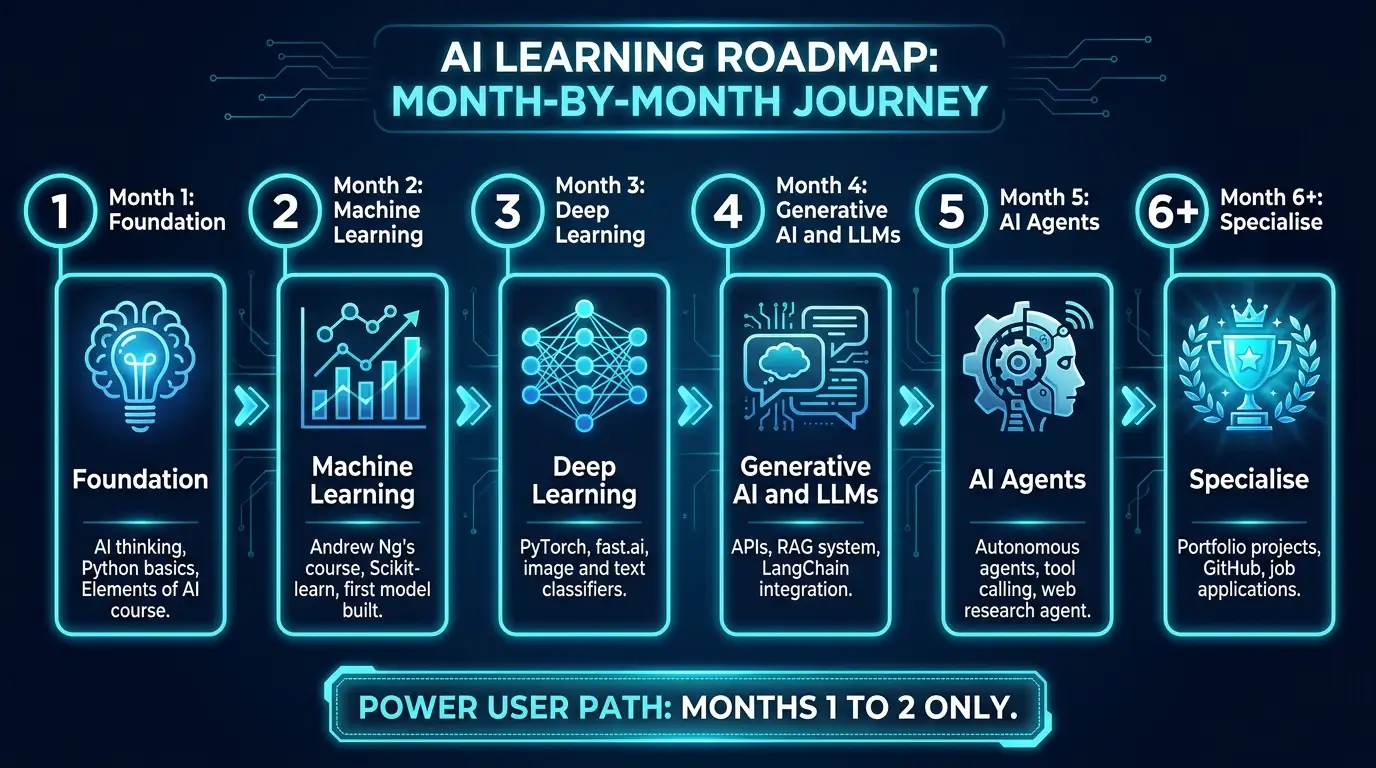
2026. Power Users can stop at Month 2 and immediately
apply their
The Best Free Resources to Learn AI in 2026
Every resource you need to go from zero to job-ready in AI is available for free in 2026. Budget is not a barrier to learning AI unless you choose to make it one. Here are the highest-quality free resources at each stage of the learning journey, verified and recommended by experienced AI practitioners.
Free Courses for AI Beginners
- Elements of AI (University of Helsinki) — A 20 to 30 hour no-code introduction rated 4.8 out of 5. The best starting point for anyone regardless of background
- Machine Learning Specialization (Andrew Ng, Coursera) — The most respected free ML theory resource. Audit for free or pay for the certificate. Covers every essential ML concept clearly
- fast.ai Practical Deep Learning for Coders — The best practical deep learning course available for free. Top-down approach builds working models immediately
- Hugging Face NLP Course — Free, practical, focused on transformer models and natural language processing. Directly applicable to real generative AI development
- Google’s Machine Learning Crash Course — A fast-paced free introduction to machine learning from one of the world’s leading AI organisations
Free Tools and Practice Environments
- Google Colab — A free cloud-based Jupyter notebook environment with GPU access. Removes the need to set up a local development environment and lets you start building immediately
- Kaggle — Free datasets, notebooks, and competitions for data science and machine learning. Reading other users’ notebooks teaches you more than most courses
- Hugging Face — The GitHub of AI models. Free access to thousands of pre-trained models and datasets with a rapidly growing community
- GitHub — Host your portfolio projects for free. Essential for sharing your work with potential employers
- LangChain Documentation — Free, comprehensive, and the starting point for building AI agents and applications with LLMs
Free Learning Communities
- Kaggle Forums — Active community of data scientists and ML practitioners sharing notebooks, solutions, and advice
- Hugging Face Discord — Fast-moving community focused on open-source AI development
- r/MachineLearning and r/learnmachinelearning on Reddit — Active communities covering everything from beginner questions to research paper discussions
- Twitter and LinkedIn AI communities — Follow AI practitioners, researchers, and educators who share real-world insights and learning resources daily
For a structured compilation of the best free and paid AI learning resources available in 2026, read the complete guide at
AI Weekly’s complete guide to learning AI in 2026
which covers resources from beginner to advanced level with detailed explanations of what each one offers.
What Skills Do You Actually Need to Learn AI
One of the most common myths about learning AI is that you need advanced mathematics before you can begin. That was true in 2015 when most AI work happened in academic research labs. It is no longer true in 2026. Modern AI development, especially on the Builder path, starts with building real projects and layers in mathematical theory as it becomes relevant rather than as a prerequisite.
Essential Skills for AI Power Users
AI Power Users need exactly zero technical prerequisites. The skills you develop on this path include clear communication for prompt writing, critical thinking to evaluate AI outputs accurately, familiarity with the major AI tools and their strengths and weaknesses, and workflow design to automate repetitive tasks using no-code tools. All of these are learnable by anyone regardless of educational or professional background.
Essential Skills for AI Builders
The core technical skills for AI building in 2026 are Python programming, data handling, and machine learning fundamentals. Beyond those core skills, the specific skills you need depend on your chosen specialisation.
For AI engineering roles, the priority skills are API integration, prompt engineering, RAG system design, agent framework implementation, and production deployment using cloud platforms like AWS, Google Cloud, or Azure. For machine learning engineering roles, the priority skills are model training, MLOps pipelines, model evaluation and monitoring, and large-scale data processing.
Mathematics for AI builders in 2026 means the following: basic statistics (averages, distributions, probability), linear algebra fundamentals (vectors and matrices), and a conceptual understanding of calculus (gradient descent). You do not need to derive equations from scratch. You need to understand what these concepts mean so you can diagnose problems in your models and understand why they behave the way they do.
Soft Skills That Separate Good AI Practitioners from Great Ones
The AI practitioners who advance fastest combine technical skills with strong communication, problem decomposition, and intellectual curiosity. AI systems require clear problem definition before any technical work can begin. If you cannot articulate exactly what problem you are solving and what success looks like, no technical skill will compensate for that gap. Employers consistently report that their hardest-to-find AI talent combines deep technical knowledge with the ability to communicate findings clearly to non-technical stakeholders.
AI Career Paths and Salaries You Can Realistically Target in 2026
The AI job market in 2026 is the strongest it has been at any point in the field’s history. AI startups attracted 33 percent of all venture capital funding in Q1 2026 alone. Every major employer across every industry is hiring people with AI skills, and the gap between supply and demand for qualified practitioners is growing wider every quarter.
AI Career Roles and Their Salaries
- AI Engineer — Builds production applications using AI APIs, agent frameworks, and LLM integrations. This is the highest-demand role in 2026. Median salary in the US: $150,000 to $200,000
- Machine Learning Engineer — Trains, optimises, and deploys ML models at scale. Requires deeper understanding of model architecture and MLOps. Median salary: $160,000 to $220,000
- Data Scientist — Analyses data, builds predictive models, and extracts business insights. The most established AI-adjacent role. Median salary: $130,000 to $180,000
- Prompt Engineer — Designs and optimises prompts for AI systems. A newer role that is increasingly valued in enterprise AI deployments. Median salary: $100,000 to $150,000
- AI Product Manager — Defines and manages AI product roadmaps. Requires understanding of AI capabilities and limitations without necessarily writing code. Median salary: $140,000 to $190,000
Outside the United States, AI salaries vary significantly by region but are consistently above the market average for software roles in every major technology hub including the United Kingdom, Germany, Canada, Australia, Singapore, and India. Remote roles in AI often pay US-equivalent salaries to practitioners located anywhere in the world, making this a uniquely geographically flexible career path.
The comprehensive AI career salary data and role breakdown from the Syracuse University iSchool at
Syracuse University’s guide to how to learn AI in 2026
provides additional context on career trajectories and the skills most valued by hiring managers across different AI roles.
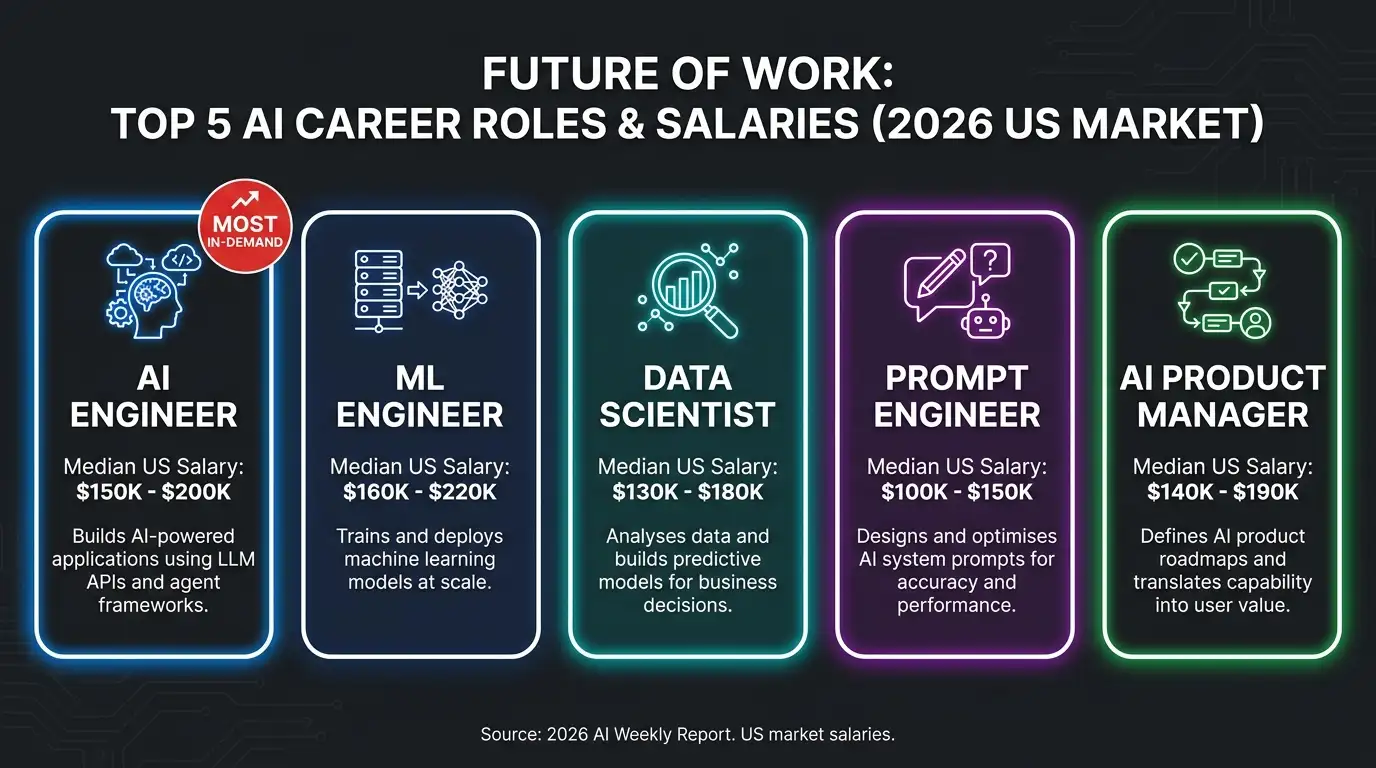
roles requiring deep programming expertise to product
and prompt roles accessible without coding backgrounds.
AI Engineer is the most in-demand title, with median
salaries reaching $200,000 in the United States
Common Mistakes Beginners Make When They Learn AI
Most people who start to learn AI give up within the first sixty days. The reasons are consistent and predictable, which means they are also avoidable. Understanding these mistakes before you start keeps you in the small percentage of beginners who finish what they started.
Starting Without a Clear Goal
Starting to learn AI without knowing why you are learning it or what you plan to do with it is the fastest route to confusion and abandonment. Decide before you begin: are you a Power User, a Builder, or a Researcher? What specific outcome do you want to achieve in six months? Write it down. Every resource choice, time investment, and project decision becomes dramatically easier when you have a specific destination in mind.
Jumping Between Resources Without Finishing Anything
Tutorial hopping is the single biggest time-waster in AI learning. Beginners start a YouTube course, switch to a Coursera specialisation, then a paid bootcamp, then a free blog series, finishing nothing and retaining fragments from each. Pick one structured resource for each stage of the roadmap and complete it before moving to the next. Finishing one imperfect course beats starting ten perfect ones.
Focusing Only on Tools Without Building Understanding
Using AI tools effectively is valuable. Understanding why they behave the way they do is what separates practitioners from users. Beginners who learn only to use ChatGPT or run pre-built notebooks hit a ceiling quickly when they encounter a problem the tool cannot solve out of the box. Build a conceptual understanding of machine learning alongside your tool usage and you give yourself the foundation to adapt to every new tool that emerges rather than having to relearn from scratch each time.
Waiting Until You Feel Ready Before Building
Most people who successfully learned AI in 2026 started building before they felt ready. They built bad models, wrote messy code, produced projects with embarrassing errors, and improved through the process of doing rather than through the process of watching more videos about doing. In AI, building bad things teaches you more than watching good explanations of building better things. Start building in month one, not month six.
Frequently Asked Questions About How to Learn AI
How long does it take to learn AI
The timeline depends entirely on your learning path and goal. Power Users who want to use AI tools more effectively can build useful skills in two to four weeks of focused practice. Builders who want to become AI engineers typically need six to twelve months of consistent study before they are competitive for entry-level roles. Researchers pursuing academic AI typically need a graduate degree spanning two to five years. Consistency matters far more than speed. Thirty minutes daily produces better results than marathon study sessions once a week.
Can I learn AI without knowing how to code
Yes, but it depends on your goal. The Power User path requires zero coding knowledge and delivers real value immediately. The Builder path requires Python programming as its foundational skill. Python is the most beginner-friendly programming language in existence and millions of people with no prior programming experience have learned it successfully as their first language. You do not need to learn programming before starting your AI journey. You can start with the Power User path and add Python skills incrementally as your interest in building grows.
Do I need a degree to get an AI job in 2026
No. A strong portfolio of real AI projects demonstrates competency more effectively than a degree alone in the current hiring market. Several of the most respected AI practitioners and engineers in 2026 came from non-computer science backgrounds including marketing, biology, economics, and education. Employers want to see that you can build real things, understand what you built, and communicate your decisions clearly. A GitHub portfolio with three strong projects and a clear explanation of your technical choices achieves this more convincingly than most academic credentials.
What is the best free resource to learn AI for beginners
The Elements of AI course from the University of Helsinki is the best starting point for absolute beginners regardless of background. It takes 20 to 30 hours, requires no code, and builds a clear conceptual foundation. After completing it, follow with Andrew Ng’s Machine Learning Specialization on Coursera for the Builder path, or move directly to practising AI tools for the Power User path. Both are available free of charge.
How do I switch careers to AI from a non-technical background
Start on the Power User path immediately to build confidence and demonstrate value in your current role using AI tools. Simultaneously begin learning Python on the side. After three to six months of consistent practice, transition to the full Builder roadmap. Many successful career switchers used their domain expertise from their previous field as a differentiator, building AI applications in healthcare, legal, finance, or marketing that specialists from those fields are uniquely positioned to understand and sell. Your existing expertise is an asset, not an obstacle.
What is the difference between machine learning and generative AI
Machine learning is the broader field that includes all approaches to teaching computers to learn from data including classification, regression, clustering, and recommendation systems. Generative AI is a specific and rapidly growing subset of machine learning focused on models that create new content including text, images, audio, and code. Learning machine learning fundamentals gives you the understanding to work with both traditional ML systems and generative AI applications, which is why the roadmap above covers machine learning before generative AI.
CONCLUSION
Now you have everything you need to begin your AI learning journey with clarity and confidence. You know how to learn AI in a structured, efficient way that matches your actual goal rather than following the scattered, overwhelming approach that causes most beginners to give up before they ever build anything useful.
Choose your path today. If you want to use AI tools more effectively starting this week, open the Elements of AI course and begin. If you want to become an AI engineer, open Python and write your first ten lines of code today. The gap between the people who thrive in the AI economy and those who fall behind is not talent, age, or educational background. It is the decision to start, made on a specific day, followed by consistent daily practice.
The resources are free. The community is enormous. The demand for people with AI skills has never been higher. There has never been a better moment in history to learn AI, and in twelve months from today, the only question is whether you will have started or whether you will still be researching where to begin.
Start today. Build something imperfect this week. Improve it next week. That is the entire secret to learning AI in 2026.
For the full month-by-month practical curriculum with specific project instructions and resource links at each stage, read the detailed learning guide at
Analytics Vidhya’s comprehensive guide to learning AI from scratch in 2026
which covers the complete Builder path in technical detail and includes recommended projects and portfolio-building strategies for each stage of the journey. For the latest data on AI salaries, job market demand, and hiring trends read the IBM machine learning resource hub at
IBM’s 2026 machine learning resource guide
which provides authoritative coverage of machine learning concepts, applications, and career opportunities updated continuously by IBM’s AI research teams.

Prince Anichi
Founder and Lead Technology Editor at Ortechy. Covering digital economy shifts, tech ecosystems across Africa, cybersecurity intelligence, and emerging software platforms.