Space-Based Data Centers Explained: Why Tech Giants Are Moving Computing Into Orbit in 2026
INTRODUCTION
What if the next great leap in computing doesn’t happen on Earth at all? What if the data centers that power your AI assistant, stream your content, store your files, and run the backbone of the global internet are not buried underground in Virginia or humming away in Iceland, but are instead orbiting the planet at 28,000 kilometers per hour, bathed in unlimited solar energy, 400 kilometers above your head?
That is no longer science fiction. In 2026, space-based data centers have become one of the fastest-moving frontiers in technology. Google has announced a moonshot called Project Suncatcher. SpaceX has filed plans with the FCC to launch up to one million satellites for distributed orbital computing. Blue Origin has submitted plans for a 51,600-satellite constellation called Project Sunrise. A Y Combinator-backed startup called Starcloud has already launched the first GPU into orbit, trained an AI model in space, and reached a $1.1 billion unicorn valuation after just 17 months. And chipmaker NVIDIA has launched a dedicated space computing business line.
This guide is the most complete, plain-language explanation of space-based data centers available in 2026. We cover what they are, how they work, why the world’s biggest tech companies are racing to build them, which companies are leading the charge, what the massive challenges are, and when — realistically — this technology will change your world.
What Are Space-Based Data Centers? A Clear Definition
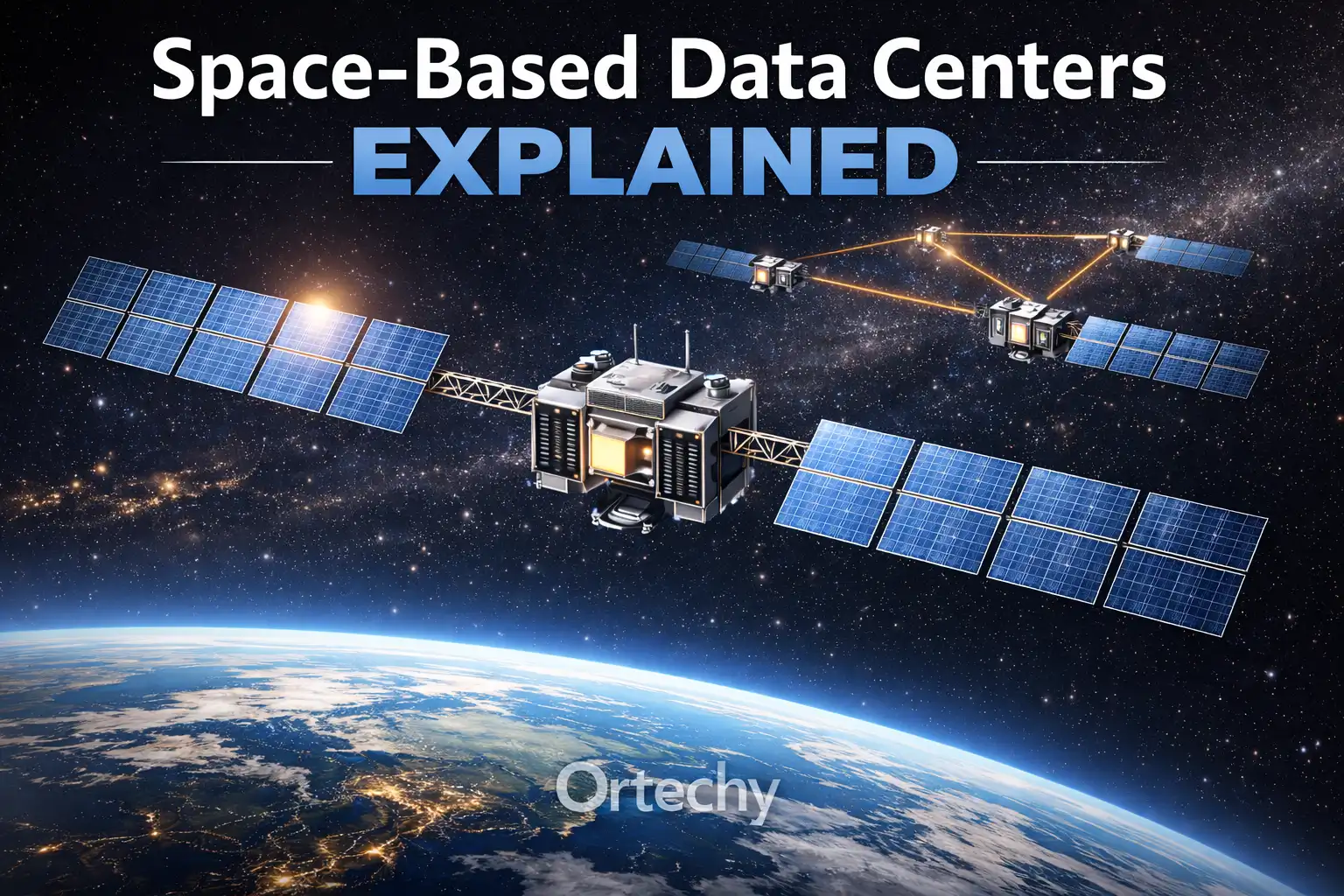
Space-based data centers also called orbital data centers or orbital AI infrastructure are computer processing facilities built into satellites or spacecraft and placed in Earth’s orbit. Instead of occupying massive buildings on the ground, these facilities house powerful computer chips, storage systems, and networking hardware inside purpose-built spacecraft that orbit the planet continuously.
The core concept is straightforward: take the computing hardware that normally sits in a building on Earth, put it on a satellite, launch it into orbit, and power it using direct solar energy. In the right orbit — particularly sun-synchronous orbit, where the satellite is constantly in sunlight, solar panels can generate almost continuous, free, renewable electricity. The result is a data center that requires no land, no grid connection, no power bills, and very little cooling infrastructure.
Unlike traditional data centers, which are built as enormous fixed facilities, orbital data centers are typically modular. Individual satellites carrying compute hardware can be linked together through high-speed optical laser communications into clusters that collectively function as a single processing system. Think of it as a distributed supercomputer that happens to be flying around the planet.
The concept of space-based cloud computing is not entirely new, military and government systems have used on-orbit data processing for decades but 2025 and 2026 mark the year that serious commercial investment, actual hardware launches, and billion-dollar company formations made it undeniably real.
Why Is Everyone Moving Computing Into Space? The Energy Crisis Driving It All
To understand why tech giants are suddenly racing to put data centers in orbit, you need to understand the single biggest constraint facing the AI industry right now: electricity.
Artificial intelligence — particularly the training and running of large language models like GPT, Gemini, and their successors — requires staggering amounts of computing power. And computing power requires electricity. A lot of it. AI-related electricity consumption is projected to grow 50% annually through 2030, and data centers with more than 25 gigawatts of power capacity are currently under construction in the United States alone, according to industry analysts.
The problem is that the global power grid is already struggling. Utilities in major tech hubs — Virginia, Texas, Ireland, Singapore — are warning that they cannot connect new data centers fast enough. Some regions have imposed moratoriums on new data center approvals. The land required for massive facilities is increasingly scarce and expensive. Water consumption for cooling is drawing regulatory scrutiny. And the carbon footprint of running billions of chips 24 hours a day is becoming a serious reputational and regulatory issue for tech companies.
Space solves all of these problems simultaneously — at least in theory. In orbit, solar energy is free, constant, and 36% more intense than on Earth’s surface (because there’s no atmosphere to absorb it). There’s no land to buy, no grid to connect to, no water to use for cooling. As Elon Musk put it at a March 2026 presentation: “You’re power constrained on Earth. Space has the advantage that it’s always sunny.”
Google’s analysis, published in a research paper, found that if launch costs drop to $200 per kilogram, the economics of space-based data centers could become comparable to Earth-based facilities when accounting for energy costs alone. For the world’s largest tech companies spending billions per year on electricity, that is an extraordinarily compelling proposition.
The Major Players: Who Is Building Orbital Data Centers in 2026?
The space computing race has attracted some of the biggest names and most ambitious projects in the history of technology. Here is a detailed look at each major player and what they are building right now.
Google — Project Suncatcher
Google announced Project Suncatcher in November 2025, calling it a “moonshot” to scale machine learning compute in space. The project envisions a network of solar-powered satellites equipped with Google’s own Tensor Processing Units (TPUs) — the custom AI chips Google designed specifically for machine learning workloads — connected to each other through high-speed optical laser communication links.
Google’s initial concept involves clusters of up to 81 satellites flying in tight formation within a 1-kilometer radius, functioning collectively as a single AI supercomputer. In partnership with Planet Labs, Google plans to launch two prototype spacecraft by early 2027 to test TPU performance in orbit, validate heat management, and test the high-bandwidth intersatellite laser links. Google CEO Sundar Pichai said of orbital data centers: “There’s no doubt to me that, a decade or so away, we’ll be viewing it as a more normal way to build data centers.”
Read Google’s full announcement and technical research paper at
Google’s official Project Suncatcher announcement
and the detailed engineering paper at
Google Research’s space-based AI infrastructure design paper.
SpaceX / xAI — One Million Satellites for Distributed Compute
SpaceX — which recently merged with Elon Musk’s AI company xAI — filed plans with the FCC in January 2026 to launch up to one million satellites for distributed computing in orbit. Musk unveiled the first-generation “AI Sat Mini” spacecraft concept, featuring solar arrays spanning approximately 180 meters — larger than SpaceX’s own Starship rocket. The proposal leverages Starlink’s existing constellation as a communications backbone and SpaceX’s Starship megarocket as the launch vehicle. For detailed NPR coverage of Musk’s orbital data center vision, see
NPR’s in-depth report: Big Tech’s next move is to put data centers in space.
Blue Origin — Project Sunrise (51,600 Satellites)
Blue Origin, Jeff Bezos’s space company, filed an FCC application in March 2026 for permission to launch up to 51,600 satellites into low Earth orbit under a project called Project Sunrise. These compute satellites would interface with Blue Origin’s previously proposed TeraWave constellation — a ~5,000-satellite internet network — to provide the communications backbone for data transmission. Bezos has stated that orbital data centers could be cheaper than terrestrial facilities “in the next couple of decades.” Blue Origin’s New Glenn rocket, which entered operational service in 2025, provides vertical integration advantages similar to what gave SpaceX dominance in satellite communications. For more on Blue Origin’s orbital data center plans, read
TechCrunch’s coverage of Blue Origin entering the space data center market.
Starcloud — The First GPU in Orbit
While the tech giants are filing plans and publishing research papers, Starcloud (formerly Lumen Orbit) has already launched. This Y Combinator-backed startup launched the first satellite carrying an NVIDIA H100 GPU — the same data center-class chip used by hyperscalers on Earth — in November 2025. It became the first company to train an AI model in space and run a version of Google Gemini in orbit. In April 2026, Starcloud raised $170 million in a Series A led by Benchmark and EQT Ventures, valuing the company at $1.1 billion — one of the fastest unicorn achievements in startup history. The company’s long-term vision is a 5-gigawatt orbital data center spanning 4 kilometers in solar panel width. For the full funding story, visit
TechCrunch’s report on Starcloud’s $170 million Series A
and the technical breakdown on
NVIDIA’s official Starcloud blog.
Axiom Space — Orbital Data Centers on the Space Station
Axiom Space took a uniquely pragmatic approach: rather than waiting for future rockets, it deployed its first orbital data center unit — Data Center Unit-1 (AxDCU-1) — aboard the International Space Station in fall 2025, powered by Red Hat Device Edge software. Two full orbital data center nodes were then launched to low Earth orbit on January 11, 2026. Axiom plans to expand from kilowatts to megawatts of processing power as its commercial space station — Axiom Station — is assembled. For full technical details, see
Axiom Space’s official Orbital Data Center page.
Kepler Communications — The Largest Orbital Compute Cluster Today
As of April 2026, Kepler Communications of Canada operates the largest compute cluster currently in orbit — approximately 40 NVIDIA Orin edge processors across 10 operational satellites, all connected by laser communication links. The company has 18 customers and is growing rapidly. While smaller than the gigawatt-scale visions of SpaceX and Blue Origin, Kepler represents what is commercially operational today, not what is theoretically possible tomorrow. For the latest on Kepler’s business, see
TechCrunch’s report on Kepler’s orbital compute cluster going live.
NVIDIA — Bringing Space Computing to the Mainstream
In March 2026, NVIDIA officially launched a dedicated space computing business line, bringing its accelerated computing platforms — including the Jetson Orin and IGX Thor — to orbital data centers, geospatial intelligence, and autonomous space operations. NVIDIA’s involvement is a watershed moment: it signals that space computing has moved from being a niche experiment to a mainstream commercial market that the world’s most important chip company is investing in seriously. Read the official announcement at
NVIDIA’s official space computing announcement.
How Do Space-Based Data Centers Actually Work?
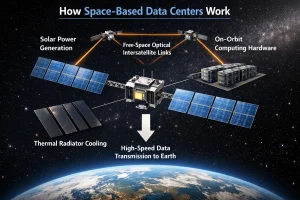
Understanding orbital AI infrastructure requires looking at the four core engineering systems that make it function: power generation, computing hardware, thermal management, and communications.
Power: Unlimited, Free Solar Energy
In sun-synchronous orbit, a satellite can be positioned so it is in near-constant sunlight. Solar panels in orbit receive approximately 36% more solar energy than equivalent panels on Earth’s surface, because there is no atmosphere to absorb and scatter sunlight. A large orbital data center could theoretically generate gigawatts of power from solar arrays alone — with no fuel costs, no grid fees, and no carbon emissions beyond the launch itself.
Computing: The Same GPUs and TPUs Used on Earth
The most significant recent breakthrough is the discovery that standard terrestrial computing chips — the same NVIDIA H100 GPUs used in Earth-based data centers — can survive and operate in low Earth orbit. Starcloud’s November 2025 launch proved this at scale. The radiation environment of LEO is harsh, but manageable with appropriate shielding and error correction. Google’s radiation testing found that its Trillium-generation TPUs “survived without damage when tested in a particle accelerator to simulate low-earth orbit levels of radiation.”
Cooling: The Vacuum Problem
This is one of the most underappreciated engineering challenges of space-based computing. On Earth, data centers cool their chips using air conditioning, water, or liquid cooling systems. In space, there is no air and no water. Heat can only be removed by radiation — essentially, by building large flat panels that radiate heat away as infrared energy into the cold of space. Designing passive radiators large enough to dissipate the heat from thousands of high-powered chips, without adding too much weight or surface area, is one of the central engineering problems of orbital data centers. Starcloud’s proposed 5-gigawatt facility would require radiator panels as large as its solar arrays — spanning kilometers.
Communications: Laser Links at the Speed of Light
Getting data in and out of an orbital data center — and between individual satellites in a cluster — requires high-bandwidth communication systems. Most leading projects are developing Free-Space Optical (FSO) links, also called laser intersatellite links, which use tightly focused laser beams to transmit data between spacecraft at the speed of light. These links can achieve data rates of hundreds of gigabits per second. However, they require extremely precise pointing between satellites, which in turn requires advanced formation-flying orbital mechanics to keep spacecraft in precisely defined positions relative to each other.
The Challenges: Why Space-Based Data Centers Are Not Coming Tomorrow
For all the excitement around orbital data centers, it is essential to be honest about the formidable obstacles that stand between today’s prototypes and the gigawatt-scale space computing facilities that tech companies are envisioning. These are real, serious engineering and economic challenges — not minor inconveniences.
Launch Costs Are Still Too High
This is the single biggest barrier. Getting hardware into orbit currently costs approximately $1,000 per kilogram. Google’s analysis shows that costs would need to fall to $200 per kilogram before space data centers become economically competitive with terrestrial facilities. SpaceX’s Starship rocket — which has a potential payload of 100+ metric tons to low Earth orbit — is the primary hope for achieving those costs, but Starship is still in development and won’t be flying at high commercial cadence until the late 2020s at the earliest. Most industry experts expect full cost-competitiveness not before 2030–2035.
Maintenance Is Nearly Impossible
On Earth, data center workers are “on-site every single day,” according to Raul Martynek, CEO of DataBank, which operates 75 terrestrial data centers. Hardware fails. Chips need to be replaced. Software needs updating in person. In space, you cannot send a technician to swap a failed GPU. On-Orbit Servicing (OOS) technologies are being developed, but they are still in early stages. This means orbital data centers must either be designed as completely disposable (and re-launched when obsolete) or be engineered for extraordinary reliability with extensive redundancy — both of which dramatically increase cost.
Space Debris and Orbital Congestion
With SpaceX alone proposing a million satellites, Blue Origin proposing 51,600, and Starcloud proposing 60,000, the question of orbital congestion and space debris becomes acute. Low Earth orbit is already becoming crowded. Adding hundreds of thousands of new satellites dramatically increases the probability of collisions, which can generate debris clouds that endanger other satellites. International regulatory frameworks for managing orbital slots and debris mitigation are lagging far behind the pace of commercial ambition.
Radiation Damage
Low Earth orbit is a harsh radiation environment. High-energy particles — from solar flares and the Van Allen belts — can flip bits in memory chips, cause errors in processing, and degrade hardware over time. While early tests suggest that terrestrial chips like NVIDIA’s H100 can survive LEO radiation, long-term radiation hardening of dense computing hardware at scale remains an unresolved engineering challenge. As Starcloud CEO Philip Johnston candidly noted, “An H100 is probably not the best chip for space, to be honest.”
Latency
Even moving at the speed of light, the round-trip signal delay between Earth and a low Earth orbit satellite is 5–20 milliseconds — manageable for many applications but problematic for latency-sensitive workloads. For real-time applications requiring sub-millisecond response times, orbital data centers introduce a fundamental physical delay that cannot be engineered away. This limits their suitability to workloads where latency is less critical, such as AI model training, batch inference, and large-scale data analysis.
For a comprehensive look at the challenges facing this technology, see the excellent Wikipedia overview at
Space-based data center — Wikipedia
and the Dassault Systèmes technical analysis at
Dassault Systèmes: Why data centers are moving to space.
What Types of Workloads Will Space-Based Data Centers Handle?
Not all computing tasks are equally well-suited to orbital AI infrastructure. Industry experts generally divide the workload landscape into categories based on latency requirements, data volume, and proximity to data sources.
AI model training is the most discussed use case and arguably the best fit. Training large AI models takes days or weeks, involves enormous amounts of computation, and is not latency-sensitive — you simply need processing power and electricity, both of which space provides abundantly. Starcloud’s first satellite already demonstrated AI training in orbit using an H100 GPU.
Earth observation and satellite imagery processing is another ideal workload. Remote sensing satellites generate enormous amounts of raw data — up to 10 gigabytes per second in the case of synthetic aperture radar (SAR) systems. Processing this data on-orbit rather than sending all of it to Earth dramatically reduces bandwidth requirements and enables near-real-time insights. This is one of the clearest near-term commercial applications of space-based edge computing.
Sovereign and secure cloud storage is a third category gaining attention. Lonestar Data Holdings is pioneering lunar-orbit data storage specifically marketed as sovereign, jurisdiction-independent storage — appealing to governments and organizations that want data that is physically beyond the reach of any nation’s legal system.
What orbital data centers will NOT replace — at least not in this decade — are the real-time, latency-sensitive workloads that require millisecond responses: high-frequency financial trading, real-time video streaming, interactive applications, and autonomous vehicle decision-making. These workloads will continue to require terrestrial, edge-located computing infrastructure for the foreseeable future.
The Environmental Argument: Are Space Data Centers Actually Greener?
One of the most compelling arguments for space-based data centers is environmental sustainability — but the reality is more complex than the marketing suggests.
The case for greener orbital computing is real: once in orbit, a solar-powered data center produces zero carbon emissions in its operations. No fossil fuel electricity, no massive cooling water consumption, no land use. Starcloud’s CEO has claimed that over the lifetime of an orbital data center, the carbon savings relative to a terrestrial facility could be as much as 10 times, even accounting for launch emissions. Google’s November 2025 research paper on space data centers highlighted the environmental benefits as a primary motivation for Project Suncatcher.
However, the environmental case is not airtight. Every rocket launch consumes significant propellant and generates carbon, soot, and chemical emissions. Replacing millions of tons of computing hardware every few years — because orbital hardware has limited lifespans and cannot be easily repaired — generates enormous e-waste that cannot be recycled. And the space debris generated by large constellations adds to an increasingly polluted orbital environment. A Nature Electronics paper published in October 2025 warned that the development of carbon-neutral data centres in space requires careful lifecycle analysis and international governance to avoid simply moving environmental damage from Earth to orbit.
Frequently Asked Questions About Space-Based Data Centers
When will space-based data centers be commercially available?
Small-scale orbital compute is commercially available right now, through companies like Kepler Communications and Starcloud. However, large-scale data centers competitive with terrestrial hyperscale facilities are not expected until the 2030s at the earliest, dependent primarily on the commercial viability and launch cadence of SpaceX’s Starship rocket driving down launch costs to ~$200/kg.
Which companies are leading in orbital data centers?
Google (Project Suncatcher), SpaceX/xAI, Blue Origin (Project Sunrise), Starcloud, Axiom Space, and Kepler Communications are the primary players as of 2026. NVIDIA’s entry into space computing as a hardware supplier is also a major industry milestone. For the most up-to-date competitive landscape, see the full overview at
RackSolutions: Are data centers headed to space?
Why is power the main reason for moving data centers to space?
AI computing’s energy demands are growing at 50% per year, outpacing the grid’s ability to supply power in major tech hubs. Space provides unlimited, free, continuous solar energy with zero fuel costs or carbon emissions. Once launch costs fall sufficiently, the energy economics of space become highly competitive with — and potentially better than — terrestrial data centers.
What is Google Project Suncatcher?
Google Project Suncatcher is a research moonshot announced in November 2025 to explore scaling machine learning compute in space using constellations of solar-powered satellites carrying Google’s custom TPU AI chips, connected by free-space optical laser links. Two prototype satellites are planned for launch by early 2027 in partnership with Planet Labs. Full details at
Google’s official Project Suncatcher page.
Will space data centers replace Earth-based data centers?
No — at least not in the foreseeable future. Even the most optimistic projections see orbital data centers complementing rather than replacing terrestrial facilities. Latency-sensitive workloads, real-time applications, and the sheer scale of existing terrestrial infrastructure mean Earth-based data centers will remain dominant for decades. As one Dassault Systèmes expert summarized: “A space-based data center would need a backup.” The future is hybrid — a combination of orbital and ground-based computing working together.
CONCLUSION
The Orbital Computing Revolution Is Just Beginning
Space-based data centers explained in a single sentence: they are the tech industry’s answer to an electricity crisis that is threatening to become the defining bottleneck of the AI age. When the most powerful companies in the world — Google, SpaceX, Blue Origin, and NVIDIA — are all simultaneously racing to move computing into orbit, that is not a coincidence or a fad. It is a response to a fundamental physical constraint, and it represents one of the most ambitious engineering endeavors in human history.
The technology is real. The hardware has launched. The first AI models have been trained in space. A startup has already achieved unicorn status on the promise of orbital AI infrastructure. The world’s largest tech companies have filed plans with regulators for millions of satellites. And the economics — while not yet competitive at scale — have a clear path to viability as launch costs fall through the 2030s.
What was once confined to military strategy papers and university research proposals is now the subject of billion-dollar investments, FCC filings, rocket launches, and announcements from the world’s most valuable companies. The era of space-based cloud computing has begun — and over the next decade, it will reshape what is physically possible in computing, artificial intelligence, and the digital economy.
Did this guide on space-based data centers give you a clearer picture of where computing is headed? Share it with anyone who wants to understand the next frontier of tech — and drop a comment below telling us which project excites you most: Google’s Project Suncatcher, SpaceX’s million-satellite vision, or something else entirely.
For ongoing coverage of orbital data centers and space computing technology, follow
SpaceNews,
Data Center Dynamics,
and
TechCrunch’s space computing coverage
— the three best sources for breaking news and analysis in this rapidly evolving field.