In this article19 sections
- 01.What Are Cloud Phones and How Do They Work
- 02.The Evolution: From Social Media Farms to Financial Crime Infrastructure
- 03.How Cybercriminals Use Cloud Phones for Financial Fraud in 2026
- ↳1. Creating and Trading Verified Fake Accounts
- ↳2. Authorised Push Payment Fraud
- ↳3. Money Mule Account Management
- ↳4. Credential Stuffing at Mobile Scale
- ↳5. Social Engineering Support Infrastructure
- 04.Why Cloud Phones Are So Difficult for Security Systems to Detect
- 05.The Scale of the Threat: Numbers That Demand Attention
- 06.How Financial Institutions Are Responding
- 07.What Individuals Can Do to Protect Themselves
- 08.Frequently Asked Questions About Cloud Phone Cybercrime
- ↳What is a cloud phone in cybersecurity?
- ↳Why can’t banks detect cloud phone fraud?
- ↳How much does it cost criminals to use cloud phones for fraud?
- ↳Are cloud phones illegal?
- ↳What is the best protection against cloud phone financial fraud?
- 09.Cloud Phones Have Changed the Fraud Landscape Permanently
Cloud Phones: The New Secret Weapon of Cybercriminals in 2026
A new and deeply troubling tool has entered the cybercriminal arsenal and most fraud detection systems cannot see it coming. Cloud phones are remote-access Android devices hosted in data centres, accessible from anywhere in the world through a simple internet connection, and capable of running real banking apps, financial platforms, and social media accounts while appearing to every security system as a completely legitimate smartphone.
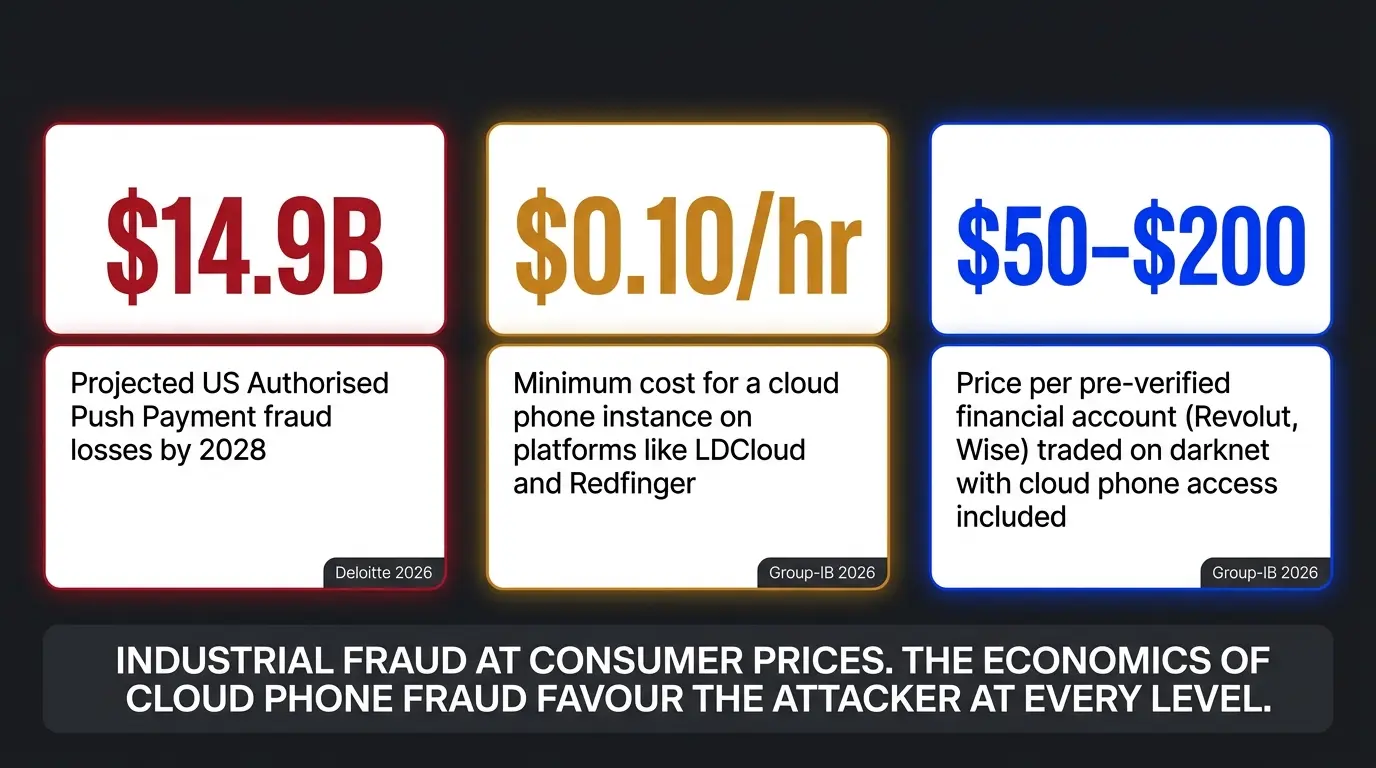
The Group-IB High-Tech Crime Trends Report 2026 identified cloud phones as one of the most significant emerging threats in financial fraud, describing how this technology has moved from social media automation into industrial-scale financial crime that is largely invisible to modern detection systems. Major cloud phone platforms including LDCloud, Redfinger, and GeeLark offer device rentals for as little as $0.10 to $0.50 per hour. That price point puts sophisticated fraud infrastructure within reach of anyone with minimal capital investment and basic technical knowledge.
This article explains exactly what cloud phones are, how criminals use them to bypass fraud detection, why they are so difficult to stop, and what financial institutions and individuals can do to protect themselves against this rapidly growing threat.
What Are Cloud Phones and How Do They Work
A cloud phone is a virtual Android device that runs a real mobile operating system and real hardware components inside a data centre server, but is accessed and controlled entirely through the internet. The key word here is real. Cloud phones are not emulators that simulate a mobile environment in software the way BlueStacks does on a desktop computer. They run actual Android operating systems with genuine hardware profiles, real sensor data, real device fingerprints, and real behavioural signals that are indistinguishable from a physical smartphone sitting in someone’s hand.
When you access a cloud phone, you see the phone screen in your browser or app. You tap, swipe, type, and interact with it exactly as you would a physical device. The cloud phone executes every action in a real Android environment on a physical server chip. Any app you install on it, including banking apps, payment platforms, and social media services, behaves exactly as it would on a real smartphone because it is running on real smartphone hardware, just hosted remotely.
This is the property that makes cloud phones simultaneously valuable as a legitimate productivity tool and devastating as a fraud weapon. The legitimate use cases are real and widespread. Businesses use cloud phones to manage multiple social media accounts, test mobile apps across many device configurations, run mobile automation workflows, and access region-locked services. These are legal, commercially useful applications that have driven the growth of cloud phone platforms into a significant commercial market.
But the same properties that make cloud phones useful for legitimate businesses make them the perfect fraud infrastructure. As Infosecurity Magazine’s March 2026 report on cloud phones and financial fraud confirmed: because cloud phones behave like legitimate smartphones, fraud detection systems often cannot distinguish them from real user devices. This makes them significantly more difficult to detect than the traditional emulators and virtual devices previously used in fraud schemes.
The Evolution: From Social Media Farms to Financial Crime Infrastructure
Cloud phones did not begin as criminal infrastructure. Understanding how they arrived at their current role in organised financial fraud requires tracing a decade-long evolution that mirrors how cybercrime adapts and advances when defenders improve their defences.
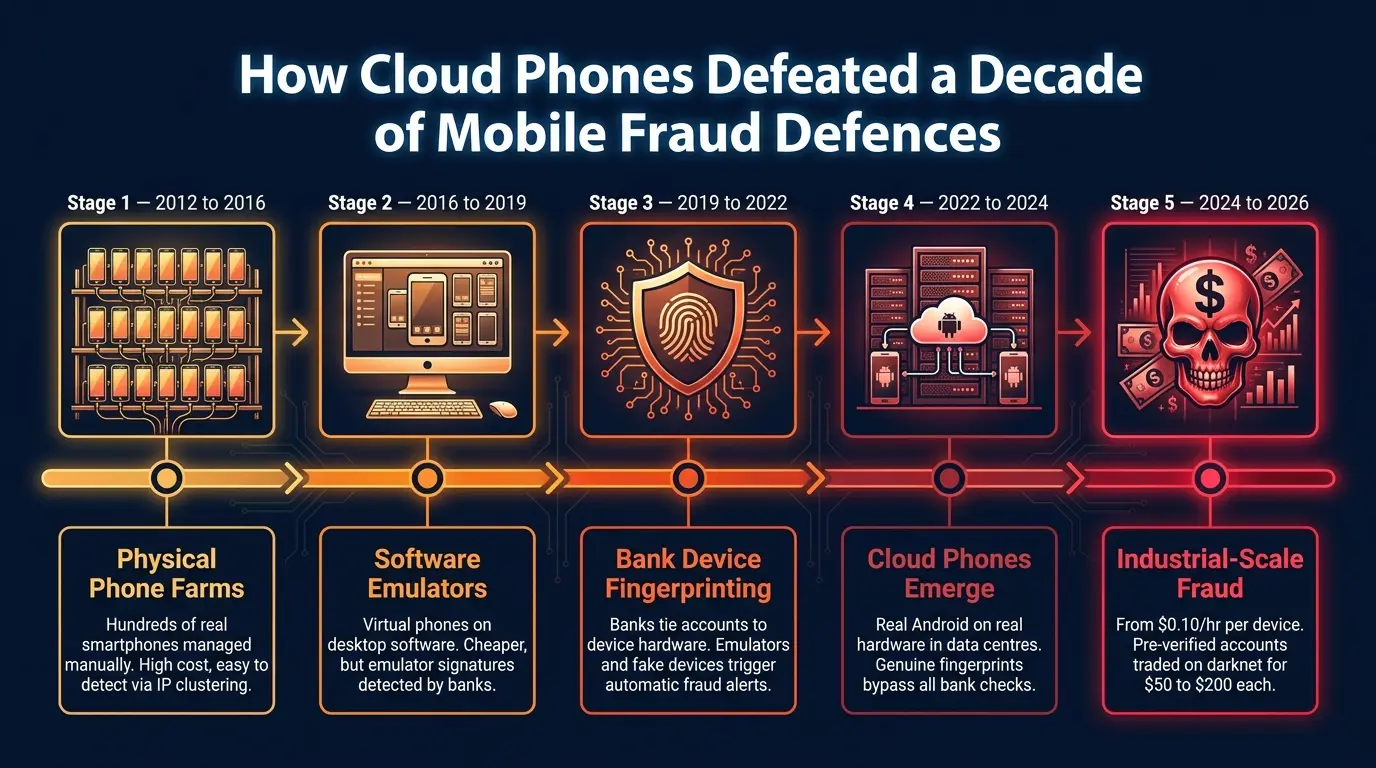
The story starts with social media engagement farms in the early 2010s. Operators used large arrays of physical smartphones to manage hundreds of fake social media accounts simultaneously, inflating follower counts, likes, and engagement metrics for clients willing to pay. The work was manual, expensive in hardware terms, and easy to detect through IP analysis and device consistency checks.
The transition to emulators came next. Emulators allowed operators to run many virtual phone instances on a single computer, dramatically reducing hardware costs and enabling even larger account farms. Banks and social media platforms responded by implementing device fingerprinting, tying accounts to specific hardware signatures including device model, brand, hardware identifiers, IP address, time zone, sensor data, and behavioural signals. A device with a different fingerprint attempting to access an account triggered automatic fraud alerts.
Cloud phones defeated this defence entirely. By running real Android operating systems on real hardware in data centres, cloud phones generate genuine, consistent device fingerprints that pass every check banks and platforms use to distinguish real devices from fakes. As TechRadar’s in-depth investigation into cloud phone fraud explains, banks tied accounts to devices and spotted fraud by checking for device fingerprint changes, a detection method that cloud phones bypass by providing a consistent, legitimate-looking fingerprint every single time.
How Cybercriminals Use Cloud Phones for Financial Fraud in 2026
The cloud phone fraud playbook has become highly sophisticated and operationally efficient. Group-IB’s April 2026 research revealed the detailed mechanics of how criminal operations exploit this technology at scale.
1. Creating and Trading Verified Fake Accounts
The first stage of cloud phone fraud is account creation. Criminals use cloud phones to create accounts on financial platforms, digital banks, payment services, and cryptocurrency exchanges. Because the cloud phone presents as a genuine smartphone with a real device fingerprint, the account creation process passes every automated check the platform runs.
These pre-verified accounts become commodities. Darknet markets actively trade verified dropper accounts created on cloud phones, with Revolut and Wise accounts priced between $50 and $200 each, often including continued access to the specific cloud phone instance that created and aged the account. This is a significant operational detail: the buyer of the account also gets access to the cloud phone it was created on, ensuring that any future authentication checks pass the same device fingerprint the account was originally associated with.
2. Authorised Push Payment Fraud
Authorised push payment fraud is where cloud phones cause the most direct financial damage. APP fraud works by convincing a legitimate account holder to transfer money voluntarily to a criminal-controlled account. Once the victim sends the money, it moves through a chain of accounts before reaching the criminal, with cloud phones managing the intermediate accounts to ensure every transaction appears to originate from a legitimate device.
According to The Register’s reporting on cloud phone fraud in March 2026, citing Deloitte research, authorised push payment fraud losses in the United States are estimated to increase from $8.3 billion in 2024 to $14.9 billion by 2028. Cloud phones are a major driver of that growth because they allow fraudulent transfers to pass through banking fraud detection systems without triggering any alerts. To the bank’s fraud detection system, it appears to be the same device that has always accessed the account, with the same hardware fingerprint, the same behavioural signals, and the same geographic indicators. No alert fires. The money moves.
3. Money Mule Account Management
Money mule accounts are used to receive and rapidly redistribute stolen funds before financial institutions can freeze them. Managing dozens or hundreds of mule accounts simultaneously requires a device for each account that passes device fingerprint checks. Cloud phones solve this problem at low cost, allowing a single operator to manage a large network of mule accounts from a single internet connection without any of them triggering the device-sharing detection that would flag a traditional account farm.
4. Credential Stuffing at Mobile Scale
Credential stuffing attacks use stolen username and password combinations from data breaches to attempt logins across multiple platforms. Traditional credential stuffing is detectable through IP analysis and device fingerprint checks. Cloud phones provide a different genuine device fingerprint for each account being tested, dramatically reducing detection rates and making it possible to test stolen credentials against banking and payment apps in a mobile environment that bypasses desktop-focused detection systems.
5. Social Engineering Support Infrastructure
Cloud phones are also used as support infrastructure for vishing and social engineering operations. A criminal calling a victim while appearing to be a bank representative can use a cloud phone running the victim’s bank’s app to perform real-time account operations during the call, adding a layer of operational authenticity to social engineering attacks that makes them more convincing and more damaging.
Why Cloud Phones Are So Difficult for Security Systems to Detect
The core detection challenge with cloud phones comes down to a single property: they are real. Fraud detection systems are built around the assumption that fraudulent activity originates from devices that are somehow identifiably fake. Emulators have software tells. Virtual machines have detectable hypervisor signatures. Device farms using many physical phones are identifiable through shared IP addresses and behavioural patterns. Cloud phones have none of these tells.
A cloud phone generates a genuine hardware fingerprint because it runs on genuine hardware. It generates genuine sensor data because its sensors are real. It generates consistent behavioural patterns because the criminal operator who controls it can deliberately mimic the behaviours of a legitimate user over time. And because cloud phone platforms are also used by large numbers of legitimate businesses for app testing, social media management, and workflow automation, even the detection of cloud phone infrastructure itself does not reliably indicate fraud.
The challenge is compounded by the low cost and accessibility of the platforms. At $0.10 to $0.50 per hour, a criminal operation can afford to use dozens or hundreds of cloud phone instances simultaneously, rotate through them regularly, and abandon instances that begin to attract scrutiny. The economics of the attack massively favour the attacker: the infrastructure costs of running a cloud phone fraud operation are a tiny fraction of the proceeds it generates.
Group-IB’s research confirms that this technology has effectively industrialised financial fraud by removing the hardware constraints that previously limited the scale at which fraud could be operated. A single operator with a laptop and a modest budget can now manage fraud infrastructure at a scale that previously required physical phone farms worth tens of thousands of dollars and significant logistical overhead.
The Scale of the Threat: Numbers That Demand Attention
The financial damage from cloud phone-enabled fraud is already measured in billions and is growing rapidly. The specific numbers available from public research sources give a clear picture of the scale of this problem.
Authorised push payment fraud losses in the US are projected to grow from $8.3 billion in 2024 to $14.9 billion by 2028 according to Deloitte analysis cited in Group-IB’s report. Cloud phones are identified as a significant contributor to this growth trajectory because they specifically solve the detection problem that banking fraud systems have built around mobile device fingerprinting.
The darknet account trading market enabled by cloud phones runs at scale. Pre-verified accounts on platforms including Revolut, Wise, and various cryptocurrency exchanges change hands for $50 to $200 per account, with the cloud phone instance included. This market exists because the demand from criminal operations for clean, verified financial accounts consistently exceeds what can be created through other means.
The broader mobile fraud landscape provides context for how cloud phones fit into a growing crisis. Kaspersky data cited by Cybersecurity Intelligence’s analysis of mobile device threats shows that security products blocked 33.3 million attacks involving malware, adware, or unwanted mobile software in 2024, translating to an average of 2.8 million attacks per month. Cloud phone infrastructure enables a subset of these attacks to operate at a scale and with a detection evasion capability that was not previously achievable.
How Financial Institutions Are Responding
The financial services industry is actively developing new detection approaches as cloud phone fraud grows. The challenge is that every detection method must avoid false positives that would disrupt legitimate cloud phone use, which creates a narrow and technically demanding detection window.
Behavioural biometrics is one of the most promising detection approaches. Rather than relying on device fingerprints that cloud phones can replicate accurately, behavioural biometric systems analyse how a user interacts with their device: the pressure of their taps, the rhythm of their typing, the angle at which they hold the phone, the speed and pattern of their scrolling. These micro-behaviours are extraordinarily difficult to replicate artificially because they are tied to individual human motor patterns that develop over years of device use. A cloud phone operated by a criminal does not replicate the subtle behavioural signature of the account’s legitimate owner.
Network analysis is another developing approach. Cloud phone instances, even when they use different IP addresses, often connect from data centre IP ranges rather than consumer ISP ranges. Sophisticated fraud detection can flag logins from data centre infrastructure as elevated risk, particularly when combined with other signals. However, the use of residential proxy networks layered over cloud phones is an evolving countermeasure that criminals are already deploying to defeat this detection method.
Machine learning models trained on the specific behavioural patterns of cloud phone fraud operations are being developed by major financial institutions and cybersecurity vendors. Group-IB’s Fraud Intelligence platform is one example of this approach, providing intelligence-driven detection that identifies cloud phone infrastructure through pattern analysis across large volumes of transaction and authentication data.
What Individuals Can Do to Protect Themselves
Cloud phone fraud targets individuals primarily through the authorised push payment vector, which means the most important protection is awareness of how these scams work.
Never transfer money in response to an unexpected call, text, or email, even if the caller appears to know your account details, speaks with apparent authority, and creates urgency around an immediate threat to your account. Legitimate banks and financial institutions do not initiate contact asking you to transfer funds to a new account for security reasons. This scenario is always a scam, regardless of how convincing the caller sounds.
Enable transaction notifications on every financial account you hold so that any movement of funds triggers an immediate alert to your phone. If you receive an alert for a transaction you did not initiate, contact your bank immediately through their official number, not through any number provided by the person who called you.
Understand that cloud phone fraud specifically bypasses device-based security. This means that the device fingerprint protection that banks use to verify your account is not a reliable protection against cloud phone-enabled attacks that target your account through social engineering rather than direct compromise. Your first and most effective defence is refusing to initiate any transfer that was requested by someone who contacted you unexpectedly.
Use a dedicated, unique email address for each major financial platform you use. If criminals obtain your email address from a data breach, a unique email for each platform limits the damage by preventing them from using a single address to target your accounts across multiple services.
Frequently Asked Questions About Cloud Phone Cybercrime
What is a cloud phone in cybersecurity?
In cybersecurity, a cloud phone is a remote-access Android device hosted in a data centre that runs a real mobile operating system and genuine hardware components accessible through the internet. Unlike software emulators, cloud phones generate authentic device fingerprints that pass bank and platform security checks. Cybercriminals use them to create verified financial accounts, manage money mule networks, execute authorised push payment fraud, and bypass device-based fraud detection systems without triggering any alerts.
Why can’t banks detect cloud phone fraud?
Banks struggle to detect cloud phone fraud because cloud phones generate the same genuine hardware fingerprints, sensor data, and behavioural signals as legitimate smartphones. Fraud detection systems built around device fingerprinting cannot distinguish a cloud phone from a real device because the cloud phone is a real device, just hosted remotely. The account also consistently presents the same device fingerprint it was created with, which the bank interprets as a trusted, known device. Behavioural biometrics and network-level analysis are emerging as the most promising detection approaches but are not yet widely deployed at scale.
How much does it cost criminals to use cloud phones for fraud?
Cloud phone platforms charge as little as $0.10 to $0.50 per hour per device. This extremely low cost means criminal operations can afford to use dozens or hundreds of instances simultaneously, rotate through them regularly, and abandon any that begin to attract scrutiny. The low infrastructure cost relative to the potential fraud proceeds is what has driven the rapid adoption of cloud phones as fraud infrastructure across organised criminal groups globally.
Are cloud phones illegal?
Cloud phone platforms are legal commercial services with genuine legitimate use cases including mobile app testing, social media account management, workflow automation, and accessing region-locked services. The platforms themselves are not criminal infrastructure. What is illegal is using cloud phones to create fraudulent financial accounts, execute fraud, manage money mule networks, or conduct any other financially criminal activity. The legal challenge is that detecting criminal use on these platforms requires cooperation between cloud phone providers, financial institutions, and law enforcement agencies across multiple jurisdictions.
What is the best protection against cloud phone financial fraud?
The most reliable protection against cloud phone financial fraud is refusing to initiate any fund transfer requested by someone who contacted you unexpectedly, regardless of how convincing they sound or how much they appear to know about your account. Cloud phone fraud at the individual level primarily operates through social engineering that convinces victims to transfer money voluntarily. Technical security measures including transaction alerts, strong authentication, and unique email addresses per platform provide additional layers of defence but do not substitute for the awareness that any unexpected request to move money is a major red flag requiring independent verification.
Cloud Phones Have Changed the Fraud Landscape Permanently
Cloud phones represent a genuine inflection point in the economics of financial fraud. They have removed the hardware constraints that previously limited the scale of mobile fraud operations, defeated the device fingerprinting defences that banks spent years building and deploying, and created a commoditised fraud infrastructure that any criminal with $50 and an internet connection can access.
The Group-IB assessment that this technology has industrialised cybercrime is accurate and important. Industrial fraud operates at a scale, speed, and cost efficiency that individual detection measures and single-institution responses cannot match. Addressing the cloud phone threat requires coordinated action between cloud platform providers, financial institutions, payment networks, law enforcement, and regulators across multiple countries simultaneously.
For individuals, the most important takeaway is that the device-level security you rely on for your banking accounts is no longer sufficient to protect you against a fraud operation that has solved the device fingerprinting problem. Awareness of how authorised push payment fraud works, and the discipline to verify any unexpected financial request through an independently confirmed channel, is currently your most effective protection.
The full Group-IB research on cloud phone fraud infrastructure, including detailed technical analysis of the platforms being used and the fraud operations they enable, is available at Group-IB’s blog post on cloud phones as the invisible threat, which is the most comprehensive public-facing analysis of this emerging cybercrime trend currently available.

Prince Anichi
Founder and Lead Technology Editor at Ortechy. Covering digital economy shifts, tech ecosystems across Africa, cybersecurity intelligence, and emerging software platforms.