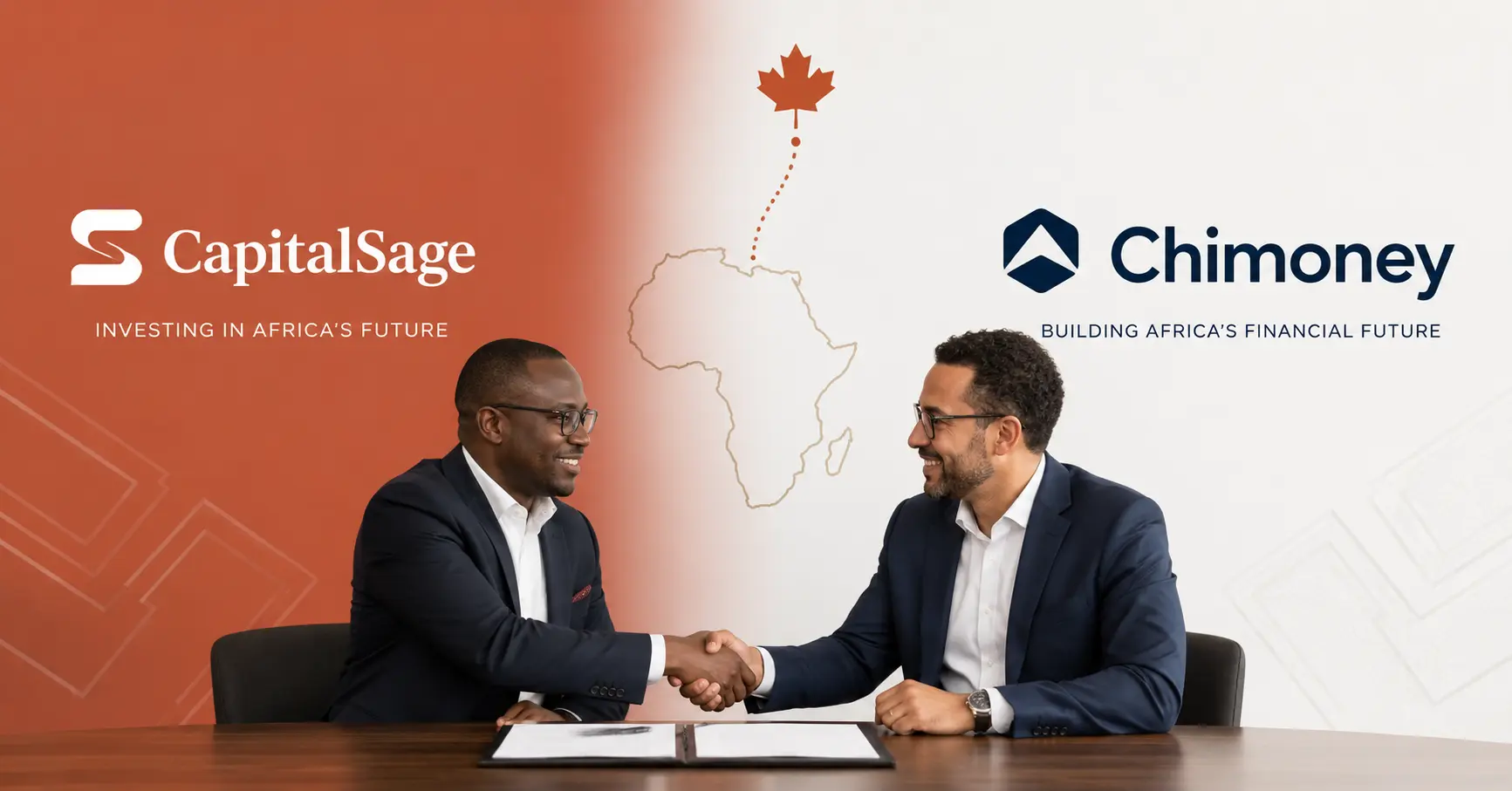
Toronto / Lagos, June 16, 2026 — Four weeks after publicly announcing its wind-down, Chimoney has a buyer. Chi Technologies Inc., the Canadian federal corporation that operates as Chimoney, has signed an agreement to be acquired by CapitalSage Vantage Limited, a subsidiary of the Nigeria-based CapitalSage Holdings, in a deal that preserves the startup’s Canadian Payment Service Provider (PSP) and Money Services Business (MSB) licences, repays every investor in full, and sets up a relaunch of the platform as cross-border payments infrastructure focused on the Africa–Canada corridor.
The acquisition was announced on June 16, 2026. Financial terms were not disclosed. The agreement was signed in person at OneEleven Innovation Hub in Toronto, where senior CapitalSage executives flew specifically to formalise the deal alongside a private gathering with Canadian business and financial services leaders as part of the group’s broader planned entry into the Canadian market.
How a Shutdown Post-Mortem Became the Acquisition Pitch
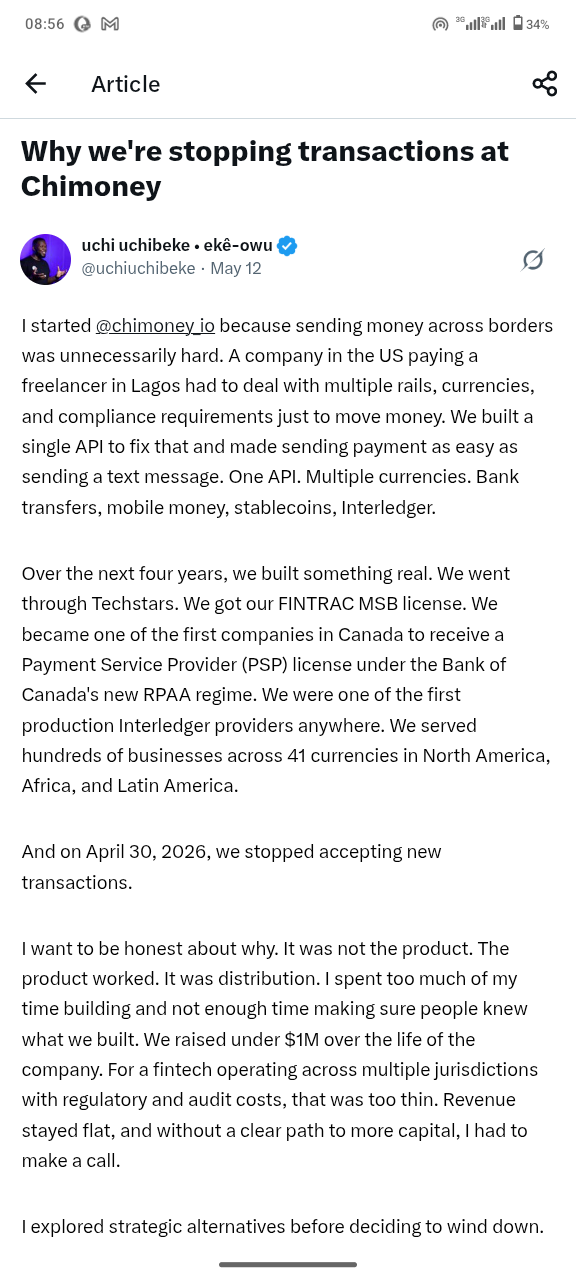
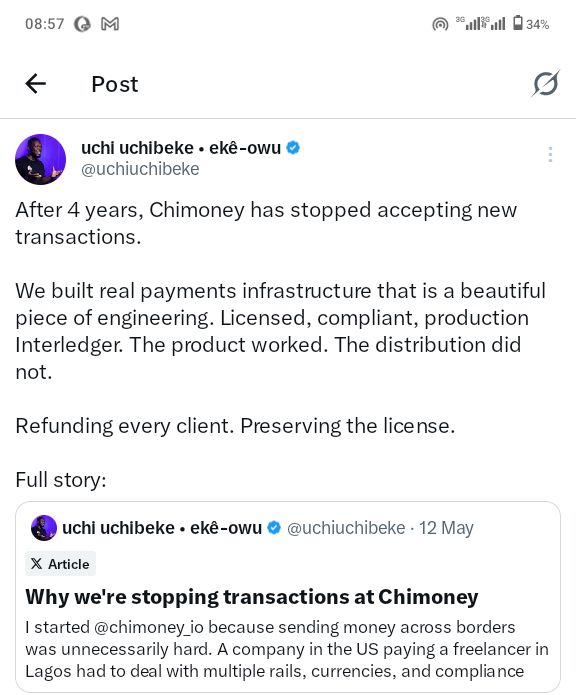
Chimoney stopped processing new transactions on April 30, 2026. Founder and CEO Uchi Uchibeke formally disclosed the closure on X on May 12, 2026, in a candid post-mortem that reached more than a dozen publications within days. TechCabal’s original shutdown report confirmed the core issue: Chimoney had raised less than $1 million in total funding across four years and could not sustain the capital demands of running a cross-border payments infrastructure business.
What Uchibeke said publicly in that post-mortem set the sequence that followed. “When I announced the wind-down in May, I told the truth about what went wrong,” he wrote on X. “The coverage reached over a dozen publications. Everyone used my framing. Within days, CapitalSage reached out. The wind-down became the pitch.”
In a separate statement issued with the acquisition announcement, Uchibeke was equally direct about what the business had and had not achieved. “When I announced the wind-down in May, I was honest about what went wrong,” he said. “We built real infrastructure but never solved distribution or liquidity.”
According to both companies, CapitalSage initiated discussions with Uchibeke shortly after the shutdown coverage went live. The parties moved from first contact to a signed agreement in under four weeks, a pace that reflects how clearly CapitalSage had identified what it was acquiring and why.
What Chimoney Built and Why the Infrastructure Retained Value
Chimoney was founded in 2022 with a specific thesis: that cross-border money movement should be as simple as sending a message. Through a single API (application programming interface), the platform enabled businesses to pay freelancers, vendors, and contractors across 41 currencies in Africa, North America, and Latin America. It supported bank transfers, mobile money, airtime top-ups, gift cards, stablecoin off-ramps, and Interledger-based payment rails, all from one integration point.
In 2023, Chimoney joined the Techstars Toronto accelerator programme. That same year it acquired Scrim, a social payments application. The company served hundreds of businesses and built what Uchibeke consistently described as a functioning product. The problem was never the technology.
“The product worked,” Uchibeke said in his May post-mortem. “It was distribution.”
What kept the corporate entity attractive after the commercial product stopped was a set of regulatory assets that are difficult and time-consuming to obtain independently. Chimoney’s PSP licence and its Retail Payment Activities Act (RPAA) registration, secured in November 2025, are among the first cohort issued under Canada’s new retail payments regime. That registration carries no expiration date. Uchibeke had deliberately preserved both licences under dormant status during the wind-down, a decision he described as commercially rational given how hard they are to replicate. The PSP licence, he told Technext, “is hard to get and will only get harder.”
Technext, which broke the original shutdown story and conducted the only direct interview with Uchibeke during the wind-down period, confirmed the acquisition after reviewing the official press release and receiving direct responses from the founder.
Who CapitalSage Is and What It Gets From This Deal
CapitalSage Holdings is a multinational conglomerate, not a fintech-first company. That context matters for understanding why this acquisition makes sense from its side of the table. The group operates across fintech, agribusiness, manufacturing, and healthcare in Nigeria, Kenya, the United Kingdom, the United Arab Emirates, and The Gambia. Its Group Managing Director and founder, John Adedamola Alamu, built the company from a microlending operation started with N100,000 in 2014 into a diversified group active across three continents.
The group’s CEO, Abiola Bawuah, brings a background that is specifically relevant to what Chimoney’s infrastructure is designed to do. She spent more than 25 years in banking across Africa and served most recently as Chief Executive Officer of United Bank for Africa’s (UBA) operations across 20 countries. Those two decades of institutional African banking relationships represent exactly the liquidity access and correspondent banking infrastructure that Chimoney lacked independently.
Upon closing, Chimoney becomes CapitalSage’s first payment entity in Canada. That gives the group a regulated entry point into the Canadian financial system, which is a significant strategic asset for a conglomerate that has been expanding its footprint outside Africa. The acquisition essentially compresses what would have been years of regulatory licensing and market entry work into a single transaction.
Bawuah and Alamu traveled to Toronto in person to sign the agreement at OneEleven Innovation Hub. The visit also included a private meeting with Canadian business and financial services leaders, indicating that CapitalSage’s interest in Canada extends beyond the Chimoney platform itself.
What the Deal Means for Investors and the Chimoney Team
The investor settlement provision was, by Uchibeke’s own account, a condition he refused to negotiate away. The press release confirms that all existing Chimoney investors will be repaid in full once the transaction closes. For a company that raised less than $1 million and ran out of operating capital before reaching sustainability, a full investor settlement through acquisition is not a standard outcome.
“Every person who believed in this company when it was just an idea will get their money back,” Uchibeke said in the announcement. “How you close something matters as much as how you build it.”
The Chimoney team also participates in the transaction proceeds. Two senior members are joining CapitalSage directly to support the platform’s relaunch: Faheed Alli-Balogun, Head of Product, and Hammed Babatunde, Head of Operations. Uchibeke himself will remain involved for six months to lead the transition before handing operations to the CapitalSage team. After that, he plans to focus on APort, a separate company he is building around pre-action authorisation for AI agents, which he confirmed is a distinct legal entity with its own funding and no connection to Chimoney’s assets or client funds.
Looking at the outcome as a whole, Uchibeke reflected on what the process had required and what it had returned. “Chimoney has been one of the hardest and most rewarding things I have done,” he told Technext. His note on X struck a similar tone: “Control your narrative and the right people find you.”
What the Platform Will Look Like Under CapitalSage
Upon closing, Chimoney will relaunch as a cross-border payments infrastructure business serving the Africa–Canada corridor as its primary market, with plans to activate US payment corridors as a second phase. The relaunch will run on Chimoney’s existing technical infrastructure, with CapitalSage providing the institutional capital, liquidity, and banking relationships the original company never had.
Uchibeke framed the combination in terms of the specific gaps the acquisition fills. “I’m looking forward to Chimoney continuing its mission to unlock economic opportunities for everyone under the CapitalSage umbrella and structure,” he said. “I’m confident the team will scale up governance, liquidity, and go-to-market capabilities.” Those three items, governance, liquidity, and go-to-market, are precisely what the original Chimoney could not solve with under $1 million in total capital.
The transaction will close in phases to accommodate regulatory requirements, including re-registration obligations under Canada’s Retail Payment Activities Act. CapitalSage will need to complete the Bank of Canada re-registration process before the licence formally transfers. No specific closing date was provided.
Unresolved Questions Around Developer and User Claims
Not every aspect of the wind-down has been fully resolved heading into the acquisition. Customer wallet balances from the original shutdown are being refunded through a self-service process with a window open until August 31, 2026. Chimoney published migration playbooks for developers who had built on its API when the shutdown was announced in May.
However, as Innovation Village noted in its analysis of the deal, unresolved claims remain from third-party applications that relied on Chimoney’s infrastructure. Users whose Know Your Customer (KYC) submissions sat unprocessed for extended periods before the shutdown may find the August 31 refund window effectively inaccessible. These cases represent an inherited obligation for the relaunched business, and how CapitalSage addresses them will shape early developer and user trust.
Neither the press release nor statements from either company addressed these outstanding claims directly.
The Broader Signal for African Fintech
The Chimoney case is already being discussed in the African tech community as a data point about how regulatory infrastructure retains value even when commercial operations collapse. Several other African-founded fintechs, including LemFi, NALA, Fincra, and Grey Finance, have secured Canadian RPAA registrations since early 2026, signalling continued institutional interest in the Africa–Canada corridor even as individual operators have struggled with unit economics.
What distinguishes Chimoney’s outcome from a typical startup failure is the combination of a founder who preserved the regulatory asset deliberately, disclosed the failure transparently, and framed the wind-down in terms that made the remaining value legible to a strategic buyer. Thecondia’s reporting on the acquisition described the deal as giving CapitalSage a regulated Canadian payments foothold while accelerating its Africa–Canada corridor ambitions, two outcomes that the group could not have achieved as quickly through any other route.
The transaction also raises a practical question for the African fintech ecosystem more broadly: when a startup closes, who owns the regulatory licences, and how much are they worth to the right buyer? Chimoney’s answer, in this case, was enough to repay every investor, compensate the team, and restart the platform under institutional ownership. That outcome will not be universal. But it suggests that founders approaching a wind-down with regulatory assets in hand have more options than a straightforward closure if they are willing to communicate transparently and move quickly when the right acquirer appears.
Uchibeke put it plainly on X: “The wind-down became the pitch. The next chapter starts now.”

Prince Anichi
Founder and Lead Technology Editor at Ortechy. Covering digital economy shifts, tech ecosystems across Africa, cybersecurity intelligence, and emerging software platforms.