How Tech Entrepreneurs Build Successful Companies That Last
Nine out of ten startups fail. That number gets repeated so often it almost loses its weight. But behind it sits a sharper question: what separates the ten percent that survive and scale from the majority that quietly shut down? Tech entrepreneurs who build successful companies do not rely on luck. They follow a set of repeatable principles around vision, product, team, and execution that stack the odds firmly in their favour.
The global startup ecosystem now includes over 150 million ventures, according to data tracked by industry analysts. Yet first-time founders still carry only an 18% success rate. The gap between ambition and achievement is real, and it is measurable. Understanding how successful tech founders close that gap is the starting point for anyone looking to build something that lasts.
This guide breaks down the core strategies, mindsets, and decisions that define how tech entrepreneurs build successful companies. From identifying a genuine market problem to assembling the right team and managing growth, each section covers a distinct phase of the builder’s journey. Whether you are preparing to launch or already scaling, these principles apply directly.
Why Most Tech Startups Fail Before They Find Their Footing
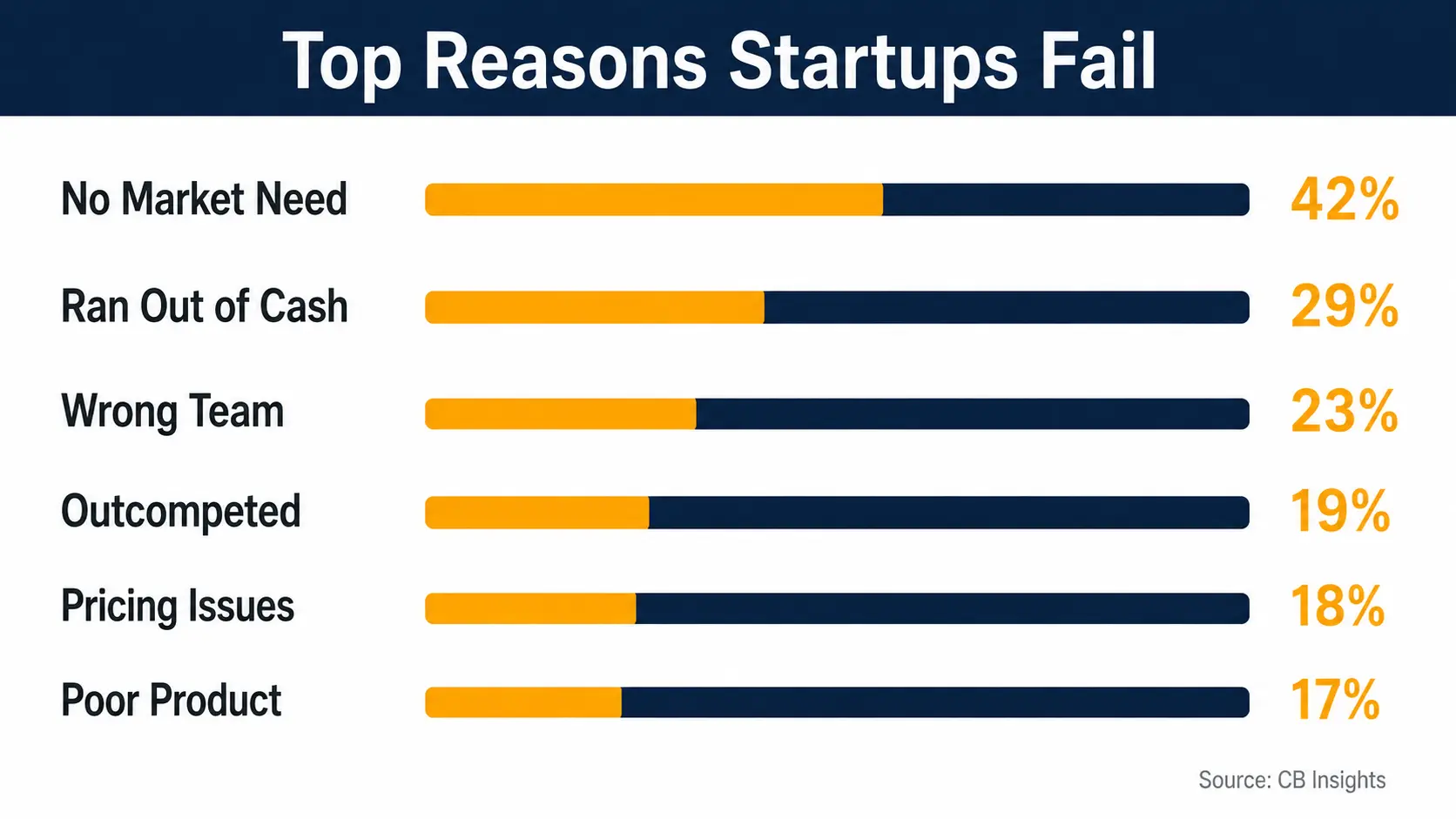
Before studying what works, it helps to understand what consistently goes wrong. Research from CB Insights found that 42% of startups fail because they build something the market does not actually need. That is the single most common cause of startup death, and it is entirely preventable with early research and honest feedback loops. You can read the full breakdown in CB Insights’ report on the top reasons startups fail.
Running out of cash ranks second, accounting for 29% of failures. Poor team composition follows at 23%. The pattern is consistent: startups do not collapse because of bad luck. They collapse because of avoidable structural weaknesses in strategy, hiring, and financial management.
The Product-Market Fit Problem
Product-market fit (PMF) is the point at which a product satisfies a genuine, widespread demand in a defined market. Many early-stage founders skip the validation work required to confirm PMF before building. They invest months of development into features that users do not want or need.
Successful tech entrepreneurs validate before they build. They run small experiments, talk directly to potential customers, and measure demand before writing a single line of production code. This discipline saves time, capital, and the team’s energy.
How Tech Entrepreneurs Build Successful Companies With Clear Vision
Every major technology company that endures was founded on a specific, well-defined vision. Vision is not a vague statement about changing the world. It is a concrete picture of a future problem solved at scale, and a clear reason why your company is the one to solve it.
Jeff Bezos launched Amazon with the view that the internet would transform retail, starting with books and expanding outward. Elon Musk built SpaceX around the explicit goal of making humanity multi-planetary. Steve Jobs envisioned a computer in every home before personal computing was mainstream. Each vision was precise enough to guide daily decisions and bold enough to attract believers.
Translating Vision Into Concrete Goals
Vision without execution is just an idea. Successful founders translate their long-term vision into a sequence of measurable milestones. They break a ten-year ambition into annual targets, quarterly sprints, and weekly priorities.
This approach, often described as objective and key result (OKR) goal-setting, was pioneered at Intel and later adopted by Google, where it helped structure the company’s rapid expansion. OKRs give large teams a shared language for progress without requiring constant top-down instruction.
- Set one overarching company objective per quarter
- Assign two to four measurable key results per objective
- Review progress weekly at team level and monthly at company level
- Adjust key results when market conditions shift, but protect the core objective
Identifying a Real Problem Worth Solving
The best tech companies start with a real problem, not a product concept. Founders who begin with “I want to build an app” often produce solutions searching for problems. Founders who begin with “this specific process is broken and I know exactly why” build companies with natural demand.
Airbnb was not founded on a grand theory of travel. It started because two founders could not afford rent and realised other travellers needed affordable accommodation. Slack began as an internal communication tool for a gaming company that pivoted. The product solved a genuine pain point the founders experienced themselves.
How to Validate a Problem Before Building
Validation does not require a finished product. It requires honest conversations, simple prototypes, and a willingness to hear feedback that challenges your assumptions.
- Interview at least 20 potential customers about their current workflow or pain point
- Ask them to describe the problem in their own words, not yours
- Build a minimal version of a solution, often called a minimum viable product (MVP)
- Measure whether users return to it without prompting
- Charge for early access to confirm genuine willingness to pay
Retention and payment are the two most reliable signals that a problem is worth solving at scale. Everything else is feedback that helps you refine the approach.
Building the Right Team From the Start
Technology is rarely the competitive advantage of a successful startup. Teams are. The combination of skills, trust, and shared values within a founding team determines how well a company adapts to the challenges that every early-stage business eventually faces.
A study tracking startup outcomes found that 23% of failures are directly linked to assembling the wrong team. Not the wrong people individually, but the wrong combination of skills, personalities, or values for the specific company and market. The inverse is equally true: a strong founding team can navigate poor early products, limited capital, and unexpected competition.
What Successful Tech Founders Look for in Early Hires
Early hiring is different from later-stage hiring. In the first five to ten employees, every person shapes culture, sets standards, and defines what the company values in practice. A single poor fit at this stage has an outsized effect on team dynamics and output.
Successful founders look for people who combine genuine skill with intellectual honesty and mission alignment. They avoid hiring for credentials alone. A candidate who has shipped real products, navigated genuine setbacks, and communicates clearly is more valuable than one with an impressive title and no demonstrated output.
- Prioritise demonstrated output over stated experience
- Test cultural alignment through honest conversations about disagreement and failure
- Hire people who are better than you in their specific domain
- Avoid early hires who optimise for personal reward over company mission
Mastering the Funding Landscape Without Losing Control
Raising capital is a tool, not a measure of success. Many founders confuse a large funding round with building a successful business. The two are related but distinct. Capital enables execution. It does not replace strategy, product judgment, or customer relationships.
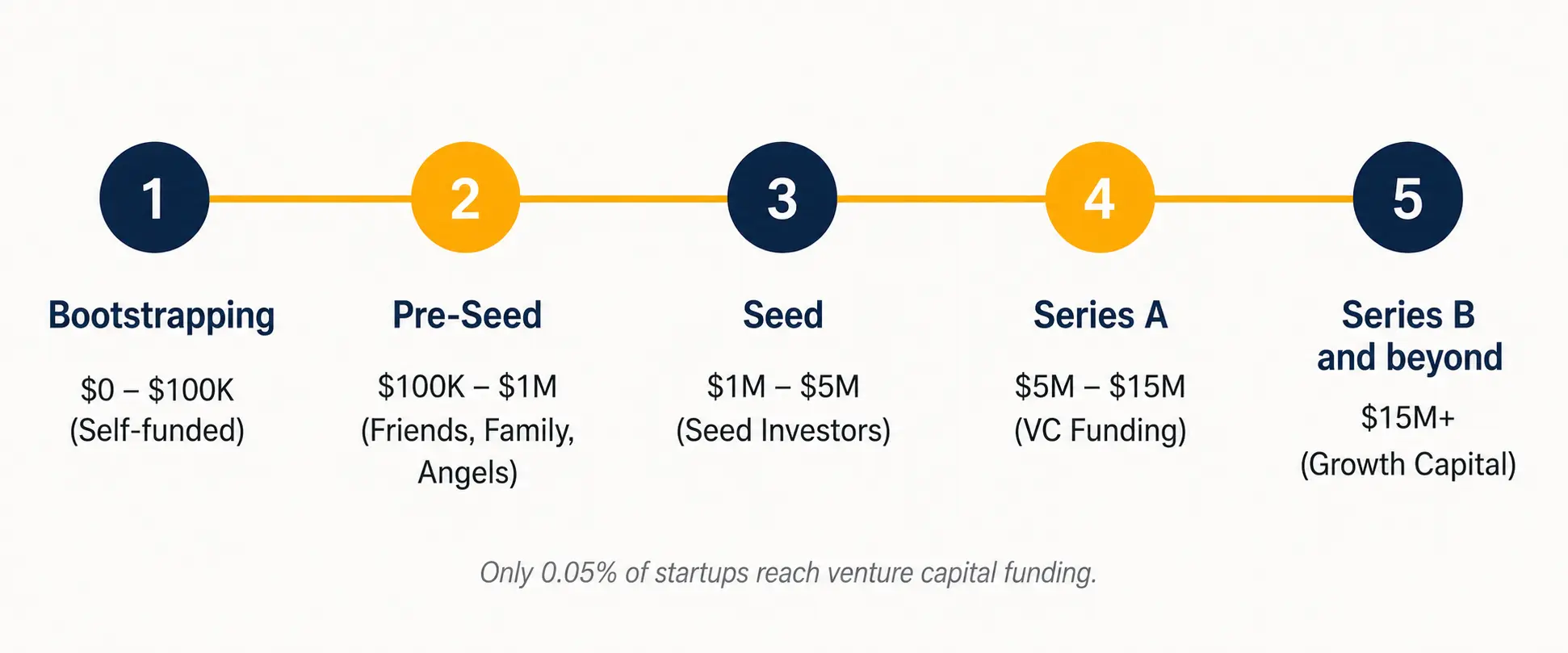
US venture capital investment reached $190.4 billion in 2024, a 30% increase over the prior year, as reported by Embroker’s comprehensive startup statistics report. Despite this surge, only 0.05% of startups ever receive venture capital funding. The vast majority of successful businesses are funded through personal savings, bank loans, angel investors, or revenue-based financing.
Choosing the Right Funding Path for Your Stage
Different funding sources suit different stages and company types. A consumer app with viral growth potential may suit venture capital. A professional services business with steady recurring revenue may thrive on debt or organic reinvestment.
Bootstrapping, the practice of funding growth entirely through revenue, forces discipline and customer focus that external capital can delay. Many of the most resilient technology companies, including companies like Basecamp and Mailchimp, scaled without venture funding and maintained full strategic control as a result.
Customer Obsession as a Growth Strategy
Across every major technology success story, one thread runs consistently: obsessive focus on the customer. Not the product, not the technology, and not the funding. The customer.
Amazon built its entire operating culture around customer obsession. Bezos famously kept an empty chair in meetings to represent the customer whose perspective needed to be heard. This practice reinforced a cultural norm that every decision should begin and end with customer impact. The results are documented in Amazon’s growth from an online bookstore to one of the most valuable companies in history.
Building Customer Feedback Into Daily Operations
Customer obsession is not a marketing posture. It is a set of daily habits and operational decisions that ensure real customer needs drive product development, support, and strategy.
- Read and respond to customer support tickets at the founding team level, at least weekly
- Conduct monthly customer interviews even after achieving product-market fit
- Track customer retention and churn as primary business health metrics
- Build a Net Promoter Score (NPS) survey into your product and review results monthly
Companies that embed customer feedback loops into their operations consistently outperform those that rely on intuition alone. This is especially true in enterprise technology, where customer needs evolve as their own markets shift.
Scaling Operations Without Breaking Culture
Growth creates pressure. The systems, habits, and team dynamics that work at ten people rarely survive unchanged to 100. Successful tech entrepreneurs anticipate this transition and build scalable processes before they become urgent.
Businesses that write out detailed business plans grow 30% faster than those that do not, according to research cited by Embroker’s startup statistics. Planning is not bureaucracy. It is the infrastructure that allows a growing team to make consistent decisions without requiring founder involvement in every choice.
Protecting Culture During Rapid Growth
Culture is not a set of values written on a wall. It is the sum of behaviours that are rewarded, tolerated, and corrected inside a company every day. As teams grow, the founding team loses the ability to shape culture through direct interaction. Systems, hiring standards, and documented norms take over that role.
Successful founders document their culture explicitly and revisit those documents regularly. They promote people who model the behaviours they want to spread and address misalignments quickly. Culture drift is common in fast-growing companies, and it is almost always easier to correct early than late.
Leveraging Technology and AI to Build Competitive Advantage
Technology is not only the product that tech entrepreneurs sell. It is also the infrastructure they use to operate more efficiently and identify opportunities faster than competitors. The global artificial intelligence (AI) market is projected to grow at a compound annual growth rate (CAGR) of 37.3% from 2023 to 2030, according to data tracked by Founders Forum Group’s startup guide.
Founders who understand how to apply AI within their own operations gain a structural advantage in speed, cost, and customer insight. This applies whether you are building an AI company or simply using AI tools to improve an existing product or workflow. The companies most likely to benefit are those that embed AI thoughtfully rather than reactively.
Practical Ways Tech Founders Apply AI in Early-Stage Companies
Early adoption of AI tools does not require a data science team. Many powerful applications of AI in startups involve off-the-shelf tools applied with discipline and clarity of purpose.
- Use AI writing and research tools to accelerate content, customer communication, and competitive analysis
- Apply machine learning models to customer behaviour data to identify churn risks early
- Automate repetitive support tasks with AI-powered tools to reduce response time and free up team capacity
- Use AI-assisted code review and testing to accelerate engineering output without sacrificing quality
The Role of Resilience and Learning From Failure
Every founder who has built a lasting company has also navigated serious setbacks. The startup journey includes product failures, funding rejections, team departures, and market shifts. What distinguishes successful tech entrepreneurs is not the absence of failure but the quality of their response to it.
Apple famously fired Steve Jobs in 1985 before rehiring him 12 years later. The company he returned to was weeks from bankruptcy. Jobs rebuilt it into the most valuable company in the world. Elon Musk nearly ran both Tesla and SpaceX into insolvency in 2008 before securing last-minute investments that saved both companies. Resilience is not a personality trait. It is a practice built on honest self-assessment, fast learning, and stubborn commitment to a long-term vision.
Building Personal Resilience as a Founder
Resilience in a founder has practical, operational implications. Founders who burn out, make fear-driven decisions, or avoid difficult conversations create fragile companies. Those who build personal systems for managing pressure and uncertainty create companies that can absorb shocks.
- Maintain a clear decision-making framework so that stress does not drive choices
- Build a network of peer founders who can offer honest, experienced perspective
- Treat setbacks as data points rather than verdicts on your capability
- Protect physical health and sleep as business-critical priorities, not personal luxuries
Marketing and Distribution as a Core Competency
A common mistake among technical founders is treating marketing as something to address after the product is built. In practice, distribution is often harder than product development and equally important to company success. Many well-built products have failed because their founders could not reach the right audience at the right time.
Successful tech entrepreneurs treat marketing and distribution as first principles, not afterthoughts. They identify their ideal customer profile before launching, map out the channels those customers use to discover new products, and build a go-to-market strategy alongside their product roadmap. Research shows that 82% of consumers now use social media platforms to discover and research products, making digital distribution a non-negotiable part of any startup’s growth strategy, according to data compiled by Hostinger’s entrepreneurship statistics report.
Choosing the Right Growth Channel for Your Company
Not every distribution channel works for every business. The right channel depends on your customer type, average contract value, sales cycle length, and competitive landscape. Choosing the wrong channel early wastes time and capital that early-stage companies cannot afford to lose.
Business-to-business (B2B) software companies often grow best through content marketing, direct sales, and referral networks. Consumer apps tend to scale faster through social media, influencer partnerships, and viral product loops. The most important step is to test two or three channels early and double down on the one that delivers the lowest customer acquisition cost (CAC) alongside the highest retention rate.
Frequently Asked Questions
What is the most important quality in a successful tech entrepreneur?
Clarity of vision combined with the ability to execute is the defining combination. Successful tech entrepreneurs know exactly what problem they are solving and why they are the right person to solve it. They also build the systems, teams, and habits needed to turn vision into shipped products and real revenue.
How do tech entrepreneurs choose which market to enter?
Most successful founders enter markets where they have direct experience with a problem. Insider knowledge of a specific industry’s pain points gives founders an advantage in product design and customer conversations. Markets with large and growing demand, limited incumbent innovation, and a clear monetisation path are typically the strongest early targets.
How much capital do you need to start a tech company?
The average seed funding round is $2.2 million, though many successful tech companies launched on far less. What matters more than the initial amount is how efficiently capital is deployed. Founders who focus on reaching clear validation milestones before spending heavily tend to extend their runway and build more durable businesses.
What is the biggest reason tech startups fail?
According to CB Insights, the leading cause of startup failure is building a product for which no genuine market need exists. This accounts for 42% of documented failures. The solution is rigorous early validation through customer interviews, small-scale experiments, and honest measurement of demand before significant investment in product development.
How do tech entrepreneurs build a strong company culture?
Culture is built through consistent behaviour at the leadership level, not through written values alone. Founders who model the behaviours they want to see, reward the right actions, and address misalignments quickly create cultures that reinforce themselves as the company grows. Culture should be documented explicitly and revisited regularly as the team scales.
When should a tech startup consider raising venture capital?
Venture capital makes sense when a company has validated product-market fit, operates in a large and growing market, and needs significant capital to accelerate a clear growth path before competitors do. Raising before validation is a common mistake that leads to premature scaling of a model that has not yet been proven to work.
What It Really Takes to Build a Lasting Tech Company
The pattern behind every enduring tech company is not genius or luck. It is a disciplined approach to a specific set of decisions made early and revisited continuously. Tech entrepreneurs who build successful companies validate before they build, hire for complementary strengths, stay obsessed with customer needs, and treat setbacks as information rather than verdicts.
The statistics are humbling. Ninety percent of startups fail, and the majority of those that do run out of either cash or conviction before finding their footing. But the ten percent that survive share clear, learnable habits. Vision that is specific enough to guide daily decisions. Products that solve verified problems. Teams selected for skill and values alignment. Operations built to scale before they have to.
The global startup ecosystem is growing faster than at any point in history. Entrepreneurs filed 5.2 million new business applications in the United States alone in 2024, a 48.6% increase over 2019, as tracked by Shopify’s entrepreneurship statistics report. The opportunity has never been larger, and neither has the competition. The founders who study what works, apply it deliberately, and adapt quickly are the ones who will define the next generation of category-defining companies.
Start with a real problem. Build with your customer at the centre. Hire people who are better than you. Protect your vision and stay flexible on the path. That is not a formula for guaranteed success, but it is the closest thing the startup world has to one.

Prince Anichi
Founder and Lead Technology Editor at Ortechy. Covering digital economy shifts, tech ecosystems across Africa, cybersecurity intelligence, and emerging software platforms.