
Over twelve thousand companies have already registered on Nigeria’s official startup portal since the Nigeria Startup Act took effect, and that number keeps climbing. If you want to register a tech startup in Nigeria the right way in 2026, you need more than a CAC certificate. You need the correct business structure, the right tax setup, and in many cases the NITDA Startup Label that unlocks real tax breaks.
This guide walks you through every step, from choosing between a business name and a limited company, to filing on the CAC portal, to applying for startup status. Also included are honest cost breakdowns, common filing mistakes, and answers to the questions founders ask most.
Now, let us start where every founder actually starts: deciding what kind of company you are building before you touch a registration form.
What Actually Counts as a Tech Startup in Nigeria
Before you register a tech startup in Nigeria, understand that “startup” is now a legal term, not just a vibe. The Nigeria Startup Act 2022 defines a labelled startup as a company whose core objective is the innovation, development, production, or improvement of a digital technology product or process, and which has been in existence for less than ten years.
This means a food delivery app, a fintech platform, or a SaaS tool built for Nigerian businesses can qualify. However, a regular retail shop with a website usually cannot, because the software itself is not the core product.
The distinction matters because only labelled startups get access to the tax holidays and funding schemes described later in this guide. If your business genuinely builds digital products, keep that framing in mind through every registration step.
Step 1: Choose Your Business Structure
Therefore, your first real decision is structure. Nigeria’s Corporate Affairs Commission (CAC) offers three common paths: business name, private limited company, and incorporated trustee for nonprofits.
A business name is the cheapest and fastest option, but it offers no liability protection and cannot receive equity investment. This structure suits a solo freelancer, not a scaling tech company.
A private limited company, known as an LTD, is what serious tech founders choose. Because it separates your personal assets from business debts and allows you to issue shares to co-founders and investors, it is also the only structure eligible for the NITDA Startup Label discussed later.
- Business Name: fast, cheap, no investor readiness
- Private Limited Company (LTD): investor ready, limited liability, startup label eligible
- Incorporated Trustee: for nonprofits and foundations only
If you plan to raise money, hire staff, or apply for the Startup Label, register as a private limited company from day one. Switching structures later costs more time and money than starting correctly.
Step 2: Reserve Your Company Name on the CAC Portal
Once you settle on a structure, name reservation comes next. All CAC filings in Nigeria now happen through the Company Registration Portal, and this stage cannot be skipped.
First, run your proposed name through the CAC Intelligent Name Search tool to check for conflicts. This tool instantly shows whether your chosen name is available, taken, or too similar to an existing registration, as detailed in Legit.ng’s breakdown of the CAC registration process.
Then, create a profile on the portal, select “Name Reservation,” choose your business classification and nature of business, and submit your top two name choices. Approval for a clean, available name typically comes back quickly.
Avoid generic, one-word names. Names that closely resemble existing companies or use restricted words like “Bank” or “Federal” get rejected automatically, and every rejection costs you a resubmission fee.
Step 3: File Your Incorporation Documents
Documents You Will Need
With your name reserved, incorporation documents come next. For a private limited company, CAC requires a specific set of information before it issues a certificate.
- Proposed share capital, with most Nigerian tech startups registering at the ₦100,000 minimum bracket
- Details of at least one shareholder and one director, including valid identification
- A registered office address in Nigeria, not a post office box
- Memorandum and Articles of Association, which CAC requires a legal practitioner to prepare for a limited company
Filing and Approval Timeline
Because CAC has automated most of the process, a well-prepared business name registration now takes two to five working days, while a private limited company takes five to fourteen working days according to AfroTools’ 2026 registration timeline guide.
However, delays happen constantly. Incomplete documentation, name conflicts, and high filing volume during peak periods are the three biggest causes of slow approvals. Submit clean documents the first time and you avoid the queue entirely.
Step 4: Understand What It Really Costs to Register a Tech Startup in Nigeria
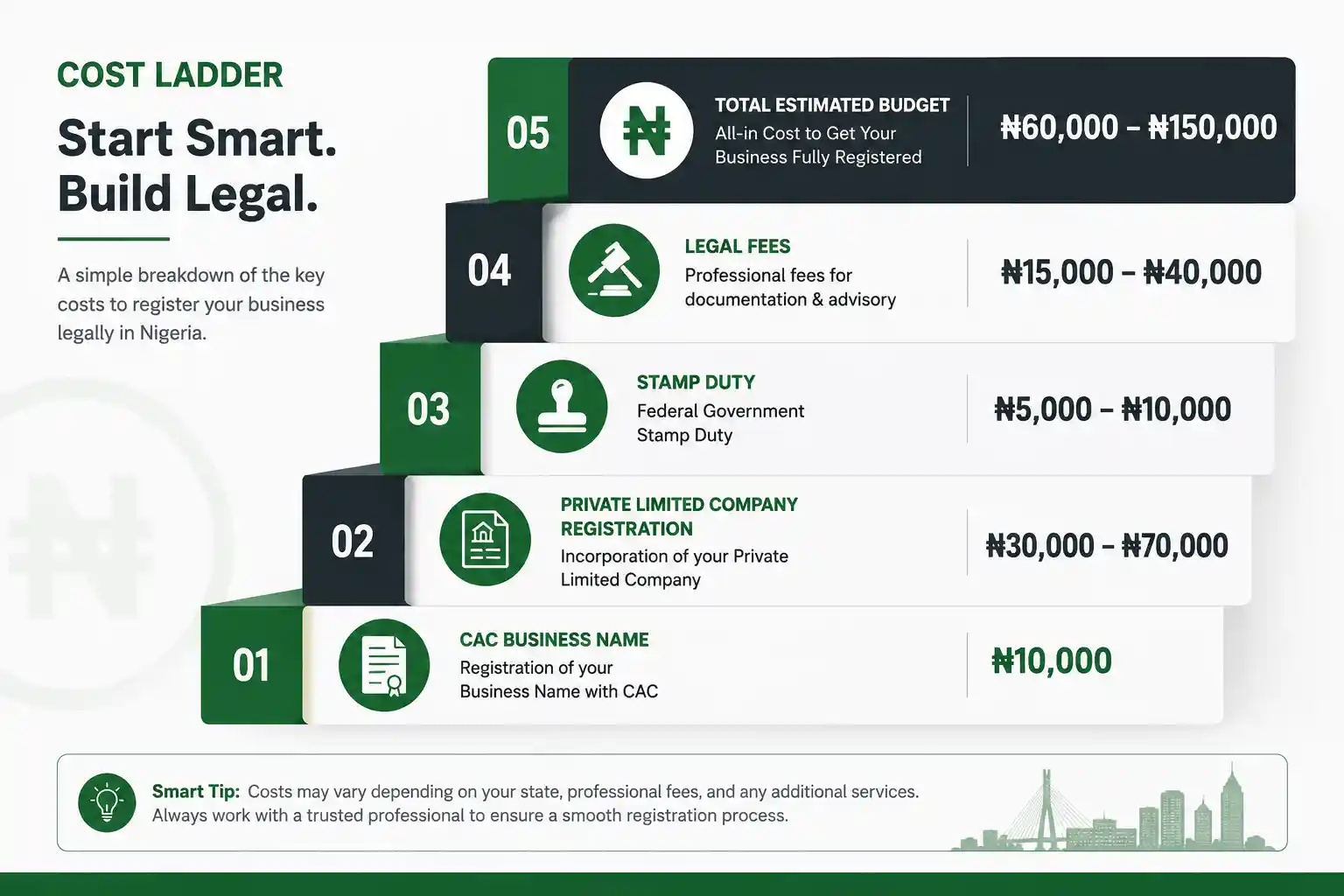
Now for the numbers founders actually search for. CAC’s official 2026 fee schedule charges ₦10,000 for a business name and a base of roughly ₦30,000 to ₦50,000 for a private limited company, depending on share capital, as outlined in SmartSMS Solutions’ 2026 CAC fee breakdown.
Beyond the CAC fee itself, three additional costs catch founders off guard. Stamp duty from the Federal Inland Revenue Service, professional fees for a lawyer to prepare your Memorandum and Articles of Association, and annual returns filing once your first year closes.
- CAC business name registration: ₦10,000
- CAC private limited company registration: ₦30,000 to ₦50,000
- Stamp duty (FIRS, based on share capital): 0.75 percent of share capital
- Legal fees for Memorandum and Articles of Association: ₦20,000 to ₦50,000
- Accredited agent fees (optional): ₦30,000 to ₦65,000
- Annual returns filing: ₦5,000 and above per year
Budget between ₦60,000 and ₦150,000 total for a properly incorporated private limited company once legal and stamp duty costs are included. This is far cheaper than the ₦300,000 or more that some agents quote founders who do not know the real government rates.
Step 5: Register for Tax and Get Your TIN
After incorporation, CAC registration automatically generates a Tax Identification Number, or TIN, for your new company. This is now handled during the incorporation process itself rather than as a separate visit to the Federal Inland Revenue Service.
Then, register for Value Added Tax if your company will invoice clients, and set up a company account on the TaxPro Max platform for annual filing. Because Nigerian tax authorities have digitised most of this workflow, you can complete it without visiting a tax office in person in most states.
This means your paperwork burden shrinks significantly compared to five years ago, but you still need to file annual returns on time to avoid penalties.
Step 6: Apply for the NITDA Startup Label Under the Nigeria Startup Act
Why the Startup Label Matters
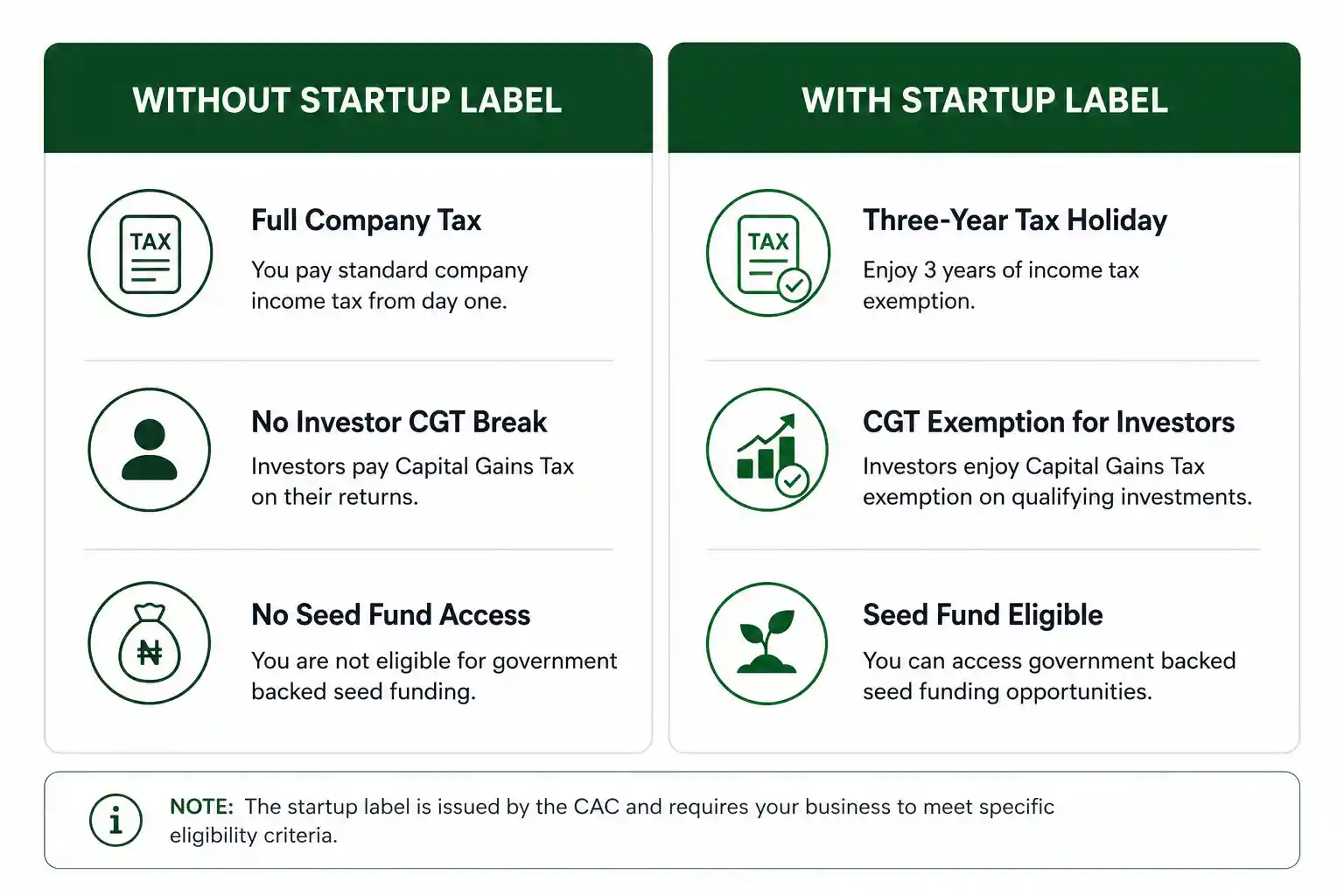
This is the step most guides skip, and it is arguably the most valuable one for genuine tech founders. The Nigeria Startup Act created a “Startup Label,” issued by the National Information Technology Development Agency (NITDA), which functions as the master key to every tax incentive under the Act, as explained by Chambers and Partners’ analysis of the Nigerian Startup Act.
Without this label, your private limited company gets none of the following benefits, no matter how innovative your product is.
What the Label Unlocks
- Pioneer Status Incentive: a three year exemption from Companies Income Tax, extendable for two more years
- Capital Gains Tax exemption for investors who hold equity in your company for at least two years
- Research and development tax deductions for qualifying local R&D spend
- Access to the Startup Investment Seed Fund, a government backed early stage financing pool managed through the Nigeria Sovereign Investment Authority
To qualify, register as a private limited company with CAC, keep your company under ten years old, and show that your core business is genuinely a digital product or process, not just a website bolted onto a traditional business, according to KPMG Nigeria’s overview of Startup Act incentives.
Once eligible, apply directly through the official Nigeria Startup Portal. The application asks for your CAC documents, a description of your digital product, and evidence of Nigerian founder equity.
Step 7: Open a Business Bank Account and Build Your Compliance Calendar
Finally, take your CAC certificate, TIN, and Memorandum and Articles of Association to a Nigerian bank to open a corporate account. Most tier one banks now process this within a week for a properly incorporated LTD.
Then, build a simple compliance calendar. Annual returns to CAC, VAT filing if applicable, PAYE if you hire staff, and pension remittance under the Pension Reform Act all carry real penalties for late filing.
In practice, founders who set calendar reminders for these dates in their first month avoid nearly all the compliance headaches that catch second year startups off guard.
Common Mistakes That Delay Tech Startup Registration in Nigeria
Also worth flagging are the recurring errors that push registration timelines from days into weeks.
- Choosing a business name so generic that it fails the CAC similarity check on the first attempt
- Registering as a business name first and converting to a private limited company later, which adds cost and paperwork instead of saving it
- Hiring an unaccredited agent who promises twenty four hour company registration, a timeline CAC’s own processing windows do not support
- Skipping the Startup Label application because founders assume “that is for later,” then losing a full tax year of eligibility
- Forgetting that a Memorandum and Articles of Association must be prepared by a licensed legal practitioner, not drafted informally
The single costliest mistake is delaying the Startup Label application. The Pioneer Status tax holiday only runs from the date your label is approved, not from your company’s founding date, so every month you wait is a month of tax relief you never recover.
Registering the Right Way From Day One
Registering a tech startup in Nigeria in 2026 is genuinely faster than it was even three years ago, thanks to CAC’s digitised portal and NITDA’s startup labelling system. However, speed only helps you if you register with the correct structure from the start.
The founders who benefit most are the ones who treat CAC incorporation and the NITDA Startup Label as one connected process, not two separate errands. A private limited company gives you the legal foundation, and the Startup Label gives you the tax runway to actually build.
My honest take, after watching Nigerian founders navigate this system, is that the biggest gap is not the paperwork itself but awareness. Most early stage founders never apply for the Startup Label simply because nobody told them it existed. Do not be that founder.
Start with your CAC filing on the official CAC portal, and once your certificate is in hand, move straight to the Nigeria Startup Portal for your label application. Both steps together, done properly, position your company for real growth rather than just paper compliance.
Frequently Asked Questions
How long does it take to register a tech startup in Nigeria?
A business name typically takes two to five working days, while a private limited company takes five to fourteen working days. Delays usually come from name conflicts or incomplete documents, not the CAC system itself.
Do I need a lawyer to register a private limited company?
Yes. CAC requires the Memorandum and Articles of Association for a private limited company to be prepared by a licensed legal practitioner, so budget for this cost from the start.
What is the minimum share capital for a Nigerian tech startup?
Most startups register with ₦100,000 in issued share capital, which is the standard minimum bracket most CAC agents recommend for new companies.
Is the NITDA Startup Label mandatory?
No, but it is the only way to access Pioneer Status tax holidays, Capital Gains Tax exemptions, and the Startup Investment Seed Fund. Skipping it means leaving real incentives unclaimed.
Can a business name qualify for the Startup Label?
No. The Nigeria Startup Act requires labelled startups to be registered as private limited companies, so a sole proprietorship business name is not eligible.
How much should I budget to register a tech startup in Nigeria?
Plan for roughly ₦60,000 to ₦150,000 total once CAC fees, stamp duty, and legal fees for your incorporation documents are included.

Prince Anichi
Founder and Lead Technology Editor at Ortechy. Covering digital economy shifts, tech ecosystems across Africa, cybersecurity intelligence, and emerging software platforms.