
Before anything else: this is not about your personal WhatsApp, and it is not about the free WhatsApp Business app that most small shops in Lagos, Abuja, and Port Harcourt use to chat with customers. What is changing on October 1, 2026, is how Meta prices messages sent through the WhatsApp Business Platform, the API-based system that banks, fintechs, airlines, and larger retailers plug into to run customer service at scale. If your business runs on the ordinary WhatsApp Business app, this update does not touch you directly. If it runs through an API or a third-party provider like a chatbot vendor or a CRM tool, it very much does.
What Meta Is Changing From October 1
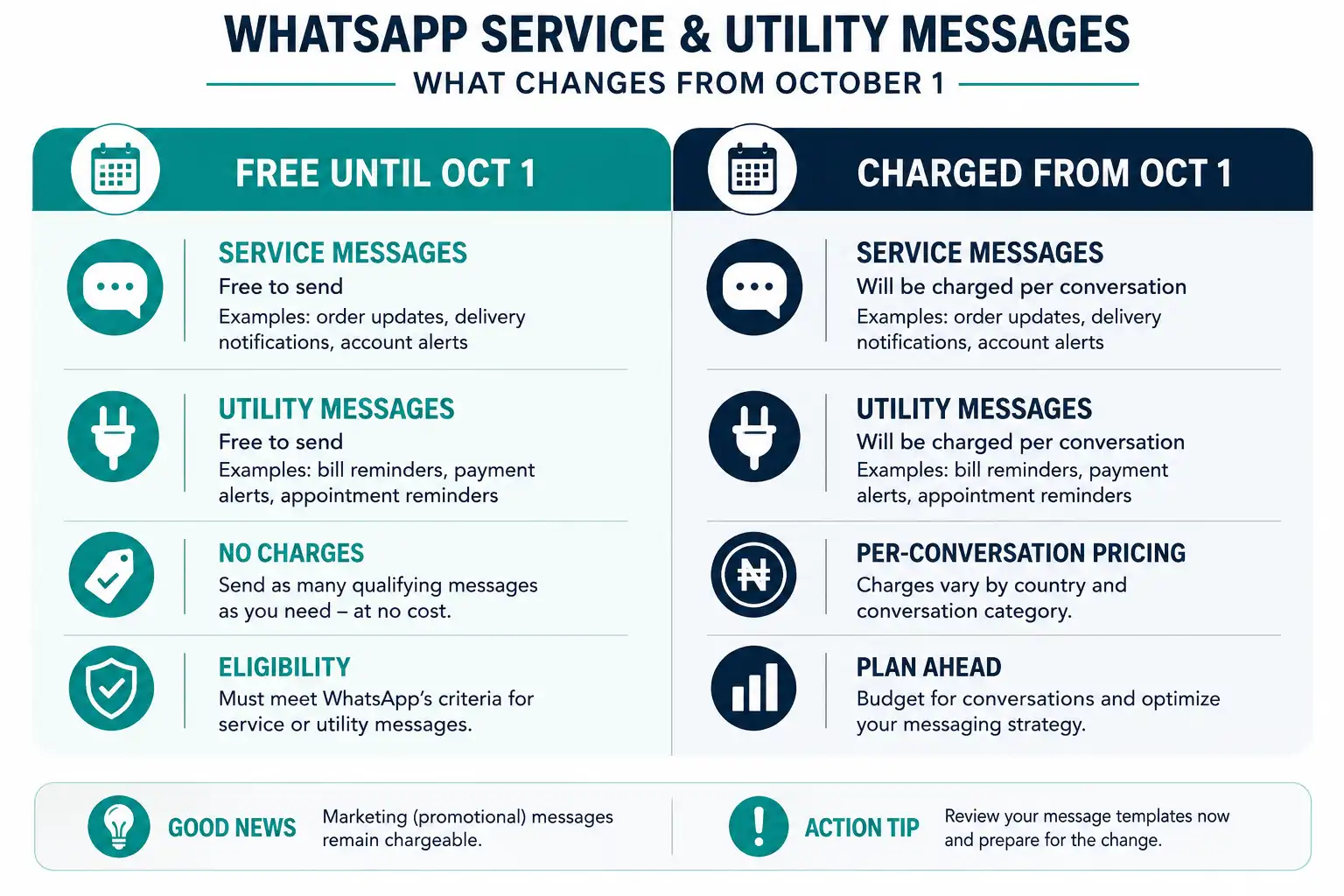
Since November 2024, replies that a business sends to a customer inside WhatsApp’s 24-hour “customer service window”, the period that opens whenever a customer messages first have been free. Since July 2025, that same free treatment was extended to utility templates (things like order confirmations) sent inside that window. Both of those free rides end on October 1, 2026.
According to Meta’s WhatsApp Business Platform documentation, two things become billable on that date: every service message (a free-form reply written by a human agent or a third-party AI system) and every utility template sent within the 24-hour window. Meta will apply the same per-message rate to service messages that it already charges for utility and authentication templates in that market. There is no separate “service” price list, it simply inherits the utility/authentication rate for whichever country the customer’s number belongs to.
A related change happened earlier, and it’s easy to confuse with this one. Since August 1, 2026, Meta has charged for its own AI agent, the Meta Business Agent on a per-token basis, at $2 per million tokens, which works out to roughly 4 to 5 cents per reply. That is a different charge, for a different product, and it started two months before the October update.
Who Is Actually Affected and Who Isn’t
The charge applies only to messages sent through the WhatsApp Business Platform: the Cloud API, or any Business Solution Provider (BSP) built on top of it, such as the chatbot and CRM tools many Nigerian companies use for customer support. It does not apply to the free WhatsApp Business mobile app, and it does not touch ordinary personal WhatsApp accounts at all.
In practice, that means the businesses that will feel this are the ones already paying Meta for template messages, examples are banks sending transaction alerts, fintechs sending OTPs and payment confirmations, e-commerce platforms sending order and delivery updates, airlines and logistics firms tracking shipments, and telcos running large-scale customer support. A market woman replying to customers from her personal phone is not who this is aimed at.
What Nigerian Businesses Might Actually Pay
Here is where some caution is needed. As of this writing, Meta has not yet published the exact October rate for Nigerian numbers — its own documentation commits to announcing final country-level rates by September 1, 2026, just ahead of the change taking effect. Several Nigerian outlets have already reported working figures of roughly $0.0101 (about ₦14) for a chargeable utility-type message and about $0.062 (about ₦84) for what they describe as the new charge, using an exchange rate near ₦1,340 to the dollar.
To make the scale concrete: a Nigerian fintech(let’s say Paystack) sending 500,000 service or utility replies a month, at roughly $0.01 each, would be looking at somewhere around $5,000 in Meta charges before any markup its BSP adds on top. That is illustrative math, not a real company’s bill, but it shows why volume, not the size of a single charge, is what will move the needle.
Why This Matters More in Nigeria Than It Might Look
WhatsApp is not a side channel for a large share of Nigerian businesses, for many, it is the customer service desk, the order tracker, and the sales floor rolled into one. Banks and fintechs lean on it for balance alerts and OTPs. Logistics and e-commerce players use it to tell customers where their package is. Retailers run entire sales conversations through it because it’s where their customers already are. That heavy reliance is exactly what turns a small per-message fee into a real line item once volumes climb into the hundreds of thousands or millions a month.
There’s also a currency layer to this. Meta’s rates are set in US dollars (with local-currency billing for some markets), so a naira-denominated business absorbs both Meta’s per-message rate and whatever the exchange rate happens to be doing that quarter. And most Nigerian businesses don’t talk to Meta directly, they go through a BSP, which typically adds its own platform fee or per-message markup on top of Meta’s charge. The number on Meta’s rate card is the floor, not the final bill.
If You Use the Regular WhatsApp Business App
Nothing here changes for you. The pricing update sits entirely on the API side of WhatsApp, the WhatsApp Business Account tied to a Cloud API integration or a BSP. The free mobile app that most small and informal businesses use has no metering attached to it and isn’t part of this billing system at all.
What to Do Before October 1
- Check whether your business messages customers through the API or a BSP (not just the free app), that’s the only setup this affects.
- Pull your recent service-message and in-window utility-message volumes through Meta’s Pricing Analytics API, or ask your BSP for the equivalent report, to estimate what October’s bill could look like.
- Make sure a payment method is on file in Meta’s Billing Hub by September 30, 2026. Meta has said it will stop delivering service messages for any Solution Provider or directly-integrated business without one once the charge begins.
- Look at where conversations run long for no good reason. Consolidating a few back-and-forth messages into one clear reply, or moving structured information collection to WhatsApp Flows, cuts the number of billable messages without cutting service quality.
- Ask your BSP directly what its markup will be on top of Meta’s new charge because that answer matters as much as Meta’s own rate card.
The Bigger Picture
This is the latest step in a shift that has been running since mid-2025, when Meta dropped its old conversation-based billing (a flat fee per 24-hour thread) in favour of per-message pricing for template messages. Free service replies and free in-window utility messages were, in effect, a transition benefit. Meta is now closing that gap, at the same time it’s pushing its own AI product, Meta Business Agent, as a token-billed alternative for automating replies. Read together, the message to businesses is less “WhatsApp got more expensive” and more “every message on this platform now has a price tag attached, including the ones that used to be a courtesy.”
Ortechy’s Take
The panic-inducing version of this headline “Meta will charge you to use WhatsApp” doesn’t hold up. The accurate version is narrower and, frankly, more useful to plan around: if your business already pays Meta for template messages, your support conversations are about to start costing money too, at roughly the same rate as your utility templates. The businesses that will handle this best are the ones that go and check their actual message volumes now, rather than waiting for the September rate card and finding out the hard way in their first October invoice.

Prince Anichi
Founder and Lead Technology Editor at Ortechy. Covering digital economy shifts, tech ecosystems across Africa, cybersecurity intelligence, and emerging software platforms.