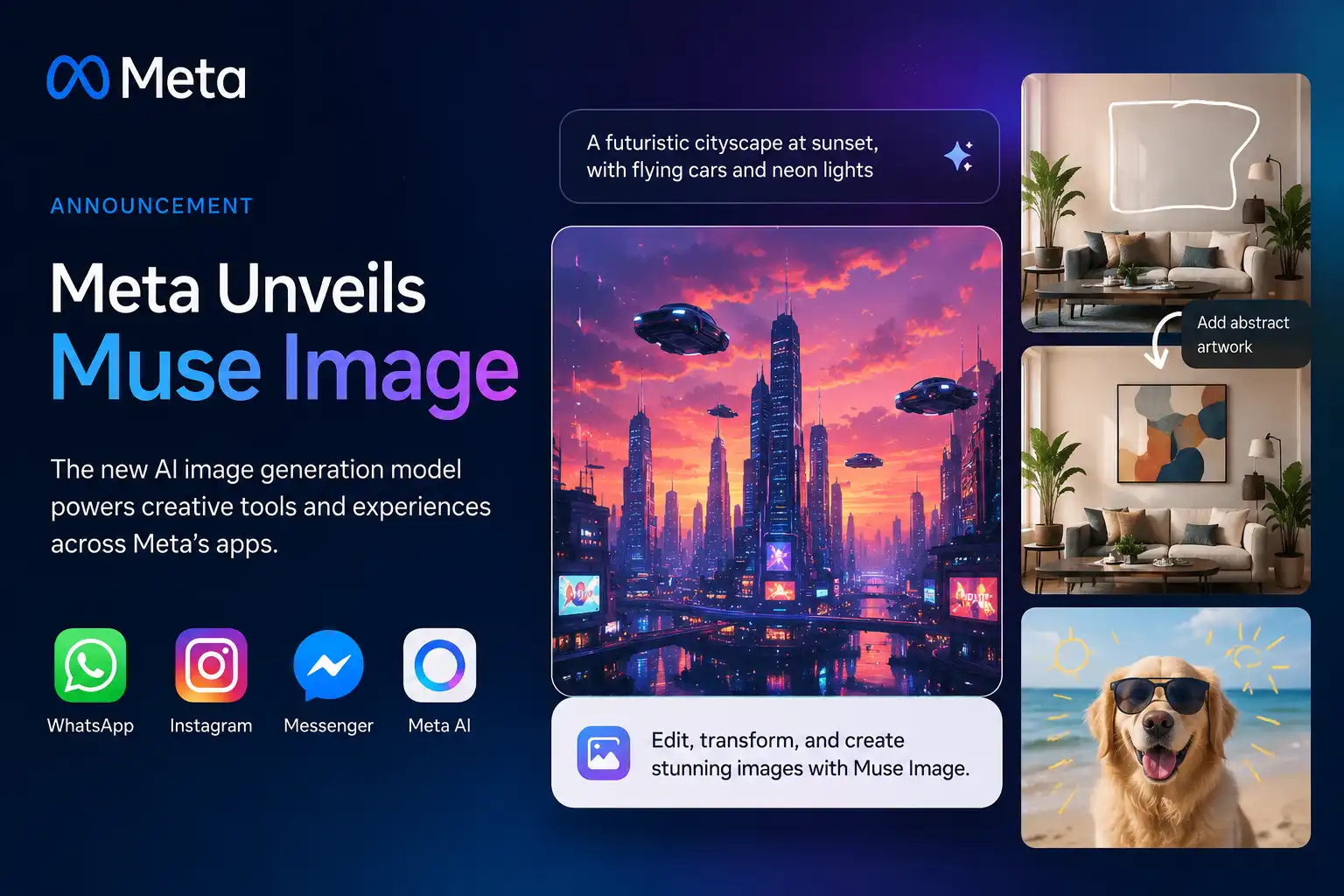
Meta Platforms Inc. rolled out its first in-house AI image generation model on Tuesday, marking the company’s most direct challenge yet to OpenAI and Google in the fast-moving race to control how people create pictures with artificial intelligence.
The model, called Muse Image, is now live inside the Meta AI chatbot and is being embedded across Instagram and WhatsApp, according to a blog post published by Meta. The company said the tool will expand to Facebook and Messenger later this year, and that advertisers will gain access to it within weeks through Meta’s Advantage+ ad platform.
Muse ImageMuse Image is the second major release from Meta Superintelligence Labs, the research division Meta built roughly a year ago after committing billions of dollars to attract AI talent, including compensation packages for some researchers that reportedly exceeded 200 million dollars. The lab is led by Alexandr Wang, Meta’s chief AI officer, who previously oversaw the April debut of Muse Spark, the large language model that replaced Meta’s Llama family in the company’s own products, TNW reported.
A Late Entry Into a Crowded Field
Meta is not the first major technology company to release an AI image generator, and executives have acknowledged as much. Google’s Nano Banana became a hit with consumers after its release last fall, and OpenAI has offered image generation tools for years. Meta’s decision to build its own model, rather than continue relying on outside vendors, reflects a broader push to bring core AI capabilities in-house.
Before Tuesday, image generation inside Meta AI was handled by third-party vendors, including Midjourney and Black Forest Labs, according to Quartz. That arrangement ends with the introduction of Muse Image, which Meta now positions as the default engine behind image creation across its family of apps.
Meta also confirmed that a companion video generation model, Muse Video, remains in development. The company has not given a release date, though a Meta spokesperson said it is expected in the coming months, according to Bloomberg.
How the Model Works
Muse Image supports text-to-image generation, image-to-image editing, and instruction-based editing, in which users upload an existing photo and modify it using natural language, sketches, or handwritten annotations. Rather than regenerating an entire image for a small change, the model can edit specific regions only, a design intended to make tasks such as background swaps and object removal more efficient, according to The Tech Portal.
The model is designed to interpret complex, multi-part prompts involving several objects, camera angles, lighting conditions and spatial relationships at once. Meta said Muse Image works in tandem with Muse Spark, which handles reasoning and real-time web lookups before Muse Image renders the final visual. In its blog post, Meta described the process as one in which the system plans out an image before it draws it, rather than generating pixels in a single pass.
One of the more notable features allows users to tag public Instagram accounts and pull in real photos of friends or creators to build personalized images, such as event invitations or composite postcards. Meta said the feature is enabled by default, though Instagram users can opt out through account settings, a detail confirmed independently by Axios
Performance Against Rivals
Meta released internal benchmark data alongside the launch showing Muse Image trailing OpenAI’s newest release, GPT Image 2, in overall image quality, while outperforming Google’s Nano Banana 2 on editing-focused tasks involving one or more reference photos, according to CNBC.
Because the figures come from Meta itself, they have not yet been verified by independent testing. Benchmarks published by a model’s own developer are typically treated with caution in the industry until outside researchers can replicate the results using neutral prompts and evaluation criteria.
Commercial Rollout and Advertiser Access
Meta said advertisers and agencies will be able to use Muse Image through Advantage+, the company’s AI-powered advertising suite, to generate and vary image-based ad creative in the coming weeks. The company said the tool brings native reasoning to the creative process, allowing brands to adjust elements, swap styles, and produce on-brand ad variations with fewer iterations, according to its statement reported by CNBC.
Consumer use of Muse Image is free, Meta said, though people who want higher usage limits can subscribe to one of the company’s paid AI plans introduced in May.
Safety Measures and Privacy Questions
Meta said every image produced with Muse Image carries an invisible watermark, and that the system includes safeguards intended to block content that violates the company’s terms of service, including child sexual abuse material. A Meta spokesperson confirmed the watermarking and safety measures to Bloomberg.
The disclosure comes against a backdrop of ongoing concerns about misuse of AI image tools across the industry. Other companies’ models have reportedly been used to create non-consensual sexualized images and manipulated sexualized images of minors, according to Bloomberg’s reporting. Meta has not disclosed independent audit results for its own safeguards.
The default-on setting for Instagram photo tagging is likely to draw scrutiny from privacy advocates, given that many users may be unaware their public photos can be incorporated into other people’s AI-generated images unless they actively opt out.
Meta’s Broader AI Strategy
The launch follows a difficult stretch inside Meta’s AI division. The company reassigned thousands of engineers to data labeling and AI-related work earlier this year, a move that hurt morale and that executives have since acknowledged was handled poorly, according to Axios. Meta also began using employees’ work activity to collect AI training data before pausing the program after a privacy lapse exposed potentially sensitive information internally.
Meta has also lost access to a portion of contracted computing capacity from Google earlier this year due to constraints, which set back some internal projects and led the company to ask staff to limit AI token usage, according to Bloomberg and Yahoo Finance. Muse Spark has since absorbed more of that workload. Separately, Meta cut roughly 8,000 jobs in May and has signed new computing agreements with CoreWeave, Google and Oracle as it continues to expand its data center footprint.
The company is also weighing whether to open Muse Image to outside developers and is exploring a cloud computing venture that would let outside companies rent access to its AI models and infrastructure, a plan that would place Meta in more direct competition with Amazon Web Services, Microsoft Azure and Google Cloud.
What Next?
Meta’s rollout plan calls for Muse Image to reach Facebook and Messenger later this year, alongside wider WhatsApp availability beyond the limited markets where the feature is currently active. Advertiser access through Advantage+ is expected within weeks.
Independent researchers and rival companies are likely to test Meta’s benchmark claims in the coming days, which should offer a clearer picture of how Muse Image actually performs against GPT Image 2 and Nano Banana 2 outside of Meta’s own testing environment. Meta has not said whether it plans to publish further technical documentation on the model’s architecture or training data.
We covered everything you need to know about Meta Muse Image and you can access it here.

Prince Anichi
Founder and Lead Technology Editor at Ortechy. Covering digital economy shifts, tech ecosystems across Africa, cybersecurity intelligence, and emerging software platforms.