In this article29 sections
- 01.What the OpenAI IPO Filing Actually Means
- ↳The Confidential S-1 Process Explained
- 02.OpenAI IPO Valuation: How Did We Reach $1 Trillion?
- ↳The March 2026 Funding Round Sets the Baseline
- ↳How the Ownership Structure Breaks Down
- 03.The Financial Reality Behind the OpenAI IPO
- ↳Revenue Growth That Defies Historical Comparison
- ↳The Loss Problem Every Investor Must Understand
- ↳Why the Losses Are a Compute Story
- 04.ChatGPT User Growth and the Monetisation Challenge
- ↳900 Million Weekly Users, Only 4 Percent Paying
- ↳How OpenAI Is Expanding Its Revenue Streams
- 05.OpenAI vs Anthropic: Two AI Giants Head to Wall Street
- ↳Anthropic Filed First
- ↳The Broader AI Industry Race to Go Public
- 06.Governance and Structural Risks in the OpenAI IPO
- ↳The Public Benefit Corporation Conversion
- ↳Microsoft’s Stake and What It Means for Investors
- 07.What the OpenAI IPO Means for the AI Investment Landscape
- ↳Setting AI Company Valuation Benchmarks
- ↳The Key Metric to Watch When the S-1 Goes Public
- 08.Frequently Asked Questions
- ↳When is the OpenAI IPO date?
- ↳What is OpenAI’s IPO valuation?
- ↳Is OpenAI profitable?
- ↳Who are the main underwriters for the OpenAI IPO?
- ↳How does the OpenAI IPO compare to Anthropic’s?
- ↳Can I buy OpenAI stock now?
- 09.Conclusion
OpenAI IPO Filing 2026: What the $1 Trillion AI Race Means for Investors
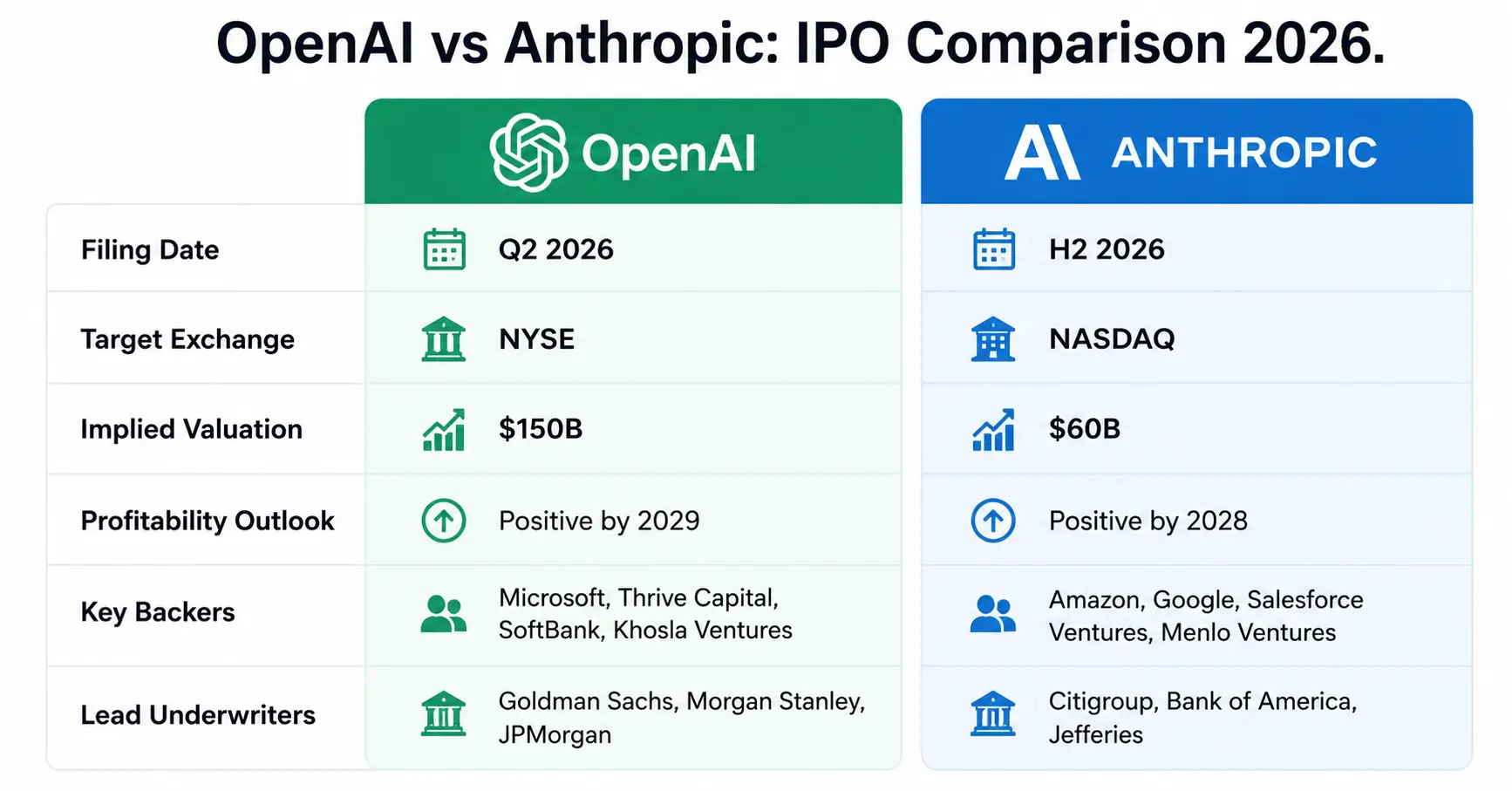
The OpenAI IPO is the most anticipated public listing in technology history. On 22 May 2026, OpenAI confidentially filed its S-1 prospectus with the United States Securities and Exchange Commission (SEC), targeting a public debut as early as September 2026 at a valuation analysts expect to exceed $1 trillion. Goldman Sachs, Morgan Stanley, and JPMorgan are leading the deal.
The numbers behind this filing are extraordinary and, in equal measure, sobering. OpenAI generates roughly $2 billion per month in revenue. It also loses more than $1.22 for every dollar it earns. This is a company racing to dominate artificial intelligence while burning capital at a rate that makes even the most aggressive tech investors pause.
This post breaks down everything you need to know about the OpenAI IPO: the financials, the governance questions, the competitive landscape, and what it all means if you are watching the AI industry’s defining public market moment.
What the OpenAI IPO Filing Actually Means
The Confidential S-1 Process Explained
A confidential S-1 filing lets a company submit its draft prospectus to the SEC for private review. Revenue figures, profit margins, and risk disclosures stay out of public view while regulators examine the paperwork. Only when the company launches its roadshow does the prospectus become available to everyone.
OpenAI confirmed its confidential filing publicly on 8 June 2026, weeks after the initial submission. This approach is standard for high-profile technology listings. It lets the company manage market reaction to its financial data before committing to a public launch window, as confirmed by ITP.net’s coverage of the dual AI IPO filings.
The filing follows a major corporate restructuring. In October 2025, OpenAI converted from a capped-profit hybrid structure into a Public Benefit Corporation (PBC). That conversion removed a 100x investor return cap and opened the door to conventional equity investment at the scale a public listing requires.
OpenAI IPO Valuation: How Did We Reach $1 Trillion?
The March 2026 Funding Round Sets the Baseline
To understand the IPO pricing, start with the most recent private funding round. In March 2026, OpenAI raised $122 billion at an $852 billion post-money valuation, the largest private technology financing ever completed. Backers included Amazon, Nvidia, and SoftBank.
By the time the S-1 hit the SEC, analyst estimates had pushed the expected OpenAI IPO valuation above $1 trillion. That figure would make OpenAI’s debut roughly four times larger than Alibaba’s 2014 listing, which held the record for the largest technology IPO for over a decade.
How the Ownership Structure Breaks Down
Microsoft holds approximately 26.79 percent of OpenAI on a fully diluted basis following the restructuring, a stake valued at roughly $228 billion. The renamed OpenAI Foundation retains a 26 percent stake. The remaining shares sit with employees and other investors.
However, governance raises real concerns. As of April 2026, all but one Foundation board member also sat on the Public Benefit Corporation board, limiting the independence of the nonprofit oversight that was originally central to OpenAI’s mission. Public Citizen, a consumer advocacy group, has argued this arrangement is impermissible. No active legal challenge currently stands, but the structure will face scrutiny from SEC reviewers and institutional investors.
The Financial Reality Behind the OpenAI IPO
Revenue Growth That Defies Historical Comparison
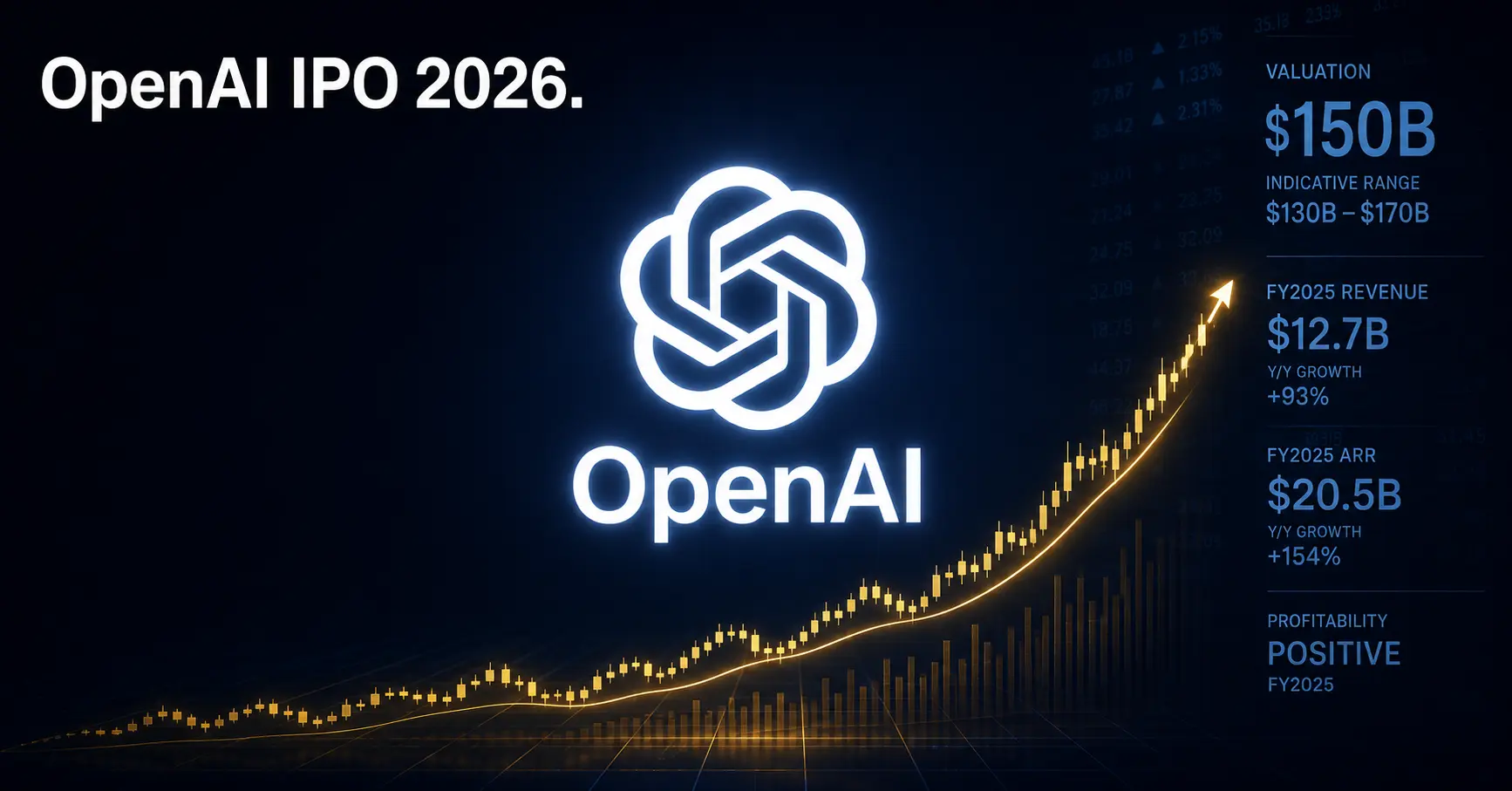
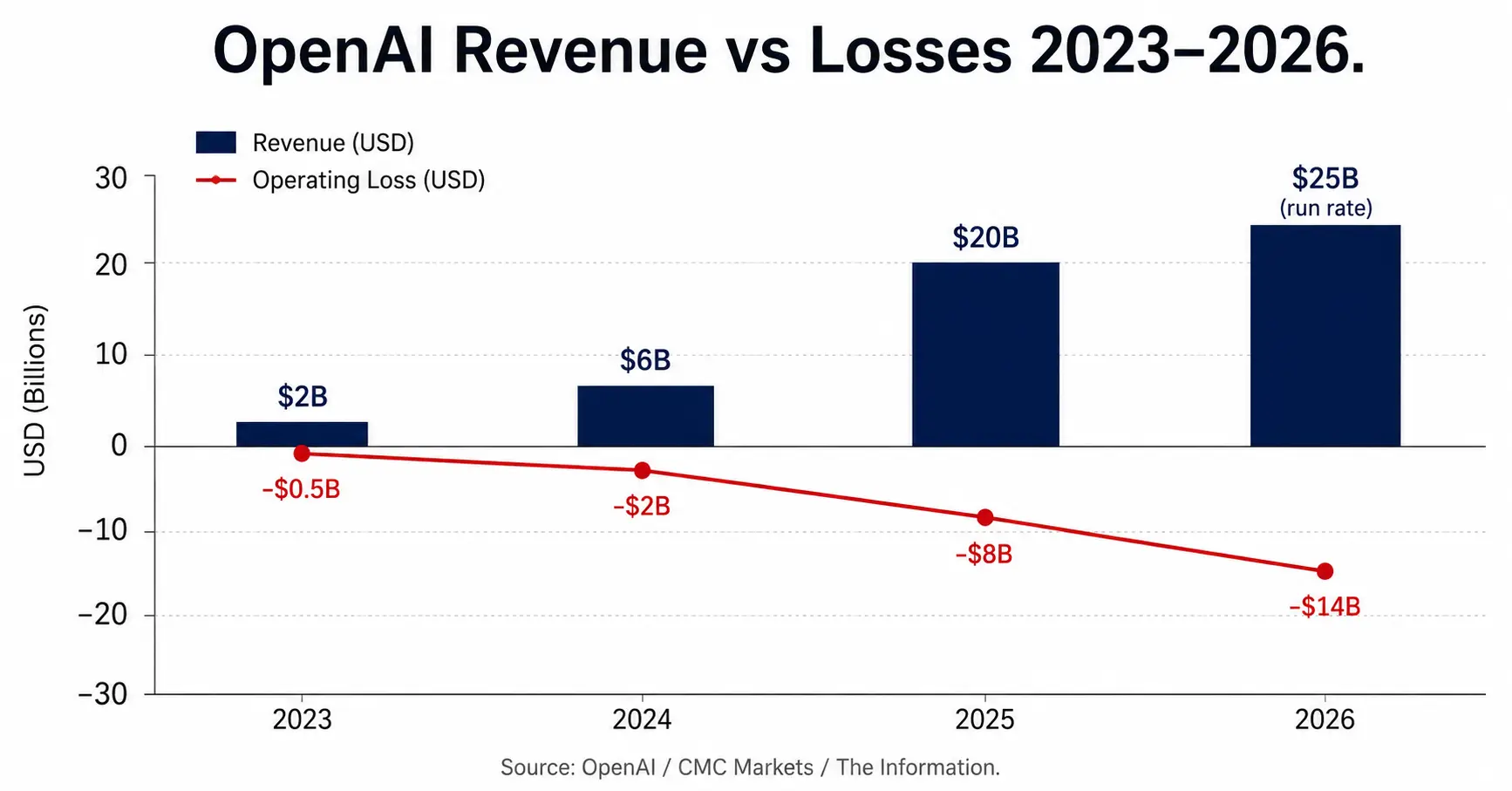
OpenAI’s revenue trajectory is genuinely striking. The company went from $2 billion in annualised revenue at the end of 2023 to $6 billion in 2024, then crossed $20 billion by the close of 2025, according to CMC Markets’ detailed OpenAI IPO analysis. By March 2026, annualised revenue had reached $25 billion on a run rate of $2 billion per month.
For comparison, Google took over a decade to reach comparable annual revenue levels. Sam Altman has publicly targeted $100 billion in annual revenue by 2027, which would represent one of the fastest revenue ramp-ups in corporate history.
The Loss Problem Every Investor Must Understand
Beneath the headline growth sits a difficult cost structure. OpenAI generated $5.7 billion in revenue in the first quarter of 2026. It also posted an adjusted operating margin of negative 122 percent. In practical terms, for every dollar OpenAI earned, it lost an additional $1.22, as reported by Where’s Your Ed At’s analysis of OpenAI’s Q1 2026 financials.
Internal projections show a $14 billion operating loss for full-year 2026. The company does not expect to reach profitability until around 2030. HSBC analysts estimate OpenAI may need over $207 billion in additional capital through 2030 just to meet its existing compute commitments.
Why the Losses Are a Compute Story
The loss story is not primarily about inefficient operations. It is a compute story. OpenAI plans to spend $50 billion on computing infrastructure in 2026 alone. To frame that number: the entire US semiconductor industry spent $56 billion on research and development in 2023.
The infrastructure commitments already on the books include:
- A $38 billion deal with Amazon Web Services running from 2025 to 2031
- A $60 billion per year agreement with Oracle covering 2027 to 2031, a $300 billion total commitment
- A multi-year GPU supply arrangement with AMD worth roughly $90 billion in cumulative value
These deals reflect the fundamental economics of large language model development. Every time a user queries ChatGPT, OpenAI pays for the GPU compute that generates the response. Unlike traditional software, the marginal cost of serving each additional user does not fall meaningfully as scale increases.
ChatGPT User Growth and the Monetisation Challenge
900 Million Weekly Users, Only 4 Percent Paying
ChatGPT reached 900 million weekly active users by March 2026, according to OpenAI’s own disclosures. The product’s growth has been unusually fast. It crossed 300 million weekly users in late 2024, 400 million in February 2025, 700 million by September 2025, and 900 million by early 2026.
However, only approximately four percent of those users currently pay for the service, according to Financial Times reporting. OpenAI has 50 million consumer subscribers and over one million business customers. The gap between reach and monetisation is one of the central questions any investor must resolve before evaluating the IPO.
How OpenAI Is Expanding Its Revenue Streams
Additionally, OpenAI has started diversifying revenue beyond ChatGPT Plus subscriptions. In January 2026, the company began showing advertisements to some US users of the free ChatGPT tier. Enterprise API licensing now covers over one million business customers. Strategic licensing deals tied to the $500 billion Stargate artificial intelligence infrastructure project with SoftBank and Oracle add another revenue layer.
Now, OpenAI is also building toward the operating system layer, expanding from browser and mobile access into native desktop applications for Mac and Windows. The company is also targeting personal finance and voice assistant markets following its acquisition of Weights.GG in January 2026, a voice-cloning technology firm.
OpenAI vs Anthropic: Two AI Giants Head to Wall Street
Anthropic Filed First
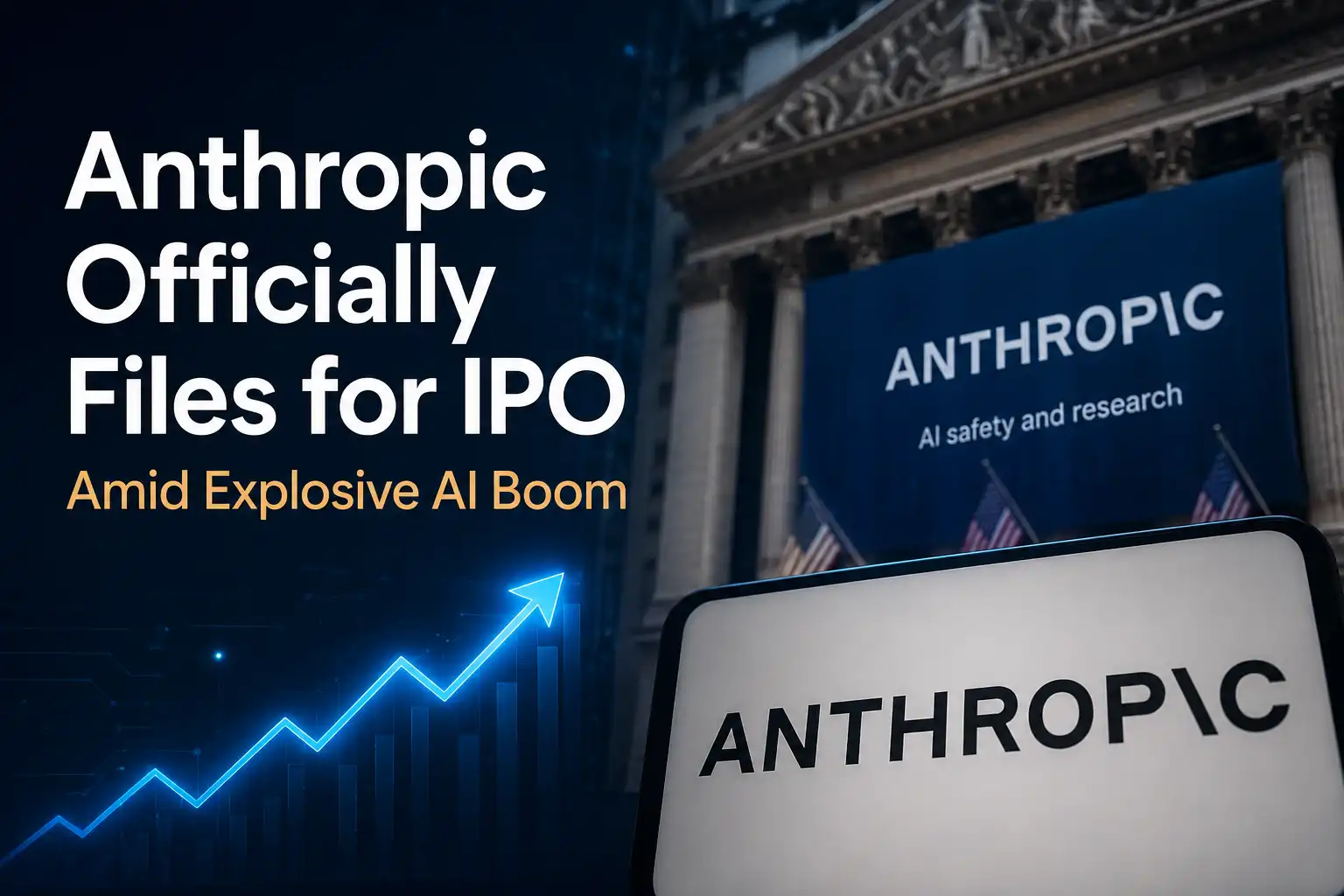
OpenAI is not alone in pursuing a public listing. Anthropic confidentially filed with the SEC on 1 June 2026, days before OpenAI’s public confirmation, targeting an October 2026 listing on the NASDAQ at a valuation of approximately $965 billion. That makes Anthropic’s implied valuation actually higher than OpenAI’s most recent private-market benchmark of $852 billion.
The financial contrast between the two companies is notable. Anthropic has told investors it expects to report its first profitable quarter in the second quarter of 2026. OpenAI does not project profitability until around 2030. Both companies are pursuing public listings in the same window, giving institutional investors a direct comparison between two very different risk profiles.
The Broader AI Industry Race to Go Public
The simultaneous push toward public markets reflects a broader shift in the artificial intelligence sector. Private funding rounds have grown to sovereign-scale sizes. Compute spending has become a geopolitical issue. The question of which AI platform becomes the default infrastructure layer for businesses worldwide remains genuinely open.
SpaceX also filed its public S-1 on 20 May 2026, disclosing financials for its combined SpaceX and xAI entity. The 2026 initial public offering season is shaping up to be the most consequential for the technology sector in a generation.
Governance and Structural Risks in the OpenAI IPO
The Public Benefit Corporation Conversion
The October 2025 conversion to a Public Benefit Corporation was the structural change that made this IPO legally possible. Before the conversion, a 100x investor return cap had limited OpenAI’s attractiveness to conventional equity investors. That cap was removed as part of the restructuring.
Critics have noted a less-reported detail. The original investor return cap had been quietly modified years before the formal PBC transition to allow a 20 percent annual increase starting in 2025. A 20 percent compounding increase doubles roughly every four years. The cap was structurally weak long before the formal switch was made.
Microsoft’s Stake and What It Means for Investors
Microsoft’s 26.79 percent fully diluted stake gives it enormous influence over OpenAI’s direction. The partnership has delivered compute access, distribution, and credibility. It has also created a dependency that public market investors will need to assess carefully. If Microsoft’s relationship with OpenAI shifts post-IPO, the consequences for both product development and revenue could be significant.
Furthermore, legal risks were cleared earlier this year when a California jury dismissed Elon Musk’s lawsuit against OpenAI, removing one of the last major institutional overhangs ahead of the listing, as noted by RoboRhythms’ analysis of the OpenAI IPO filing.
What the OpenAI IPO Means for the AI Investment Landscape
Setting AI Company Valuation Benchmarks
The OpenAI IPO will not just test one company’s finances. It will establish valuation benchmarks for the entire artificial intelligence sector. How public markets price OpenAI’s growth trajectory against its losses will determine the standard against which every other AI startup is measured going forward.
If investors accept a premium valuation despite negative margins, it signals that growth rate and market dominance outweigh near-term profitability in AI. If the market reprices sharply downward from private valuations, it will tighten funding conditions across the industry and force a rethink of how AI companies are built and capitalised.
The Key Metric to Watch When the S-1 Goes Public
The S-1 prospectus will become publicly available approximately 15 days before the IPO roadshow begins. When it drops, the gross margin line is the most important number to find. OpenAI’s gross margin was 33 percent in 2025, up from roughly four percent in 2024. That improvement is meaningful. However, the question is whether the margin trajectory is moving toward software-like economics or whether compute costs will keep it structurally below software peers.
Also, watch the ChatGPT subscriber conversion rate. Currently, roughly 900 million weekly users produce only 50 million paying subscribers. Closing that conversion gap is the single biggest lever OpenAI has for improving margins without cutting costs. The S-1 will be the first place to find audited answers, according to analysis by INDmoney’s inside look at OpenAI’s confidential SEC filing.
Frequently Asked Questions
When is the OpenAI IPO date?
OpenAI filed its S-1 confidentially on 22 May 2026 and confirmed the filing publicly on 8 June 2026. The company is targeting a public listing as early as September 2026, though the exact date depends on regulatory review and market conditions. No official IPO date has been confirmed.
What is OpenAI’s IPO valuation?
OpenAI’s most recent private-market valuation was $852 billion, set during its March 2026 funding round. Analysts project the OpenAI IPO valuation could exceed $1 trillion at listing, which would make it one of the largest public debuts in history.
Is OpenAI profitable?
No. OpenAI posted an adjusted operating margin of negative 122 percent in the first quarter of 2026, losing approximately $1.22 for every dollar earned. The company does not project profitability until around 2030 and expects to post a $14 billion operating loss in 2026.
Who are the main underwriters for the OpenAI IPO?
Goldman Sachs, Morgan Stanley, and JPMorgan are leading the offering. This is a standard arrangement for a high-profile technology listing at this scale and reflects the deal’s significance to Wall Street.
How does the OpenAI IPO compare to Anthropic’s?
Anthropic filed confidentially with the SEC on 1 June 2026, targeting an October 2026 NASDAQ listing at roughly $965 billion. Unlike OpenAI, Anthropic expects to report its first profitable quarter in mid-2026. Both companies are heading to public markets in the same window, giving investors a direct comparison point.
Can I buy OpenAI stock now?
Not yet. OpenAI shares will only become available after the IPO is priced and listed on a public exchange. Until then, access is limited to accredited investors through private secondary markets. The public offering is expected sometime in the second half of 2026.
Conclusion
The OpenAI IPO represents more than one company going public. It is the moment when artificial intelligence’s most recognised name submits its finances to public scrutiny for the first time. The revenue growth is extraordinary. The losses are also extraordinary. Both are real, and both will define how public markets ultimately value this company and the broader AI sector around it.
For investors, the central question is straightforward even if the answer is not: does OpenAI’s trajectory toward $100 billion in revenue and eventual profitability justify buying in at a $1 trillion valuation before that profitability arrives? The gross margin improvement from four percent in 2024 to 33 percent in 2025 is the most encouraging data point on the table. Whether that trend continues through 2026 and 2027 will determine whether the bull case holds at any price above $852 billion.
Whatever the outcome, the OpenAI IPO will set the tone for AI investment for years to come. It will establish how public markets price technology companies that operate at a loss in pursuit of long-term dominance at a global scale. The S-1 prospectus, when it becomes public ahead of the roadshow, will be the most closely read financial document of 2026. For a deeper grounding in how AI company economics work, the Sacra OpenAI revenue and funding analysis is one of the most rigorous independent resources available.
Follow the gross margin line when the prospectus drops. Watch the subscriber conversion rate. Keep one eye on Anthropic’s competing filing, which targets a listing before OpenAI’s own roadshow begins. The race to define AI’s public market era has started, and 2026 is when it gets real.

Prince Anichi
Founder and Lead Technology Editor at Ortechy. Covering digital economy shifts, tech ecosystems across Africa, cybersecurity intelligence, and emerging software platforms.