Technologies That Could Change the World by 2035
The next decade may be the most transformative in human history. Technologies that could change the world by 2035 are no longer confined to research labs or speculative reports. They are being tested in hospitals, funded by governments, and deployed in cities right now. The gap between science fiction and everyday life has never been smaller.
In 2025 alone, IBM announced a path to fault-tolerant quantum computing by 2029, CRISPR gene therapy successfully eliminated tumors in end-stage cancer patients, and the U.S. Department of Energy released a national roadmap targeting fusion energy on the grid by the mid-2030s. These are not distant promises. They are active, measurable programs with published timelines and real results.
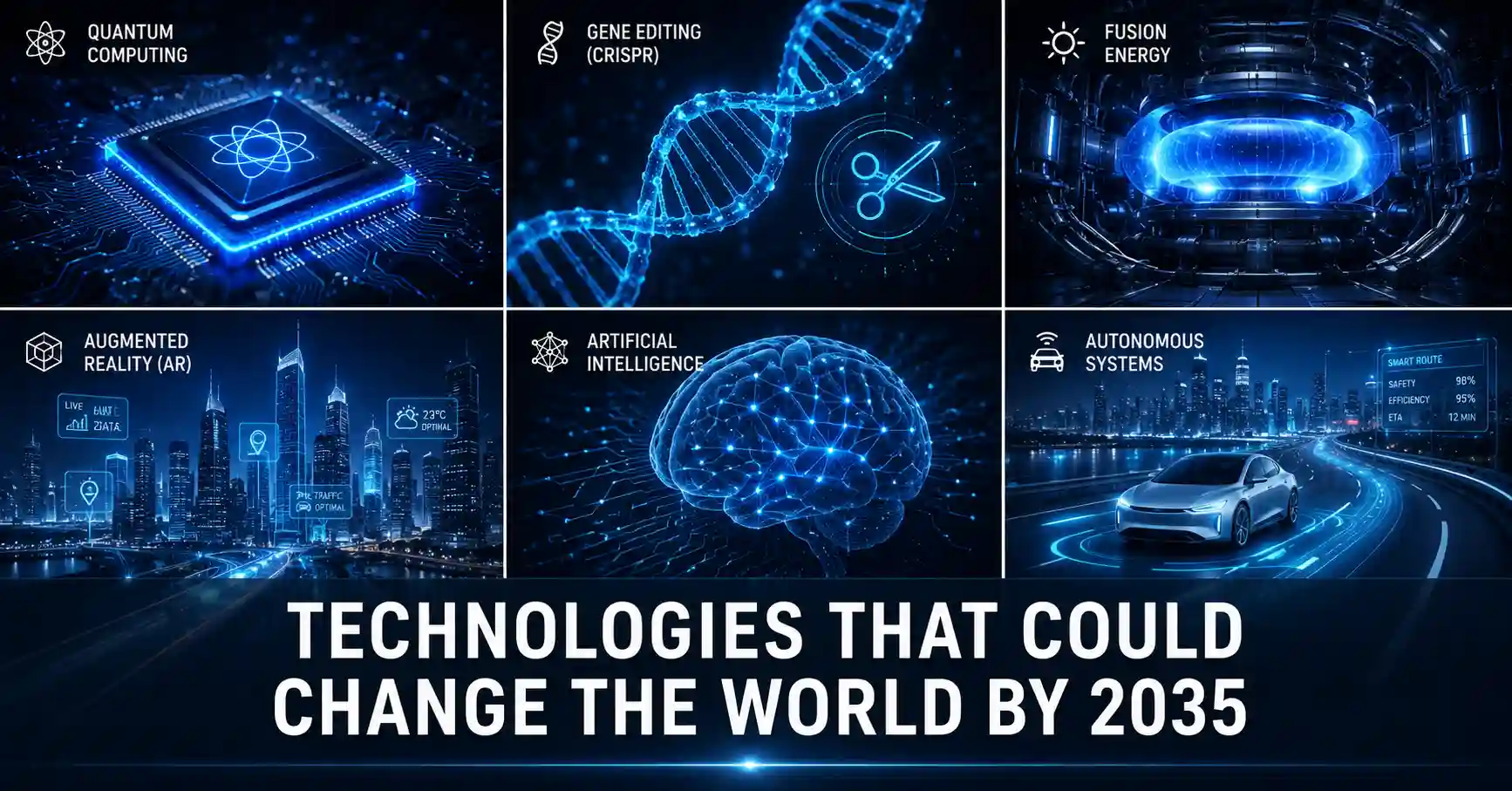
This post covers the ten most significant emerging technologies set to reshape the world before 2035. Each one carries genuine, verified momentum. Understanding them now gives you a clearer picture of what is coming and why it matters.
Why the Next Decade Is Different for World-Changing Technologies
Previous technology cycles moved in isolated waves. Computing arrived, then the internet, then smartphones. Each wave took decades to mature. What makes the 2025-to-2035 window unique is that multiple transformative technologies are converging at once. Artificial intelligence (AI), quantum computing, biotechnology, and clean energy are not developing in separate silos. They are feeding into each other and accelerating together.
The economic scale reflects this urgency. Private investment in fusion energy alone surpassed $9.7 billion by July 2025, as reported by the U.S. Department of Energy’s Fusion Science and Technology Roadmap. The AI sector commands hundreds of billions more. Governments from Washington to Beijing are treating these technologies as strategic national priorities, not optional research projects.
Additionally, regulatory frameworks are catching up. The U.S. Food and Drug Administration (FDA) approved the first CRISPR-based gene therapy in 2023, opening a legal pathway that now supports over 250 active clinical trials worldwide. Speed, scale, and investment are all pointing in the same direction.
Artificial Intelligence: The Foundation Layer for All Future Technologies
From Tool to Infrastructure
AI is no longer a product you buy. By 2035, it will function more like electricity: invisible, essential, and embedded in almost every process. Today’s AI helps with writing, coding, and customer service. Tomorrow’s AI will design drugs, run power grids, and diagnose diseases before symptoms appear.
According to a major canvassing by the Pew Research Center involving over 300 technology experts, AI systems by 2035 are expected to enable personalized medical care, fact-based digital discourse tools, and ambient computing environments that respond to context without direct user input, as detailed in Pew Research’s expert predictions report on digital life by 2035.
Agentic AI and Autonomous Systems
The shift toward agentic AI is already underway. Agentic AI refers to systems that set goals, take multi-step actions, and complete tasks without constant human input. Huawei’s Intelligent World 2035 report projects that by 2035, nine billion people will be connected to 900 billion AI agents, effectively creating an agentic internet that replaces the passive, scroll-based web we use today.
Furthermore, global computing capacity is expected to increase by 100,000 times over the next decade, driven by breakthroughs in semiconductor materials and computing architectures. This scale of processing power will make real-time AI in every device, vehicle, and institution not just possible but inevitable.
Quantum Computing: Solving Problems Classical Computers Cannot
The Race to Practical Advantage
Quantum computing uses the principles of quantum physics to process information in ways that conventional computers cannot. While a standard computer uses bits that are either zero or one, a quantum computer uses qubits, which can exist in multiple states simultaneously. This allows quantum machines to solve certain problems exponentially faster.
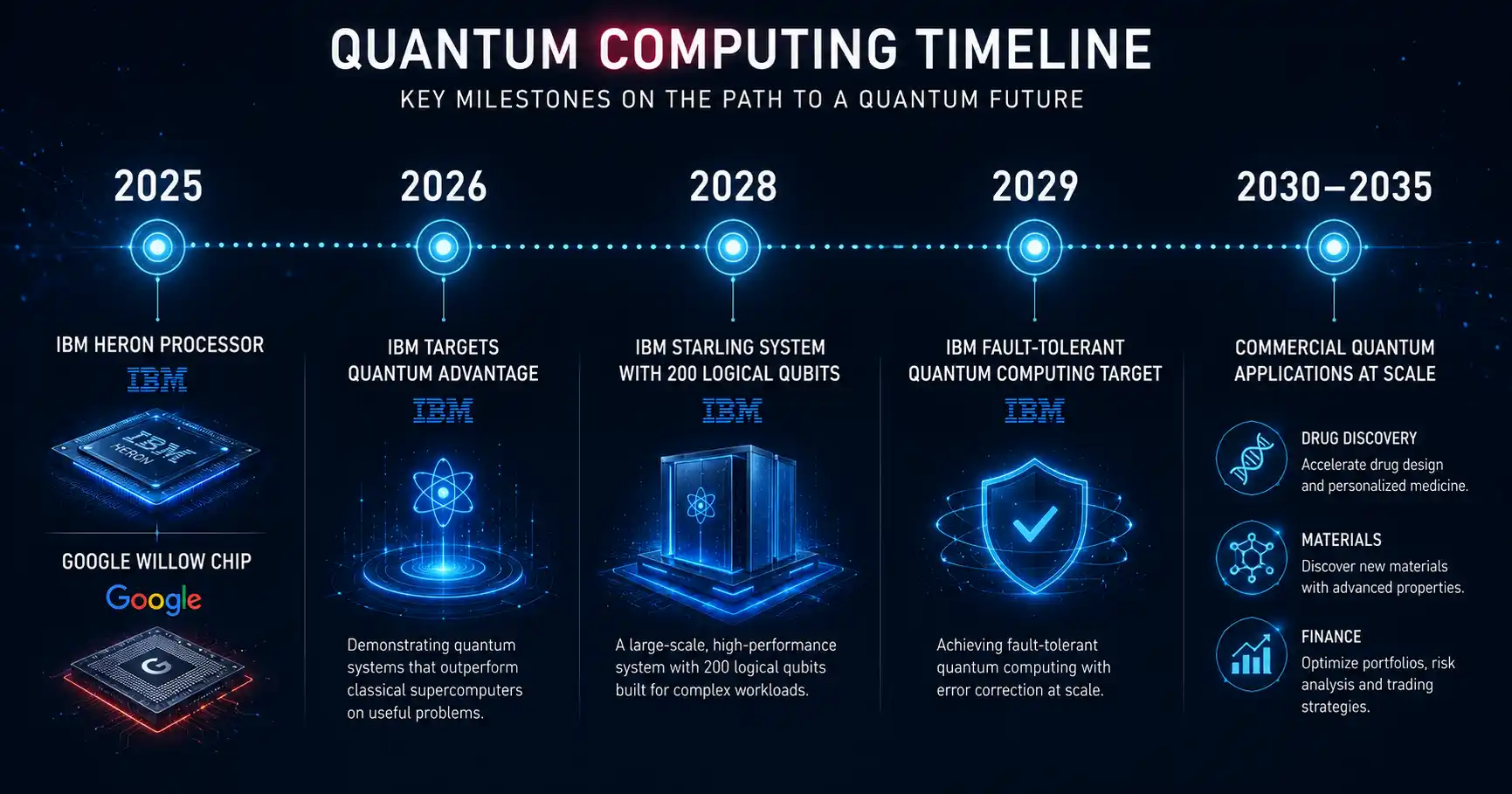
The progress made in 2025 was substantial. IBM announced its Quantum Loon processor, demonstrating all hardware elements required for fault-tolerant quantum computing, and committed to achieving quantum advantage by end-2026 and full fault tolerance by 2029, as confirmed in IBM’s official November 2025 newsroom announcement.
Real-World Applications Taking Shape
Google’s Willow chip, featuring 105 superconducting qubits, demonstrated exponential error reduction as qubit counts increased, a milestone known as going below threshold that validates the path to reliable, large-scale quantum systems. Meanwhile, Caltech researchers built a record-breaking 6,100-qubit array in which qubits maintained their quantum state for 13 seconds, ten times longer than any previous system.
In practice, IonQ and Ansys ran a medical device simulation in 2025 that outperformed classical high-performance computing by 12 percent, marking one of the first documented cases of real-world quantum advantage. By 2035, quantum computers are expected to accelerate drug discovery, break current encryption systems, and solve optimization problems in logistics, finance, and climate modeling that today require months of computing time.
CRISPR Gene Editing: Rewriting the Biology of Disease
From Lab to Clinic
CRISPR-Cas9 is a gene-editing tool that works like molecular scissors. Scientists use it to cut and rewrite specific sequences of DNA with precision that was unimaginable a decade ago. The technology has now moved firmly from laboratory research into human clinical trials with documented results.
A landmark 2025 trial at the University of Minnesota used CRISPR to help the immune system attack advanced gastrointestinal cancers, finding the treatment safe across all 12 patients, with one patient achieving a complete response in which metastatic tumors disappeared over several months and have not returned in over two years, as published in Lancet Oncology and reported by the University of Minnesota Medical School.
Beyond Cancer: Cholesterol, Blood Disorders, and More
Also in 2025, a Cleveland Clinic Phase 1 trial used CRISPR-Cas9 to produce a one-time infusion that safely reduced LDL cholesterol and triglycerides in patients with lipid disorders resistant to all current medications. Levels dropped within two weeks and held for at least 60 days, with no serious adverse events reported.
Separately, UK researchers reported the first successful treatment of Huntington’s disease using a gene therapy delivered directly to the brain, reducing disease progression by up to 75 percent in clinical trials. As of early 2026, CRISPR Medicine News monitors approximately 250 active clinical trials involving gene-editing therapies, spanning blood disorders, cancers, cardiovascular disease, and rare inherited conditions. By 2035, CRISPR treatments for a wide range of previously incurable diseases are expected to be commercially available.
Nuclear Fusion Energy: Clean Power Without Limits
Why Fusion Is Different From Every Other Energy Source
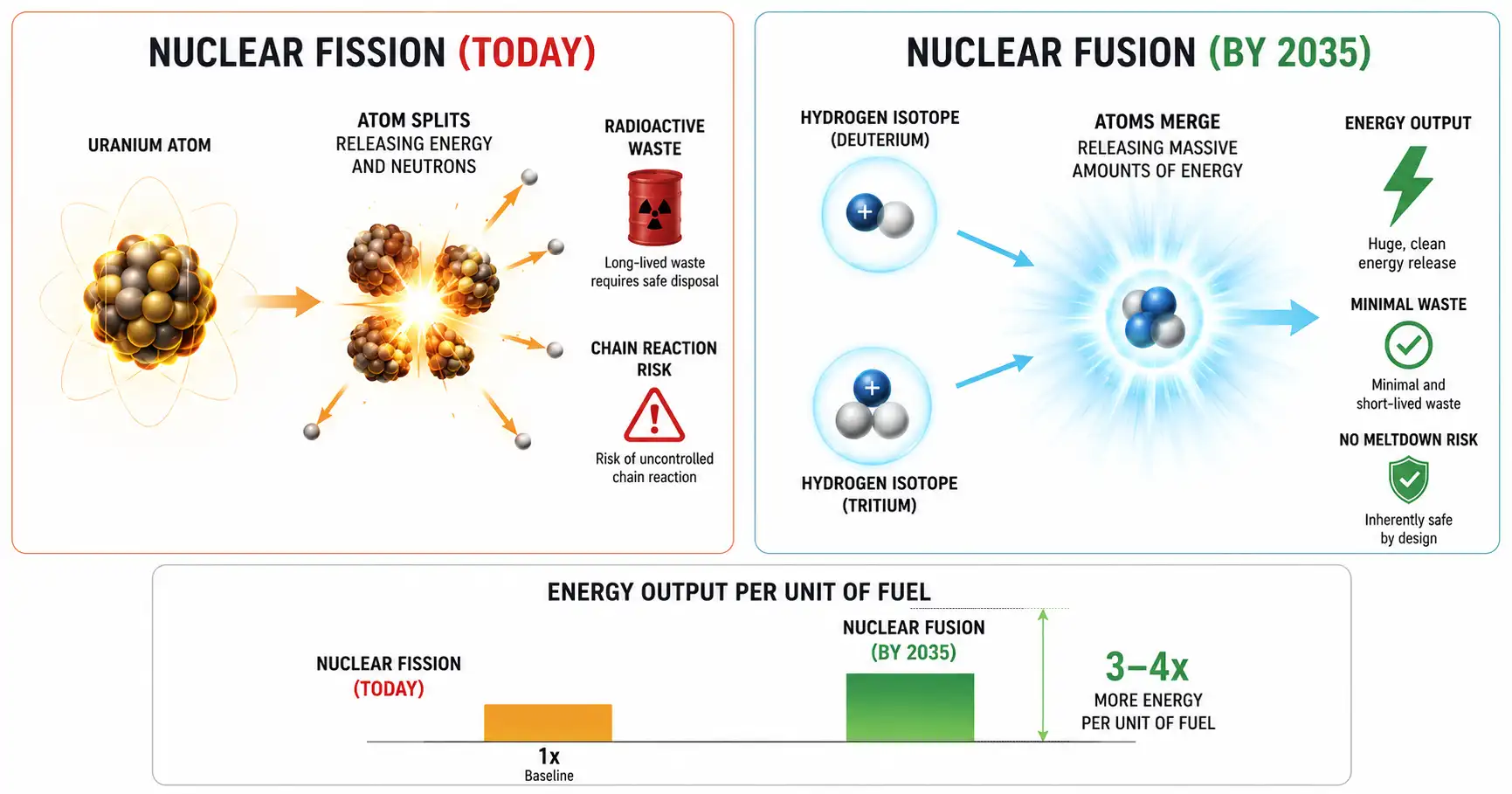
Nuclear fusion is the process that powers the sun. It combines light atoms, typically hydrogen isotopes, to release enormous amounts of energy. Unlike nuclear fission, which splits heavy atoms and produces long-lived radioactive waste, fusion creates minimal waste and carries no risk of a chain reaction or meltdown. The fuel source, hydrogen, is effectively unlimited.
The challenge has always been containing plasma at temperatures hotter than the sun long enough to extract usable energy. That engineering problem is now being solved. The U.S. Department of Energy released its national Fusion Science and Technology Roadmap in October 2025, targeting commercial fusion power on the grid by the mid-2030s, backed by over $9.7 billion in private investment from U.S. fusion companies.
Companies Racing Toward the Grid
Helion Energy secured a permit for its Orion facility in Washington State in late 2025, the first fusion facility permitted for a commercial industrial site rather than a specialist research zone. The company holds a standing power purchase agreement (PPA) with Microsoft targeting power delivery by 2028. Commonwealth Fusion Systems has announced a commercial plant timeline targeting 2031 to 2032.
Market analysts project the fusion energy sector could reach between $40 billion and $80 billion by 2035 if key technological milestones are achieved, and could exceed $350 billion by 2050. The trajectory is no longer speculative. It is an engineering race with known participants and measurable checkpoints.
Brain-Computer Interfaces: Connecting Minds and Machines
Brain-computer interfaces (BCIs) translate electrical signals from the brain into digital commands. They allow people to control devices, communicate, or interact with software using thought alone. The technology is already helping paralyzed patients type messages and control robotic limbs, and it is accelerating fast.
By 2035, BCIs are expected to move from purely medical applications into cognitive enhancement and sensory expansion. AI-enhanced BCIs will treat neurological conditions including Parkinson’s disease, severe depression, and spinal cord injuries. Memory enhancement and sensory augmentation may become clinically available for specific conditions by the end of the decade, representing a fundamental shift in what it means to interact with digital systems.
Experts surveyed by Pew Research predict that brain-computer interfaces will restore and enhance cognitive abilities, with physical augmentation helping mobility, strength, and recovery becoming normalized well before 2035. This technology will not just treat disability. It will redefine the boundary between human cognition and machine processing.
Autonomous Vehicles and Smart Mobility
Self-driving vehicles have been discussed for over a decade, but the underlying technology is finally reaching the maturity needed for large-scale deployment. The combination of improved AI perception, vehicle-to-vehicle communication, and edge computing, which processes data locally on the device rather than sending it to a remote server, is making autonomous systems more reliable than human drivers in controlled environments.
By 2030, autonomous vehicles are expected to dominate transportation in major cities. By 2035, the effects will reshape urban planning at scale. Demand for parking infrastructure will decline significantly as autonomous ride-sharing services replace private car ownership in dense urban areas. Huawei’s technology research team projects that Level 4 autonomous vehicles, which handle all driving without any human input under specific conditions, will serve as mobile workspaces and third spaces for passengers by 2035.
However, the transformation goes beyond cars. Autonomous delivery, drone logistics, and AI-managed traffic systems will collectively reduce congestion, lower transport emissions, and improve last-mile delivery efficiency in ways that current infrastructure cannot achieve.
Synthetic Biology: Engineering Life Itself
Synthetic biology applies engineering principles to living organisms. Scientists design and build new biological parts, systems, and organisms that do not exist in nature, or redesign existing ones to perform new functions. The applications range from designing microbes that consume plastic waste to engineering cells that produce cancer-fighting proteins on demand.
Harvard Business School has identified synthetic biology as one of three technologies already past commercial viability and on track to change the foundations of business and society by 2035, alongside AI and blockchain. Plant-based biomanufacturing, in which plants are engineered to produce pharmaceuticals, enzymes, or industrial materials, is creating entirely new categories of sustainable production. Stress-resilient crops engineered through synthetic biology could address food security for a global population projected to reach 9.7 billion by 2050.
The European Innovation Council has highlighted synthetic biology as a critical emerging technology alongside several others across health, green, and digital sectors. Unlike previous biotech advances that modified existing organisms incrementally, synthetic biology is beginning to design entirely new biological systems from first principles, with applications across medicine, agriculture, manufacturing, and environmental remediation.
Advanced Energy Storage and Next-Generation Batteries
Every clean energy transition depends on one bottleneck: storage. Solar panels and wind turbines generate power when the sun shines or the wind blows. Without efficient, affordable storage, surplus energy is lost and supply gaps persist. Solving this problem is as strategically important as building the renewable generation capacity itself.
Solid-state batteries, which replace the liquid electrolyte in conventional lithium-ion batteries with a solid material, offer significantly higher energy density, faster charging, and improved safety. They are in advanced development at Toyota, QuantumScape, and Samsung, with commercial electric vehicles using solid-state cells targeted for production by 2027 to 2028. By 2035, grid-scale solid-state and next-generation battery systems are expected to make 24-hour renewable power delivery economically viable in most major markets.
Meanwhile, Huawei’s projections indicate that AI storage demand will increase by 500 times between 2025 and 2035, eventually accounting for more than 70 percent of global total data storage, which will drive massive parallel innovation in storage technology across both consumer and industrial applications.
Extended Reality: When Digital and Physical Worlds Merge
Extended reality (XR) is the umbrella term for augmented reality (AR), virtual reality (VR), and mixed reality (MR). AR overlays digital information onto the physical world. VR places users inside entirely simulated environments. MR allows digital objects to interact with the physical environment in real time. By 2035, these technologies will converge into an ambient layer of computing that surrounds everyday life.
Voice, gesture, and neural interfaces will reduce reliance on screens. Information will appear in a user’s field of vision only when relevant, then disappear. This shift will reduce digital overload and create a more natural relationship between humans and the technology around them. Industries from surgery and engineering to retail and education will build workflows around XR as a primary interface rather than a supplementary tool.
The global XR market, valued at around $40 billion in 2024, is projected by multiple analysts to exceed $250 billion by 2030. By 2035, XR headsets and smart glasses are expected to achieve the kind of mass adoption that smartphones reached by 2015, fundamentally changing how people access information, collaborate at a distance, and experience entertainment.
Frequently Asked Questions
What technologies will have the biggest impact by 2035?
AI, quantum computing, CRISPR gene editing, nuclear fusion, and brain-computer interfaces are all on verified development timelines with documented milestones. Each one affects multiple industries simultaneously, which makes their combined impact significantly larger than any single technology in isolation.
Is nuclear fusion energy actually achievable by 2035?
The U.S. Department of Energy published a formal roadmap in October 2025 targeting commercial fusion power on the grid by the mid-2030s. Helion Energy has a power agreement with Microsoft targeting 2028 delivery, and Commonwealth Fusion Systems has announced a commercial plant timeline of 2031 to 2032. These are engineering projects with permits and funding, not theoretical targets.
How close is quantum computing to being practically useful?
IBM is targeting quantum advantage, meaning a quantum computer outperforms classical computers on a real-world task, by end-2026. In 2025, IonQ already demonstrated 12 percent performance superiority over classical systems in a medical simulation. Fault-tolerant quantum computing at scale is targeted for 2029 by IBM.
What can CRISPR gene editing treat right now?
The FDA approved the first CRISPR-based therapy, Casgevy, for sickle cell disease in 2023. Clinical trials in 2025 showed positive results for heart disease, advanced cancers, and Huntington’s disease. As of early 2026, more than 250 gene-editing clinical trials are actively enrolling patients worldwide.
Will brain-computer interfaces be available to the general public by 2035?
Clinical applications for neurological conditions such as Parkinson’s disease, spinal cord injury, and severe depression are expected to reach broad medical deployment before 2035. Consumer applications for cognitive enhancement are at earlier stages, with researchers expecting limited but real availability by the end of the decade.
What is the biggest risk of these emerging technologies?
Experts surveyed by Pew Research consistently identify two core risks: the concentration of these technologies’ benefits among a small number of wealthy nations and individuals, and the use of AI and synthetic biology tools in ways that could degrade privacy, enable surveillance, or produce biological risks. Governance frameworks are developing alongside the technologies, but the pace of regulation trails the pace of deployment.
The Future Is Already Being Built: What These Technologies Mean for You
The technologies covered in this post share one important characteristic. None of them are waiting for a distant breakthrough to become real. Quantum computers exist and are commercially accessible today via cloud platforms. CRISPR therapies are saving lives in clinical trials right now. Fusion energy companies are applying for permits and signing power contracts. The gap between laboratory and daily life is measured in years, not generations.
What changes between now and 2035 is scale, cost, and reach. Technologies that currently serve thousands of patients or require billion-dollar facilities will, within a decade, become accessible to millions of people across diverse economic settings. The pattern matches what happened with genomic sequencing, which cost $3 billion for the first human genome in 2003 and under $200 today.
The single most important takeaway is this: these technologies are not developing independently. AI is accelerating CRISPR research. Quantum computing will optimize fusion energy design. Brain-computer interfaces will run on AI models trained on quantum hardware. The convergence is what makes the next decade genuinely unprecedented. Each advance amplifies the others, compressing the timeline for transformations that would otherwise take much longer.
To stay informed as these developments unfold, two authoritative resources are worth bookmarking: the Pew Research Center’s ongoing expert canvassing on digital life by 2035 and the U.S. Department of Energy’s official fusion energy roadmap. The world that arrives in 2035 is being designed today, and understanding it starts with paying attention now.

Prince Anichi
Founder and Lead Technology Editor at Ortechy. Covering digital economy shifts, tech ecosystems across Africa, cybersecurity intelligence, and emerging software platforms.