In this article35 sections
- 01.What Is Social Engineering in Cyber Security?
- 02.How Social Engineering Attacks Work: The Psychology Behind Every Attack
- ↳Authority
- ↳Urgency and Fear
- ↳Likeability and Familiarity
- ↳Scarcity and Reciprocity
- 03.The Most Common Types of Social Engineering Attacks in 2026
- ↳1. Phishing
- ↳2. Spear Phishing
- ↳3. Vishing (Voice Phishing)
- ↳4. Smishing (SMS Phishing)
- ↳5. Pretexting
- ↳6. Baiting
- ↳7. Quid Pro Quo
- ↳8. Tailgating and Piggybacking
- ↳9. ClickFix Attacks
- 04.Why Social Engineering Attacks Succeed So Consistently
- 05.Real-World Social Engineering Examples from 2025 and 2026
- ↳The $1.5 Billion Bybit Heist
- ↳The Scattered Spider Retail Attacks
- ↳The AI Director Voice Clone
- 06.How to Defend Against Social Engineering Attacks
- ↳1. Train People to Recognise the Tactics
- ↳2. Implement Multi-Factor Authentication Everywhere
- ↳3. Establish Verification Procedures for High-Risk Requests
- ↳4. Apply the Principle of Least Privilege
- ↳5. Deploy Technical Controls Alongside Human Training
- ↳6. Create a Culture Where Reporting Is Safe
- 07.Frequently Asked Questions About Social Engineering in Cyber Security
- ↳What is the most common type of social engineering attack?
- ↳How is social engineering different from hacking?
- ↳Can AI be used for social engineering attacks?
- ↳How do I know if I am being socially engineered?
- ↳What industries are most targeted by social engineering attacks?
- 08.Social Engineering Is a Human Problem That Requires a Human Solution
What Is Social Engineering in Cyber Security? Everything You Need to Know in 2026
Social engineering in cyber security is the art of manipulating people rather than machines. Instead of breaking through firewalls or cracking encryption, a social engineering attacker exploits human trust, fear, urgency, and helpfulness to steal information, gain access, or trigger actions that compromise security. It is the most widespread attack method in cyber security today and it is getting more dangerous every year.
The statistics make the scale of this threat impossible to ignore. According to research compiled by StationX from over 50 authoritative sources including IBM, Verizon, CrowdStrike, and the FBI, a staggering 98 percent of all cyberattacks involve some form of social engineering. Social engineering losses hit $16.6 billion in 2024 according to FBI Internet Crime Complaint Center data. And 95 percent of all cybersecurity incidents trace back to human error triggered by social engineering tactics.
This guide explains exactly what social engineering is, how every major type of attack works, why these attacks succeed so consistently, and what you and your organisation can do right now to defend against them.
What Is Social Engineering in Cyber Security?
Social engineering is a method of attack where criminals manipulate people into revealing confidential information, transferring money, clicking malicious links, or granting access to systems and data they should not be able to reach. The attacker never needs to exploit a single line of code. They exploit human psychology instead.
Think about how trust works in everyday life. You hold a door open for someone in a uniform. You answer a question from someone who sounds authoritative. You act quickly when you receive an urgent message from your bank. Social engineers study and exploit these exact instincts. They design every interaction to feel legitimate, urgent, and reasonable so that their target acts before stopping to question anything.
The Verizon 2025 Data Breach Investigations Report confirmed that social engineering is a factor in 60 percent of all data breaches. It is not a niche threat or an advanced attacker technique. It is the dominant method through which criminals gain their first foothold in systems, companies, and individual accounts worldwide.
How Social Engineering Attacks Work: The Psychology Behind Every Attack
Every social engineering attack exploits one or more psychological principles that govern how human beings make decisions under pressure. Understanding these principles is the first step toward recognising an attack when it is happening to you.
Authority
Attackers impersonate people or organisations with authority, such as a CEO, an IT administrator, a government agency, a bank, or a police officer. Most people naturally comply with requests from authority figures without questioning them deeply. A criminal who convincingly impersonates an executive asking an employee to transfer funds urgently will succeed in many cases simply because the request appears to come from someone in power.
Urgency and Fear
Creating a sense of urgency is the most reliable way to shut down critical thinking. When you believe you need to act immediately to prevent something bad from happening, you skip the verification steps that would normally expose a scam. An email claiming your account will be suspended in 24 hours, a call saying your Social Security number has been compromised, or a message warning that a payment failed all create the same effect: panic that overrides rational judgement.
Likeability and Familiarity
People are far more willing to help someone they like or recognise. Social engineers study their targets on social media and professional networks to build convincing familiarity before making a request. They mention names, reference recent events, and speak the language of the target’s industry to feel like someone the victim already knows.
Scarcity and Reciprocity
Scarcity makes offers feel more valuable. Reciprocity makes people feel obligated to return favours. Attackers use both by offering something first, a piece of information, a small gift, helpful technical assistance, and then leveraging the resulting sense of obligation to extract something far more valuable in return.
The Most Common Types of Social Engineering Attacks in 2026
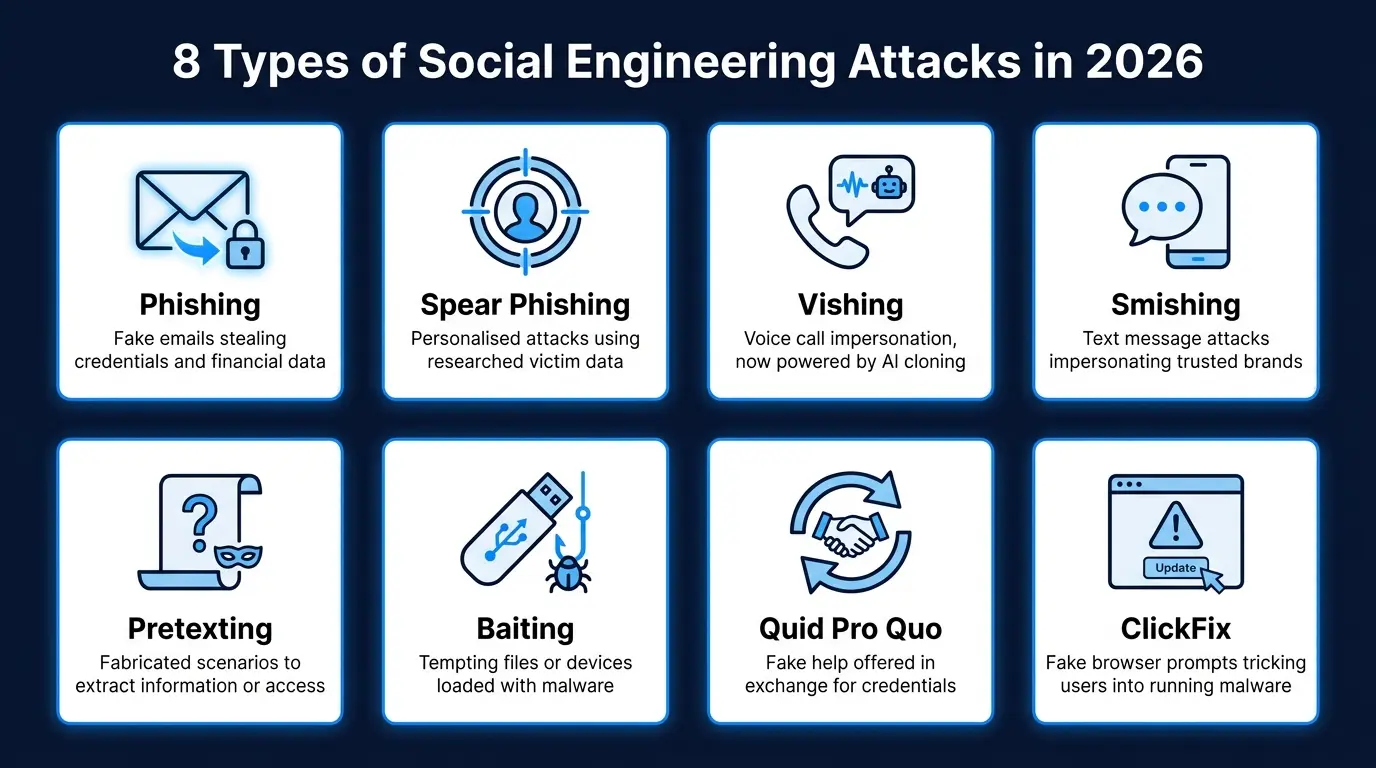
Social engineering attacks take many forms, each tailored to a different channel, target, and desired outcome. Here is how every major type works, with real examples from 2025 and 2026.
1. Phishing
Phishing is the most common social engineering attack in cyber security. It uses fraudulent emails, messages, or websites that impersonate trusted organisations to steal login credentials, financial information, or personal data. According to the Verizon DBIR 2025, phishing accounted for 57 percent of all social engineering breaches. In 2026, 82.6 percent of phishing emails are AI-generated, making them grammatically perfect and contextually convincing in ways that earlier phishing attempts never were.
A phishing email might appear to come from your bank warning you about suspicious activity. It directs you to a fake website that looks identical to your bank’s site. You enter your login credentials. The attacker captures them and takes over your account within minutes.
2. Spear Phishing
Spear phishing is a targeted version of phishing directed at a specific individual or organisation. Instead of a generic message sent to millions of addresses, a spear phishing attack is personalised using information the attacker researched about you specifically. It references your name, your employer, your role, your colleagues, and sometimes recent events in your professional life to feel completely legitimate.
The $1.5 billion Bybit cryptocurrency heist in February 2025 began with a spear phishing attack. North Korea’s Lazarus Group socially engineered a developer at Safe{Wallet} by posing as a trusted open-source contributor. The attacker maintained access for 20 days before manipulating a multisignature wallet transaction that moved $1.5 billion in a single transfer. SecurityWeek’s Cyber Insights 2026 analysis details how this attack and others like it are reshaping the threat landscape.
3. Vishing (Voice Phishing)
Vishing is social engineering carried out over phone calls. An attacker calls you impersonating a bank fraud department, a government agency, a tech support team, or even a colleague. The goal is to extract sensitive information, transfer money, or convince you to install software that gives them remote access to your device.
Vishing surged 442 percent in a single six-month period according to CrowdStrike data. In 2026, AI voice cloning has made vishing attacks far more convincing because attackers can now clone the voice of a real person using as little as three seconds of publicly available audio. A bank manager in one high-profile case transferred $35 million after receiving a call from what he believed was the voice of his bank’s director. The voice was entirely AI-generated. In another case documented in 2026, a single vishing call resulted in 12.4 million CarGurus records being stolen.
4. Smishing (SMS Phishing)
Smishing attacks arrive via text message and have grown sharply as email security filters have improved. Attackers send messages impersonating delivery companies, banks, government agencies, or retailers. A typical smishing message tells you your package could not be delivered and asks you to click a link and confirm your address or payment details. That link leads to a fake site that harvests your information.
5. Pretexting
Pretexting involves creating a fabricated scenario, called a pretext, to manipulate a target into providing information or access. An attacker might call an employee pretending to be from the IT department and explain that they need the employee’s login credentials to perform an urgent system update. They build a convincing backstory, reference plausible technical problems, and use insider-sounding language to establish credibility before making their request.
Pretexting now accounts for more than 50 percent of all social engineering incidents according to StationX analysis of Verizon DBIR 2025 data. It is particularly effective because it exploits the natural human desire to be helpful to a colleague who appears to need assistance.
6. Baiting
Baiting attacks offer something tempting to lure a victim into a trap. The most famous physical example is leaving USB drives in a car park outside a target organisation, pre-loaded with malware. Curious employees pick them up and plug them into their work computers, triggering the malware automatically. Digital baiting works the same way through free software downloads, free media files, or prize notifications that install malicious code when opened.
7. Quid Pro Quo
Quid pro quo attacks offer a service in exchange for information. A common version involves an attacker calling employees posing as IT support and offering to fix a problem they did not know they had. In exchange for the “fix,” they ask for the employee’s login credentials to complete the support session. The employee believes they are receiving help while they are actually giving an attacker the keys to their account.
8. Tailgating and Piggybacking
Tailgating is a physical social engineering attack where an unauthorised person follows an authorised person through a secured door without using their own credentials. The attacker might dress as a delivery driver, carry large boxes to create a situation where someone holds the door out of courtesy, or simply walk confidently behind an employee. Once inside, they have physical access to devices, server rooms, and confidential materials.
9. ClickFix Attacks
ClickFix is a rapidly growing social engineering technique that manipulates victims through fake browser prompts and error messages. ClickFix campaigns surged 517 percent in 2025. An attacker creates a fake website or injects a malicious pop-up into a legitimate site that tells the user their browser needs to be fixed. The pop-up provides instructions asking the user to open their command prompt and paste a piece of code. That code is malware. The entire attack bypasses traditional email security because it happens in the browser and the user executes the malicious code themselves.
Why Social Engineering Attacks Succeed So Consistently
The most important reason social engineering attacks succeed is that they target something no firewall or antivirus can patch: human nature. Technical security controls are powerful but they assume that the humans using them make rational decisions under pressure. Social engineering is specifically designed to prevent rational decision-making.
A 2025 IBM study found that generative AI allows criminals to create a convincing phishing message in just five minutes. The same message would have taken a skilled human attacker hours to write. That speed advantage means attackers can run personalised campaigns at scale that were previously impossible. They can target thousands of individuals with personalised spear phishing messages that reference each person’s specific job title, employer, recent professional activity, and personal connections.
The rise of deepfake technology compounds this further. Voice deepfakes and video deepfakes remove the last line of defence that many people rely on, namely the ability to verify identity through voice or appearance. When you cannot trust that the voice on the phone belongs to the person it claims to, and when AI can simulate that voice in real time, the traditional cues that separate legitimate contact from criminal impersonation disappear entirely.
Secureframe’s analysis of social engineering statistics shows that 68 percent of businesses report experiencing social engineering attempts every single week, and 83 percent of organisations faced these attacks in 2025, up from 76 percent in 2024.
Real-World Social Engineering Examples from 2025 and 2026
Abstract statistics become real when you look at specific incidents. These attacks from the past two years show how social engineering operates in practice across industries and scales.
The $1.5 Billion Bybit Heist
North Korea’s Lazarus Group executed the largest cryptocurrency theft in history using social engineering as the initial access vector. They posed as a legitimate open-source contributor to gain the trust of a developer at Safe{Wallet}, a smart contract platform used by Bybit. After maintaining trusted access for 20 days, they manipulated a transaction that moved $1.5 billion in February 2025.
The Scattered Spider Retail Attacks
The hacking group Scattered Spider caused $300 million in losses through social engineering attacks on major UK and US retailers. Their method in most cases was vishing. They called IT help desks and used detailed personal information gathered from LinkedIn and other sources to convince support staff to reset employee credentials or grant multi-factor authentication bypasses. No technical exploit was needed at any stage of the attack.
The AI Director Voice Clone
A bank manager received a phone call from someone with the voice of his bank’s director. The director instructed him urgently to authorise a $35 million transfer. The voice was entirely synthesised by AI using publicly available audio of the real director. The manager complied, and the money was gone before the fraud was detected.
How to Defend Against Social Engineering Attacks
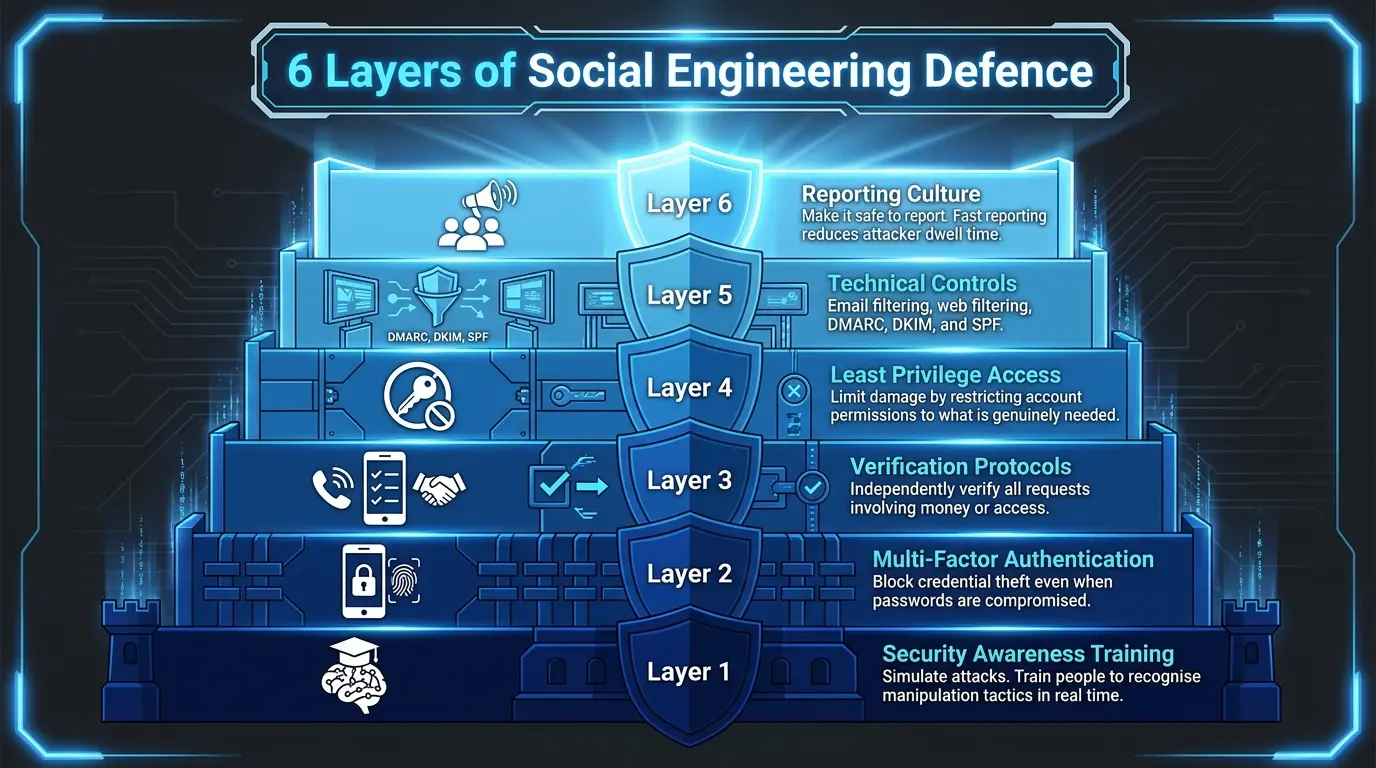
The most effective defence against social engineering combines human training with technical controls and verification procedures. No single measure is sufficient on its own because these attacks adapt to whatever gaps they find.
1. Train People to Recognise the Tactics
Regular, realistic security awareness training is the foundation of any effective defence. People who understand how social engineering works, who know the specific tactics attackers use, and who practise identifying suspicious requests in simulated exercises make significantly better security decisions under pressure.
Training needs to go beyond annual slideshows. Simulated phishing campaigns that send realistic fake phishing emails to employees and provide immediate feedback when someone clicks a link deliver measurable improvements in phishing resistance. According to Vectra AI’s social engineering defence research, organisations that run continuous simulation-based training reduce click rates on phishing simulations by up to 75 percent within twelve months.
2. Implement Multi-Factor Authentication Everywhere
Multi-factor authentication stops credential theft attacks even when a social engineering attack successfully captures a username and password. If an attacker phishes your login credentials but cannot provide the second authentication factor, they cannot access the account. Enable MFA on every account that supports it, starting with email, VPN access, and any system containing sensitive data.
Use authenticator apps rather than SMS-based codes wherever possible. SMS codes are vulnerable to SIM-swapping attacks, where a criminal convinces your mobile carrier to transfer your phone number to their SIM card, giving them access to every SMS verification code sent to your number.
3. Establish Verification Procedures for High-Risk Requests
Create clear, mandatory protocols for any request involving money, credentials, or sensitive data access. Every such request should require verification through a second, independently established channel. If someone emails you asking for a bank transfer, call them back on a number from your own records rather than one they provide. If someone calls claiming to be from IT support and asks for your password, end the call and contact the IT desk directly through your company’s official internal directory.
Establish code words or callback verification protocols for authorising high-value financial transactions over the phone. These simple procedural controls stop pretexting and vishing attacks even when the attacker is highly convincing.
4. Apply the Principle of Least Privilege
Limit the damage a successful social engineering attack can cause by ensuring that every user, system, and account holds only the permissions genuinely needed for their specific role. An attacker who successfully compromises a standard employee account through phishing gains far less access than one who compromises an administrator account. Segmenting access limits the blast radius of every successful attack.
5. Deploy Technical Controls Alongside Human Training
Human training works best when supported by technical controls that catch what human judgement misses. Deploy advanced email filtering that analyses sender reputation, detects domain spoofing, and flags messages with characteristics common in phishing campaigns. Use web filtering to block access to known malicious sites. Enable anti-spoofing controls including DMARC, DKIM, and SPF on your email domain to prevent criminals from sending emails that appear to come from your own organisation.
Monitor for unusual behaviour across your systems using behavioural analytics tools that flag anomalies such as an employee accessing files they have never touched before or a login occurring from an unusual geographic location at an unusual time. These signals often indicate that a social engineering attack has already succeeded and that a criminal is operating inside an account.
6. Create a Culture Where Reporting Is Safe
One of the most underestimated defences against social engineering is psychological safety. Employees who feel safe reporting a suspicious interaction or admitting they may have clicked a wrong link report incidents faster. Fast reporting dramatically reduces the damage of an attack because security teams can respond before an attacker moves from initial access to their main objective. Punishing employees who fall for social engineering attacks discourages reporting and gives attackers more time to operate undetected.
Frequently Asked Questions About Social Engineering in Cyber Security
What is the most common type of social engineering attack?
Phishing is the most common social engineering attack in cyber security. It accounts for 57 percent of all social engineering breaches according to the Verizon 2025 DBIR. It operates primarily through email but increasingly through SMS, messaging apps, and browser-based attacks called ClickFix. In 2026, the majority of phishing emails are AI-generated, making them significantly harder to identify through grammar or formatting alone.
How is social engineering different from hacking?
Traditional hacking exploits technical vulnerabilities in software, systems, and networks. Social engineering exploits human vulnerabilities including trust, fear, authority, and the desire to be helpful. The two are not mutually exclusive. Most major breaches combine both, using social engineering to gain initial access and then technical tools to move through the network and reach the ultimate target. Social engineering is often called the entry point that makes technical hacking possible.
Can AI be used for social engineering attacks?
Yes, and it already is at massive scale. As reported by SecurityWeek’s 2026 social engineering analysis, criminals now use large language models to generate personalised phishing emails in minutes, AI voice cloning to impersonate executives in real time, deepfake video to conduct fake video calls, and autonomous AI agents to run entire social engineering campaigns without human oversight. AI has lowered the skill level required to run sophisticated attacks and dramatically increased the volume and personalisation of attacks that are possible simultaneously.
How do I know if I am being socially engineered?
Look for these warning signs in any communication: urgency that demands immediate action without time to verify, requests for credentials or financial transfers through an unusual channel, messages that create fear about account suspension or legal consequences, unexpected contact from someone claiming authority, requests that bypass normal procedures, and anything that feels slightly off about the sender, the scenario, or the request being made. When in doubt, stop and verify the request through an independently confirmed contact method before acting on it.
What industries are most targeted by social engineering attacks?
Finance, healthcare, technology, government, and retail are the most heavily targeted industries. Financial services attract attacks because the immediate monetary reward is highest. Healthcare is targeted because patient records are extremely valuable on the dark web and because healthcare workers operate under time pressure that makes them more susceptible to urgency-based manipulation. Technology companies are targeted to gain access to intellectual property, customer data, and the supply chain access that can be used to attack downstream victims.
Social Engineering Is a Human Problem That Requires a Human Solution
Understanding what social engineering is in cyber security reveals something uncomfortable: the most sophisticated security technology in the world cannot fully protect an organisation whose people do not know how to recognise and respond to manipulation. Technical defences are essential but they protect the perimeter. Social engineering attacks walk through the front door with an invitation.
The solution is equally human. People who understand social engineering tactics, who have practised identifying suspicious requests, who know that it is always acceptable to pause and verify before acting, and who feel safe reporting when something seems wrong form the strongest security layer any organisation can build. Technology amplifies that human defence but cannot replace it.
In 2026, as AI makes social engineering attacks faster, more personalised, and more convincing than ever before, this human layer of awareness matters more than it has at any previous point in cyber security history. Invest in it accordingly.
For the most comprehensive and current data on social engineering threats and statistics read the full research at StationX’s 2026 social engineering statistics report which draws from over 50 authoritative sources including IBM, Verizon, CrowdStrike, and the FBI Internet Crime Complaint Center.

Prince Anichi
Founder and Lead Technology Editor at Ortechy. Covering digital economy shifts, tech ecosystems across Africa, cybersecurity intelligence, and emerging software platforms.