
In this article17 sections
- 01.Reason 1: No Real Market Need for the Product
- 02.Reason 2: Running Out of Cash Before Finding Product-Market Fit
- 03.Reason 3: The Wrong Team for the Stage of the Business
- 04.Reason 4: Ignoring the Competition Until It Is Too Late
- 05.Reason 5: Pricing and Business Model Failures
- 06.Reason 6: Building a Product Nobody Can Find
- 07.Reason 7: Technology and Product Problems Specific to the AI Era
- 08.Reason 8: Regulatory and Legal Obstacles
- 09.Reason 9: Poor Timing: Too Early or Too Late for the Market
- 10.What Separates Startups That Survive From Those That Do Not
- 11.Frequently Asked Questions About Why Tech Startups Fail
- ↳What percentage of tech startups fail within the first three years?
- ↳What is the number one reason tech startups fail?
- ↳Do most tech startup founders try again after failing?
- ↳How does the AI funding boom affect startup failure rates?
- ↳Can a tech startup avoid failure by raising more money?
- 12.The Startups That Survive Know Why Others Fail
Why Most Tech Startups Fail Within Their First Three Years: The Real Reasons Behind the Numbers
The statistics on why tech startups fail are sobering but important. Approximately 90 percent of all startups fail. Around 20 percent close in the first year alone. By year five, 63 percent of tech businesses have shut down. And in 2026, with AI startups attracting nearly 50 percent of all global venture capital, the failure rate for AI companies is actually higher than for traditional tech firms, sitting between 85 and 90 percent despite the record-breaking capital flowing into the sector.
These numbers are not meant to discourage you from building. They are meant to show you exactly what kills startups so you can make smarter decisions from day one. The founders who succeed are not necessarily smarter or more talented than those who fail. In most cases, they simply avoided the specific, predictable mistakes that end the majority of tech companies before they ever get the chance to find out if their idea could have worked.
This guide draws on research from over 200 founder surveys, CB Insights analysis, and the most comprehensive 2026 startup failure data available to give you an honest and detailed explanation of every major reason tech startups fail within their first three years.
Reason 1: No Real Market Need for the Product
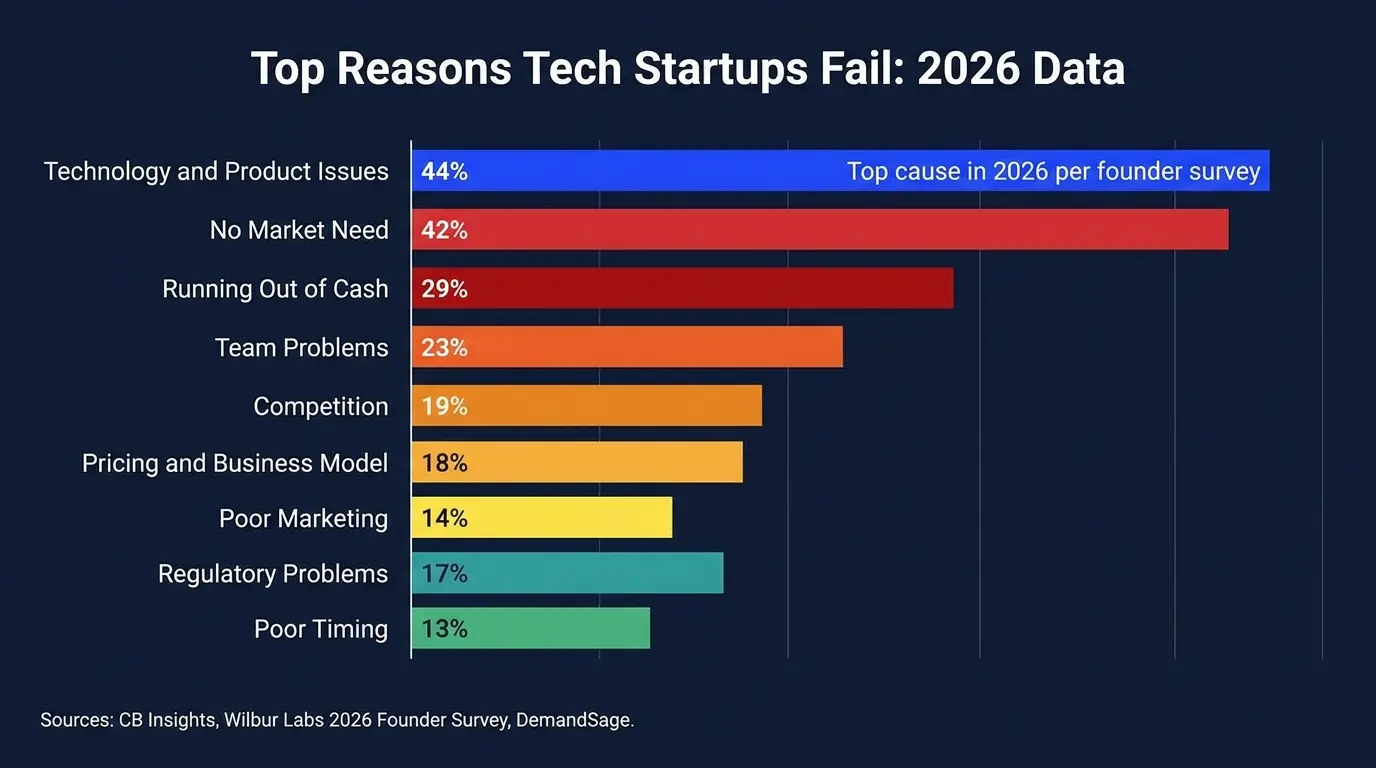
The leading cause of startup failure is building something the market does not actually want. This single reason accounts for approximately 42 percent of all startup closures. It is the most common, the most painful, and the most preventable cause of failure in the entire list.
The problem is almost never a lack of intelligence or effort. Founders who build products nobody wants usually work incredibly hard. They spend months writing code, designing interfaces, refining features, and polishing their pitch. They build exactly what they intended to build. The fatal mistake is that they validated their own idea rather than the market’s genuine need for it.
Talking to potential customers before writing a single line of code is the most reliable way to avoid this outcome. Not one conversation. Not ten conversations. Dozens of conversations with the specific people you intend to sell to, asking about the problem rather than about your solution, listening for the emotional language that signals a genuine pain point rather than a polite interest. The founders who build for a real, proven, acutely felt need almost always find customers. The founders who build first and validate later often discover that the need they assumed existed either does not or is not painful enough for anyone to pay to solve.
According to the 2026 survey of 200 US tech founders conducted by Wilbur Labs, more than half of founders surveyed said that the most important lesson from their failure was the need to better understand product-market fit. This was the top takeaway across more than a decade of studying startup failure, and it has grown more prominent, not less, as the AI era has made it faster and cheaper to build products that technically work but commercially fail.
Reason 2: Running Out of Cash Before Finding Product-Market Fit
Running out of money is the second most common cause of startup failure, cited in 29 percent of shutdowns. But the way most founders think about this reason is slightly wrong. Running out of cash is rarely the root cause. It is almost always a symptom of something deeper: spending too fast, raising too little, failing to generate revenue quickly enough, or spending on the wrong things at the wrong time.
The 2026 Wilbur Labs founder survey showed a meaningful shift in how founders understand this cause. In 2023, running out of money was cited as the primary cause of failure by 38 percent of founders. By 2026, that figure dropped to 25 percent. Founders increasingly point to technology and product issues as the first cause, suggesting that AI tools have lowered the cost of building, but that the cash problem has not disappeared. It has simply moved downstream.
The most dangerous cash management mistake early-stage founders make is scaling expenses before validating revenue. Hiring a large team, paying for expensive tools, committing to long office leases, and spending heavily on marketing before proving that customers will pay is a pattern that ends hundreds of technically capable startups every year. The correct sequence is to validate that customers will pay, understand your unit economics, and then spend to grow what is already working.
The funding winter between 2022 and 2026 made this problem significantly worse. Global VC deals fell from a peak of 17,000 in Q1 2022 to 9,400 in Q3 2025, a 45 percent collapse in deal volume. US startup closures rose 25.6 percent in 2024. The cohort of startups launched in 2021 and 2022 on abundant zero-interest-rate era capital is now experiencing the highest concentration of failures, according to data compiled by SEOScaleUp’s 2026 startup failure statistics report.
Reason 3: The Wrong Team for the Stage of the Business
Team problems are cited in 23 percent of startup failures and they take more forms than most founders anticipate. The most obvious team failure is a skills gap: a technical founding team with no commercial experience, or a business-minded founding team trying to build a technical product without the right engineering capability. But the subtler and often more destructive team failures happen inside companies that have the right skills on paper.
Co-founder conflict is one of the most common and devastating team failure modes. Two founders who align perfectly during the excitement of early-stage building often diverge sharply when the business faces genuine adversity, resource constraints, or a need to change direction. Disagreements about vision, about equity, about pace, and about which problems to prioritise have killed companies that had real traction and genuine market need.
Hiring too quickly is a second major team failure. The pressure to demonstrate growth leads many early-stage founders to add headcount before the business has the product clarity, the processes, and the revenue to support a larger team. Wrong hires in early-stage startups are disproportionately damaging because every person you add at the ten-person stage represents 10 percent of your company’s human capacity. A single misaligned hire at that stage can derail focus, damage culture, and burn cash that cannot easily be replaced.
Hiring too slowly in the wrong areas creates the opposite problem. A founder who is brilliant at building a product but who avoids hiring a commercial lead for too long often spends months building features that have no sales process to convert into revenue. The 2026 Wilbur Labs survey found that 30 percent of founders cited hiring missteps as a major cause of their startup’s failure, up from previous years.
Reason 4: Ignoring the Competition Until It Is Too Late
Approximately 19 percent of startups fail because they either underestimated their competition or failed to monitor competitive dynamics until a better-resourced rival had taken the market. Both versions of this mistake are more common and more dangerous than most first-time founders expect.
The most seductive version of competitive blindness is the belief that your technology is so superior that competition does not matter. Technology advantages are real but they are temporary. A larger competitor with more resources can replicate a technical advantage in months once they see it working in the market. A well-funded rival with a worse product but a better sales team and an existing customer relationship will often win the commercial battle even when the technical battle goes the other way.
The competitive threat that kills the most tech startups in 2026 is platform risk. Building a product that depends on a single large platform, whether an app store, a social media algorithm, an API, or a cloud marketplace, means that a policy change by that platform can eliminate your distribution channel overnight. Startups built on top of Twitter’s API experienced this catastrophically in 2023. Startups that built their entire growth on TikTok organic reach discovered similar fragility when algorithm changes and regulatory uncertainty disrupted their access. Diversifying distribution channels from the start is not optional risk management. It is basic survival planning.
Reason 5: Pricing and Business Model Failures
Pricing mistakes and flawed business models cause roughly 18 percent of tech startup failures. This category covers a wide range of specific errors, all of which share a common root: the founders never truly validated whether their business could generate more money than it spends at a scale that matters.
Underpricing is the most common pricing mistake. Early-stage founders often set prices low to attract their first customers, intending to raise them later. In practice, raising prices on existing customers is one of the hardest commercial manoeuvres a startup can attempt. The initial price anchors customer expectations and creates a ceiling that is very difficult to raise without losing the early adopters who validated your product. Price too low from day one and you build a product with real customers but no viable business behind it.
Unit economics confusion destroys companies that appear to be growing rapidly. A startup selling a subscription service at $50 per month that costs $200 in customer acquisition costs and $30 per month to serve is not a growing business. It is a shrinking one, losing money on every customer at an increasing rate. Many high-profile tech shutdowns in 2023 and 2024 were companies that had been hiding broken unit economics behind fundraising that allowed them to keep operating below cost for years. When the funding stopped, the reality of the business model became visible immediately.
Reason 6: Building a Product Nobody Can Find
Marketing neglect kills a significant portion of technically excellent startups. Fourteen percent of startup failures are attributed to poor marketing, but this figure almost certainly understates the real impact because marketing failure often presents as no customer growth, which then shows up in the data as a cash problem or a product problem rather than being correctly identified as a distribution failure.
The most common manifestation of this failure is what experienced investors call “building in the dark.” A founding team spends six to twelve months building a product, launches it, and waits for customers to discover it. In 2026, with millions of apps, SaaS products, and digital services competing for attention across every niche, waiting to be discovered is not a strategy. It is a hope.
The founders who avoid this failure treat distribution as a product requirement rather than an afterthought. They ask how each customer will hear about the product before they write the first line of code. They experiment with acquisition channels in parallel with product development rather than sequentially. They build the habit of talking to potential customers continuously, not just in a pre-launch discovery sprint that they consider a one-time exercise.
Reason 7: Technology and Product Problems Specific to the AI Era
Technology and product issues now rank as the leading cause of startup failure in the 2026 Wilbur Labs survey, cited by 44 percent of founders. This is a significant shift from 2023 when running out of money dominated the failure narrative. The rise of AI as a development tool has created a paradox: building is faster and cheaper than ever, but building the right thing in a way that actually works in a customer’s real environment has become more difficult.
AI startups face a specific version of this problem. According to data cited by Digital Silk’s 2026 startup failure rate statistics report, 95 percent of generative AI pilot projects in enterprises fail to deliver any measurable ROI, with only 5 percent yielding a positive return. The failure is not usually that the AI technology does not work in a laboratory setting. It fails because the use cases are poorly chosen, the data quality required to run them is absent in real enterprise environments, and the integration complexity is significantly higher than the demos suggested.
Technical debt is a slower but equally lethal version of product failure. Early-stage startups often make architectural shortcuts that allow them to move fast in the beginning. Those shortcuts accumulate and become increasingly expensive to unwind as the product grows. Teams spend more and more of their engineering capacity maintaining and patching fragile infrastructure rather than building new features. Velocity drops. Customers notice. And the technical founders who built the original product often find themselves spending most of their time fighting fires rather than creating value.
Reason 8: Regulatory and Legal Obstacles
Regulatory failure accounts for around 17 percent of startup closures, and in tech specifically, this number is rising. The sectors where tech startups most frequently encounter fatal regulatory problems are fintech, healthtech, edtech, crypto, and any company collecting or processing personal data at scale.
The most dangerous regulatory failure mode is not building an illegal product. It is building a product that operates in a legal grey area without a clear compliance strategy, raising a Series A, scaling to thousands of customers, and then discovering that a regulatory interpretation or a new rule requires changes to the product architecture that are prohibitively expensive to make. Several high-profile crypto and fintech startups experienced exactly this outcome in 2024 and 2025, shutting down or selling at distressed valuations not because their technology failed but because the regulatory environment shifted beneath them.
The correct approach is to treat regulatory compliance as a product requirement from day one rather than a problem to address once you have customers. This is especially important for any startup operating in a sector with existing regulatory frameworks: financial services, healthcare, education, and data privacy all carry compliance requirements that are not optional and that become more expensive to retrofit the longer they are ignored.
Reason 9: Poor Timing: Too Early or Too Late for the Market
Market timing accounts for approximately 13 percent of startup failures and is one of the most difficult failure modes to diagnose in real time because a startup that is too early and a startup that is building something nobody wants can look identical from the outside for long periods.
Being too early is a genuine and underappreciated form of startup failure. A product that would have been enormously successful in 2026 might have failed in 2020 because the infrastructure it depends on, the consumer habits it requires, or the regulatory clarity it needs did not yet exist. Dozens of companies tried to build what Uber built before smartphones made it possible. They were not wrong about the opportunity. They were wrong about the timing.
Being too late is the more obvious failure, entering a market where a well-funded, well-known competitor has already won the majority of customers and where the cost of acquisition for the remaining potential customers is prohibitive. Many startups founded in 2020 and 2021 to ride specific pandemic-era trends discovered by 2023 and 2024 that the behaviour changes they had built around had partially reverted and that the market they had planned for was significantly smaller than the one they had launched into.
What Separates Startups That Survive From Those That Do Not
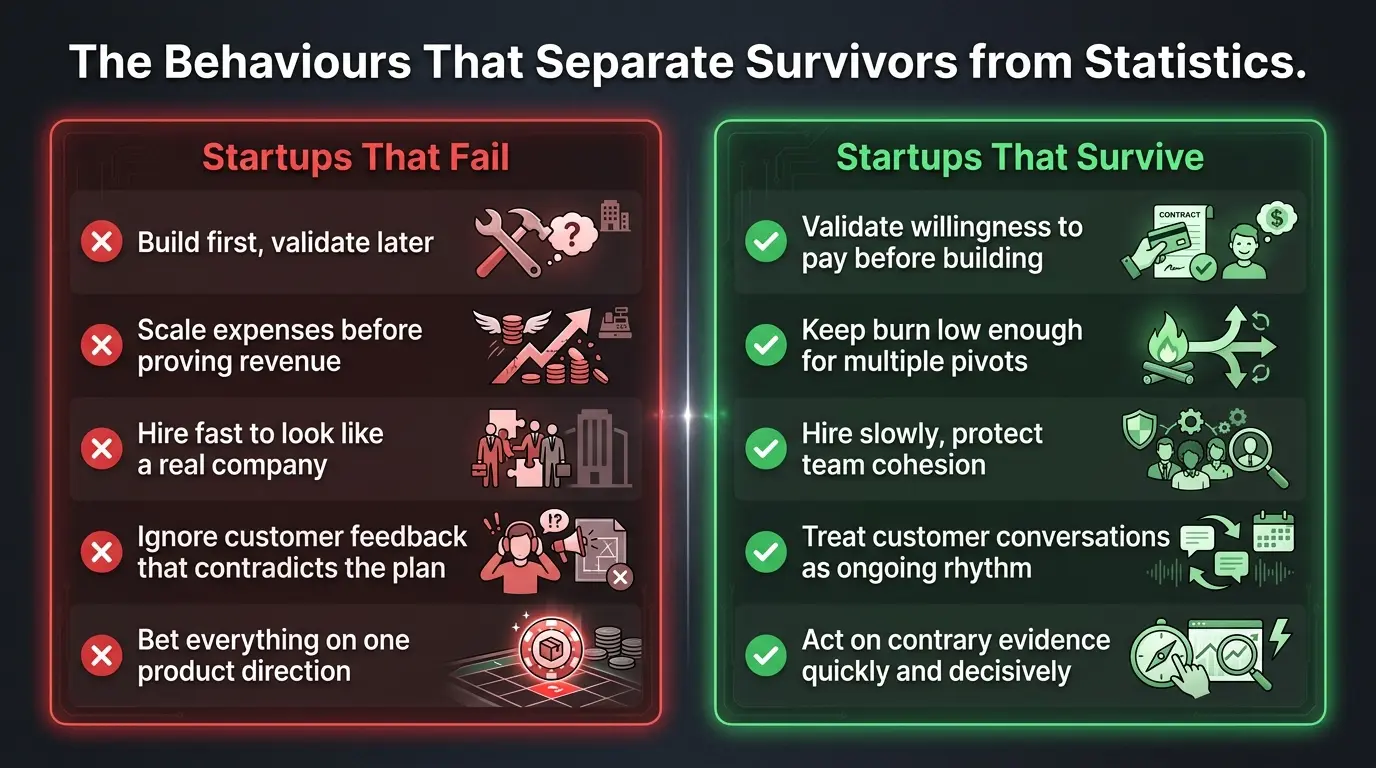
The data on startup failure becomes genuinely useful when you look at what the survivors did differently. The pattern is consistent across every major study of startup success and failure.
Founders who survive their first three years share several common behaviours. They validated customer willingness to pay before building a complete product. They kept burn rates low enough to have runway for multiple pivots rather than betting everything on a single product thesis. They hired slowly, fired decisively, and protected their founding team’s cohesion. They treated customer conversations as an ongoing operating rhythm rather than a one-time discovery exercise. And when they encountered evidence that something was not working, they acted on that evidence quickly rather than extending their commitment to a failing direction.
First-time founders have an 18 percent success rate. Founders who failed in a previous startup have a 20 percent success rate. The difference is modest in percentage terms but the underlying reason is significant: experienced founders who have already failed have already made most of the mistakes on this list and have a detailed internal model of what those mistakes feel like before they become fatal. That pattern recognition is worth more than almost any other asset a founding team can hold.
For the most comprehensive data on startup failure rates, success factors, and industry-specific dynamics, the full report at Failory’s 2026 startup failure rate analysis is one of the most rigorous publicly available resources, covering failure rates by stage, sector, geography, and founding team characteristics.
Frequently Asked Questions About Why Tech Startups Fail
What percentage of tech startups fail within the first three years?
Approximately 60 to 70 percent of tech startups fail within their first three years. Around 20 percent close in the first year. By year five, 63 percent of tech businesses have shut down entirely. The failure rate varies significantly by sector: blockchain and cryptocurrency startups fail at a rate of approximately 95 percent, AI startups fail at 85 to 90 percent, and traditional tech startups fail at around 70 percent. These figures come from analysis compiled by DemandSage’s 2026 startup failure statistics report drawing on CB Insights, Bureau of Labor Statistics, and Crunchbase data.
What is the number one reason tech startups fail?
The leading cause of tech startup failure is building a product for which there is no genuine market need. This single reason accounts for approximately 42 percent of all startup closures. Founders build products based on assumptions about customer pain rather than direct, repeated, validated evidence of demand. The solution is to interview potential customers extensively before building, focus on problems people are already paying to solve, and measure customer enthusiasm by willingness to pay rather than willingness to give positive feedback.
Do most tech startup founders try again after failing?
Yes, and more often than most people expect. The 2026 Wilbur Labs survey found that over 80 percent of founders who experienced a startup failure said the experience made them more likely to launch a new company, not less. Failure in startup culture is widely understood as a learning event rather than a terminal outcome. Founders who fail once have a slightly higher success rate on their second attempt, 20 percent versus 18 percent for first-time founders, suggesting that the experience does build meaningful advantage even when it ends in closure.
How does the AI funding boom affect startup failure rates?
AI startups attract record capital but fail at higher rates than traditional tech companies. In 2025, AI startups attracted approximately $210 billion in investment, nearly 50 percent of all global venture capital. Despite that funding advantage, the failure rate for AI startups sits between 85 and 90 percent. The core problem is that enterprise buyers run pilot projects to evaluate AI products, and 95 percent of those pilots fail to show measurable ROI because the use cases are chosen poorly and the data quality needed to run them in real environments is absent. Capital alone does not solve a product-market fit problem.
Can a tech startup avoid failure by raising more money?
Raising more money delays failure but does not prevent it if the underlying problems are not addressed. Additional capital buys time, and time is genuinely valuable because it creates more opportunities to find product-market fit, experiment with business models, and iterate on distribution. But founders who use additional funding primarily to extend a strategy that is not working, rather than to learn faster and pivot more decisively, typically reach the same outcome on a longer timeline and with more investor capital destroyed in the process.
The Startups That Survive Know Why Others Fail
The reasons why tech startups fail within their first three years are remarkably consistent across time, geography, and sector. No market need. Cash burned before finding traction. Team problems that undermine execution. Competitive blindness. Broken unit economics. Invisible products with no distribution strategy. Technology that works in demos but fails in real enterprise environments. These are not random events or bad luck. They are predictable patterns that every founder can study, recognise, and avoid with the right preparation.
The most valuable thing you can do with this information is use it before you need it. Map every reason on this list against your current startup or the one you are planning. Ask honestly which failure modes you are most vulnerable to right now. Identify the two or three that feel most likely and make eliminating them the priority for the next 90 days. The startups that survive their first three years are not the ones with the best ideas. They are the ones that identified their biggest risk and addressed it before it became fatal.
For the most in-depth and regularly updated analysis of global startup failure patterns across every sector and geography, the comprehensive 2026 failure statistics resource at GrowthList’s startup failure statistics report provides detailed breakdowns by industry, stage, geography, and cause that help founders benchmark their situation against the full landscape of startup outcomes.

Prince Anichi
Founder and Lead Technology Editor at Ortechy. Covering digital economy shifts, tech ecosystems across Africa, cybersecurity intelligence, and emerging software platforms.