Nigerian fintechs lost billions of naira to fraud in a single quarter of 2025, and that number keeps climbing. This is why fraud detection AI in Nigeria has stopped being a nice-to-have feature and become core survival infrastructure. Firms that once bought fraud protection off the shelf are now hiring data scientists and writing their own detection models from scratch.
This post explains why that shift is happening, what it costs, and where it is heading. You will see the real numbers behind the panic, the specific weaknesses of vendor tools in the Nigerian market, and how companies like PalmPay and OPay are structuring their own defences. You will also get a clear build versus buy breakdown you can actually use.
Now, let us start with the scale of the problem that pushed the industry here in the first place.
The Real Cost of Fraud Driving This Shift
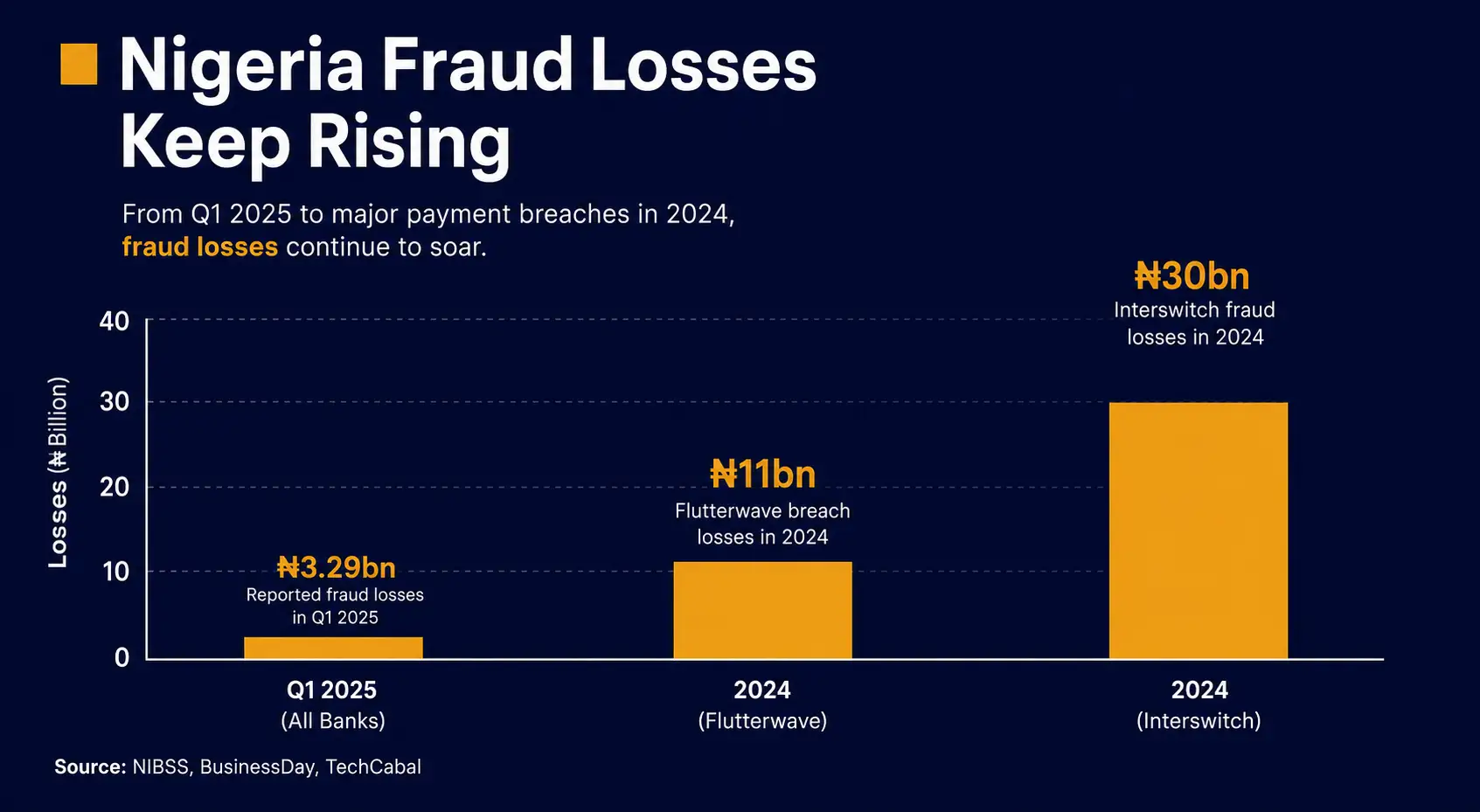
Nigeria’s instant payment ecosystem processed nearly 11 billion transactions in 2024, more than double the volume recorded just two years earlier. However, growth in transaction volume came with a much sharper growth in fraud losses, which jumped 603% to ₦3.29 billion in the first quarter of 2025 alone, as reported by Techpoint Africa’s analysis of Nigeria’s fraud landscape.
Because the numbers kept getting worse, regulators started asking hard questions. In early 2026, the Economic and Financial Crimes Commission reported that over 200,000 victims lost roughly ₦18 billion through a single scheme known as “FF Investment,” which moved money across multiple fintech and banking platforms, according to Tekedia’s reporting on AI adoption among Nigerian fintechs.
Individual companies have felt this pain directly. Flutterwave reportedly lost ₦11 billion to a security breach in 2024, while Interswitch absorbed losses of ₦30 billion after a system glitch let merchants file and receive chargebacks they were not owed. These are not small, one-off incidents. They are the reason fraud has become a boardroom problem rather than just an engineering one.
What the CBN’s Own Data Shows About AI Adoption
The Central Bank of Nigeria has been tracking this shift closely. Its Fintech Report 2025 found that 87.5% of surveyed Nigerian fintechs now deploy artificial intelligence primarily for fraud detection, making it the single most common AI use case in the sector, based on Nairametrics’ coverage of the CBN survey findings.
This means fraud detection now outranks customer service automation and credit scoring as the leading reason Nigerian fintechs invest in AI at all. Therefore, when people talk about “AI in Nigerian fintech,” they are mostly talking about fraud detection AI in Nigeria, whether they realise it or not.
Additionally, the same report flagged trust problems between institutions. Fidelity Bank at one point restricted transfers to neobanks such as Moniepoint, OPay, and PalmPay over concerns about their know your customer processes, while Wema Bank removed seven fintechs from its payment gateway due to fraudulent activity. This kind of inter-bank friction adds real pressure on fintechs to prove their fraud controls work, and prove it fast.
Why Vendor Fraud Tools Struggle With Nigerian Transaction Patterns
The Data Is the Model
Here is the core technical problem. A fraud detection vendor’s model is trained on its own transaction data, and that data usually comes from markets that behave nothing like Nigeria’s. SIM swaps, agent banking fraud, and USSD-based scams are far more common locally than in the American or European datasets most global vendors train on.
This means a generic fraud model can look impressive in a sales demo and still miss the fraud patterns that actually hit Nigerian users every day. Industry analysis on African fintech development notes that build versus buy decisions in this space are shaped more by data availability than by model sophistication, and that fraud models “are the data” rather than a separate layer bolted on top, according to Scrums.com’s analysis of AI development trends in African fintech.
Identity Fraud Is Getting Harder to Outsource Detection For
Identity based attacks are becoming the dominant fraud vector in Nigeria specifically. Infostealer malware activity rose 66% in 2025 and affected nearly 29% of Nigerians, and in February 2026 threat actors were found advertising more than 10,000 Nigerian ID photos and 15,000 complete identity profiles on underground forums, per Techpoint Africa’s reporting cited above.
Because these leaked identity sets are hyper-local, a fraud model needs local context to catch the resulting synthetic identities. A vendor tool built for a different region simply has not seen this specific attack pattern before, which is exactly the gap that in-house teams are trying to close.
What “Building Your Own Fraud AI” Actually Means in Practice
Building in-house does not usually mean one engineer writing a single algorithm. In practice, teams stack several models together, each one targeting a different type of fraud signal, then combine the outputs into a single real time risk score.
This layered approach mirrors what independent data scientists in Nigeria are already experimenting with outside the big fintechs. One example is a three-model, real-time fraud detection system built and deployed as a live API, designed to generate actionable intelligence rather than a simple flag or no-flag decision. The goal is always the same: catch fraud before money leaves the account, not after.
- A behavioural model that studies typical spending, login, and device patterns for each user
- A network model that looks for connections between accounts involved in coordinated fraud rings
- A document and identity model that checks onboarding data against known synthetic identity patterns
- A rules engine layered on top for instant blocking of confirmed high-risk patterns
Case Study Snapshot: How Nigerian Fintechs Are Responding
PalmPay, one of Nigeria’s largest digital payment platforms, has built its cybersecurity strategy around a multi-layered architecture. This includes AI-powered fraud monitoring, continuous risk assessment, behavioural analysis, and multi-factor authentication working together to catch suspicious activity in real time, as detailed by BusinessDay’s report on fintech cybersecurity strategy.
OPay has taken a similar path, running AI fraud detection as core infrastructure across hundreds of millions of monthly transactions rather than as a bolted-on feature. This scale is exactly why a generic vendor model becomes harder to justify. At that transaction volume, even a small accuracy gap translates into enormous naira losses.
Meanwhile, more than 281,500 user accounts were exposed through data breaches and leaks in a single quarter, according to the BusinessDay report referenced above. This exposed data becomes raw material for the next wave of account takeover attempts, which is precisely the threat category that in-house behavioural models are built to catch.
The Build vs Buy Trade-off, Compared
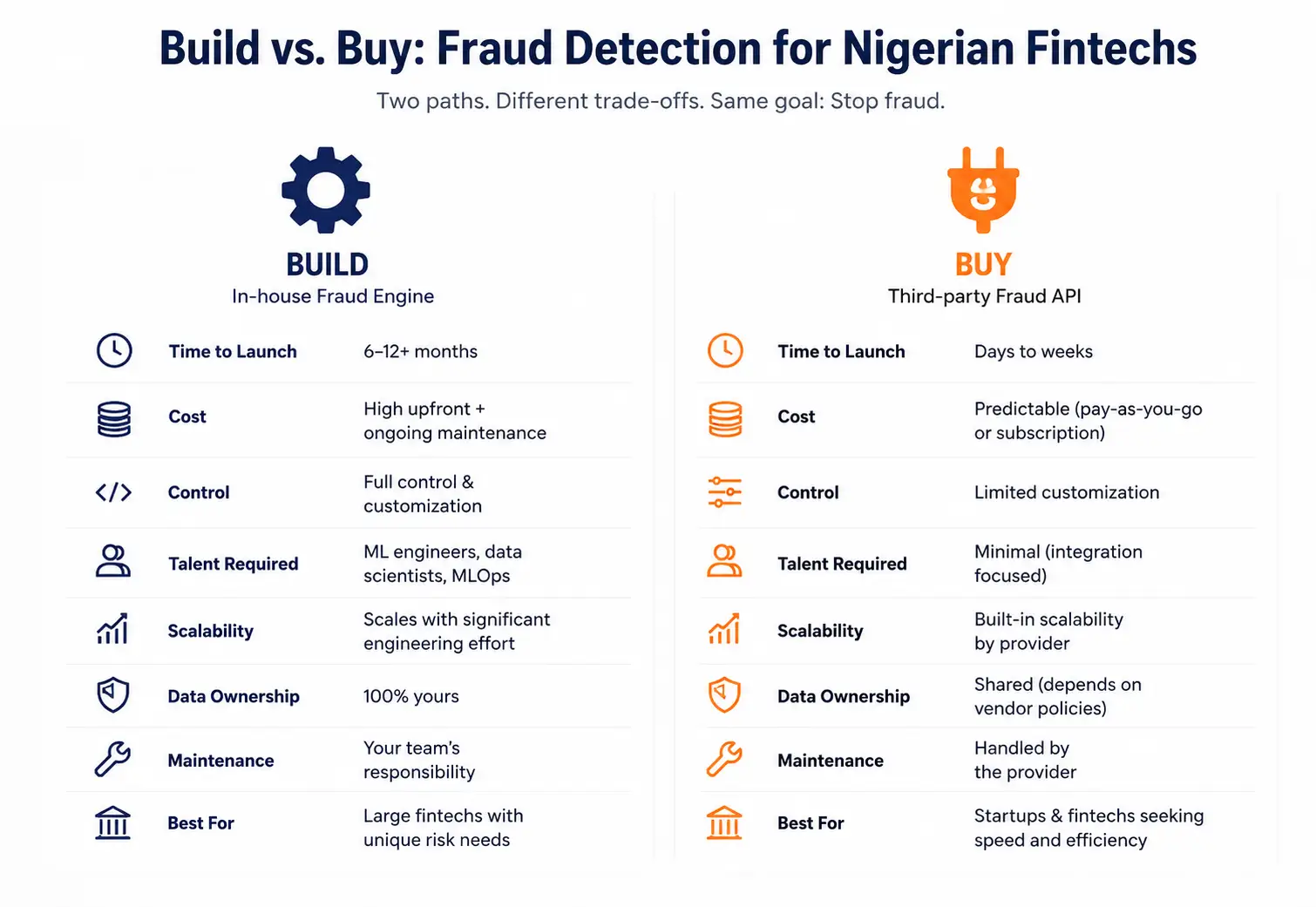
The table below breaks down how building in-house compares with buying a vendor fraud solution across the factors that matter most to a Nigerian fintech team.
| Factor | Build In-House | Buy Vendor Tool |
|---|---|---|
| Time to first working version | Three to nine months, depending on team size | Days to a few weeks |
| Fit with local fraud patterns | High, since models train on your own users | Often low without heavy customisation |
| Upfront cost | High, mainly salaries and infrastructure | Lower, usually pay per transaction or per check |
| Long-term cost at scale | Can flatten out or drop as volume grows | Can rise quickly as transaction volume scales |
| Explainability for regulators | Full control over logic and audit trail | Depends on vendor’s transparency |
| Talent dependency | High, needs data science and ML engineering staff | Low, mostly integration engineering |
Talent, Cost, and Time: The Hidden Trade-offs of Building In-House
Building in-house is not free, and it is rarely fast. Compliance and product teams who have gone this route often spend two to three months just getting engineers up to speed by shadowing fraud analysts before writing a single line of production code, based on commentary from fraud automation vendor Unit21 on the realistic timeline for building financial crime AI internally.
This delay matters because fraud typologies shift constantly, and regulators expect every automated decision to be explainable. A team that spends a full quarter building a general-purpose model often finds it handles routine cases well but falls apart on the unusual edge cases that cause the biggest losses. In practice, this means in-house builds only pay off once a fintech has enough transaction volume and enough engineering capacity to keep iterating on the model after launch.
Cost is the other constraint. A small fintech with limited transaction volume may spend more hiring a data science team than it would simply paying a vendor per transaction check. This is why in-house fraud AI tends to appear first at scale, among companies like OPay, PalmPay, Moniepoint, and Flutterwave, rather than at seed-stage startups.
Where Vendor Tools Still Make Sense
Building everything in-house is not always the smarter choice. Document verification, optical character recognition for identity documents, and biometric face matching are examples of components that do not need to be proprietary, because the underlying technology is fairly standardised across markets.
For most fintech products, integrating a ready-made fraud detection module can save six to 12 months of model development time compared with building the same capability from scratch. This means the smartest approach is usually a hybrid one: buy the non-differentiating pieces, and build the parts that depend on your own transaction history and user behaviour.
- Buy: document OCR, face matching, basic identity verification checks
- Buy: device fingerprinting and IP reputation lookups
- Build: behavioural fraud scoring based on your own users’ transaction history
- Build: network analysis that links accounts involved in coordinated fraud
- Build: credit and risk models trained on proprietary lending data
Regulatory Pressure From the CBN Is Accelerating the Shift
Regulation is pushing this trend along even faster. The CBN has been tightening expectations around data handling, and over 90% of Nigerian banks and fintechs are now facing a shift away from foreign cloud infrastructure, as the CBN pushes for local data storage by 2027, according to a related BusinessDay report referenced earlier in this piece.
This data localisation push makes foreign fraud vendors a harder sell, because sending transaction data to servers outside Nigeria becomes both a compliance risk and, soon, a regulatory violation. In-house models trained and hosted locally sidestep this problem entirely, which gives Nigerian fintechs one more practical reason to build rather than buy.
What This Means for Nigeria’s Digital Finance Ecosystem
This shift toward fraud detection AI in Nigeria is reshaping how fintechs compete. A company’s fraud model is quietly becoming a competitive advantage in its own right, not just a background compliance function.
Fintechs that build strong in-house fraud detection can offer faster onboarding, fewer false declines, and better trust with partner banks, all of which translate into real growth. Meanwhile, companies still relying entirely on generic vendor tools risk becoming the weak link that fraudsters specifically target, since compromised accounts at weaker institutions can be used to stage attacks against better-protected ones.
The result is a two-speed market. Larger players with the engineering resources to build their own systems are pulling ahead in fraud prevention, while smaller fintechs must choose carefully which pieces to build and which to buy, guided by exactly the trade-offs outlined above.
The Build Decision Nigerian Fintechs Cannot Avoid Much Longer
Fraud detection AI in Nigeria has moved from an optional upgrade to a core part of staying in business. The scale of losses, the CBN’s own survey data, and the growing sophistication of identity fraud all point the same direction: generic vendor tools are struggling to keep pace with local fraud patterns.
Building in-house is not automatically the right answer for every company. It demands real engineering talent, patience through a slow first few months, and enough transaction volume to justify the investment. However, for fintechs operating at scale, proprietary fraud models trained on their own users are increasingly becoming the only realistic way to stay ahead of fraud that is, by definition, designed specifically to beat generic detection systems.
My own view, watching this space closely, is that the hybrid approach will win out for most companies. Buy the commodity pieces, such as document checks and face matching, and build the parts that depend on your own data. That is the split the strongest Nigerian fintechs already seem to be settling on.
For fintechs still weighing this decision, the CBN’s Fintech Report 2025 is worth reading in full, since it lays out exactly how the rest of the industry is allocating its AI investment, as summarised by Techpoint Africa’s breakdown of the top AI use cases among Nigerian fintechs.
Frequently Asked Questions
Why are Nigerian fintechs building their own fraud AI instead of buying it?
Vendor fraud tools are usually trained on transaction data from other markets, so they often miss fraud patterns specific to Nigeria, such as SIM swap fraud and agent banking scams. Building in-house lets fintechs train models on their own users’ behaviour instead.
How many Nigerian fintechs currently use AI for fraud detection?
According to the Central Bank of Nigeria’s Fintech Report 2025, 87.5% of surveyed Nigerian fintechs already deploy AI for fraud detection, making it the most common AI use case in the sector.
Is building an in-house fraud detection system expensive?
Yes, it usually requires hiring data scientists and machine learning engineers, plus several months before the system reaches production quality. It tends to make more financial sense once a fintech has enough transaction volume to justify the investment.
Do fintechs still use any vendor tools if they build fraud AI in-house?
Most do. Components like document verification, face matching, and device fingerprinting are commonly bought from vendors, while behavioural fraud scoring and network analysis are usually built in-house.
What role does the CBN play in this shift toward in-house fraud AI?
The CBN’s data localisation push, which requires most banks and fintechs to move away from foreign cloud infrastructure by 2027, makes foreign fraud vendors harder to use and gives fintechs another reason to build and host models locally.
Can smaller Nigerian fintechs afford to build their own fraud AI?
It is harder for smaller fintechs, since the talent and infrastructure costs are significant relative to their transaction volume. Many smaller players choose a hybrid approach, buying vendor tools for basic checks while building only their highest-priority fraud models in-house.

Prince Anichi
Founder and Lead Technology Editor at Ortechy. Covering digital economy shifts, tech ecosystems across Africa, cybersecurity intelligence, and emerging software platforms.