How to Get Tech Startup Funding in 2026: The Complete Step-by-Step Guide for Founders
INTRODUCTION
Learning how to get startup funding is one of the most important skills any tech founder can develop. You have the idea, you have the ambition, and you understand the problem your startup solves better than anyone. But without capital, even the best ideas stall before they reach the customers who need them most.
The good news is that startup funding in 2026 follows a predictable structure. Every stage has clear benchmarks, known investor expectations, and proven strategies that work when applied correctly. The founders who raise successfully are not always the ones with the best ideas. They are the ones who understand the funding system deeply and prepare for each stage with precision.
This guide covers everything you need. You will learn the full funding journey from idea to Series A, what investors actually look for at each stage, how to build a pitch that converts, which funding sources match your stage and sector, and the critical mistakes that kill fundraising rounds before they close.
Understanding the Startup Funding Landscape in 2026
The startup funding environment of 2026 is more selective than the boom years of 2020 to 2022 but more accessible than the correction period of 2023. Capital is flowing again, but investors have changed what they want to see before writing a check.
AI startups now capture over 50 percent of total global venture funding, with Series A funding for AI companies averaging $51.9 million, approximately 30 percent higher than for non-AI startups. Pre-money valuations for AI seed rounds averaged $17.9 million in 2024, which is 42 percent higher than non-AI companies at the same stage. Y Combinator’s 2025 batch was over 72 percent AI-powered, representing a seismic shift in where accelerator money flows.
But this does not mean only AI companies get funded. Healthtech, fintech, climate tech, defence tech, and deep tech all attracted strong capital deployment in 2025 and 2026. The common thread across every successful raise is not sector but fundamentals: clear traction, capital efficiency, realistic unit economics, and a team that investors trust to execute.
The capital environment rewards founders who treat fundraising as a strategic sales process rather than a search for charity. You are selling equity in your company. Investors are buying future returns. The more clearly you demonstrate that your company will deliver those returns, the faster and more easily you raise.
The Complete Startup Funding Stages: From Pre-Seed to Series A and Beyond
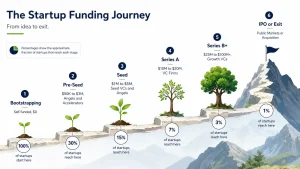
Every startup funding journey moves through stages. Understanding which stage you are in, what investors expect at that stage, and how to prepare tells you exactly where to focus your energy before you contact a single investor.
Stage 1: Bootstrapping (Before Any Outside Capital)
Bootstrapping means funding your startup from personal savings, early revenue, or credit without taking outside investment. This stage builds something critically valuable: proof that you can create without burning other people’s money. Many legendary startups including Mailchimp and Basecamp grew to enormous scale through bootstrapping alone. Mailchimp reached a $12 billion acquisition without ever taking venture capital.
Bootstrapping is not the right choice for every startup. If your market requires speed, if a competitor is racing you to product-market fit, or if your infrastructure costs are high before revenue arrives, bootstrapping alone may cost you the market window. But every founder should bootstrap as far as possible before raising external capital because every dollar you raise costs you equity and control.
Stage 2: Pre-Seed Funding ($50,000 to $3 Million)
Pre-seed is the first formal outside capital a startup raises and it typically comes from angel investors, friends and family, accelerators like Y Combinator and Techstars, and dedicated pre-seed micro-VC funds. The capital funds your transition from idea to functional product, typically covering MVP development, your first one or two team members, and early customer validation experiments.
In 2026, average pre-seed valuations sit between $5 million and $7.5 million with the median at approximately $5.7 million. The post-money SAFE (Simple Agreement for Future Equity) is the overwhelming standard instrument for pre-seed rounds under $4 million. It is simple, founder-friendly, and does not require assigning a company valuation at the earliest and riskiest stage of development.
What pre-seed investors want to see:
- A clearly articulated problem that a large number of people have and currently pay to solve
- A founding team with relevant expertise, ideally direct experience with the problem being solved
- An early prototype, mockup, or waitlist demonstrating that the idea has moved beyond a slide deck
- A compelling and honest explanation of why you are the right team to win this market
- A realistic ask with a clear explanation of what milestones the capital will help you reach
Stage 3: Seed Funding ($1 Million to $5 Million)
Seed funding is the first major institutional round where startups raise capital to build product, reach early customers, and prove their business model works. Only about 4 percent of startups that launch ever reach a seed round. Average seed deal sizes in 2026 have stabilised in the $2 million to $4 million range after the inflated rounds of 2021 and 2022.
Seed investors expect more than promising ideas in 2026. They want early revenue signals, with many expecting $300,000 to $500,000 in annual recurring revenue before engaging seriously. They want evidence of product-market fit, meaning customers who pay and return, a team that has demonstrated it can ship product and respond to feedback, and a clear path toward the metrics that will support a Series A raise in 18 to 24 months.
Seed investors include seed-stage VC funds, angel investors, family offices, and accelerator alumni networks. Notable seed-stage firms include First Round Capital, Floodgate, Initialized Capital, and hundreds of micro-VC funds that write checks of $250,000 to $1 million. Accelerators like Y Combinator and Techstars offer $100,000 to $150,000 plus mentorship and network access in exchange for equity.
Stage 4: Series A Funding ($10 Million to $20 Million)
Series A is the first institutional round where startups raise to scale what is already working. You have proven product-market fit and are now building the sales, marketing, and engineering infrastructure to grow predictably. This is also known as the “Series A Crunch” because only 20 to 30 percent of seed-funded startups reach this stage.
Minimum ARR for a competitive Series A pitch in 2026 is $1.5 million, with top-performing companies showing $3 million or more. Investors expect year-over-year growth of 2x to 3x minimum, a LTV to CAC ratio greater than 3 to 1, and a leadership team that has filled critical gaps including VP of Sales or CTO roles. Series A investors include traditional VC firms such as Sequoia, Benchmark, Andreessen Horowitz, and Union Square Ventures.
How to Build a Startup Pitch That Gets Investors to Say Yes
Your pitch deck is the single most important document in your fundraising process. It is not a business plan and it is not a product brochure. It is a structured argument that answers the question every investor is silently asking: why will this company produce a significant return on my capital?
According to data from Techstars, it typically takes 100 to 200 investor conversations to close a solid pre-seed or seed round. That rejection rate is not a signal of failure. It is the normal cost of raising institutional capital. Preparation is the main variable you can control, and a well-structured deck dramatically increases your conversion rate across those conversations.
The 10 Slides Every Investor Pitch Deck Needs
- The Problem — State the problem clearly and make it feel urgent. Use data, customer quotes, or a vivid real-world scenario that makes the pain tangible for an investor who may not live in your world
- The Solution — Explain your product simply. One sentence. If it takes three sentences to explain what you do, work on it until it takes one
- The Market Size — Show the total addressable market, the serviceable addressable market, and the serviceable obtainable market with sources. Investors need to see that the prize is worth winning
- The Business Model — Explain exactly how you make money, how much you charge, and what the economics look like per customer over time
- Traction — Show every real signal of demand you have. Revenue, active users, pilot agreements, waitlist numbers, retention rates, customer testimonials. This is the most important slide for seed and later rounds
- The Competition — Acknowledge competitors directly. Show how you are positioned differently. Claiming no competition signals naivety, not opportunity
- The Product — Screenshots, a demo link, or a brief walkthrough. Make the product real and tangible
- The Team — Why are you and your co-founders the right people to build this specific company? Highlight relevant experience, domain expertise, and previous startup or operator experience
- The Financials — A 3-year projection with clearly stated assumptions. Show you understand your unit economics and can model the business realistically
- The Ask — State exactly how much you are raising, what instrument you are using (SAFE, convertible note, or priced equity), and precisely what milestones the capital will help you reach
Keep your deck to twelve slides maximum. Investors review hundreds of decks. Density signals respect for their time and confidence in your ability to communicate clearly. Every slide that does not earn its place weakens the slides around it.
How to Find the Right Investors for Your Startup Stage and Sector
Most founders waste enormous amounts of time pitching the wrong investors. A venture capital firm focused on Series B SaaS companies will not invest in your pre-seed consumer app regardless of how compelling your pitch is. Targeting the right investor at the right stage in the right sector is the highest-leverage action you can take to increase your funding success rate.
Where to Find Angel Investors
Angel investors are high-net-worth individuals, often successful founders or executives, who write checks of $25,000 to $250,000. They invest in 10 to 20 companies per year, provide mentorship and introductions, and are the primary source of capital for pre-seed and early seed rounds. The best ways to reach angels are warm introductions through your existing network, founder communities on platforms like LinkedIn and X (formerly Twitter), angel networks like AngelList and SeedInvest, and local entrepreneurship events.
When approaching angels, lead with specificity about why you are reaching out to them specifically. Reference their portfolio companies, their stated investment thesis, or their published writing about the problem space you are addressing. Generic outreach receives generic rejection. Personalised outreach that demonstrates you have done your research opens doors.
Where to Find Seed and Series A VCs
Venture capital firms at the seed stage include dedicated seed funds and micro-VCs with smaller fund sizes, while Series A firms manage larger funds and write bigger checks. The most effective way to approach VCs is through a warm introduction from a founder they have previously backed, a portfolio company operator, or a mutual connection in your extended network.
Research your target VCs on Crunchbase, their firm websites, and their public writings. Understand their investment thesis, their typical check size, their portfolio concentration in your sector, and any public statements from their partners about what they want to fund. Show up to the first conversation knowing their portfolio better than most of their own associates do.
How to Apply to Accelerators
Accelerators like Y Combinator, Techstars, and 500 Global offer capital, mentorship, and network access in exchange for equity, typically 7 to 10 percent. Y Combinator is the most prestigious, with alumni including Airbnb, Stripe, Dropbox, Coinbase, and hundreds of billion-dollar companies. Acceptance rates are under 2 percent, which means you need a compelling application that is honest, specific, and clearly demonstrates why your team is uniquely positioned to solve the problem you have identified.
For the Y Combinator application specifically, answer every question with extreme clarity and brevity. The application reviewers read thousands of submissions. Founders who make their value proposition legible in five words beat founders who bury it in five paragraphs. The Y Combinator guide to seed fundraising, available on their official library, is the single most authoritative resource on raising early-stage capital and every founder should read it before submitting any application. Find it at
Y Combinator’s official guide to seed fundraising.
How to Get Startup Funding Without Venture Capital
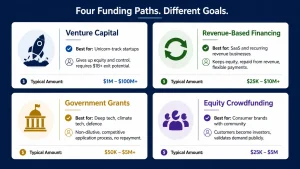
Venture capital is not the right path for most startups. VC requires a credible path to a $1 billion or larger exit because fund math demands it. If your business has a realistic best-case outcome of $50 million in revenue, VC is the wrong tool even if you can raise it. These alternative funding sources often better match the actual scale and nature of your business.
Revenue-Based Financing
Revenue-based financing gives you capital upfront in exchange for a percentage of future monthly revenue until a repayment cap is reached, typically 1.5 to 3 times the amount borrowed. You keep your equity entirely. Payments flex with your revenue so you pay less in slow months and more in strong months. Providers include Clearco, Lighter Capital, and many startup-focused lenders. This structure works best for SaaS businesses or any company with predictable recurring revenue.
Government Grants and Non-Dilutive Funding
Many governments offer non-dilutive grants, tax credits, and subsidies for technology companies. In the United States, the Small Business Innovation Research (SBIR) and Small Business Technology Transfer (STTR) programmes provide millions of dollars in grants to early-stage technology startups without taking equity. Research and development tax credits reduce your effective burn rate without diluting your cap table. If you are building in deep tech, defence technology, or climate technology specifically, government funding can be a significant and underutilised resource.
Crowdfunding
Equity crowdfunding through platforms like Wefunder, Republic, and StartEngine allows founders to raise from hundreds of small investors under Regulation Crowdfunding rules. Individual investors can commit as little as $100. This approach works particularly well for consumer companies with passionate communities, because your customers become your investors and your most vocal advocates simultaneously. Crowdfunding also serves as powerful market validation, demonstrating to later institutional investors that real people believe in your product enough to put money into it.
Venture Debt
Venture debt is a loan structure available specifically to startups that have already raised equity. Lenders like Silicon Valley Bank, Mercury, and dedicated venture debt funds provide loans that help extend runway between rounds without additional equity dilution. Venture debt is useful for bridging to your next milestone, financing equipment purchases, or extending runway when you are close to a round but not yet there.
For a comprehensive breakdown of all funding options and when each makes sense, the complete startup funding guide from Pitchwise covers every stage in detail at
Pitchwise’s complete guide to startup funding rounds in 2026.
Common Startup Funding Mistakes That Kill Fundraising Rounds
Most fundraising failures trace back to a small number of avoidable mistakes. Knowing these before you start your raise saves months of wasted time and protects your company from the most common and costly errors.
Raising at the Wrong Time
The single biggest fundraising mistake is raising too early. Investors consistently fund traction, not just ideas. Every investor you pitch before you have meaningful traction is a conversation that could end in a permanent no from someone who might have said yes six months later with more evidence. As a general rule, raise when you have enough proof to make investors believe the risk is worth the return, not when you need money.
Targeting the Wrong Investors
Sending your deck to a VC whose fund minimum check is $5 million when you need $500,000 wastes everyone’s time. Research your target investors carefully. Understand their fund stage, their typical check size, their portfolio, their investment thesis, and whether they are currently in an active investment period or in fundraising mode themselves. Targeted outreach to well-matched investors closes faster and with better terms than spray-and-pray cold outreach.
Underestimating the Timeline
Most founders underestimate how long fundraising takes by a factor of two or three. A seed round typically takes three to six months from first pitch to close. A Series A frequently takes six to nine months. Starting your raise when you have three months of runway remaining is a catastrophic mistake that puts investors in a power position and you in a desperate one. Always begin fundraising with at least nine months of runway remaining.
A Messy Cap Table
Institutional investors conduct rigorous due diligence before closing. A cap table with dozens of small informal angels, unclear SAFE terms, missing documentation, or unresolved co-founder equity disputes can kill a round at the final stage after months of work. Use Carta or Pulley to manage your cap table from day one. Convert to a Delaware C-Corporation early if you plan to raise institutional capital. A clean corporate structure signals professionalism and saves weeks during due diligence.
Raising the Wrong Amount
Ask for a specific amount tied to specific milestones, not the largest number you think you can get. Founders who raise $3 million when they need $1.5 million often dilute themselves unnecessarily and face pressure to deploy capital faster than their business can productively absorb it. The right amount is the number that gets you to the milestones that support your next raise with 18 to 24 months of runway. For more guidance on avoiding fundraising mistakes specifically around SAFE terms and valuation caps, the Kruze Consulting pre-seed funding guide at
Kruze Consulting’s Pre-Seed Funding Guide for 2026
is one of the most detailed and practical resources available.
Frequently Asked Questions About How to Get Startup Funding
How long does it take to get startup funding?
Pre-seed and seed rounds typically take three to six months from first investor conversation to money in the bank. Series A rounds often take six to nine months. Planning for these timelines from the outset prevents the dangerous situation of running out of runway before a round closes. According to Techstars data, most founders need 100 to 200 investor conversations before closing a seed round, which underscores why starting early and building a wide pipeline matters more than perfecting a single pitch.
How much equity should I give up in early funding rounds?
A healthy guideline is to give up 10 to 20 percent of your company per major funding round. Giving up more than 25 percent in a single round at the pre-seed or seed stage can create serious problems for later rounds because subsequent investors want to see founders with meaningful ownership stakes who remain highly motivated. Plan your dilution path from day one and model what your ownership will look like after pre-seed, seed, and Series A before you accept any term sheet.
What do venture capital investors look for in startups?
In 2026, venture capital investors look for a large addressable market, strong founding team, early evidence of product-market fit, capital efficiency, and a credible path to a significant exit. The “growth at all costs” mentality of the early 2020s has been replaced by a focus on unit economics, sustainable scalability, and teams that can build lasting businesses rather than simply burning capital to show revenue growth.
Can I get startup funding without a product?
Yes, but it is becoming harder. Modern no-code tools and AI-powered development platforms have dramatically lowered the cost and time required to build a prototype. Most pre-seed investors in 2026 expect at least a functional MVP or early pilot rather than a pure slide deck. The founders who raise at the idea stage in 2026 are typically second or third-time founders with a strong track record that substitutes for the traction a first-time founder needs to demonstrate.
Should I bootstrap or raise venture capital?
Bootstrap as far as you can, then raise what you need to reach the next milestone. Bootstrapping preserves equity, maintains your independence, and forces you to build a business that generates real value from real customers. Venture capital makes sense when the competitive window requires speed that organic revenue cannot provide, when your infrastructure costs are high before revenue arrives, or when you have a clear and credible path to the scale that VC returns require. Read the full analysis of bootstrapping versus venture capital at the
Presta startup funding stages strategic guide for founders in 2026.
What is the best accelerator for startup funding?
Y Combinator is the most prestigious startup accelerator in the world with alumni companies including Airbnb, Stripe, Dropbox, and Reddit. It invests $500,000 for 7 percent equity and provides access to one of the strongest founder networks on the planet. Techstars and 500 Global offer strong regional programmes with deep mentor networks. The best accelerator for your startup depends on your sector, stage, and geography. Apply to the most relevant programme for your specific company rather than defaulting to prestige alone.
CONCLUSION
How to Get Startup Funding Starts With the Right Foundation
Now you understand exactly how to get startup funding at every stage of the journey. The funding landscape of 2026 rewards founders who know their stage, understand what investors want to see at that stage, build a clear and compelling pitch, and target the right investors with enough runway to be patient.
Start with the fundamentals. Build something people want. Generate the earliest possible evidence of demand. Keep your costs lean and your focus narrow. Then, when you go out to raise, you bring investors evidence rather than promises, and evidence closes rounds while promises extend timelines.
Treat fundraising like a sales process with a hundred leads, not a search for one perfect investor. Build your pipeline wide. Pitch often. Refine your narrative after every conversation. Rejection is data, not defeat. Each no teaches you what to sharpen before the next meeting.
The founders who raise are not always the ones with the best ideas. They are the ones who understand the system, prepare relentlessly, and execute the fundraising process with the same discipline they bring to building their product. You now have the knowledge to be one of them.
For real-time benchmarks on what investors are funding right now and the latest round size data across every stage read the comprehensive startup funding data at
Founder Institute’s 2026 startup funding benchmarks and requirements
which tracks live term sheet data across hundreds of funding rounds per month and provides the most current picture of what traction, team, and terms investors actually require at each stage today.