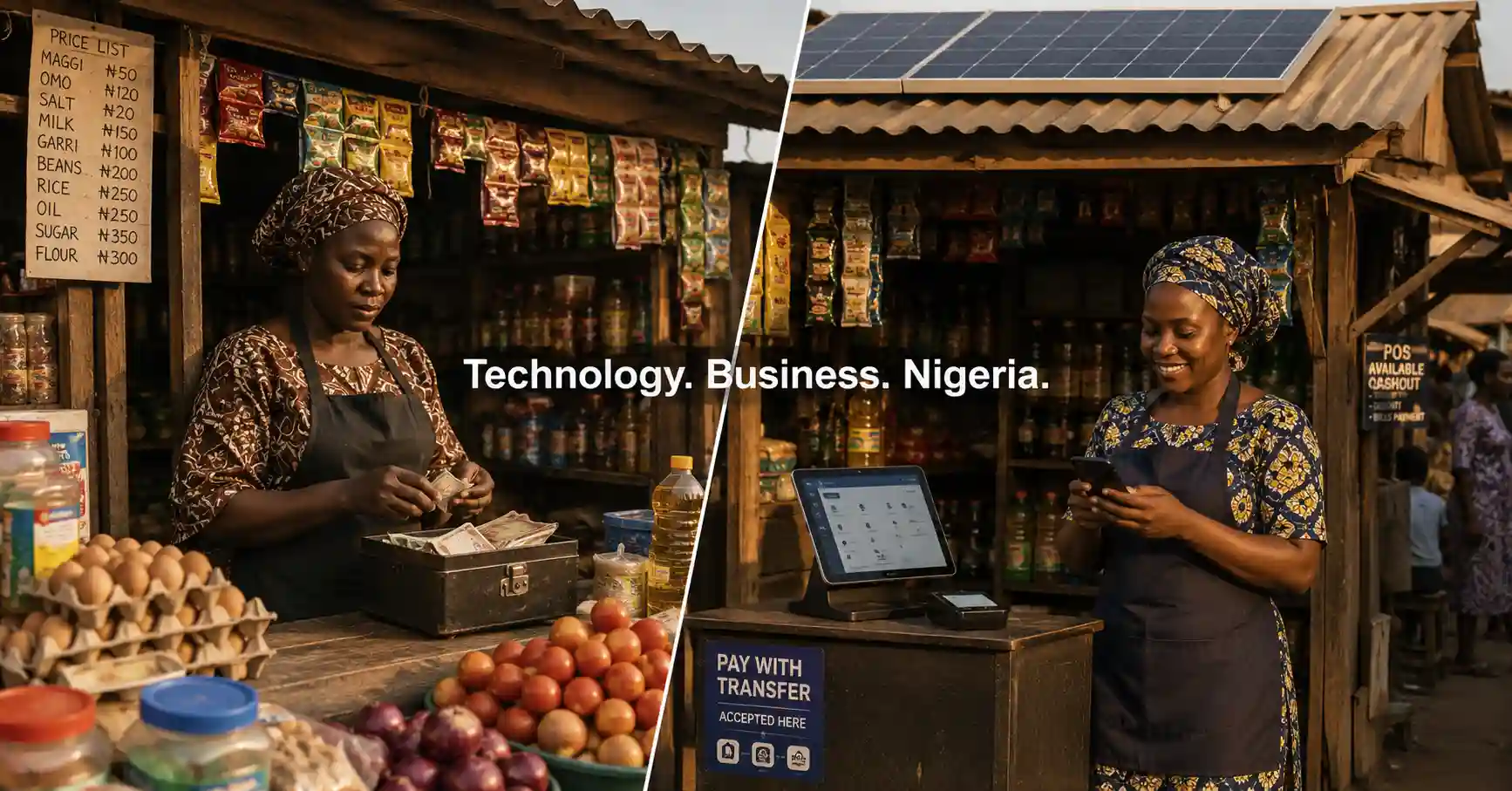
Nigeria’s digital economy contributed approximately ₦7 trillion to GDP in the first half of 2025 alone, accounting for over 14% of the country’s total economic output. That number tells a bigger story than most people realise. It is not just Lagos-based startups driving those figures. It is the tailors in Enugu, the food vendors in Ibadan, and the logistics operators in Port Harcourt who are quietly adopting emerging technologies to survive, compete, and grow. The emerging technologies transforming small businesses in Nigeria are no longer futuristic ideas. They are here, they are accessible, and many cost far less than a generator refuel.
For too long, the conversation about tech in Nigeria has centred on unicorns and venture capital rounds. But the real opportunity sits with the estimated 40 million small and micro-enterprises that form the backbone of the Nigerian economy. These businesses contribute over half of the country’s GDP, yet most still operate with manual processes, informal credit, and unreliable power. Technology is changing that equation, slowly but decisively.
This guide breaks down the most relevant and practical emerging technologies for Nigerian small business owners. We look at what each technology actually does, how local businesses are already using it, and what the honest risks and opportunities are. No hype, no corporate jargon. Just a clear look at what is worth paying attention to right now.
Why Emerging Technologies Matter More Than Ever for Nigerian SMEs
Small and medium enterprises, or SMEs, make up the majority of registered businesses in Nigeria. According to estimates from the Small and Medium Enterprises Development Agency of Nigeria (SMEDAN) and the National Bureau of Statistics (NBS), MSMEs account for roughly half of Nigeria’s GDP. Yet many of these businesses still rely on manual record-keeping, cash-only transactions, and expensive petrol generators.
The gap between awareness and adoption is the real problem. Research published in 2025 found that while Nigerian SME owners broadly understand that AI and digital tools can help their businesses, the actual implementation rate remains low. Infrastructural limitations, limited digital skills, and a shortage of strategic support all play a role. That said, the environment is shifting. Connectivity is improving. Smartphone prices are falling. And platforms originally built for large companies are now targeting small business owners directly.
The businesses that move early on these technologies will hold a real advantage. Those that wait risk being outpaced by competitors who are already automating, selling online, and accessing credit through digital channels. The window to adapt is open. The question is whether small business owners know where to look.
Artificial Intelligence Tools That Small Businesses Can Use Today
Artificial intelligence, or AI, sounds intimidating until you realise that the WhatsApp chatbot a boutique uses to answer customer questions at midnight is an AI tool. So is the accounting software that flags unusual expenses. AI in the small business context is less about robots and more about software that thinks, predicts, and automates tasks that previously required a human.
A May 2026 report by independent research firm Public First, released in partnership with Meta, found that broader AI adoption could add approximately $22 billion to Nigeria’s GDP by 2035. The same report noted that about 14 million Nigerian SMEs already use Meta-owned applications including WhatsApp, Facebook, and Instagram to run daily operations. That is not just social media use. Businesses are using these platforms to handle customer service, run targeted advertising, and process orders.
Meta has since launched a programme called “Meta Transform with AI,” targeting Nigerian business owners and developers who want to integrate AI into their operations. The initiative runs in partnership with SMEDAN and Fate Foundation, two organisations with direct reach into the SME community. This kind of structured support lowers the barrier for small businesses that cannot afford enterprise software.
Practical AI Applications for Nigerian Small Businesses
The most useful AI tools for small businesses right now fall into a few clear categories. Each addresses a common pain point that Nigerian business owners deal with daily.
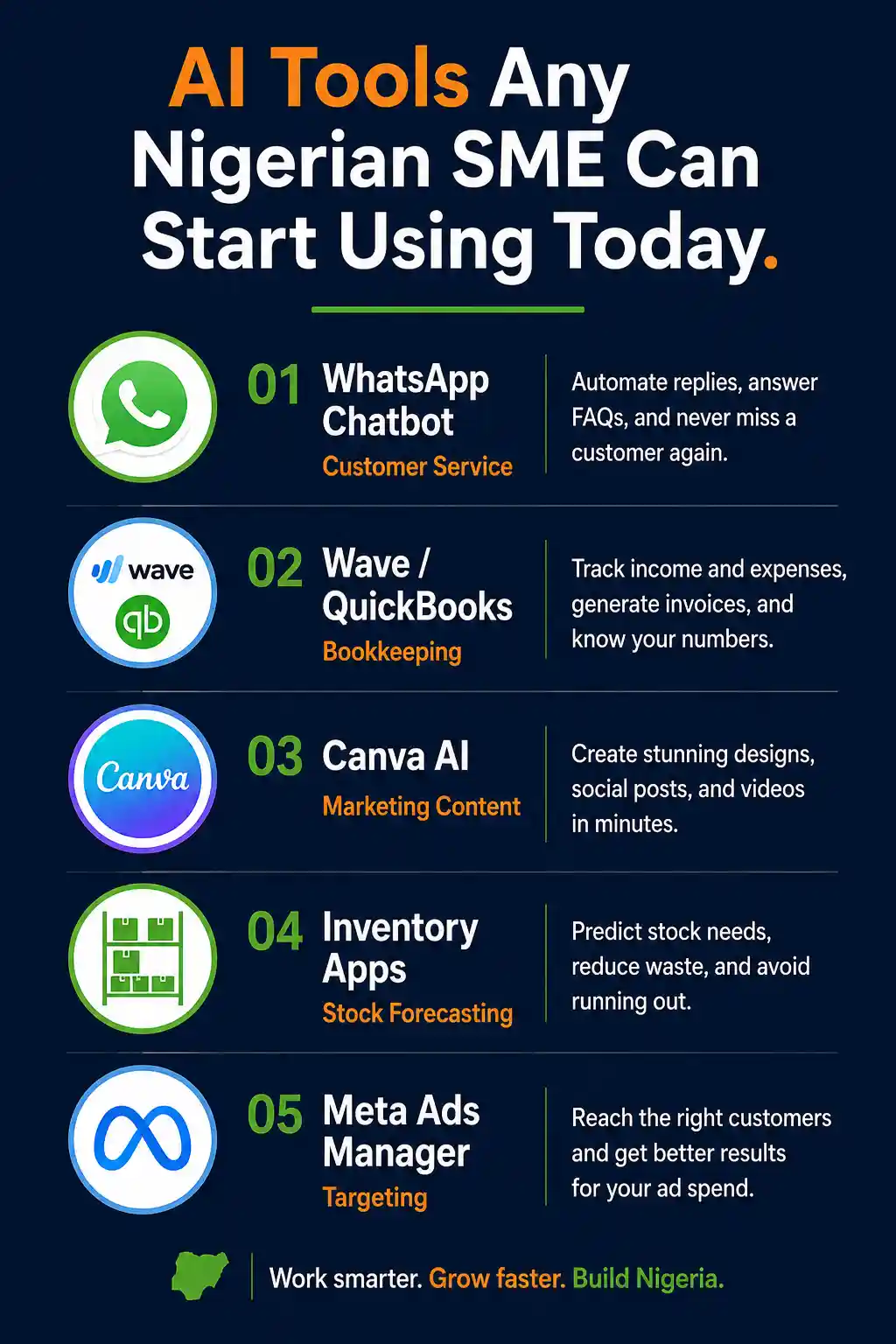
- Customer service automation: AI-powered chatbots on WhatsApp or websites can respond to common customer questions around the clock, book appointments, and send payment reminders without requiring a dedicated staff member.
- Inventory management: Tools that use historical sales data to predict what stock to order and when, reducing both overstock and shortfalls.
- Bookkeeping and financial tracking: Apps like Wave (free) and QuickBooks automatically categorise transactions, generate invoices, and flag anomalies. Many now include AI that can warn business owners when cash flow is trending negative.
- Marketing content: AI writing and design tools allow small business owners with no design training to create professional social media graphics, product descriptions, and promotional copy at virtually zero cost.
- Demand forecasting: For businesses in retail, food, or fashion, AI tools can analyse sales trends and recommend pricing adjustments or promotion timing.
Research into AI adoption across Nigerian sectors confirms that businesses deploying these tools report up to a 65% improvement in informed decision-making alongside meaningful reductions in operational costs. That is a significant competitive edge for a small shop owner operating on thin margins. The opportunity is real. The main barrier is knowing which tools to start with and how to set them up.
Fintech Platforms Giving Nigerian SMEs Access to Real Financial Services
If there is one technology that has already transformed how small businesses in Nigeria operate, it is financial technology. The story of fintech in Nigeria is well documented, but the chapter that concerns small business owners most is the one about access to credit and digital payments.
Nigeria processed over 70% of Africa’s total e-payment transaction volume in 2024, according to market research by KenResearch. That dominance reflects a country that has moved faster than almost any other on the continent in shifting everyday transactions to digital platforms. For small business owners, this shift matters because it creates a transaction history. And transaction history is the new collateral.
Traditional banks in Nigeria have historically required physical collateral, formal payslips, and months of processing time to approve loans. Most small business owners do not qualify. Fintech lenders now offer loans based on digital transaction history and business performance data instead. A market trader who processes 200 POS transactions a month, or a shop owner who sells consistently through an online platform, can now access working capital within hours.
Platforms Nigerian Small Businesses Are Already Using
Moniepoint, one of Nigeria’s fintech unicorns, started by targeting small merchants with point-of-sale (POS) solutions. Today it offers a full suite of payment, banking, and business management tools to hundreds of thousands of Nigerian SMEs. OPay, valued at $2 billion after its 2021 Series C round, has built a super-app model that combines mobile payments, bill payments, and financial services in a single platform. Both companies grew precisely because they designed products around how small business owners actually work, not how banks wished they did.
The Nigeria fintech market reached $1.13 billion in 2024 and is projected to grow to $4.24 billion by 2033 at a compound annual growth rate of 15.82%, according to IMARC Group’s Nigeria fintech market analysis. That trajectory signals sustained investment in the infrastructure that small businesses depend on. For a business owner, the practical takeaway is straightforward: there are more financial tools available to you today than at any point in Nigeria’s history, and most require nothing more than a smartphone to access.
Solar Energy Technology Solving the Generator Problem
Every Nigerian small business owner understands the generator problem. Diesel and petrol costs eat a significant share of operating expenses, and load shedding from the national grid has not improved at the pace anyone hoped. The good news is that solar technology has become dramatically cheaper over the past decade, and several companies are now packaging it specifically for small business use.
A startup called ICE Commercial Power is building solar microgrids tailored for Nigerian SMEs. According to the World Economic Forum, ICE’s solar solutions have already helped hundreds of businesses save up to 35% on their energy costs, as reported in the WEF’s feature on off-grid energy innovation in Nigeria. The company plans to connect 10,000 small businesses in the Niger Delta region in the near term, with a longer-term target of reaching more than 100,000 businesses across the country.
Beyond ICE, Anfani Energy has introduced a fractional ownership model for solar assets in Nigeria. Instead of requiring a business owner to pay upfront for a full solar installation, the platform allows multiple investors to co-finance solar equipment. The business owner accesses clean, reliable power. The investors earn returns. This kind of structured financing removes the single biggest obstacle to solar adoption for small businesses: the capital cost.
What Solar Adoption Actually Means for a Small Business
The financial case for solar is not just about saving money on diesel. It is about operational continuity. A seamless, uninterrupted power supply allows a small bakery to run commercial ovens on a predictable schedule. It allows a small clinic to keep refrigerated medications safe. It allows a retail shop to keep POS terminals running without resorting to cash-only transactions during outages.
For businesses in the service sector, power reliability also affects customer perception. Customers notice when a shop is dark at 6pm or when a restaurant cannot process card payments. Consistent power is increasingly a baseline expectation, not a premium. As solar technology continues to improve and installation costs keep falling, the business case for making the switch becomes harder to argue against.
E-Commerce Platforms Expanding Market Reach Beyond Location
Location has always been one of the biggest limitations for a Nigerian small business. A fashion designer in Aba serves the customers who can physically visit her shop. A confectioner in Jos sells to whoever happens to walk past. E-commerce technology removes that constraint entirely. It allows a business to reach customers in Lagos, Abuja, and even the diaspora without opening a second location.
Nigeria’s e-commerce sector is valued at over $13 billion, with projections pointing to significant continued growth driven by smartphone penetration and expanding internet access. Platforms like Jumia and Konga provide ready-made infrastructure for small vendors who want to sell online without building their own website. But increasingly, small businesses are also selling directly through Instagram shops, WhatsApp catalogues, and dedicated storefronts on platforms like Paystack Commerce.
The shift to online selling is not just about reaching more customers. It also creates data. A business that sells online knows which products move fastest, which price points convert, and which customer segments return most often. That data, over time, allows for smarter purchasing decisions, better marketing, and more accurate forecasting. A small business that sells online is simultaneously building a database of insights that a purely offline competitor simply cannot access.
Building a Sustainable Online Presence as a Small Business
The biggest mistake small business owners make with e-commerce is treating it as a one-time setup rather than an ongoing channel. Creating an Instagram shop or listing products on Jumia takes a few days. But the businesses that succeed online are the ones that treat digital presence as a daily operational task, not a project they completed once.
Practically speaking, this means posting consistently, responding to enquiries within the hour, and keeping product listings updated. It means using the analytics tools these platforms provide to understand what is working and adjusting accordingly. None of this requires technical expertise. It requires consistency and a willingness to learn. The businesses that put in that time are seeing results that no amount of physical location investment could match.
Blockchain for Supply Chain Transparency and Payments
Blockchain is the technology that most people have heard of and fewest people understand. Strip away the cryptocurrency noise and the core concept is straightforward: a blockchain is a shared record that nobody can alter without everyone knowing. That property, called immutability, turns out to be useful in several very practical business contexts.
For Nigerian small businesses, the two most relevant applications of blockchain technology are supply chain verification and cross-border payments. In the supply chain context, blockchain allows a business to prove the origin and journey of a product. A cocoa exporter can show buyers in Europe exactly where their cocoa was grown, when it was harvested, and how it was processed. A fashion brand using locally made fabric can verify the entire production chain. This kind of transparency is increasingly what international buyers and ethical consumers demand.
In the payments context, blockchain enables faster and cheaper international transfers. Traditional wire transfers through banks are slow and expensive. Blockchain-based payment rails reduce both the time and cost significantly. For Nigerian business owners who sell to diaspora customers or import raw materials from overseas, this matters. Some blockchain payment platforms now settle cross-border transactions in minutes rather than days, at a fraction of traditional banking fees.
Risks and Realistic Expectations Around Blockchain
Blockchain adoption for small businesses requires honest framing. Most small business owners in Nigeria do not need to build or manage a blockchain. They need to use platforms that run on blockchain infrastructure in the background while presenting a simple, familiar interface. The technology itself should be invisible. The benefit should not be.
The clearest risk is regulatory uncertainty. The Central Bank of Nigeria has historically taken a cautious stance on cryptocurrency, which shares infrastructure with many blockchain payment platforms. However, 2025 has seen active dialogue between Nigerian regulators and blockchain advocates, with clearer policy frameworks beginning to emerge. Business owners who want to explore blockchain-based payments should monitor regulatory developments closely and work only with licensed, compliant platforms.
Internet of Things Devices for Smarter Business Operations
The Internet of Things, or IoT, refers to physical devices that connect to the internet and share data automatically. Smart meters, environmental sensors, GPS trackers, and connected inventory systems all qualify. For a small business in Nigeria, IoT technology can feel abstract until you see the specific problems it solves.
Consider a cold storage business in Lagos. The biggest operational risk is temperature failure, which can destroy an entire stock of perishable goods before anyone notices. An IoT temperature sensor costs a fraction of what a single spoiled consignment does. It monitors the cold room continuously and sends an alert to the owner’s phone if the temperature rises above a safe threshold. No supervisor required. No periodic manual checks. Just an automated warning that allows action before the damage is done.
Similarly, IoT-enabled GPS trackers have become practical tools for logistics businesses and delivery operations. A business owner can monitor exactly where every vehicle or package is at any given moment, without calling drivers every hour. This reduces fuel misuse, improves delivery accuracy, and gives customers real-time visibility into their orders. These are not luxury features. They are operational improvements that directly affect profitability.
IoT and Energy Management
One particularly relevant IoT application for Nigeria is smart energy management. Devices that monitor and automate power usage can help a business reduce electricity consumption during peak hours, automatically switch between grid and solar or generator power, and track exactly how much energy each piece of equipment uses. Over time, this data reveals inefficiencies that would otherwise be invisible.
ICE Solar’s AI-powered platform in Nigeria, which won recognition through the Digital Energy Challenge 2024, uses predictive maintenance technology built on IoT sensors to prevent costly solar microgrid outages before they happen. The same principle applies to any business that runs critical equipment. Knowing a machine is likely to fail before it actually fails is not just convenient. It is the difference between a planned maintenance call and an unplanned shutdown.
Digital Marketing Technology Levelling the Playing Field
Ten years ago, a small business in Nigeria could not afford to compete with large brands in advertising. Television and radio spots were expensive. Print advertising required a budget most small businesses did not have. Digital marketing technology has fundamentally changed that calculus. A small business with a clear strategy and a modest daily ad budget can now reach precisely targeted audiences that large brands pay agencies millions to access.
Meta platforms, which include Facebook and Instagram, contributed approximately $820 million in economic value in Nigeria in 2025. Much of that value flows through the businesses that advertise on these platforms, including a large number of small businesses. The tools available are sophisticated. Business owners can target ads by location, age, interest, income level, and behaviour. They can run experiments to see which ads convert best. They can retarget people who visited their online store but did not buy.
The most powerful shift is that digital marketing performance is measurable in ways that traditional advertising never was. A business owner can see exactly how many people saw an ad, clicked on it, visited the store, and made a purchase. That accountability allows for continuous improvement and eliminates guesswork from the marketing budget. Small businesses that learn to use these tools well consistently outperform those that rely solely on word of mouth or physical signage.
What Most Small Businesses Get Wrong About Digital Marketing
The most common mistake is treating digital marketing as purely a promotion channel. Posting product photos and running discount ads is the surface level. The businesses that build real equity online are the ones creating content that is genuinely useful or interesting to their target audience. A restaurant in Abuja that posts videos of the cooking process, talks openly about ingredient sourcing, and shares the story behind the business builds something that a competitor running generic ads cannot easily replicate: trust.
Building that kind of presence takes time. But the compound effect of consistent, authentic digital content is one of the most durable competitive advantages a small business can develop. It does not require a large team. It requires a phone, a clear voice, and the discipline to show up consistently.
Cloud Computing Reducing the Cost of Business Infrastructure
Cloud computing means accessing computing power, storage, and software over the internet rather than buying and maintaining physical hardware. For a small business owner, it translates to a practical reality: you can now access enterprise-grade tools, store your business data securely, and run sophisticated operations without buying a single server or hiring an IT team.
Google Workspace, Microsoft 365, and similar cloud platforms give small businesses professional email, document collaboration, and storage for a monthly fee that most households can afford. Accounting software like QuickBooks Online or the Nigerian-built VFD’s business tools operate entirely in the cloud. Customer relationship management (CRM) systems, point-of-sale platforms, and payroll software all follow the same model. You pay for what you use and scale up only when you need to.
The business continuity argument for cloud computing is particularly compelling in Nigeria. Physical computers can be stolen, damaged in floods, or destroyed in fires. Business data stored locally dies with the hardware. Data stored in the cloud survives any physical incident and can be accessed from any device. For a business where customer records, financial data, or supplier contracts live in a single laptop, migrating to cloud storage is one of the most important risk-management steps an owner can take.
Frequently Asked Questions
Which emerging technology is most accessible for a small business in Nigeria with a limited budget?
Digital marketing tools and AI-powered chatbots offer the lowest entry barrier. Most platforms allow a business to start with a free tier or a very small daily budget. WhatsApp Business, for example, is free and includes catalogue features, automated responses, and basic analytics. These tools require a smartphone and internet access, both of which are increasingly affordable across Nigeria.
Do Nigerian small businesses really need to worry about blockchain?
Not necessarily, and certainly not in the immediate term. Blockchain matters most for businesses involved in export, international payments, or supply chain verification where proof of origin or fast cross-border settlement is a genuine need. For purely local, consumer-facing businesses, fintech payment platforms built on modern infrastructure are a more practical starting point. Follow the regulatory environment before committing any resources to blockchain-specific tools.
How can a small business in Nigeria afford solar if the upfront cost is too high?
Fractional ownership models and financing programmes are changing this. Companies like Anfani Energy allow businesses to access solar installations without paying the full cost upfront. Some solar providers also offer lease-to-own arrangements where monthly payments replace what the business currently spends on diesel. The key is to calculate your current monthly generator cost and compare it directly against the solar financing option.
Is e-commerce suitable for all types of Nigerian small businesses?
Most product-based businesses can benefit from some form of online selling, even if it is simply a WhatsApp catalogue or an Instagram shop. Service businesses, including freelancers, consultants, and tradespeople, can use online platforms to collect bookings, sell digital products, or showcase their work to attract clients. Purely location-dependent businesses like roadside food stalls may find less immediate value, but even these can use digital tools for marketing and customer retention.
What are the biggest risks of adopting new technology as a small business in Nigeria?
The three most common risks are poor internet connectivity disrupting cloud-based tools, lack of technical support when something goes wrong, and the upfront learning curve that pulls time and attention away from running the business. Mitigating these risks means choosing platforms that work well on slow connections, selecting providers with strong local customer support, and starting with one tool at a time rather than trying to digitalise everything at once.
How does a small business owner in Nigeria find reliable advice on which technology to adopt?
Tech hubs in Lagos, Abuja, Port Harcourt, and Ibadan run workshops and advisory programmes specifically for small business owners. SMEDAN also provides business development services. Online communities on WhatsApp and Telegram exist for Nigerian entrepreneurs in most sectors and are often the fastest way to get peer-reviewed, real-world advice on which tools actually work in the Nigerian context. Always cross-check recommendations against your specific business model and budget before committing.

Prince Anichi
Founder and Lead Technology Editor at Ortechy. Covering digital economy shifts, tech ecosystems across Africa, cybersecurity intelligence, and emerging software platforms.