
In Ghana, roughly nine in ten parcels of land have no formal title at all, according to research published by Blockchain Africa’s review of the Bitland project. That single fact explains why blockchain land fraud prevention has become one of the continent’s most closely watched tech experiments. When ownership records are missing, incomplete, or easy to forge, fraudsters step into the gap.
This post looks at how governments and startups across Ghana, Kenya, Rwanda, and Nigeria are using blockchain to close that gap. It covers what has actually been built, what has failed, and what the research says about whether this technology can really stop land fraud in Africa.
Now, let’s start with why the problem got this bad in the first place.
The Land Fraud Crisis Africa Faces
Land fraud in Africa rarely looks like a single dramatic crime. It usually looks like a chief selling the same plot twice, or a registry clerk quietly altering a file for a bribe.
Because record keeping was often paper based and centralized in one office, a single corrupt official could compromise an entire district’s land history. Additionally, colonial era systems in many countries were never designed to serve the majority of rural landholders, which left customary land largely undocumented.
The result is a market where buyers cannot always trust that a seller actually owns the land being sold. This uncertainty locks up capital, since unregistered land is hard to use as collateral for a bank loan.
What Blockchain Actually Does for Land Records
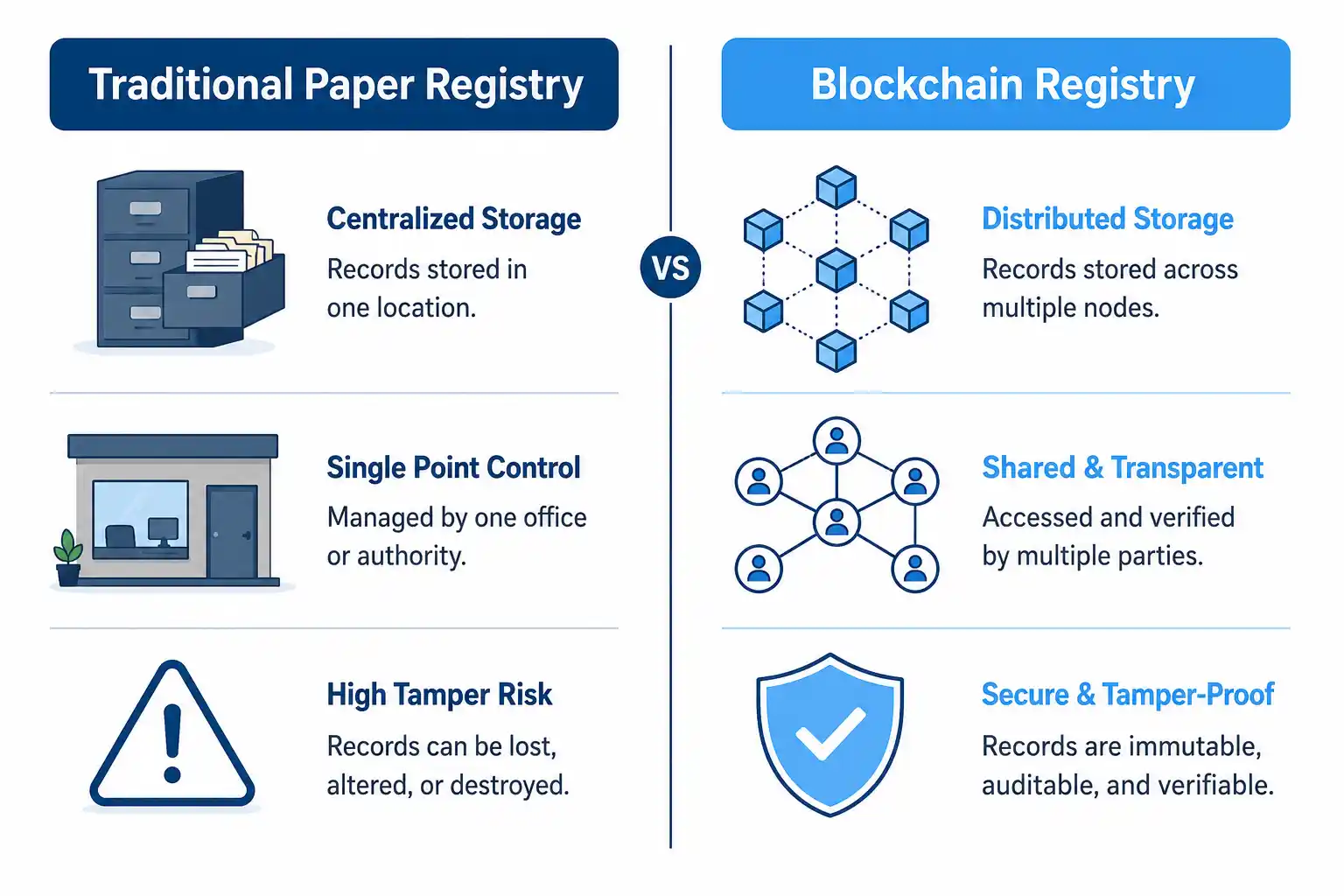
Blockchain is a shared digital ledger that many computers hold copies of at once, instead of one office holding a single paper file. Because every copy has to agree before a change is accepted, altering a past record without detection becomes extremely difficult.
In practice, this means a land title recorded on a blockchain cannot be quietly rewritten by one corrupt insider. Therefore, the same trick that let officials sell one plot to two different buyers becomes far harder to pull off.
However, blockchain does not fix bad data on its own. If a fraudulent title is entered onto the chain in the first place, the technology will faithfully preserve that fraud forever. This is the single biggest misunderstanding people have about blockchain land fraud prevention, and it matters for every case study below.
Ghana’s Bitland Experiment: Africa’s First Blockchain Land Pilot
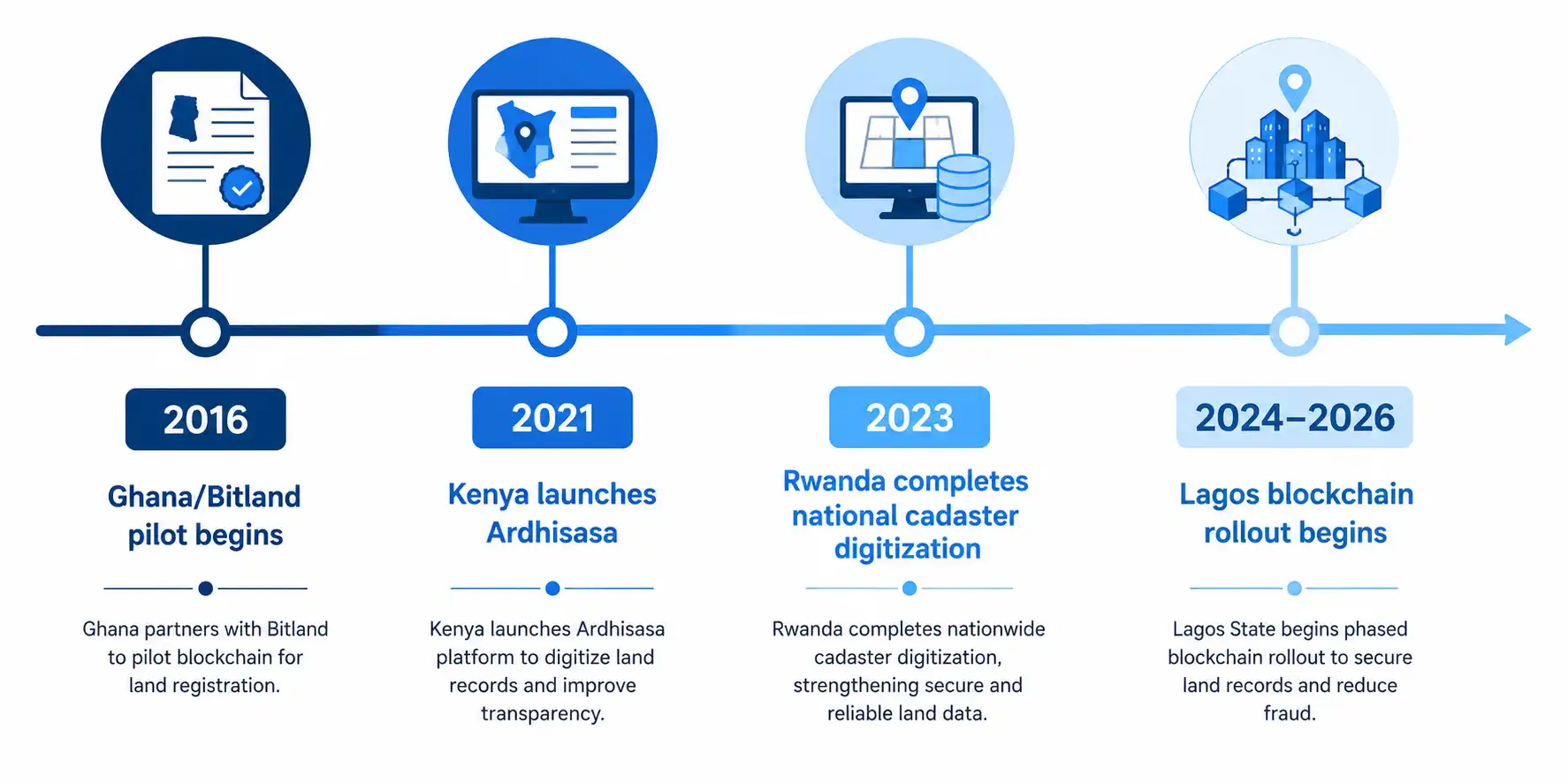
Ghana was the testing ground for one of Africa’s earliest blockchain land projects. A company called Bitland launched a pilot in Kumasi, the country’s second largest city, aiming to record land titles on a public ledger built on OpenLedger technology, as detailed by Blockchain Africa’s coverage of the project.
The pilot worked alongside Ghana’s existing Land Administration Project, a World Bank backed initiative that the Lands Commission had already run for years. Because nepotism and inconsistent record keeping had undermined that earlier effort, Bitland’s founders argued that a public, tamper resistant ledger could succeed where paper trails had failed.
What the Ghana Pilot Actually Achieved
The project surveyed customary land, issued digital title records, and worked directly with the Lands Commission on a limited scale. Still, it never scaled beyond an experimental pilot phase, and a decade later Ghana’s national registry remains largely paper based.
This means the lesson from Ghana is not that blockchain failed. Rather, it shows that technology alone cannot substitute for sustained government funding and political will.
Kenya’s Ardhisasa Platform and Blockchain Land Fraud Prevention
Kenya took a different route. Instead of a blockchain pilot run by a startup, the government built Ardhisasa, a centralized digital platform that launched in 2021 to replace manual land registration.
Ardhisasa has genuinely reduced some paperwork delays, and banks now accept its digital title deeds as loan collateral. However, critics argue the platform’s centralized design leaves it exposed to exactly the kind of single point failure that blockchain is meant to solve.
A recent opinion piece in Business Daily Africa put this plainly, noting that a true blockchain ledger would make it virtually impossible for someone to fraudulently sell land they do not own, because every computer in the network would reject an unauthorized change, according to Business Daily Africa’s analysis of Ardhisasa’s limitations.
The Real World Friction Kenyans Are Reporting
Digitization has not been painless. Reports describe poor user friendliness, data mismatches between old paper files and the new system, and months long delays in title searches, according to research from Democracy in Africa’s review of electronic land registries.
Also, digital systems create new fraud opportunities of their own. Weak login verification can allow impersonation, and a single incorrect ID number can invalidate a title for months while it gets corrected. This is a pattern worth remembering: digitizing a broken process does not automatically make it fraud proof.
Rwanda’s Digital Land Success Story
Rwanda offers the clearest counterexample of what sustained follow through can achieve. Between 2011 and 2013, the country titled nearly all of its land parcels nationwide, and by 2023 it had completed full digitization of its national cadaster and registry.
This makes Rwanda the only African country to have finished that process as of mid 2024, according to Democracy in Africa’s comparative analysis of Kenya, Ghana, and Rwanda. Notably, eighty six percent of the titles issued during that campaign included a woman as a named owner, a meaningful shift in a region where women’s land rights were historically overlooked.
Rwanda’s Remaining Gap
Even Rwanda’s success has limits. Research covering the first five years after titling found that eighty seven percent of rural land transactions still went unregistered, largely because formal registration fees were unaffordable for many families.
Therefore, Rwanda’s story is not a simple victory lap. It shows that a national titling campaign can succeed at scale, while also showing that affordability, not just technology, decides whether people actually use the system afterward.
Lagos, Nigeria: Africa’s Newest Blockchain Land Bet
Nigeria’s commercial capital is now attempting what Ghana tried a decade earlier, but at a much larger scale. The Lagos State government has partnered with a consortium of local technology firms to build a blockchain powered land registry, with a planned rollout of eighteen months, according to CoinGeek’s reporting on the Lagos initiative.
The plan includes tokenizing property records into what officials describe as digital twins, capturing ownership history, title deeds, and transaction records in one permanent digital file. If it works as intended, buyers could verify a seller’s ownership instantly instead of waiting weeks for a manual search.
This matters far beyond Lagos. As Africa’s largest city by population, Lagos carries outsized influence over how other Nigerian states and neighboring countries will judge whether blockchain land fraud solutions are worth adopting.
South Africa’s Academic Push Toward Blockchain Land Reform
South Africa has approached the problem more cautiously, through research rather than rapid deployment. A doctoral case study out of the University of Cape Town examined whether blockchain could support the country’s Electronic Deeds Registration Systems Act, finding that the existing registry works reasonably well for high value property but struggles badly at the lower end of the market, where most land reform and restitution transfers happen, per the University of Cape Town’s published thesis on land registry governance.
This finding matters because it reframes the conversation. Blockchain land fraud prevention is not primarily a rich neighborhood problem. It is a problem concentrated among the poorest landholders, who have the least access to lawyers, courts, and time to fight a fraudulent claim.
Traditional Registries Versus Blockchain Land Registries
Because the differences are easy to blur, it helps to see them side by side. Here is how the two models compare on the issues that matter most to an ordinary landowner.
- Single point of failure: A traditional paper registry can be altered by one corrupt clerk. A blockchain ledger requires consensus across many computers before any record changes.
- Speed of verification: Manual title searches in many African countries take weeks. A blockchain based search can, in theory, confirm ownership in minutes.
- Cost to set up: Paper systems are cheaper to start but expensive to maintain and audit. Blockchain systems cost more upfront but reduce long term fraud investigation costs.
- Resistance to tampering: Paper files can be lost, altered, or destroyed. Blockchain entries are extremely difficult to change once confirmed by the network.
- Garbage in, garbage out risk: Both systems share this weakness. A fraudulent title entered at the start stays wrong, whether it sits on paper or on a chain.
What the Research Says About Fraud Reduction
Academic literature is starting to catch up with the pilots. A 2026 systematic review published in the Engineering and Technology Journal compared blockchain governance models for land registries across eight jurisdictions and found an average fraud reduction of 91.4 percent in the frameworks studied, according to the Engineering and Technology Journal’s comparative review.
That figure deserves a careful read. It reflects modeled and comparative performance across research frameworks, not a single confirmed outcome from an African country’s live production system. Still, the consistency of the finding across Ethereum and Hyperledger Fabric based models is a meaningful signal that the underlying architecture works when implemented properly.
The Real Barriers Standing in the Way
None of this happens automatically. Several practical barriers keep slowing blockchain land fraud solutions down across the continent.
- Digital access gaps: Rural landholders without reliable internet or smartphones cannot easily interact with a digital or blockchain based registry.
- Legal recognition: Courts need clear laws stating that a blockchain record is legally equivalent to a traditional title deed.
- Government commitment: Pilots like Ghana’s show that funding and political will can fade once initial enthusiasm passes.
- Affordability: As Rwanda’s experience shows, even a fully digitized system will not get used if registration fees are too high for ordinary families.
- Data quality at entry: Every system, blockchain or not, depends on accurate information being entered the first time.
Where Blockchain Land Reform Is Headed Next
Momentum is building rather than fading. A recent UNECA report noted that Ghanaian authorities are still piloting blockchain based land registration to enhance transparency, even years after Bitland’s initial experiment, according to TrendsN Africa’s summary of the UNECA findings.
Meanwhile, Lagos is preparing to test the model at a scale no African city has attempted before. If that eighteen month rollout delivers even partial results, expect other Nigerian states and West African neighbors to follow quickly, simply because the political payoff of reducing land fraud is enormous.
What I Think About Blockchain Land Fraud Prevention
From what I’ve seen, blockchain will not single handedly end land fraud in Africa, and no serious researcher claims otherwise. What it offers is a genuinely harder target for the specific kind of fraud that depends on one person quietly rewriting a single centralized file.
The countries making real progress, Rwanda especially, succeeded because they paired the technology with years of sustained government investment and attention to affordability. Ghana’s experience is a reminder that a promising pilot without ongoing funding eventually stalls.
For everyday landowners across the continent, the practical takeaway is straightforward. A blockchain based title is only as trustworthy as the process used to create it, so the countries worth watching closely are the ones investing in accurate data entry, legal recognition, and affordable access, not just the ledger technology itself.
Lagos and Kenya’s next moves over the coming eighteen months will likely tell us whether blockchain land fraud prevention becomes standard practice across West and East Africa, or remains a patchwork of promising but unfinished pilots.
Frequently Asked Questions
Does any African country currently use a full blockchain land registry?
Not yet at full national scale. Ghana ran an early pilot that never expanded nationwide, Kenya’s Ardhisasa is centralized rather than blockchain based, and Lagos, Nigeria is currently building a blockchain system with an eighteen month planned rollout.
Can blockchain remove all land fraud risk in Africa?
No. Blockchain protects records after they are entered, but it cannot verify that the original information was accurate. Fraud prevention still depends heavily on honest data entry and strong legal oversight.
Why did Ghana’s Bitland project not expand nationwide?
The pilot in Kumasi demonstrated the concept but lacked the sustained government funding needed to scale beyond an experimental phase, a common challenge for early blockchain pilots in developing economies.
Is Rwanda’s land registry built on blockchain technology?
Rwanda’s system is a fully digitized national cadaster completed in 2023, rather than a blockchain based ledger. Its success came primarily from a sustained nationwide titling campaign rather than blockchain specifically.
How does blockchain actually stop someone from selling land they do not own?
Because a blockchain record is copied across many computers, any attempt to alter ownership history without proper authorization gets rejected by the rest of the network, making fraudulent resale far harder to execute undetected.
Will blockchain land registries make property transactions cheaper for ordinary people?
Potentially, over time, since faster verification can reduce legal and search costs. However, Rwanda’s experience shows that upfront registration fees still need to be affordable, or people will continue avoiding formal registration altogether.

Prince Anichi
Founder and Lead Technology Editor at Ortechy. Covering digital economy shifts, tech ecosystems across Africa, cybersecurity intelligence, and emerging software platforms.