How Emerging Technologies Create New Business Opportunities in 2026
The pace of technological change has never been faster, and the business opportunities it creates have never been larger. The global artificial intelligence market alone is valued at over $601 billion in 2026, according to data from MarketsandMarkets, and that figure represents just one thread of a much wider technological transformation. Emerging technologies are reshaping how companies operate, compete, and generate revenue across every major industry. For businesses willing to move early, the rewards are extraordinary.
Emerging technologies in 2026 are no longer confined to research labs or Silicon Valley pilot programmes. Artificial intelligence, quantum computing, green tech, and the Internet of Things are crossing from experimentation into real-world execution at scale. Companies in healthcare, finance, logistics, manufacturing, and retail are all finding new ways to build revenue streams and cut costs through technology adoption.
This post breaks down the most important technology trends shaping business this year, explains the specific opportunities each one unlocks, and shows you exactly where the market is heading. Whether you run a startup or lead an enterprise, understanding these shifts will help you make smarter decisions about where to invest and how to grow.
Why Emerging Technologies Are Driving Business Growth in 2026
Technology adoption used to follow a slow, cautious arc. Companies would wait for a technology to mature before committing serious resources to it. That model no longer applies. According to the U.S. Chamber of Commerce, 60% of business operations now use AI, double the number recorded in 2023. The shift from curiosity to core infrastructure has happened faster than most forecasts predicted.
Additionally, the cost of entry has dropped significantly. Cloud-based AI tools, no-code development platforms, and open-source frameworks mean that even small businesses can access capabilities that were previously exclusive to large enterprises. This democratisation of technology is one of the defining business stories of 2026.
Furthermore, research from IMD’s digital transformation blog confirms that McKinsey estimates robotics and automation technologies could contribute up to $13 trillion in global productivity gains by 2030. The businesses that capture a share of that value are the ones investing in the right technologies now.
The Shift from Pilot to Production
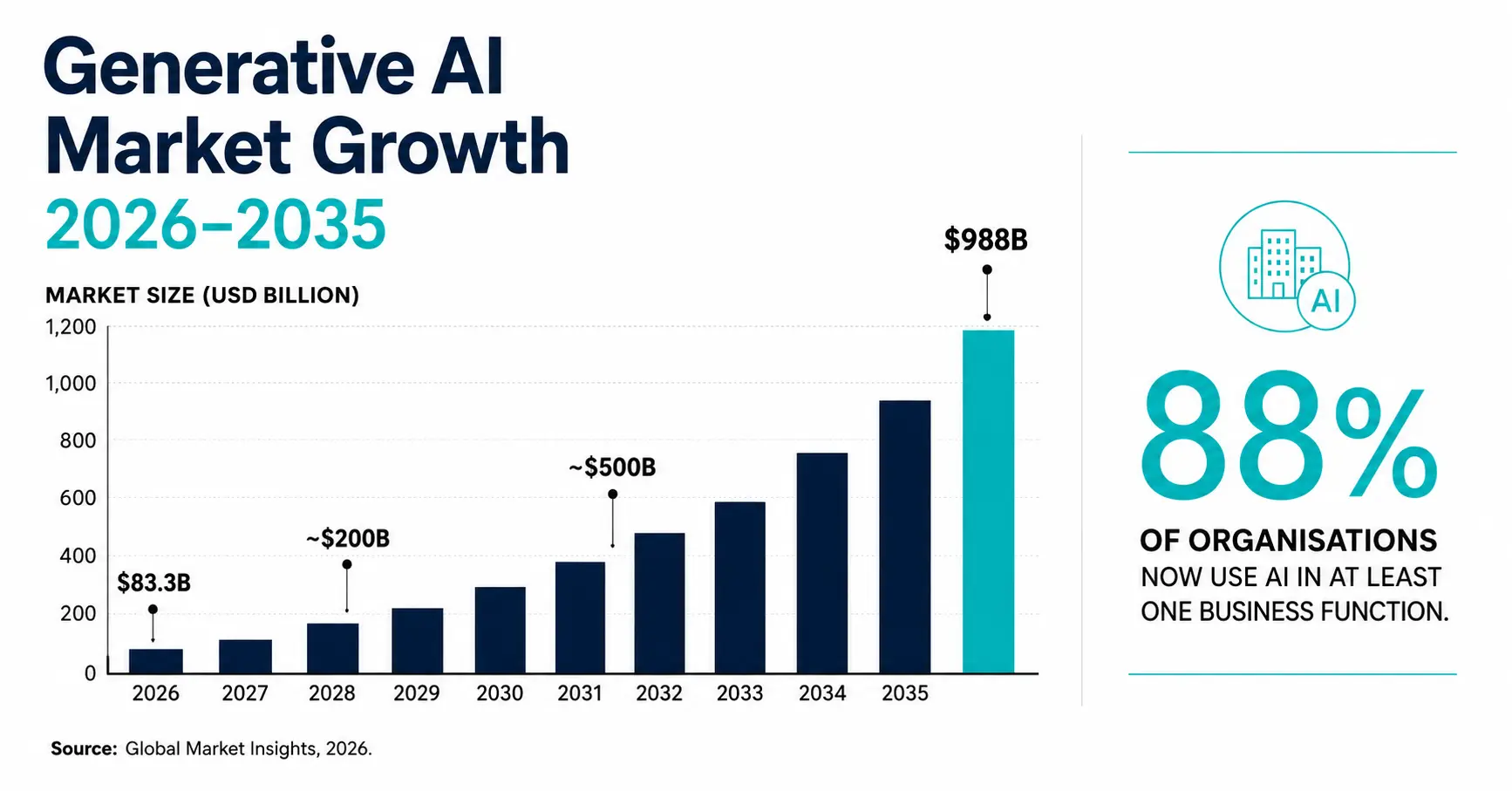
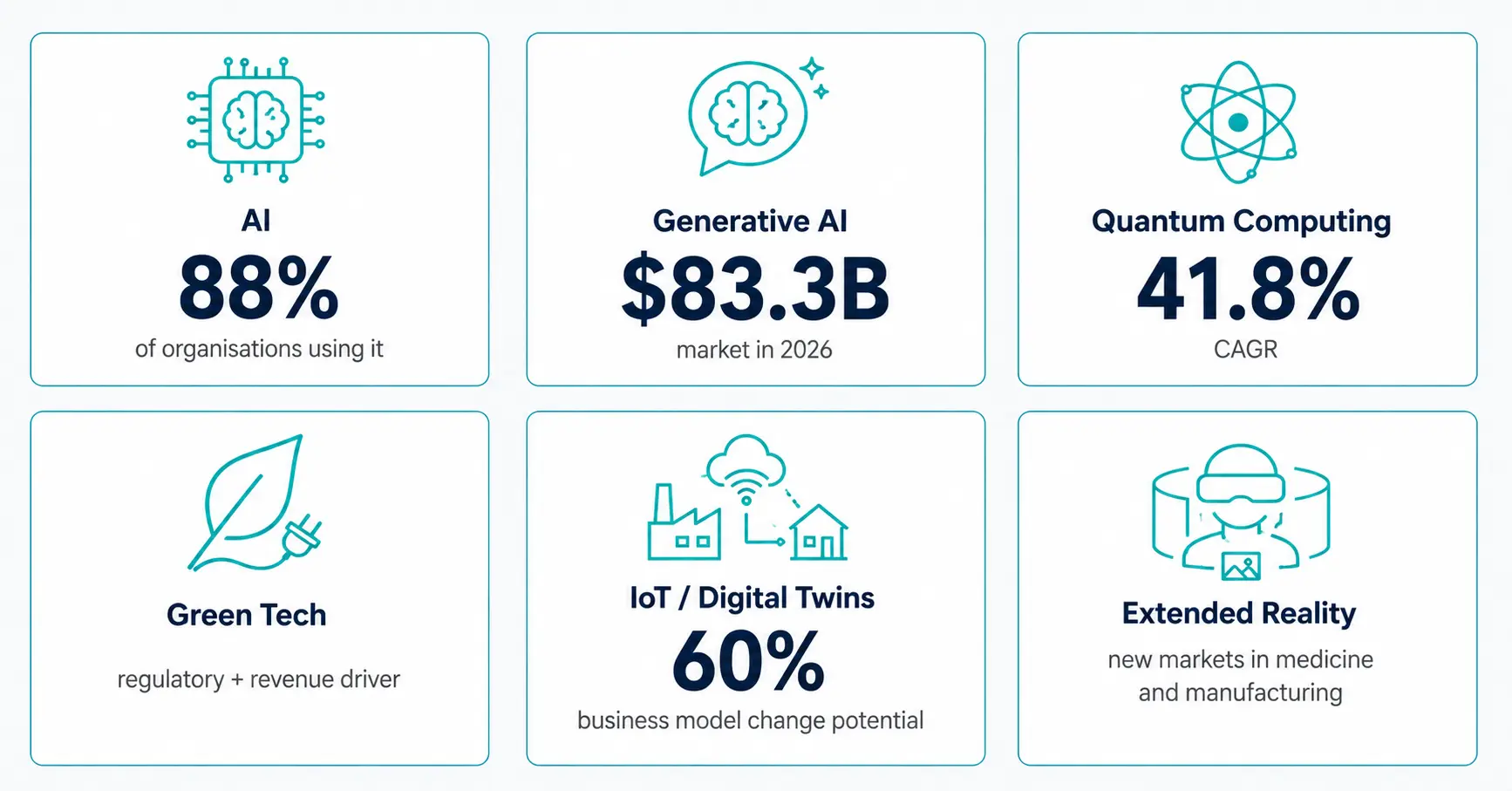
Most organisations spent 2023 and 2024 running technology pilots. In 2026, those pilots are becoming production systems. In 2024, 88% of organisations reported using AI in at least one business function, according to data from StartUs Insights. That number has continued to climb as confidence grows and results become measurable.
This shift matters because production-scale deployment creates compounding advantages. Companies that move from testing to full implementation first build data advantages, process efficiencies, and customer experience benefits that are extremely difficult for slower competitors to replicate.
Artificial Intelligence: The Biggest Emerging Technology Business Opportunity
No technology is generating more business opportunity than artificial intelligence. The generative AI market is projected to grow from $83.3 billion in 2026 to nearly $988 billion by 2035, according to Global Market Insights, representing a compound annual growth rate of 31.6%. That trajectory makes AI the single largest wealth-creation opportunity in modern business history.
However, the opportunity is not evenly distributed. Businesses that treat AI as a standalone tool rather than an integrated system are seeing limited returns. The real gains come from embedding AI into workflows, decision systems, and customer touchpoints at scale.
Generative AI and Content-Driven Revenue
Generative AI, which refers to AI systems that create text, images, video, and code rather than simply analysing existing data, has opened entirely new revenue models. Marketing agencies are using it to produce personalised content at volume. Software companies are using it to accelerate development cycles. E-commerce businesses are using it to generate product descriptions, ads, and customer service responses simultaneously.
The cloud-based deployment model currently holds 73.8% of the generative AI market, according to Grand View Research. This means businesses do not need to invest in expensive on-premise infrastructure to compete. Global Market Insights’ generative AI report shows that the content creation segment alone is projected to account for 35.7% of market share in 2026, driven by social media automation and digital marketing demand.
Agentic AI: Autonomous Systems That Generate Value Around the Clock
Beyond generative AI sits a newer and more powerful category: agentic AI. These are AI systems capable of taking actions autonomously, completing multi-step tasks without human input at each stage. Think of an AI agent that monitors inventory, places purchase orders, alerts the logistics team, and updates the customer-facing stock information, all without a human triggering each step.
The agentic AI market is projected to reach $2.8 billion in 2026, with North America registering the highest growth rate. Businesses using AI agents report productivity improvements of up to 34%, according to StartUs Insights data. For businesses operating in high-volume, process-heavy environments, that gain is transformational.
Quantum Computing: The Next Frontier of Competitive Advantage
Quantum computing is often described as a future technology. In 2026, it is beginning to deliver present-day commercial value. The global quantum computing market is projected to reach $57.56 billion by 2033, growing at a compound annual growth rate of 41.8% from 2026 onwards, according to DataM Intelligence. The machine learning segment is expected to hold the largest revenue share, at 24.4% of the market in 2026 alone.
Quantum computers process information using quantum bits, or qubits, which can represent multiple states simultaneously rather than just zero or one. This allows them to solve certain types of complex problems exponentially faster than classical computers. For businesses, this translates into faster drug discovery, more accurate financial modelling, stronger encryption, and better logistics optimisation.
Where Quantum Delivers Business Value Today
The most immediate commercial applications of quantum computing in 2026 include financial risk modelling, supply chain optimisation, cybersecurity, and pharmaceutical research. Banks and hedge funds are using quantum-enhanced algorithms to model market scenarios that classical computers cannot resolve quickly enough to be actionable.
In cybersecurity, quantum computing presents both a threat and an opportunity. Traditional encryption methods are vulnerable to future quantum attacks, which has created a booming market for quantum-safe cryptography solutions. StartUs Insights’ emerging technology report identifies the quantum computing market as racing toward a $97 billion valuation, with the security and cryptography segment growing at the fastest rate of any application category.
Green Technology: Sustainability as a Business Model
Sustainability is no longer just a compliance requirement. It has become a genuine source of competitive advantage and revenue growth. Green technology has evolved from a niche interest into a mainstream investment category, with businesses across every sector building products, platforms, and services around environmental performance.
Companies that build sustainability into their operations are seeing measurable financial benefits through energy cost reductions, access to green financing, government incentives, and growing consumer preference for environmentally responsible brands. According to IMD’s emerging technology research, green tech is one of the most important technology trends shaping business today precisely because it addresses regulatory pressure, cost reduction, and market differentiation simultaneously.
Specific Green Tech Opportunities for Businesses
The opportunity areas in green technology span multiple industries. Energy management platforms help manufacturers reduce electricity consumption and carbon output. Smart building systems automatically adjust lighting, heating, and cooling based on occupancy data. Circular economy platforms connect businesses to second-life supply chains for materials and components.
For startups, green tech is one of the most fundable sectors in 2026. Investor appetite for climate solutions remains strong, and government grant programmes in North America, Europe, and Asia Pacific are providing additional capital for innovation in this space. Businesses that build verifiable sustainability credentials now are also better positioned to attract institutional customers with their own environmental reporting obligations.
The Internet of Things: Connecting Physical and Digital Business
The Internet of Things, or IoT, refers to networks of physical devices that collect and transmit data in real time. In manufacturing, these are sensors on production equipment. In retail, they are smart shelves and automated checkouts. In agriculture, they are soil monitors and crop analytics systems. By 2026, there are approximately three billion active 5G subscriptions globally, providing the high-speed, low-latency infrastructure that IoT systems need to function at scale.
IoT creates business value through visibility. When a manufacturer can see in real time that a machine is likely to fail in 48 hours, they can schedule maintenance before the breakdown occurs. When a retailer can track exactly which products are being picked up and put down in a store, they can optimise product placement with data rather than guesswork.
IoT and the Rise of Digital Twins
One of the most powerful applications of IoT data is the digital twin. A digital twin is a real-time virtual model of a physical asset, process, or environment. Engineers can simulate changes to a production line, test a new building layout, or model the impact of a supply chain disruption, all within the digital twin, before making a single change in the real world.
This capability dramatically reduces the cost and risk of business decisions. Companies using digital twins report faster product development cycles, reduced maintenance costs, and better operational predictability. According to data from Technostacks, Gartner has confirmed that emerging technologies such as AI, IoT, and digital twins can alter a business model by 60% or more. That is not incremental improvement. That is structural reinvention.
Cybersecurity Technologies: Protecting the Digital Business Opportunity
Every new technology creates new attack surfaces. As businesses digitise more of their operations and data, the need for advanced cybersecurity grows in parallel. Cybersecurity is not just a cost centre in 2026. It is a business enabler, because companies with strong security postures can offer customers, partners, and regulators greater confidence, which translates directly into competitive advantage.
Preemptive cybersecurity, which involves using AI to predict and block threats before they occur, is one of the fastest-growing segments of the technology market. AI security platforms analyse network behaviour, identify anomalies, and automatically isolate threats faster than any human security team can respond.
Regulatory Compliance as a Business Driver
Governments worldwide are tightening data protection and cybersecurity regulations. In the European Union, the Network and Information Security 2 directive, known as NIS2, has expanded the scope of mandatory cybersecurity requirements for businesses operating in critical sectors. In the United States, the Securities and Exchange Commission has introduced new rules requiring publicly listed companies to disclose material cybersecurity incidents within defined timescales.
These regulatory changes create direct business opportunities for cybersecurity solution providers and for professional services firms that help organisations achieve compliance. Businesses that build security into their products from the ground up are also finding that it becomes a selling point, particularly when selling into enterprise or government markets where procurement teams conduct detailed security assessments.
Extended Reality: Spatial Computing Opens New Markets
Extended reality, which covers augmented reality, virtual reality, and mixed reality collectively, is reaching a genuine commercial tipping point in 2026. The underlying technology, known as spatial computing, has matured to the point where real business use cases are delivering measurable returns in industries including medicine, manufacturing, training, and retail.
In manufacturing, augmented reality headsets guide technicians through complex assembly or repair procedures, reducing error rates and training time. In medicine, surgeons use mixed reality overlays during procedures to access real-time data without looking away from the patient. In retail, virtual try-on tools allow customers to visualise products in their own homes before purchasing.
TechTarget identifies extended reality as one of the 11 emerging technologies most likely to gain commercial traction in 2026, noting that AI and software improvements are driving new business use cases at a pace not previously seen in this category. TechTarget’s emerging technologies guide points to spatial computing as the infrastructure layer that will power the next generation of immersive business applications.
How Small Businesses Can Compete Using Emerging Technologies
Large enterprises have scale, but small businesses have speed. And in 2026, speed may matter more. According to BizTech Magazine, 96% of small business owners in the United States plan to adopt emerging technologies in the near future, a figure drawn from U.S. Chamber of Commerce research. The tools to compete are available. The question is which ones to prioritise.
Small businesses are finding the most immediate returns from cloud-based AI tools for customer service automation, marketing personalisation, and financial forecasting. These solutions require no expensive hardware, minimal technical expertise to deploy, and can be scaled as the business grows.
A Practical Framework for Technology Adoption
The most effective approach for small businesses is to start with the process that causes the most friction or costs the most time, then identify a technology that addresses it directly. This avoids the trap of adopting technology for its own sake and ensures that every investment connects to a real business problem.
Then, build internal capability gradually. Technology adoption fails most often not because the tools are wrong but because the people using them do not understand how to extract value from them. Invest in training alongside tools, measure outcomes consistently, and expand from what is working rather than constantly chasing the newest release.
Additionally, BizTech Magazine’s 2026 small business technology report recommends that businesses audit their current technology stack before adding new layers. Understanding what is already working, and what gaps exist, produces a clearer investment roadmap than reacting to trend headlines alone.
Frequently Asked Questions
What are the most important emerging technologies for businesses in 2026?
The most commercially significant emerging technologies in 2026 include artificial intelligence, generative AI, agentic AI systems, quantum computing, green technology, IoT and digital twins, advanced cybersecurity platforms, and extended reality. Each creates different types of business opportunities depending on the industry and the specific problems a business needs to solve.
How much is the AI market worth in 2026?
The global artificial intelligence market is valued at approximately $601.93 billion in 2026, according to MarketsandMarkets. It is projected to reach $3.64 trillion by 2033, making it one of the largest and fastest-growing markets in economic history. The generative AI segment alone is expected to reach $83.3 billion in 2026.
Can small businesses realistically benefit from emerging technologies?
Yes, and many already are. Cloud-based AI platforms, automation tools, and no-code development environments have reduced the cost and technical complexity of technology adoption significantly. The U.S. Chamber of Commerce reports that 60% of business operations now use AI, including a growing share of small and medium-sized businesses.
What is agentic AI and why does it matter for business?
Agentic AI refers to artificial intelligence systems capable of autonomously completing multi-step tasks without requiring human input at each stage. Unlike standard AI tools that respond to prompts, AI agents can plan, act, and adapt independently. Businesses using AI agents report productivity gains of up to 34%, making them one of the most impactful technology investments available in 2026.
What is a digital twin and how does it create business value?
A digital twin is a real-time virtual model of a physical asset, process, or environment that mirrors what is happening in the real world using live data from IoT sensors. Businesses use digital twins to simulate changes, test scenarios, and predict failures before they occur in reality. This reduces risk, accelerates decision-making, and can significantly lower operational costs.
How does quantum computing affect business strategy in 2026?
Quantum computing is beginning to deliver commercial value in financial modelling, drug discovery, logistics optimisation, and cybersecurity. While full-scale quantum computers are not yet universally accessible, quantum-enhanced services are available through cloud platforms from providers such as IBM and Google. Businesses in finance, pharmaceuticals, and advanced manufacturing are the earliest to see material returns.
The Technology Decisions You Make in 2026 Will Define Your Next Decade
Emerging technologies are not a distant forecast. They are active forces reshaping markets, business models, and competitive landscapes right now. The businesses that engage seriously with AI, quantum computing, green technology, IoT, and cybersecurity in 2026 are building advantages that will compound over years. Those that wait are not just missing growth. They are allowing competitors to build structural leads that become progressively harder to close.
The data makes the case clearly. A $601 billion AI market, $57 billion quantum computing trajectory, and 96% small business technology adoption intention are not speculative numbers. They reflect decisions already being made and capital already being deployed. The question for any business leader is not whether these technologies matter, but how quickly and intelligently to act on them.
Therefore, the most productive next step is to identify one or two of the technology areas covered in this post that align most directly with your business model, and build a focused adoption plan around them. Start with the problem, not the technology. Define what success looks like before you spend a dollar. And revisit your plan every quarter, because the landscape in 2026 is moving faster than annual planning cycles can track.
For a broader view of the technology trends reshaping business at the global level, StartUs Insights’ comprehensive emerging technologies guide is one of the most detailed and regularly updated resources available. The businesses that build a habit of informed, strategic technology adoption will be the ones setting the pace, not following it, in the years ahead.

Prince Anichi
Founder and Lead Technology Editor at Ortechy. Covering digital economy shifts, tech ecosystems across Africa, cybersecurity intelligence, and emerging software platforms.