Every day, thousands of Nigerians abandon online deals before they happen. The buyer refuses to pay first. The seller refuses to ship without payment. The transaction dies in the silence between two strangers who have no reason to trust each other. This is not a logistics problem. It is a trust problem. And EscrowPay, which launched on 26 June 2026, is the first WhatsApp-native escrow service built specifically to solve it for Nigerian buyers and sellers.
The stakes are real. According to the Central Bank of Nigeria’s Payments System Vision 2028 document, Nigeria’s banking and payments ecosystem lost a combined N134.48 billion to fraud between 2020 and 2025. E-commerce fraud specifically saw a jaw-dropping 1,961 percent escalation in one recorded period. These numbers explain why cash-on-delivery became the default for online shopping in Nigeria. They also explain why that default is not working — for sellers who absorb failed deliveries and rejected parcels, or for buyers who still gamble on whether what arrives matches what they ordered.
This post breaks down exactly how EscrowPay works, why it is built differently from anything else on the Nigerian market, who is behind it, what it costs, and what comes next. If you buy or sell anything online in Nigeria, this is worth understanding.
The Trust Problem Killing Nigerian E-Commerce
Nigeria has over 122 million internet users as of 2025. Its digital economy is valued at over $10 billion. Yet online shopping still accounts for only a small fraction of total retail. The reason is not infrastructure. The reason is not payment rails. The reason, consistently, is trust.
When a buyer pays a stranger upfront on Instagram or WhatsApp, they are betting that the seller is real, that the product matches the photos, and that delivery will actually happen. Most of the time, it works. But when it does not, there is no neutral party to appeal to. The money is gone. According to the Nigerian Communications Commission, nearly 60 percent of Nigerian internet users have encountered some form of online scam. That statistic is not a fringe figure. It is why most Nigerians approach online buying with deep, rational caution.
Cash-on-delivery was invented to solve this, but it shifted the problem rather than removing it. Sellers now bear the cost of failed deliveries, customers who reject parcels at the door, and riders who travel across Lagos for nothing. Several Nigerian e-commerce giants have suspended cash-on-delivery entirely because of rising operational costs, as documented by Pavestones Legal in their analysis of escrow payments in Nigerian e-commerce. The buyers’ problem became the sellers’ problem. Nobody actually solved it.
Why Existing Solutions Fall Short
Several escrow platforms already operate in Nigeria, including AtaraPay, PayScrow, EscrowLock, and Safeburse. They are real services doing genuine work. The shared limitation, however, is friction. Most require users to create new accounts, download new apps, learn new dashboards, and abandon the channels where they already trade. That is a significant ask in a market where most buying and selling happens inside WhatsApp chats and Instagram DMs.
Additionally, many of these platforms target higher-value transactions, such as land, cars, and luxury goods. The everyday informal trade — a ₦15,000 pair of shoes, a second-hand laptop, a handmade bag — has had no low-friction escrow option. That is the gap EscrowPay is walking into.
What EscrowPay Actually Is
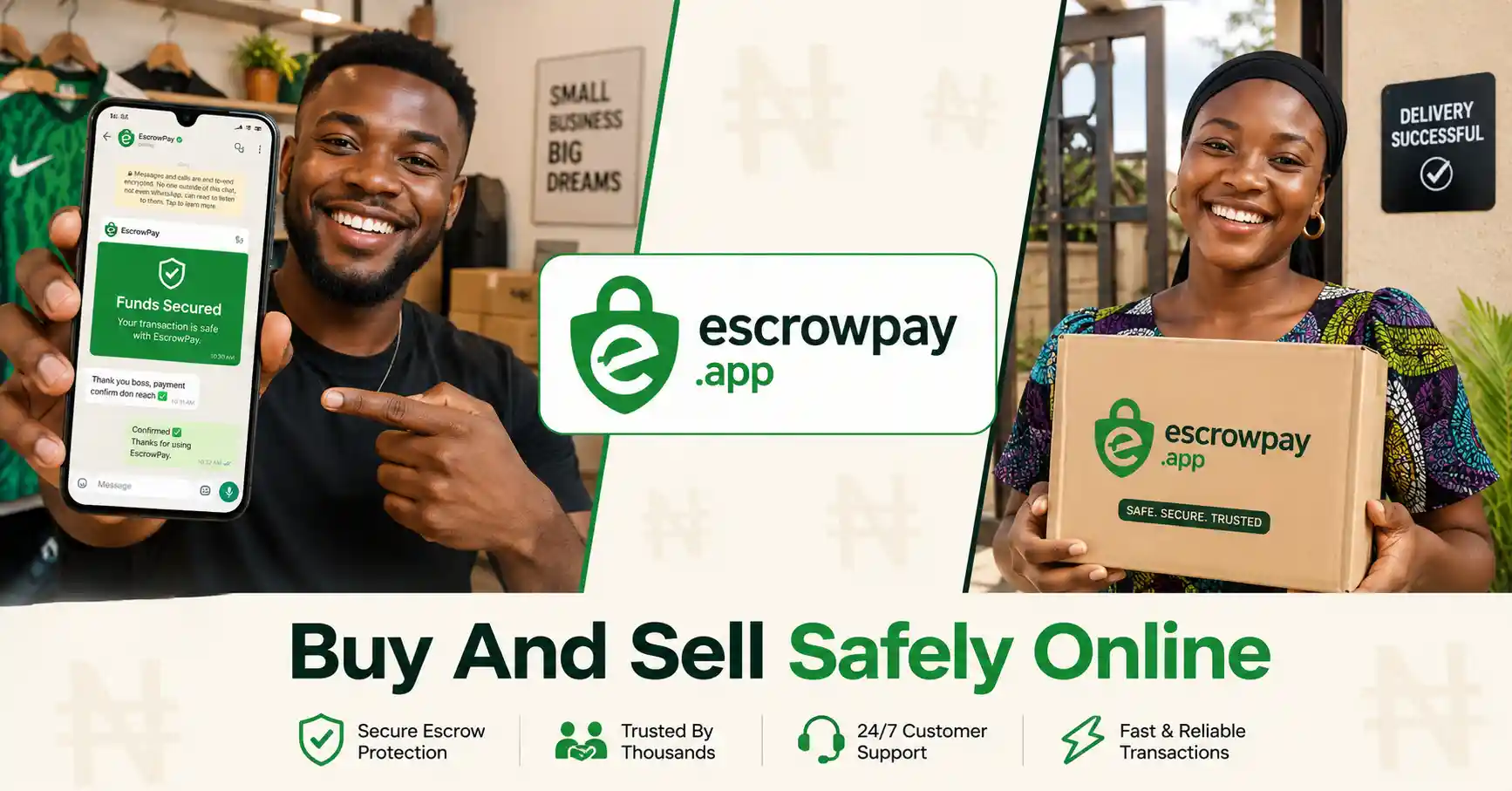
EscrowPay is a WhatsApp-native escrow service that holds a buyer’s payment securely at a CBN-licensed bank until a transaction is completed and the buyer confirms delivery. No app download. No new account. No passwords. Everything happens inside WhatsApp, which is already where Nigerian buyers and sellers communicate every day.
The company is operated by EscrowLink Technologies Limited, registered in the Federal Republic of Nigeria under registration number RC 9473181. All buyer payments are held in a designated account at Rubies Microfinance Bank, a Central Bank of Nigeria-licensed institution, and all deposits are insured by the Nigeria Deposit Insurance Corporation (NDIC). The funds do not sit on EscrowPay’s own books at any point. That distinction matters enormously for trust.
Founder and CEO Toye Akinwale puts the mission plainly: “EscrowPay doesn’t process goods, and it doesn’t process payments. It processes trust.” His governing principle is equally direct: no party should ever hold both the goods and the cash at the same time. That one rule, applied consistently, is the entire product.
How EscrowPay Works — Step by Step
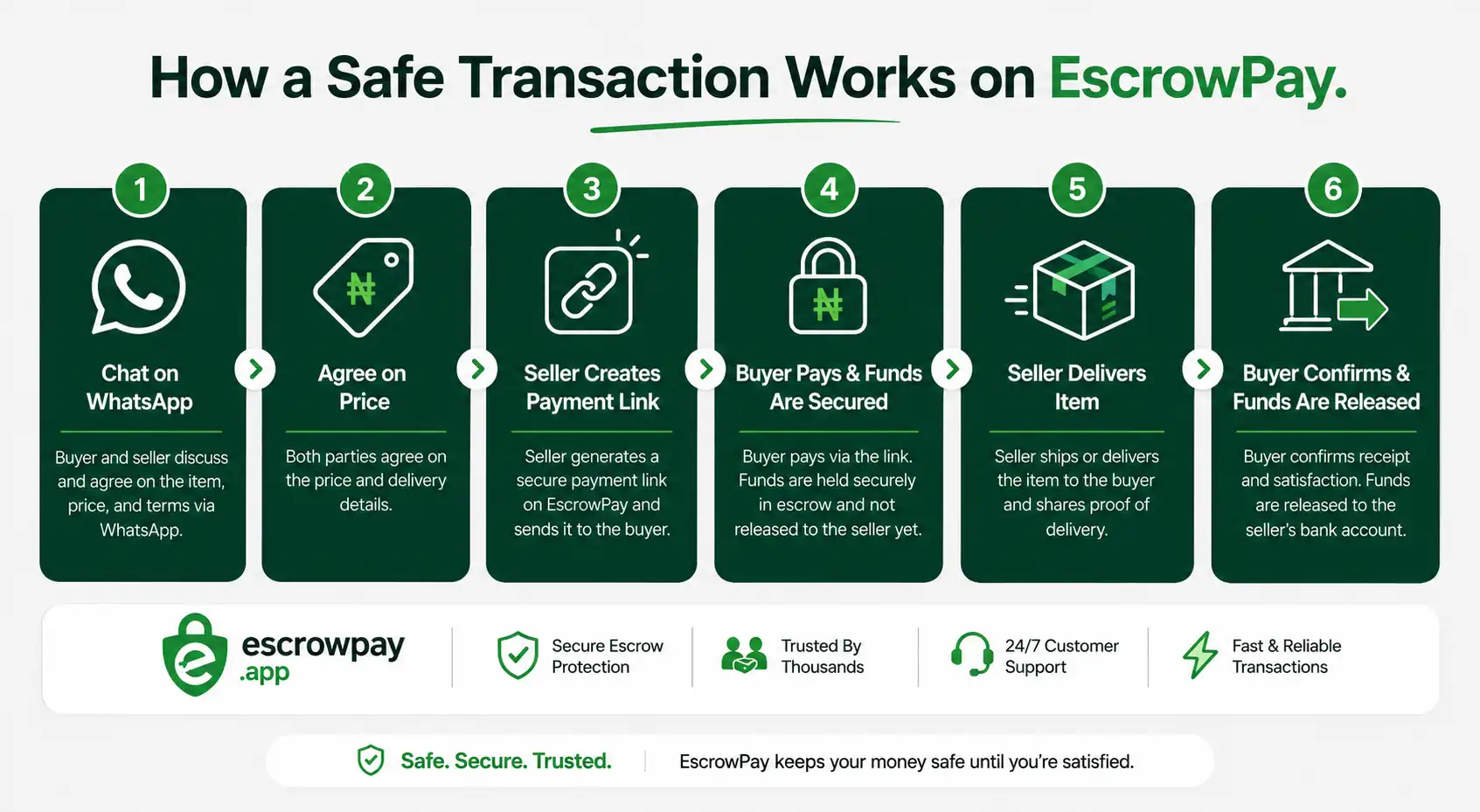
The process is designed to be fast. A seller can set up their first transaction in under five minutes. Here is how a typical transaction runs from start to finish.
For Sellers
- Message EscrowPay on WhatsApp and send the word NEW to begin.
- Enter the item name, price, and delivery window.
- EscrowPay generates a secure payment link in seconds.
- Share the link with your buyer through any channel — WhatsApp, Instagram, email, or wherever the conversation is happening.
- Once the buyer pays, EscrowPay notifies the seller. The funds are locked and cannot be reversed.
- Dispatch the item knowing the money is secured. No more shipping into uncertainty.
- After delivery, the buyer confirms receipt and the funds transfer immediately to the seller’s bank account.
For Buyers
- Receive the EscrowPay payment link from the seller.
- Review the transaction terms — item name, price, delivery window, and the total fee shown clearly before payment.
- Pay via Nigerian bank transfer.
- Track the order through the EscrowPay dashboard or within WhatsApp.
- Confirm receipt when the item arrives. If something is wrong, tap the dispute button before the auto-release window closes.
The auto-release timer adds an important protection for sellers. If a buyer receives their item but does not confirm within the agreed window — four hours for same-city delivery, 72 hours for interstate, and 120 hours for long-distance — the funds are released automatically. Buyers can request one 48-hour extension if they need more time. This removes the risk of buyers stalling indefinitely, which is a real vulnerability in manually managed escrow arrangements.
EscrowPay’s Identity Verification and Fraud Prevention
One of the core reasons online scams thrive in Nigeria is anonymity. Fraudsters create Instagram pages, sell convincingly, take payment, and vanish. Existing social platforms have no mechanism to prevent this because they are not built for transaction accountability.
EscrowPay’s response is mandatory identity verification before the first transaction. Every buyer and seller completes National Identification Number (NIN) verification through Prembly, described as a leader in Africa’s trust infrastructure. This check happens once, takes approximately one minute, and permanently links the person’s real identity to their EscrowPay account. The verification removes the anonymity that scams rely on. Anyone who defrauds someone through EscrowPay is not hiding behind a random username — they are accountable by name and identity to the Nigerian state.
This mirrors a broader shift in Nigeria’s financial system. The CBN has credited BVN and NIN integration with significantly constraining impersonation and synthetic identity fraud, as noted at the 2026 Nigeria Electronic Fraud Forum. EscrowPay is applying the same logic at the transaction layer, not just the account-opening layer.
All payments move through Nigerian bank transfer, which eliminates chargeback risk. Unlike card payments, bank transfers in Nigeria are final and verified. This is a deliberate architectural choice: it protects sellers from the kind of payment reversal fraud that has affected platforms relying on card infrastructure.
How Dispute Resolution Works
No escrow service is complete without a credible dispute process. EscrowPay’s mechanism is straightforward. If a buyer has a problem with a delivery, they tap the dispute button in their WhatsApp chat before the auto-release window closes. A trained dispute agent is assigned within two hours. Both buyer and seller then submit evidence — photographs, WhatsApp conversation screenshots, tracking references, or whatever is relevant.
The agent reviews all evidence and issues a binding resolution. Funds are either released to the seller, refunded to the buyer, or split depending on the outcome. The two-hour assignment window is fast by any standard. Most informal dispute processes in Nigeria involve days of back-and-forth messages, social media callouts, and no resolution at all. EscrowPay replaces that with a structured, time-bounded process where both sides have an equal opportunity to be heard.
The EscrowPay rider delivery option adds another layer of protection. When a seller dispatches using EscrowPay’s own rider feature, both pickup and drop-off are recorded with time stamps. That evidence is available instantly if a dispute arises. Sellers who use third-party couriers can still provide tracking references. The only option that leaves disputes harder to resolve is a buyer’s own rider, where no third-party tracking exists — though the option remains available for those who prefer it.
Pricing — What EscrowPay Costs
EscrowPay charges a single processing fee of 2.3 percent per completed transaction. There are no monthly fees, no setup costs, and no charges if a transaction does not complete. The fee is deducted from the seller’s payout at the point of fund release.
To put that in concrete terms: on a ₦200,000 sale, the seller receives ₦196,500. The buyer sees the full total, including the fee, before confirming payment — so there are no hidden charges on either side. For diaspora buyers transacting in Nigeria, the same 2.3 percent fee applies, though a Nigerian bank account is required.
This pricing model aligns EscrowPay’s incentives with successful transactions. The company only earns when a deal completes. That creates a genuine reason to resolve disputes fairly and keep the experience smooth for both sides, rather than profiting from stalled or abandoned transactions.
Who Built EscrowPay and Why
Toye Akinwale was born in Canada and has spent most of his adult life in the United Kingdom. He attended secondary school in Nigeria and, despite spending only five years in the country in total, describes himself as “101% Nigerian.” He studied Financial Services and Business Studies in the UK and built a career that included director-level roles at various investment banks, with periods at Meta and Google. He taught himself to build web applications alongside his finance career.
The idea for EscrowPay became concrete after a personal experience. Toye ordered an item from an online vendor as a gift for his mother. The experience taught him something he had observed professionally but now felt personally: the absence of a neutral party between buyer and seller is not a minor inconvenience. It is the central reason Nigerian online commerce operates below its potential.
More than 300 sellers signed up ahead of EscrowPay’s 26 June 2026 launch — before a single paid transaction had taken place. That pre-launch demand reflects how acutely Nigerian sellers feel the trust gap. When someone can demonstrate that the goods exist but cannot get paid until they ship, they lose sales. EscrowPay removes that bind at both ends simultaneously.
EscrowPay Version 2 — What Is Coming Next
EscrowPay is starting focused, but version two of the product already has a defined roadmap. Three features stand out as particularly significant for the wider market.
Free Seller Storefronts
The headline v2 feature is a free EscrowPay storefront. A seller will be able to set up a branded online presence in a few clicks, with EscrowPay’s protection built in from the first sale. For informal traders, market women, Instagram sellers, and small business owners who have no website and no budget to build one, this is potentially transformative. It lowers the barrier to selling online dramatically while attaching the safety layer from the start.
Milestone Escrow for Freelancers
The second major v2 addition is milestone escrow for service-based agreements. A freelancer and client can split any project into stages. Funds for each stage are held and released when the client approves that milestone. This addresses one of the most painful trust problems in Nigeria’s growing digital economy: clients who do not pay after work is delivered, and freelancers who cannot afford to work without some payment security upfront.
Cross-Border Payments
The third announced feature is cross-border escrow, extending the same protection to trade beyond Nigeria. As reported by Techpoint Africa, the trust gap is widest in cross-border trade, where neither party has any relationship with the other’s legal system or consumer protections. An African merchant selling to a diaspora buyer, or a Nigerian seller trading with a customer in another African country, currently has almost no protection at all. Bringing the escrow model to that context could open trade that simply does not happen today.
Why This Moment Is Right for Escrow in Nigeria
Timing matters. Several trends are converging that make 2026 a plausible moment for escrow to move from a niche service to a mainstream expectation in Nigerian online trade.
First, identity infrastructure is better than it has ever been. The NIN system, BVN integration, and platforms like Prembly have made real-time identity verification fast, affordable, and API-accessible. EscrowPay’s one-minute NIN check would have been operationally difficult to deploy at scale five years ago. Today it is a standard integration.
Second, WhatsApp is where commerce already lives. Nigeria has one of the highest WhatsApp penetration rates in Africa. Social commerce — buying and selling inside messaging apps — is not an emerging behaviour in Nigeria. It is how millions of people already trade. Any escrow solution that requires leaving that environment faces an adoption ceiling. EscrowPay operates inside it.
Third, cash-on-delivery is collapsing as a viable model. Multiple major Nigerian e-commerce operators have suspended or restricted it. The vacuum that leaves needs to be filled by something that works for both sides — not just by asking buyers to trust again, but by making trust unnecessary through a verified neutral mechanism. That is precisely what escrow does, and precisely what EscrowPay is offering at the level of everyday informal trade for the first time.
According to TechNext24’s coverage of EscrowPay’s launch, the founding thesis is that building trust into the infrastructure of a transaction removes the need to ask either party to extend it personally. That is a fundamentally different frame from consumer education campaigns or fraud awareness drives, which place the burden of protection on individuals. EscrowPay places it on the system.
My Take: What This Means for Nigerian Digital Commerce
From where I sit, watching Nigerian tech from inside it, EscrowPay feels like one of those ideas that is so obviously needed that the question is not whether it will succeed but how fast it can scale before a better-funded competitor notices the gap. The WhatsApp-native design is the smartest decision in the product. Every other escrow platform I have tested in Nigeria asks me to do something extra. EscrowPay meets me exactly where I already am.
The 2.3 percent fee is fair. On a ₦50,000 transaction, the escrow cost is ₦1,150. Anyone who has ever lost a full payment to a fraudulent seller understands why ₦1,150 is worth paying. The real question is whether everyday Nigerian buyers and sellers will make that mental shift from “escrow is for big property deals” to “escrow is for any online trade I do with someone I do not know personally.”
That shift is cultural as much as technological, and it will not happen overnight. But EscrowPay’s v2 storefront feature is where I see the sharpest long-term opportunity. If a small seller can build a branded storefront with trust built in by default — without code, without a web designer, without monthly fees — that is a genuine on-ramp to formal digital commerce for a population of traders who currently operate entirely informally. That is not just a product feature. It is infrastructure.
Nigeria’s e-commerce ecosystem is not held back by appetite. Nigerians want to buy online. They want to sell online. They are doing it every day in WhatsApp groups and Instagram comment sections. What has been missing is the middle layer that makes both sides safe enough to complete the deal with someone they have never met. EscrowPay is building exactly that layer. Whether it becomes the default, as Toye Akinwale hopes, depends on execution and adoption — but the foundation is solid, the timing is right, and the problem is real.
Is EscrowPay Safe and Regulated?
This is the right question, and the answer requires some nuance. As of early 2026, the Central Bank of Nigeria does not issue specific escrow licences. Escrow providers in Nigeria operate under the Payment Service Provider framework. What matters is whether the platform partners with regulated institutions and whether funds are genuinely insured.
EscrowPay clears both tests. Funds are held at Rubies Microfinance Bank, which is CBN-licensed. Deposits are insured by the NDIC. The company itself is a registered Nigerian entity under the Companies and Allied Matters Act. NIN verification through Prembly provides a documented identity layer. Marketplace Naija’s guide to escrow payments in Nigeria advises users to check for bank partnerships, KYC compliance, and NDPR adherence when evaluating any escrow platform — EscrowPay addresses all three.
The honest caveat is that EscrowPay launched on 26 June 2026. No platform earns a long-term trust record at launch. Watch for how disputes are handled in the first three months, how quickly the team responds to edge cases, and whether the auto-release mechanism works as stated. Those early behaviours will tell you more than any founding document can.
How EscrowPay Compares to Buying on Established Marketplaces
Some readers will ask why EscrowPay matters when Jumia and Konga already offer buyer protection. That is a fair comparison, and it misses a large portion of where Nigerian e-commerce actually lives.
Jumia and Konga operate closed marketplaces. Their buyer protection works because sellers are listed, verified, and accountable to the platform’s terms of service. The moment you leave those platforms — which most Nigerians do when buying from Instagram sellers, Facebook marketplace listings, WhatsApp group vendors, or Twitter deals — that protection disappears entirely. EscrowPay is not competing with Jumia. It is filling the enormous unprotected space that exists everywhere outside of it.
That unprotected space is where the majority of Nigeria’s informal digital trade happens. It is where the real problem lives, and where EscrowPay has planted its flag.
Why EscrowPay Matters for Nigerian E-Commerce in 2026
Pulling this together, the significance of EscrowPay is not just that it is a useful tool for cautious buyers and sellers. It is that it represents a structural shift in how the trust layer of Nigerian online commerce could be built. Every infrastructure layer that Nigeria’s digital economy needed — payment rails, identity verification, logistics — took years to reach the point where it could underpin mass consumer behaviour. Trust is the one layer that has not had a consumer-grade solution at the informal commerce level. EscrowPay is a direct attempt to build it.
The data on Nigeria’s fraud environment makes the need undeniable. Daily Trust’s reporting on Nigeria’s digital fraud losses confirms that more than 92 percent of fraud cases in recent years were linked to digital transactions. That environment is not going to improve through awareness campaigns alone. It improves when the transaction architecture itself removes the conditions that fraud depends on — anonymity, unverified identities, and unprotected payments.
EscrowPay is a small company at launch, not a sector-wide solution yet. But the model is sound, the timing is credible, and the founding team brings both financial and technology experience to a problem that needs both. If “send it through EscrowPay” becomes a normal phrase in Nigerian online trade — the way “pay me on Opay” normalised mobile payments — that is not just a win for one startup. It is a structural improvement in the confidence with which Nigerians can participate in digital commerce.
The Trust Layer Nigeria Has Needed for a Long Time
EscrowPay is not trying to replace the banks, the logistics companies, or the social commerce platforms where Nigerian trade happens. It is trying to sit between all of those things as the layer that makes every transaction safer. That is a narrow but critical position to occupy, and the WhatsApp-native design gives it a distribution advantage that most fintech startups spend years trying to engineer.
For Nigerian sellers, the immediate value is concrete: ship knowing the money is locked. For buyers, it is equally concrete: pay knowing a neutral party holds the funds until you are satisfied. For Nigeria’s digital economy as a whole, the value is harder to quantify but potentially larger: every transaction that completes safely because EscrowPay was in the middle is a transaction that builds confidence for the next one.
Toye Akinwale’s ambition is for “send it through EscrowPay” to become a normal part of how Nigerians trade. That ambition is achievable. The infrastructure is real, the fee is reasonable, the regulatory foundation is appropriate, and the problem being solved is one that every Nigerian buyer and seller has experienced personally. The test now is adoption, and for that, EscrowPay needs Nigerian traders to give it their first transaction.
If you buy or sell online in Nigeria and you have not tried an escrow service, this is a strong moment to start. Visit EscrowPay’s official website to start your first transaction or message them on WhatsApp to set up a sale.
Frequently Asked Questions About EscrowPay Nigeria
What is EscrowPay and how does it work in Nigeria?
EscrowPay is a WhatsApp-native escrow service that holds a buyer’s payment at a CBN-licensed bank until the order is delivered. The seller generates a secure payment link through WhatsApp, shares it with the buyer, and dispatches the goods once the buyer pays. Funds are released to the seller after delivery is confirmed, either by the buyer or automatically by the platform’s release timer.
Do I need to download an app to use EscrowPay?
No. EscrowPay operates entirely through WhatsApp using the official WhatsApp Business API. Sellers initiate transactions by messaging EscrowPay on WhatsApp. Buyers pay through a web link and can track transactions through the web dashboard. There is no app to download and no new account to create.
How much does EscrowPay charge per transaction?
EscrowPay charges a 2.3 percent processing fee per completed transaction, deducted from the seller’s payout. There are no monthly fees and no setup costs. The buyer sees the full total including the fee before confirming payment. On a ₦200,000 sale, the seller receives ₦196,500.
Is EscrowPay safe? Where is my money held?
Buyer payments are held in a designated account at Rubies Microfinance Bank, a CBN-licensed Nigerian financial institution. Deposits are insured by the NDIC. Funds are never held on EscrowPay’s own books. Every user completes NIN verification through Prembly before their first transaction, creating an accountable identity record for both buyers and sellers.
What happens if there is a dispute about my order?
If a buyer has a problem, they tap the dispute button in their WhatsApp chat before the auto-release window closes. A trained dispute agent is assigned within two hours. Both sides submit evidence — photos, chats, tracking references — and the agent issues a binding resolution. Funds are released to the seller, refunded to the buyer, or split depending on the outcome.
Can diaspora Nigerians use EscrowPay to buy from Nigerian sellers?
Yes. Buyers anywhere in the world who hold a Nigerian bank account can pay Nigerian sellers through EscrowPay with the same 2.3 percent fee and the same escrow protection. The buyer does not need to be physically in Nigeria to use the service, making EscrowPay accessible to the Nigerian diaspora purchasing goods for delivery to Nigerian addresses.

Prince Anichi
Founder and Lead Technology Editor at Ortechy. Covering digital economy shifts, tech ecosystems across Africa, cybersecurity intelligence, and emerging software platforms.