In this article13 sections
- 01.Flutterwave Acquires Mono and Brings Open Banking In-House
- 02.Flutterwave Secures Its Nigerian Microfinance Banking Licence
- 03.Why the Flutterwave Banking Move Matters for Nigeria’s Fintech Ecosystem
- 04.Flutterwave Capital Returns: Business Lending Is Back on the Agenda
- 05.$40 Billion in Payments and the IPO Conversation
- 06.What the Flutterwave Story Means for Nigeria’s Broader Tech Ecosystem
- 07.Frequently Asked Questions About Flutterwave in 2026
- ↳What did Flutterwave acquire in 2026?
- ↳How much has Flutterwave processed in payments?
- ↳Does Flutterwave now have a banking licence?
- ↳Is Flutterwave planning an IPO?
- ↳What is Flutterwave Capital?
- 08.Is Flutterwave Building the Financial Infrastructure Africa Needs?
Flutterwave Is No Longer Just a Payments Company: Here Is What Nigeria’s Biggest Fintech Is Building in 2026
Something fundamental has changed at Flutterwave. The company that spent a decade helping African businesses accept payments online has quietly, methodically, and decisively transformed itself into something far larger. In the first four months of 2026 alone, Flutterwave acquired an open banking startup, secured a national microfinance banking licence in Nigeria, crossed $40 billion in lifetime payment volume, revived its lending division, and positioned itself on a credible path toward an IPO. This is no longer the same company that launched in 2016 with the mission to simplify payments across Africa. This is a company building the full financial stack that Africa has needed for decades.
This article covers every major development in Flutterwave’s 2026 transformation, why each move matters for Nigeria’s fintech ecosystem, and what it all means for the millions of businesses and consumers who depend on Africa’s digital financial infrastructure every day.
Flutterwave Acquires Mono and Brings Open Banking In-House
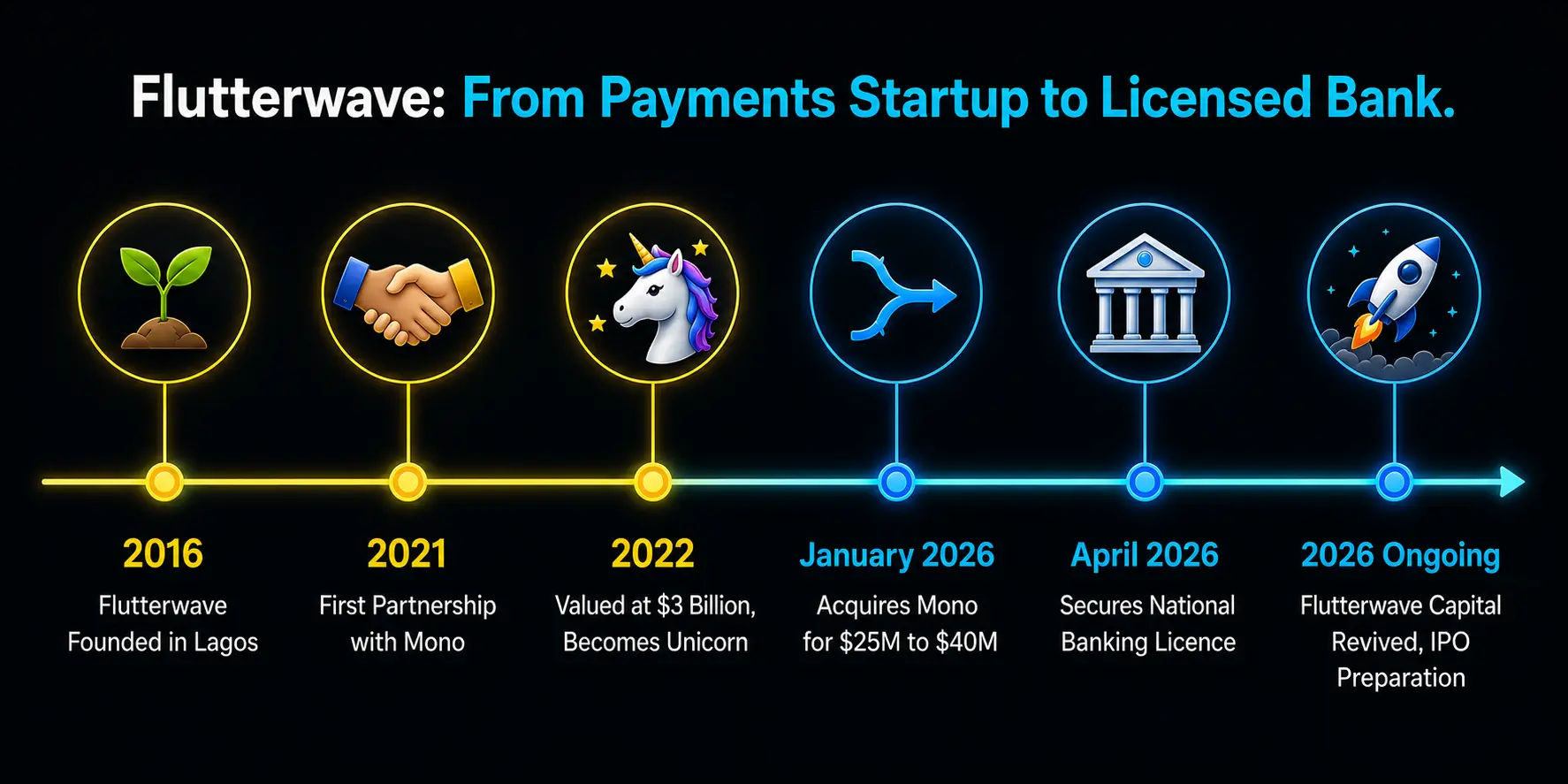
The first major signal of Flutterwave’s new direction came on January 5, 2026, when the company announced it had acquired Mono, Nigeria’s leading open banking infrastructure provider. The deal was structured entirely in shares and valued between $25 million and $40 million according to sources cited by multiple outlets including TechCrunch and Ecofin Agency.
Mono is not a payments company. Mono built an API-driven platform that connects to over 50 African banks and enables three critical capabilities: secure access to customer-permissioned financial data, identity and account ownership verification, and direct account-to-account payments. These are the plumbing layers beneath the payments experience, the infrastructure that makes it possible to verify who someone is, confirm they have money in their account, and move that money without touching a card network at all.
For Flutterwave, acquiring Mono meant pulling these capabilities fully in-house rather than depending on a third-party partner. The two companies had worked together since 2021, collaborating on bank payment products across the continent. The acquisition formalised that relationship and gave Flutterwave direct control over the open banking layer that its next generation of products depends on.
Olugbenga Agboola, Flutterwave’s founder and CEO, explained the strategic logic clearly. He said the acquisition reflects how the company thinks about the future of financial infrastructure in Africa, noting that payments, data, and trust cannot exist in silos and that open banking provides the connective tissue the ecosystem needs. Abdulhamid Hassan, Mono’s founder and CEO, described the deal as the natural progression of a partnership built around a shared belief in Africa’s open banking potential.
Mono continues to operate independently following the acquisition, with no changes to its leadership, team, or daily operations. Flutterwave holds a strategic stake rather than operational control, which allows Mono to maintain its pace of innovation while contributing its infrastructure to Flutterwave’s wider platform.
The acquisition also unlocked something Flutterwave had been pursuing quietly for months: a pathway to a Nigerian banking licence.
Flutterwave Secures Its Nigerian Microfinance Banking Licence
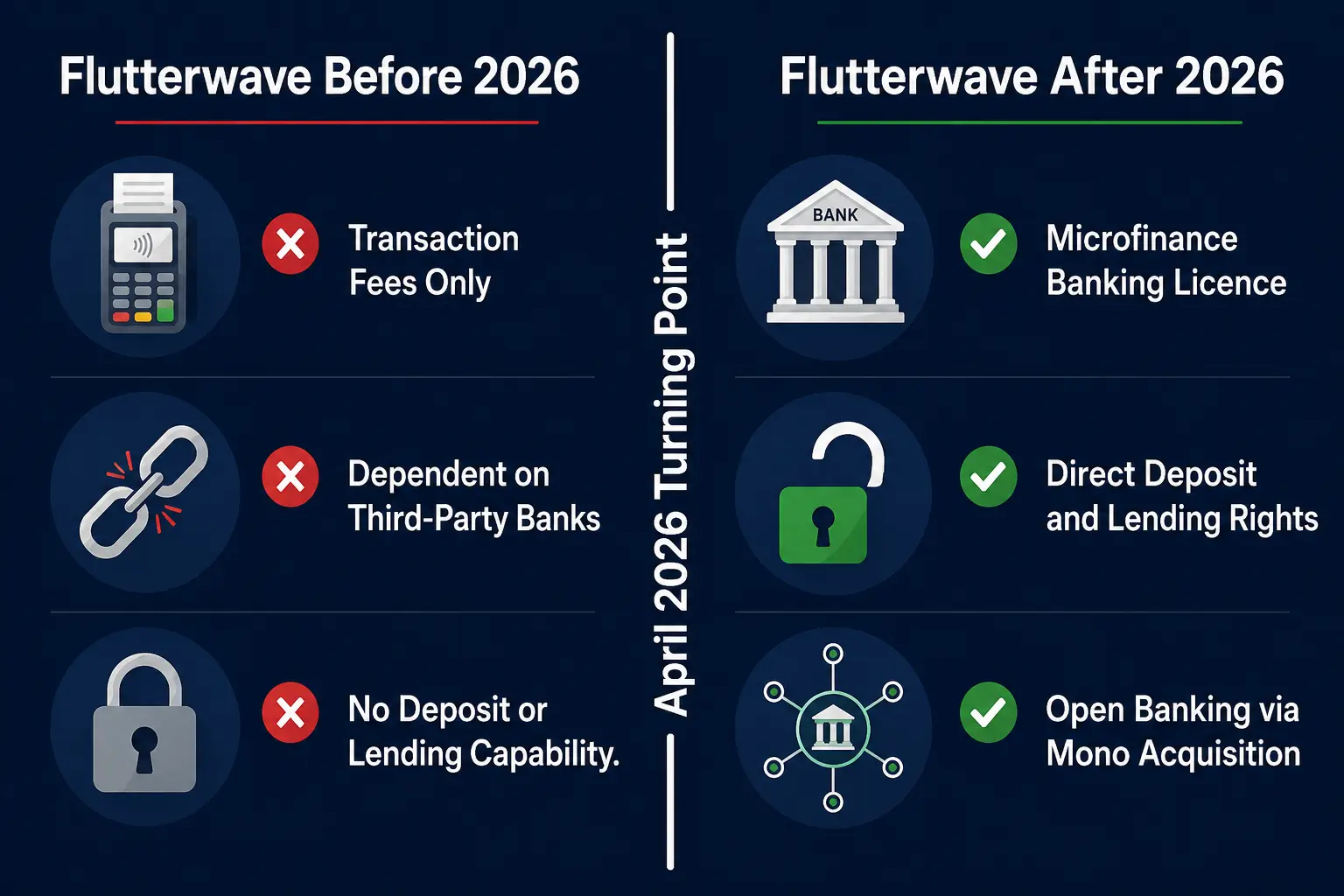
In April 2026, Flutterwave confirmed it had received a national microfinance banking licence from Nigerian regulators. The licence arrived through the Mono acquisition and marks the most significant regulatory milestone in the company’s history. For the first time, Flutterwave can hold customer deposits and issue loans directly without routing those functions through third-party commercial banks.
This changes everything about Flutterwave’s business model. For a decade, the company facilitated over $40 billion in payments on behalf of businesses across more than 35 African countries. None of that money was retained. Every naira, dollar, and cedi that moved through the platform belonged to Flutterwave’s customers, not to Flutterwave itself. The company earned transaction fees but had no access to the float, the deposit base, or the margin that comes from lending.
Agboola told TechCabal directly: “$40 billion has gone through our platform. That is not double-counting, and not one cent was retained.” The banking licence changes that equation. Flutterwave can now issue virtual accounts under its own banking identity, issue cards, hold float balances, and settle funds directly without paying third-party banks for those services. Each of those capabilities improves margin, which is precisely what the company needs as it prepares for a potential IPO.
The move also ends Flutterwave’s dependence on commercial bank partners for core product functionality. That dependence created two problems simultaneously: it compressed margins by adding an intermediary between Flutterwave and its revenue, and it introduced counterparty risk on every transaction. Banking directly removes both problems.
Flutterwave is not alone in making this transition. Three months before Flutterwave’s banking licence confirmation, Paystack, the Stripe-owned payments company that operates in Nigeria, acquired Ladder Microfinance Bank and rebranded it as Paystack Microfinance Bank. The pattern is clear: Nigeria’s most successful payments companies are converging on full banking capability as the next strategic frontier, and the regulatory environment is accommodating that ambition.
Why the Flutterwave Banking Move Matters for Nigeria’s Fintech Ecosystem
The implications of Flutterwave entering banking extend far beyond one company’s financial statements. Nigeria’s financial inclusion challenge remains substantial. Despite the progress made by fintechs over the past decade, millions of Nigerians still lack access to reliable savings, credit, and insurance products. The commercial banking sector has historically struggled to serve these customers profitably because the infrastructure costs of physical branches and legacy core banking systems make small-account banking economically unviable.
Flutterwave’s entry into banking with a digital-first, API-native infrastructure changes the unit economics of serving those customers. A company that already has the payment rails, the merchant relationships, the consumer trust, and now the regulatory permission to hold deposits can serve customers that traditional banks cannot reach profitably. That is not a marginal improvement on existing financial inclusion efforts. It is a structural change in what is possible.
The competitive dynamics also shift meaningfully. Flutterwave processing payments for businesses while also offering those businesses lending, deposit, and treasury products creates a platform stickiness that pure payment processors cannot match. Businesses that bank with Flutterwave, accept payments through Flutterwave, and borrow from Flutterwave have limited incentive to switch to a competitor for any single service, because switching one service means fragmenting the integrated experience.
That integrated model is exactly what Flutterwave is building and what its banking licence makes possible for the first time.
Flutterwave Capital Returns: Business Lending Is Back on the Agenda
Alongside the banking licence announcement, Flutterwave confirmed it is reviving Flutterwave Capital, its business lending product that was paused during a difficult period for the company in 2022 and 2023. The revival is now possible precisely because of the banking licence, which allows Flutterwave to lend from its own balance sheet rather than acting as an origination front end for third-party lenders.
Flutterwave Capital targets the gap between Nigeria’s commercial banks and its SME population. Small and medium-sized businesses that process payments through Flutterwave generate rich transaction data that allows Flutterwave to assess creditworthiness more accurately than any traditional bank can using credit bureau scores alone. A merchant processing 50 million naira per month through Flutterwave gives the company more information about their cash flow, seasonality, and financial health than a stack of audited accounts filed with a bank ever could.
Using that transaction data to underwrite loans at better rates and with faster turnaround times than commercial banks creates a product that solves a real and persistent problem for Nigerian businesses. Access to affordable working capital has consistently ranked as one of the top constraints on SME growth in Nigeria, and Flutterwave is now positioned to address it directly using data it already holds.
$40 Billion in Payments and the IPO Conversation
Flutterwave crossing $40 billion in lifetime payment volume is a milestone that deserves context. The company launched in 2016. It took seven years to cross $30 billion and less than two additional years to add the next $10 billion, which reflects the compounding network effect of a payments platform that grows as its merchants grow. Every new business that joins Flutterwave brings its customers, and those customers create more payment volume, which attracts more merchants.
The $40 billion figure also matters for a different reason: it makes Flutterwave’s IPO case more credible than it has ever been. A payments company with $40 billion in annualised transaction flow, a banking licence that improves margins, a lending product that adds net interest income, and an open banking infrastructure layer that deepens platform stickiness is a fundamentally different investment proposition than a pure payment processor with thin margins and no direct banking relationship with its customers.
Agboola has publicly discussed the IPO timeline without committing to a specific date. The banking licence, the Mono acquisition, the revival of Flutterwave Capital, and the $40 billion milestone all read as deliberate IPO preparation rather than opportunistic announcements. Each one adds a layer to the financial story that public market investors need to see: revenue diversification, margin improvement, regulatory credibility, and platform depth.
Nigeria’s startup ecosystem has been waiting for a major domestic tech IPO for years. If Flutterwave follows through, it would represent a watershed moment for African tech investment, demonstrating to global markets that Nigerian-founded technology companies can reach public market scale with the same financial discipline and strategic sophistication as their counterparts in more mature ecosystems.
What the Flutterwave Story Means for Nigeria’s Broader Tech Ecosystem
Every move Flutterwave makes in 2026 sends signals that ripple through the entire Nigerian and African startup ecosystem. When Africa’s most valuable privately held fintech acquires an open banking startup, secures a banking licence, revives its lending product, and talks about going public, it resets expectations for what Nigerian startups can build and what trajectory is possible from Lagos.
The first signal is about ambition. Flutterwave is not optimising for a smaller, more comfortable version of its existing business. It is building toward a position as a full-spectrum financial institution that competes with banks on their own ground while retaining the speed, flexibility, and data advantage of a technology company. That ambition, pursued at this scale and with this pace, is an existence proof for every Nigerian founder who has been told to think smaller.
The second signal is about the regulatory environment. Nigeria’s Central Bank granted Flutterwave a microfinance banking licence at a moment when regulators across the continent have been tightening their approach to fintech. The fact that Nigeria’s regulators are accommodating this level of ambition from a fintech suggests a maturing relationship between the startup ecosystem and the regulatory institutions that govern it, a relationship that benefits every founder building in the financial services space.
The third signal is about talent and capital. Flutterwave’s growth creates demand for engineers, product managers, compliance experts, data scientists, and business development professionals across the continent. It also creates returns for the investors who backed it early, some of whom will recycle those returns into the next generation of Nigerian startups. The ecosystem compounds on itself when its most successful companies succeed at scale.
Frequently Asked Questions About Flutterwave in 2026
What did Flutterwave acquire in 2026?
Flutterwave acquired Mono, Nigeria’s leading open banking infrastructure provider, in January 2026. The all-share deal was valued between $25 million and $40 million. Mono continues to operate independently while contributing its open banking APIs, identity verification tools, and account-to-account payment capabilities to Flutterwave’s wider platform.
How much has Flutterwave processed in payments?
Flutterwave has processed over $40 billion in lifetime payments across more than 35 African countries since its founding in 2016. CEO Olugbenga Agboola confirmed this milestone in April 2026, noting that none of that capital was retained by the company. Every dollar processed belonged to Flutterwave’s business and consumer customers.
Does Flutterwave now have a banking licence?
Yes. Flutterwave secured a national microfinance banking licence in Nigeria in April 2026, obtained through its acquisition of Mono. The licence allows Flutterwave to hold customer deposits, issue loans, and provide banking services directly for the first time without routing those functions through third-party commercial banks.
Is Flutterwave planning an IPO?
Flutterwave has discussed going public but has not announced a specific IPO date. The company’s moves in 2026, including the banking licence, the Mono acquisition, the revival of Flutterwave Capital, and the $40 billion payment milestone, all strengthen the financial narrative that supports a successful public listing. Analysts and industry observers widely interpret these moves as deliberate IPO preparation.
What is Flutterwave Capital?
Flutterwave Capital is Flutterwave’s business lending product that was paused in 2022 and 2023 and is now being revived following the company’s acquisition of a banking licence. The product uses Flutterwave’s transaction data to assess the creditworthiness of the merchants on its platform and offer them working capital loans at competitive rates and with faster approval than traditional commercial banks.
Is Flutterwave Building the Financial Infrastructure Africa Needs?
The Flutterwave of 2026 is a fundamentally different company from the one that launched a decade ago. It has moved from facilitating payments to owning the infrastructure those payments run on, from collecting transaction fees to building the balance sheet that earns interest income, and from operating as a licensed payment processor to functioning as a chartered banking institution. Each of those transitions is significant on its own. Together they represent one of the most ambitious and deliberate pivots in African technology business history.
For Nigeria’s startup ecosystem, this is a moment of genuine significance. A company born in Lagos, built on Nigerian payment problems, and grown through the complexity of operating across 35 African markets is now positioned to go public as a full-service financial institution. That outcome would not just validate Flutterwave. It would validate the entire proposition that African startups can build at global scale from African soil.
The next chapter of this story, whether it ends at an IPO, an acquisition, or continued private growth, will be one of the most closely watched in African business. Watch it closely.
For the full original reporting on Flutterwave’s banking licence and Mono acquisition read TechCabal’s in-depth analysis of Flutterwave’s microfinance banking licence and the official acquisition announcement at Flutterwave’s official press release on the Mono acquisition.

Prince Anichi
Founder and Lead Technology Editor at Ortechy. Covering digital economy shifts, tech ecosystems across Africa, cybersecurity intelligence, and emerging software platforms.