In this article22 sections
- 01.The Numbers Behind Small Business AI Adoption
- ↳Why the Gap Between Small and Large Businesses Is Closing
- 02.How Small Businesses Are Using AI to Compete in Customer Service
- ↳Chatbots and Virtual Assistants for Lean Teams
- 03.AI-Powered Marketing: Levelling the Playing Field
- ↳Personalisation at Scale
- 04.Automating Operations and Saving Time Every Week
- ↳Common Tasks AI Handles Automatically
- 05.Using AI for Data Analysis and Smarter Decision-Making
- ↳AI for Inventory and Supply Chain Management
- 06.AI Tools for Finance and Cash Flow Management
- 07.AI in Hiring and Human Resources
- 08.Real Barriers Small Businesses Still Face With AI Adoption
- 09.Where to Start: A Practical Path for Small Business Owners
- 10.Frequently Asked Questions
- ↳How are small businesses using AI to compete with larger companies?
- ↳What AI tools are most popular among small businesses in 2026?
- ↳Can a very small business with fewer than five employees benefit from AI?
- ↳How much does AI cost for a small business?
- ↳Is AI adoption risky for small businesses?
- ↳What is the most common AI use case for small businesses?
- 11.Conclusion
How Small Businesses Are Using AI to Compete With Larger Companies
Small businesses have always competed on agility. Now, they have a powerful new weapon. A 2025 survey by Thryv found that AI adoption among small businesses jumped 41% in a single year, rising from 39% to 55% of all small businesses surveyed, as reported in Thryv’s official AI and Small Business survey on Business Wire. That number has only grown since. How small businesses are using AI to compete with larger companies is no longer a niche topic. It is the defining business story of 2026.
For decades, larger companies held structural advantages that smaller rivals simply could not match. They had dedicated marketing departments, enterprise software systems, and customer service teams available around the clock. Now, affordable artificial intelligence (AI) tools are putting those same capabilities into the hands of a single founder or a five-person team.
This post covers the most important ways small businesses are deploying AI right now. From customer service and marketing to supply chain management and financial planning, you will find practical examples, verified data, and clear guidance on where to start.
The Numbers Behind Small Business AI Adoption
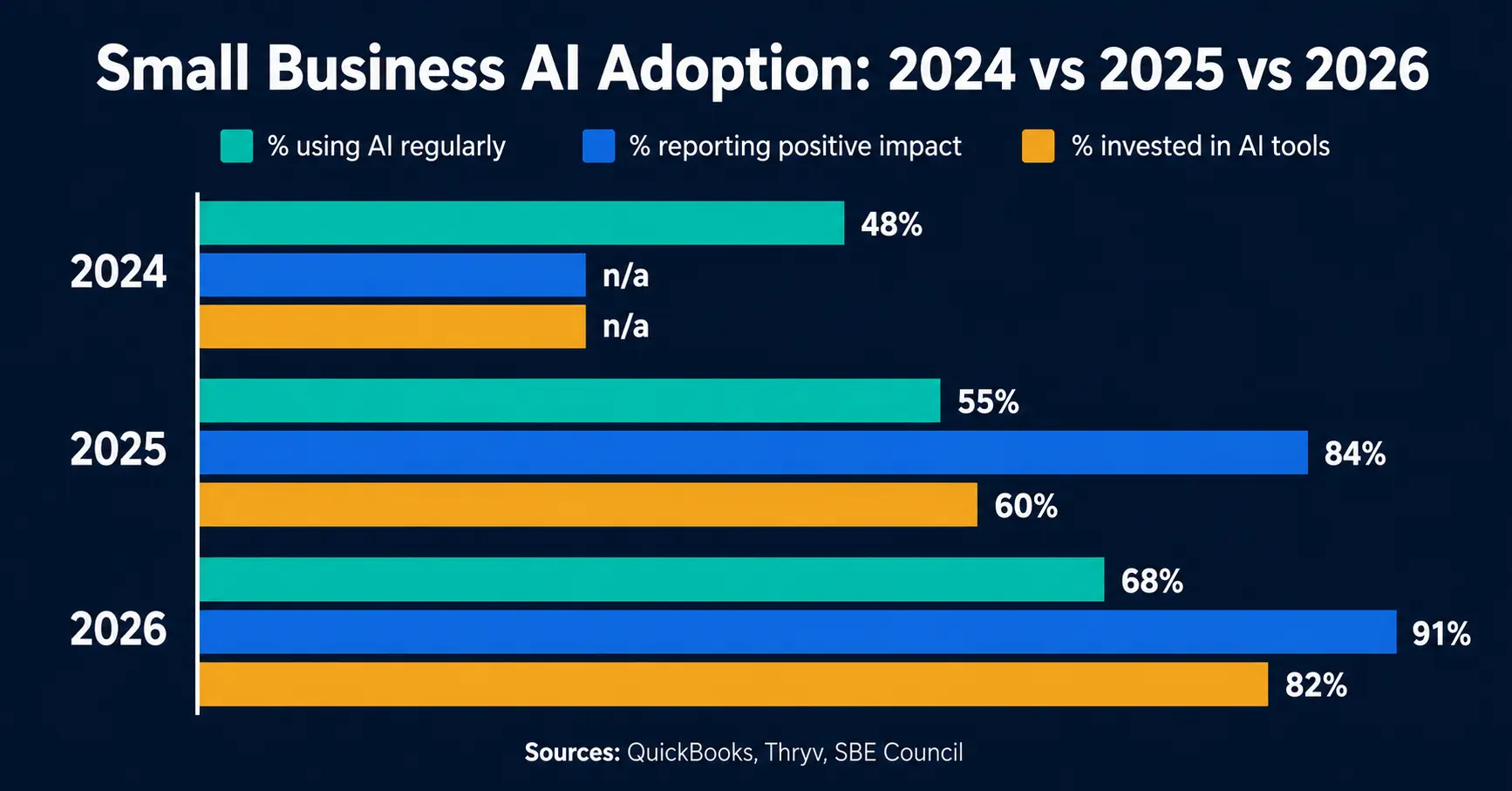
The data is striking. According to the SBE Council’s 2026 Small Business Tech Use Survey, 82% of small business employers have now invested in AI tools, as detailed in the SBE Council’s 2026 report on AI tool usage. These tools are no longer sitting unused. They are embedded into daily operations and workflows across sales, marketing, customer engagement, and financial management.
Additionally, a QuickBooks survey of more than 2,200 small businesses found that 68% of respondents use AI regularly in 2025, up from just 48% in 2024. That is a 20-percentage-point jump in 12 months. The pace of adoption is accelerating, not slowing down.
However, the gap between users and non-users matters just as much as the raw numbers. The US Chamber of Commerce found that 84% of small businesses report a positive impact from AI, even at basic usage levels. Non-adopters risk falling further behind with every month they wait.
Why the Gap Between Small and Large Businesses Is Closing
Traditionally, enterprise AI required custom software development, large IT teams, and budgets in the hundreds of thousands of dollars. That barrier no longer exists in the same form. Cloud-based AI platforms now deliver the same core capabilities at monthly subscription prices that fit easily into a small business budget.
The result is clear. The small-to-large business AI adoption gap shrank from 1.8x to 1.2x between 2024 and 2025, according to Small Business Administration data cited by AdAI Research. Small businesses are closing the distance faster than any previous technology cycle in recent history.
How Small Businesses Are Using AI to Compete in Customer Service
Customer service is one of the highest-impact areas where AI helps small businesses compete. Large companies have always been able to offer 24-hour support. Now, small businesses can too.
AI chatbots handle common queries instantly, at any hour, without adding headcount. The cost savings are dramatic. According to Gartner 2025 data, AI-handled support tickets cost between $0.50 and $1.05 each, compared to $8 to $12 for human-handled tickets. That is a cost difference of up to 24 times, as analysed in theStacc’s 2026 AI customer service cost savings report.
Furthermore, IBM data shows that AI customer service cuts support costs by 30% on average across enterprises that deployed chatbots in 2025. Top-performing deployments achieve 53% cost reductions. Small businesses using off-the-shelf tools typically see payback within three to five months.
Chatbots and Virtual Assistants for Lean Teams
Tools such as Nextiva and similar platforms give small businesses virtual receptionists that take calls, route inquiries, and schedule appointments automatically. A solo operator or a small team can now appear just as responsive as a company with a dedicated contact centre.
Also worth noting: 92% of businesses across all sizes have now integrated AI into their customer service processes to some extent, according to the Nextiva Customer Experience (CX) Trends Report 2025. Small businesses that adopt now are joining a majority, not taking an experimental risk.
AI-Powered Marketing: Levelling the Playing Field
Marketing has always been expensive when done at scale. Large companies spend millions on creative agencies, media buying teams, and data analytics platforms. AI marketing tools bring those capabilities within reach of a small business owner working alone.
Content creation and generation is now the most common AI use case among small businesses, according to AdAI Research’s 2026 statistics compilation. Tools such as ChatGPT, Jasper, and similar platforms help owners produce blog posts, social media content, email campaigns, and product descriptions in a fraction of the time it would take manually.
Additionally, AI-powered analytics tools help small businesses understand customer behaviour at a depth that was previously impossible without a dedicated data team. Predictive models can identify which customers are most likely to buy, which products are trending, and which marketing channels deliver the best return.
Personalisation at Scale
Large companies have long used personalisation to increase customer lifetime value. AI now makes the same approach available to a small e-commerce store or local service business. Email marketing platforms with built-in AI can segment audiences automatically and send tailored messages based on individual purchase history and behaviour.
Therefore, a small retailer can deliver the kind of personalised experience that customers previously only received from major brands. This directly improves customer retention, which is often more valuable than acquiring new customers.
Automating Operations and Saving Time Every Week
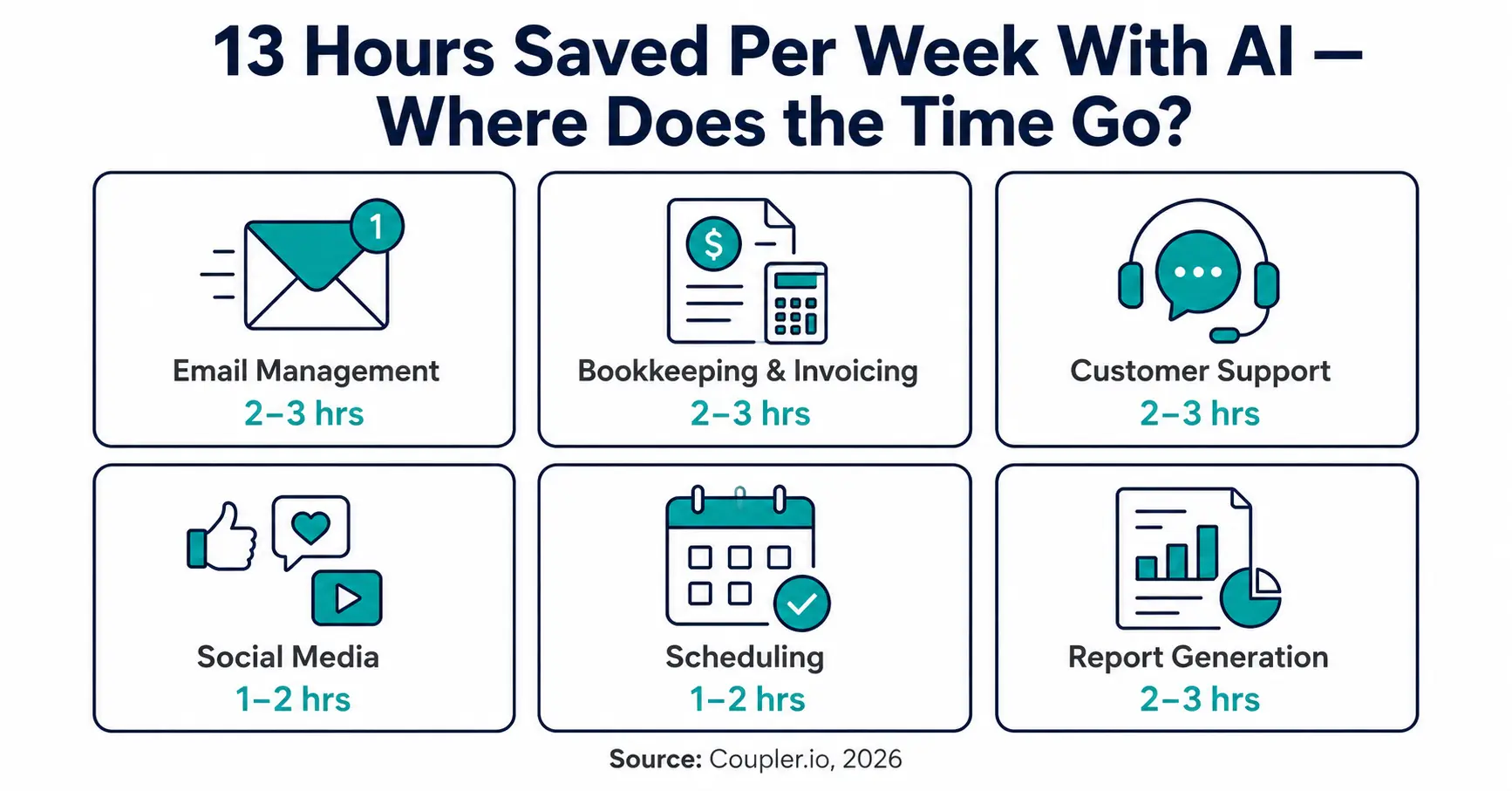
One of the most immediate benefits small business owners report is time savings. AI tools save small business owners an average of 13 hours per week, according to data compiled by Coupler.io in 2026. That is more than one and a half full working days returned to the owner every single week.
Those hours add up. Over a year, 13 hours per week equals more than 650 hours, which is roughly 16 full working weeks of freed capacity. Owners can redirect that time to strategy, sales, and growth rather than repetitive administrative work.
Common Tasks AI Handles Automatically
The range of automatable tasks continues to grow. The most widely used applications among small business owners include:
- Data entry and bookkeeping: AI accounting tools such as QuickBooks Online sync with bank accounts and automatically categorise transactions, eliminating hours of manual reconciliation each month.
- Email management: AI assistants can draft replies, summarise threads, and flag priority messages so owners focus only on what requires human attention.
- Scheduling and appointment booking: Automated booking systems handle confirmations, reminders, and rescheduling without any staff involvement.
- Report generation: AI tools pull data from multiple sources and compile regular performance reports automatically.
- Social media scheduling: AI platforms generate and schedule posts across multiple channels based on optimal engagement times.
Because these tools operate continuously in the background, small businesses can maintain the operational tempo of a much larger organisation without hiring additional staff.
Using AI for Data Analysis and Smarter Decision-Making
Large companies have always had an advantage in data. They collect more of it, they have dedicated analysts to interpret it, and they act on it faster. AI is narrowing that gap significantly.
According to Thryv research based on 540 interviews with small business decision-makers in May 2025, 62% of small business owners now use AI for data analysis, making it the single most common AI use case in the segment. This shift represents a fundamental change in how small business strategy works.
AI data tools help owners predict customer churn, project revenue, identify fraud patterns, and flag operational bottlenecks. Previously, accessing this kind of insight required expensive business intelligence (BI) software and a trained analyst to run queries. Now, many tools answer plain-language questions with visual reports in seconds.
AI for Inventory and Supply Chain Management
Supply chain management is another area where AI delivers measurable results. McKinsey estimates that AI integration into supply chain operations can reduce logistics costs by 5 to 20%, as reported by EASE Logistics in 2025. Small businesses are accessing these benefits through affordable software-as-a-service (SaaS) platforms rather than custom-built systems.
In practice, AI inventory tools predict demand more accurately, reduce overstock, and flag when reorder points are approaching. For a small product business operating with tight cash flow, smarter inventory management can mean the difference between a profitable quarter and a cash flow crisis.
AI Tools for Finance and Cash Flow Management
Financial management is one of the most stressful parts of running a small business. Cash flow uncertainty, payroll timing, and tax planning can consume enormous amounts of a founder’s mental energy. AI financial tools address each of these pain points directly.
QuickBooks Online, Xero, and similar platforms now use AI to flag unusual transactions, forecast monthly cash flow based on historical patterns, and alert owners to potential shortfalls before they become crises. These platforms are available from around $30 per month for entry-level plans.
The businesses pulling ahead are not necessarily the ones with bigger budgets. They are the ones automating financial management so that decision-making is based on real-time data rather than memory and guesswork. That is a competitive advantage that compounds over time.
AI in Hiring and Human Resources
Hiring is time-intensive for any business. For a small team, a single bad hire can significantly disrupt operations and culture. AI hiring tools help small businesses filter applications, score candidates against job requirements, and schedule interviews automatically.
Also, AI-powered platforms can identify patterns in employee turnover data, flagging which roles or teams are at highest risk of losing key people. This gives small business owners the kind of workforce intelligence that large companies have long had from dedicated HR analytics teams.
However, it is important to use these tools thoughtfully. AI screening tools work best when the criteria they apply are clearly defined and regularly reviewed for unintended bias. The technology is powerful, but it still requires human oversight at the decision stage.
Real Barriers Small Businesses Still Face With AI Adoption
The picture is not entirely straightforward. Real barriers exist, and understanding them is just as important as understanding the opportunities.
The most significant challenges include:
- Integration complexity: Connecting AI tools to existing systems remains difficult for many small businesses. 56% of companies across all sizes report high integration complexity as a barrier, according to research cited by Elementor’s 2026 AI adoption statistics analysis.
- Proving return on investment (ROI): 66% of businesses struggle to demonstrate clear ROI from AI spending. This makes it harder to justify continued investment, especially for cost-conscious small business owners.
- Data quality: AI tools perform best when they have clean, structured data to work with. Small businesses that have not invested in organising their operational data will find many AI tools less effective out of the box.
- Skills gap: A persistent AI knowledge gap affects adoption. Many owners know they should be using AI but are unsure where to start or how to evaluate tools.
Therefore, the practical advice is to start with a single, well-defined use case rather than attempting a broad transformation. Choose the most time-consuming repetitive task in your business and find one tool that solves it well. Build from that foundation.
Where to Start: A Practical Path for Small Business Owners
Given the breadth of available tools, deciding where to begin can feel overwhelming. The data points to a consistent starting pattern among small businesses that report the best results.
First, identify your biggest time drain. Whether that is customer inquiries, content creation, bookkeeping, or scheduling, there is almost certainly an AI tool built specifically for that task. Second, choose an established platform with strong reviews and a free trial period. Tools such as ChatGPT Plus, Jasper, QuickBooks, and Nextiva each offer accessible entry points at under $100 per month.
Small business owners who approach AI as a focused operational tool rather than a broad transformation project report faster results and lower frustration. The goal in year one is not to rebuild your entire business around AI. It is to reclaim time, reduce costs in one or two areas, and build confidence with the technology.
Finally, review the outcomes after 90 days. If a tool is saving meaningful time or generating measurable revenue, expand its use. If it is not delivering results, switch to an alternative. The AI tool market is competitive, and alternatives are almost always available.
Frequently Asked Questions
How are small businesses using AI to compete with larger companies?
Small businesses use AI to automate customer service, generate marketing content, manage finances, analyse data, and streamline operations. These tools give lean teams the capabilities that large companies previously accessed through expensive departments and enterprise software. The result is faster execution, lower costs, and better customer experiences without proportionally higher headcount.
What AI tools are most popular among small businesses in 2026?
The most widely used AI tools for small businesses include ChatGPT for content creation and research, QuickBooks Online for financial management, AI-powered chatbots for customer service, email marketing platforms with built-in AI segmentation, and scheduling tools with automated booking features. Most entry-level options are available for under $100 per month, and many offer free trials.
Can a very small business with fewer than five employees benefit from AI?
Yes, and in some ways the benefit is proportionally greater for very small businesses. When a single owner is handling every function, even saving a few hours per week with an AI tool creates significant value. AI tools save small business owners an average of 13 hours per week. For a solo operator, that recovered time can be the difference between growth and stagnation.
How much does AI cost for a small business?
Costs vary widely, but entry-level AI tools are genuinely affordable. Productivity tools such as Grammarly start under $20 per month. ChatGPT Plus costs $20 per month. AI-powered accounting platforms start around $30 per month. A small business can access meaningful AI capabilities across marketing, operations, and customer service for under $200 per month in total tool subscriptions.
Is AI adoption risky for small businesses?
The risks are manageable when businesses start small and review outcomes regularly. The bigger risk is inaction. As the adoption gap between AI users and non-users widens, businesses that delay are handing a compounding advantage to their competitors. Starting with one clearly defined use case limits both cost and complexity while allowing owners to build skills and confidence.
What is the most common AI use case for small businesses?
Data analysis is the most frequently cited AI use case among small business decision-makers, with 62% of owners reporting it as their primary application, according to Thryv’s 2025 research. Content creation and marketing automation rank as the second most common applications. Customer service chatbots and financial management tools round out the top four use cases.
Conclusion
How small businesses are using AI to compete with larger companies is no longer a question about the future. It is a description of what is happening right now, at scale, across virtually every industry. 82% of small business employers have invested in AI tools, and 91% of those using AI report that it directly boosts their revenue. The technology has crossed the threshold from experiment to essential.
The most important insight from the data is this: the small businesses reporting the best results are not the ones with the biggest budgets or the most sophisticated implementations. They are the ones that identified a specific problem, chose an accessible tool, and committed to using it consistently. That is a strategy any business can replicate.
If you are running a small business and have not yet adopted AI tools, the question is no longer whether you should. It is which area of your business will benefit most from starting today. Begin there, measure the results, and build from a foundation of proven wins. For a broader introduction to the AI tools available to businesses of all sizes, the US Chamber of Commerce’s guide to small business AI tools is an excellent starting point.
The larger companies you compete with have already recognised that AI is not optional. The gap between early movers and late adopters is widening every quarter. Small business owners who act now are not just catching up. They are positioning themselves to build advantages that compound over time, just as the technology itself does.

Prince Anichi
Founder and Lead Technology Editor at Ortechy. Covering digital economy shifts, tech ecosystems across Africa, cybersecurity intelligence, and emerging software platforms.