In this article25 sections
- 01.What Is On-Device AI and How Does It Differ from Cloud AI
- 02.The Chips Powering On-Device AI: Neural Processing Units Explained
- ↳Apple Silicon and the Neural Engine
- ↳Qualcomm Snapdragon and the Hexagon NPU
- ↳MediaTek Dimensity and AI Democratisation
- 03.On-Device AI in Smartphones: What It Enables Today
- ↳Real-Time Language Translation
- ↳Computational Photography
- ↳Personalised AI Assistants
- ↳Proactive Automation
- 04.On-Device AI in Laptops and AI PCs: The New Computing Category
- 05.On-Device AI in Wearables: Earbuds, Watches, and Smart Glasses
- ↳1. Smart Earbuds and On-Ear AI
- ↳2. Smartwatches and Health AI
- ↳3. Smart Glasses and Ambient AI
- 06.On-Device AI in Home Electronics: Televisions, Appliances, and Smart Speakers
- 07.The Challenges On-Device AI Still Needs to Solve
- 08.Which Companies Are Leading the On-Device AI Race
- 09.Frequently Asked Questions About On-Device AI in Consumer Electronics
- ↳What is on-device AI in simple terms?
- ↳Why is on-device AI better than cloud AI?
- ↳Which smartphones have the best on-device AI in 2026?
- ↳What is an AI PC and do I need one?
- ↳How big is the on-device AI market?
- 10.On-Device AI Is the Architecture of the Next Decade of Consumer Electronics
The Future of On-Device AI in Consumer Electronics: What to Expect and Why It Matters
Something fundamental is changing in every device you own. The AI features that once required a data centre, a fast internet connection, and a round-trip to a remote server are moving directly onto your phone, your laptop, your earbuds, and your television. On-device AI is no longer a premium experiment reserved for flagship devices. It is becoming the foundational architecture of modern consumer electronics, and the pace of that shift in 2026 is faster than most people have noticed.
More than 370 million AI-enabled smartphones shipped in 2025, accounting for nearly 30 percent of the global market according to IDC. That share is projected to reach 70 percent by 2029. IDTechEx research published in February 2026 confirms that consumer electronics will maintain over 70 percent of the entire edge AI chip market throughout the next decade. And the global on-device AI chip market is expected to reach $80 billion by 2036 as neural processing units become as standard as camera sensors and wireless radios.
This article explains exactly what on-device AI is, how it works, why the shift is happening now, which companies are leading it, what it means across every category of consumer electronics, and what comes next.
What Is On-Device AI and How Does It Differ from Cloud AI
On-device AI means that artificial intelligence computation happens locally on your device rather than being sent to a remote server for processing. When you ask Siri or Google Assistant a question and your phone sends that audio to a distant data centre which processes it and sends back an answer, that is cloud AI. When your phone processes the same request entirely on its own chip without ever leaving your device, that is on-device AI.
The distinction matters for three specific reasons that are increasingly important to both consumers and manufacturers.
Speed is the first reason. Every round-trip to a cloud server takes time. Even on a fast connection, network latency adds tens to hundreds of milliseconds to every AI request. For tasks like real-time language translation in a conversation, live transcription of a call, or instant photo enhancement the moment you press the shutter button, that latency creates a noticeable and frustrating delay. On-device processing eliminates the round-trip entirely. The result is responses that feel instantaneous because they genuinely are.
Privacy is the second reason. When your device sends audio, images, or personal data to a cloud server for AI processing, that data leaves your possession. It travels across networks, passes through third-party infrastructure, and sits on servers you do not control. On-device AI keeps your biometric data, your voice, your photos, and your personal patterns on your device where only you can access them. This is not just a consumer preference. Regulators in the European Union, the United Kingdom, and increasingly in the United States are pushing for data localisation and processing transparency that on-device architectures naturally satisfy.
Reliability is the third reason. Cloud AI requires a stable internet connection. On-device AI works anywhere. On a plane, underground, in a remote location, or any environment where connectivity is intermittent, your device’s local AI capabilities function without interruption. For features like real-time translation in a foreign country or offline voice commands in a vehicle, the absence of a network dependency is a genuine practical advantage.
For a detailed technical overview of edge AI market dynamics and the chip architectures powering this shift read the IDTechEx research at IDTechEx’s analysis of why consumer electronics leads the edge AI chip market.
The Chips Powering On-Device AI: Neural Processing Units Explained
The hardware foundation of on-device AI is the Neural Processing Unit, or NPU. An NPU is a specialised processor designed specifically to run AI workloads efficiently. While a general-purpose CPU handles the operating system, apps, and everyday computation, and a GPU handles graphics and parallel processing, an NPU is optimised for the specific mathematical operations that machine learning models perform: matrix multiplications, convolutions, and activation functions applied repeatedly across large datasets.
NPUs consume dramatically less power for AI tasks than running the same computation on a CPU or GPU. This is critical for battery-powered devices where energy efficiency directly determines how long the device lasts between charges and how hot it gets under load. An NPU completing a real-time image enhancement task in milliseconds at minimal power draw delivers an experience that would be completely impractical if run on the main CPU.
Apple Silicon and the Neural Engine
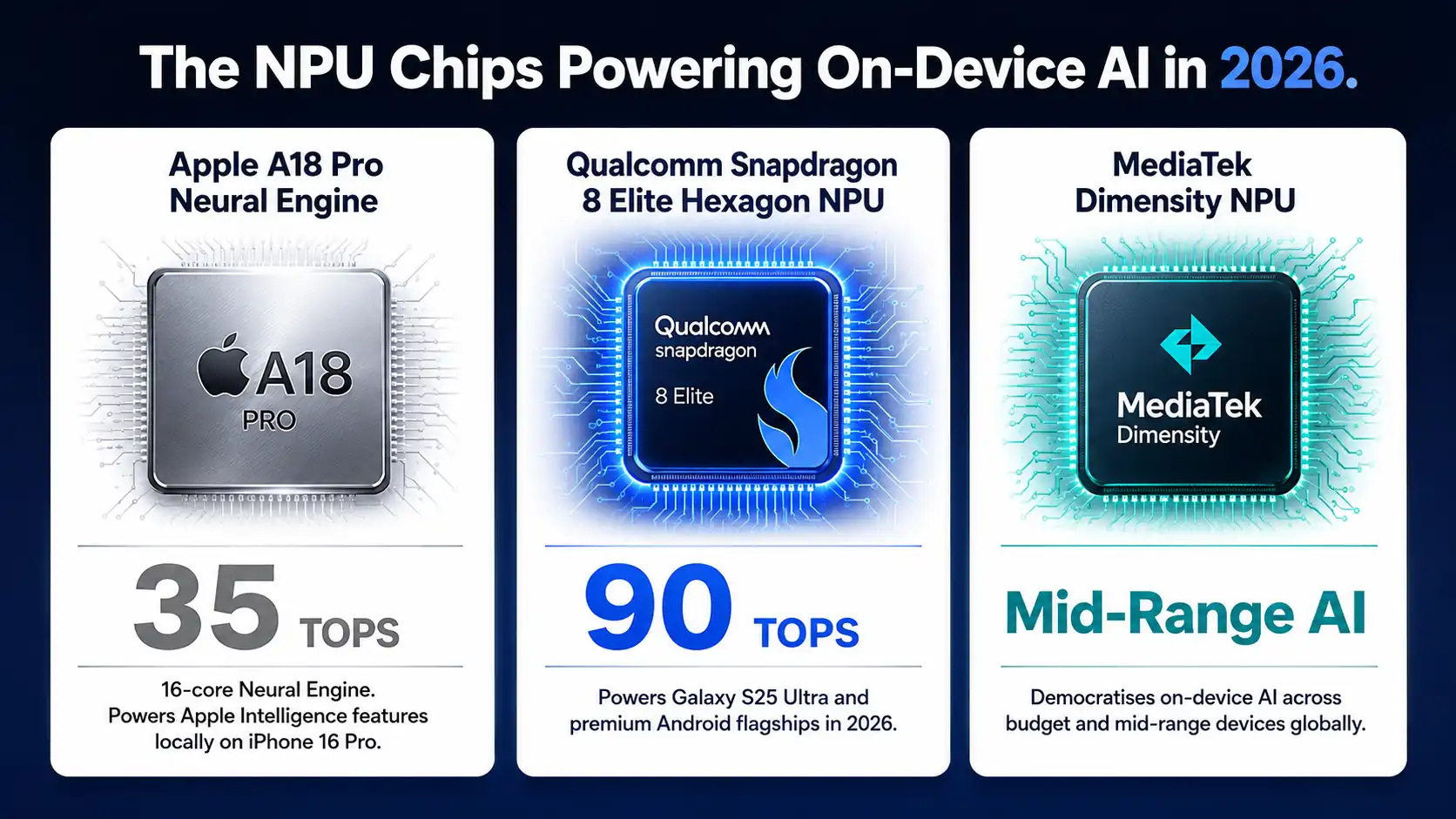
Apple’s approach to on-device AI is built around the Neural Engine embedded in every Apple Silicon chip. The A18 Pro powering the iPhone 16 Pro series includes a 16-core Neural Engine capable of performing 35 trillion operations per second. Apple Intelligence features including on-device writing tools, photo editing, personalised Siri responses, and live transcription all run locally on this Neural Engine. Apple’s Private Cloud Compute extends this architecture to the cloud for heavier tasks while maintaining the same privacy guarantees, but the majority of Apple Intelligence features run entirely on the device.
Qualcomm Snapdragon and the Hexagon NPU
Qualcomm’s Snapdragon 8 Elite, the chip powering Samsung’s Galaxy S25 Ultra and most premium Android flagships in 2026, includes the Hexagon NPU delivering 90 TOPS (tera operations per second) of AI processing capability. The Snapdragon X series for AI PCs extends this to the laptop category with on-device large language model inference, real-time meeting summaries, and AI-assisted code completion running entirely without cloud connectivity. As ACL Digital reported in its 2026 consumer electronics trend analysis, chipsets including the Snapdragon 8 Elite are specifically engineered to support on-device intelligence at ACL Digital’s consumer electronics trends report.
MediaTek Dimensity and AI Democratisation
MediaTek’s Dimensity series has democratised on-device AI capabilities across mid-range and budget smartphones. While Apple and Qualcomm command the premium tier, MediaTek ensures that AI features reach devices priced below $300, which is where the majority of global smartphone volume sits. This matters enormously for markets in Southeast Asia, Africa, and Latin America where premium smartphones are a small fraction of total device sales but the demand for AI features is growing equally fast.
On-Device AI in Smartphones: What It Enables Today
Smartphones are the most mature category for on-device AI and the best place to see what this technology delivers in practice. The features that on-device processing makes possible are already in your pocket if you own a flagship phone from 2024 or 2025.
Real-Time Language Translation
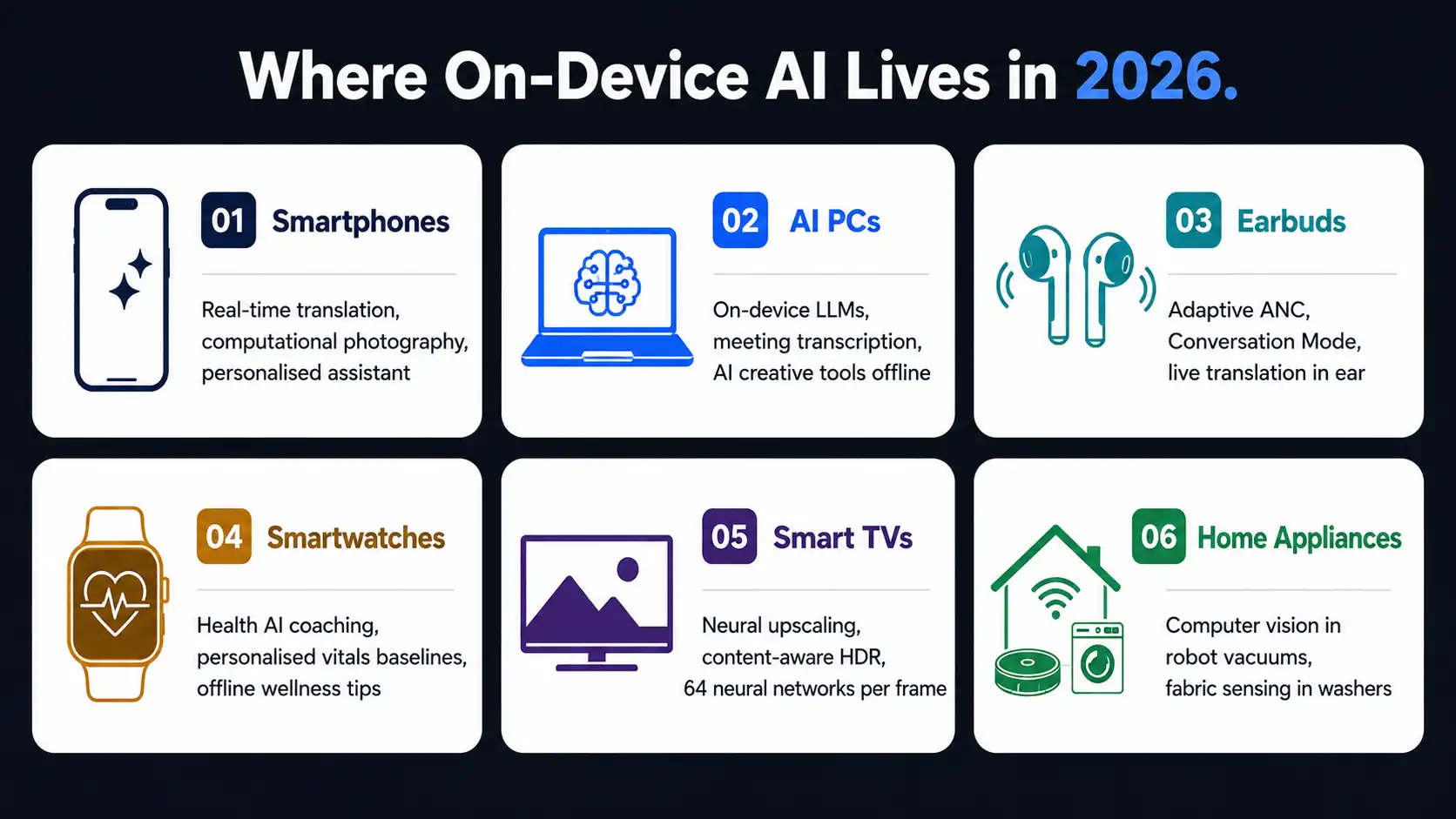
Live translation of phone calls, in-ear conversation translation through earbuds, and real-time on-screen text translation all run on-device in 2026. Samsung’s Galaxy AI Live Translate, Apple’s Live Translation in iOS 18, and Google Pixel’s Call Assist all process audio locally. The result is translation that works even when you have no data signal, responds fast enough to keep pace with natural conversation, and never sends your private call audio to an external server.
Computational Photography
The camera on your smartphone has not improved because the lens or sensor got dramatically better. It improved because the NPU processes every image through multiple neural networks in real time. Scene recognition, subject detection, dynamic range optimisation, noise reduction, and computational zoom all run locally on the device’s AI processor. The 200MP main camera on the Samsung Galaxy S25 Ultra delivers its real-world quality not primarily from its sensor specifications but from the AI processing the Snapdragon 8 Elite applies to every frame before you see the result.
Personalised AI Assistants
The shift from cloud-dependent voice assistants to genuinely personalised on-device assistants is one of the most significant changes in smartphone AI in 2026. Both Apple Intelligence and Google’s on-device Gemini Nano process context from your personal data, including your calendar, your messages, your emails, and your app usage patterns, locally without sending that data to any server. This allows the assistant to give genuinely personalised responses rather than generic answers, while keeping everything you share with it private by default.
Proactive Automation
On-device AI watches for patterns in how you use your phone and proactively automates repetitive tasks. Suggested replies, smart text selection, automatic summarisation of long messages, and context-aware app suggestions all run locally. The phone learns from your behaviour without that behavioural data ever leaving the device.
On-Device AI in Laptops and AI PCs: The New Computing Category
The AI PC is the fastest-growing new product category in consumer electronics in 2026. An AI PC is not simply a laptop with AI software installed. It is a device with a dedicated NPU in its chip architecture capable of running local large language models, performing real-time transcription, enhancing video calls, and accelerating AI-powered creative tools without a cloud connection.
Microsoft’s Copilot Plus PC specification requires a minimum of 40 TOPS of NPU performance, a threshold that filters out older processors and creates a clear definition of what qualifies as a genuine AI PC. Qualcomm’s Snapdragon X Elite and X Plus chips currently deliver the highest NPU performance in the Windows laptop market. Intel’s Meteor Lake and Lunar Lake processors include dedicated NPU blocks for the first time in Intel’s mainstream PC architecture. AMD’s Ryzen AI series completes the competitive landscape with its own NPU implementation.
What these AI PCs can do locally in 2026 would have required cloud processing as recently as 2023. Meeting transcription with speaker identification runs locally and produces searchable text summaries within seconds of a meeting ending. On-device image generation creates usable visuals in under ten seconds without sending any prompt or image data to an external server. Localised versions of small language models run in productivity apps for document summarisation, writing assistance, and code completion without any subscription fee or connectivity requirement.
On-Device AI in Wearables: Earbuds, Watches, and Smart Glasses
Wearables are the most constrained and the most interesting frontier for on-device AI. The challenge is delivering meaningful AI capability in devices with processors measured in milliwatts, batteries measured in milliamp-hours, and form factors measured in millimetres. The engineering required to run useful AI on a chip small enough to fit in an earbud or a watch is extraordinary, and the solutions emerging in 2026 are reshaping what wearables can do.
1. Smart Earbuds and On-Ear AI
The most commercially significant AI feature in earbuds is real-time audio processing. Active noise cancellation driven by local AI models that learn your ear shape and typical noise environment delivers a qualitatively different experience than static ANC algorithms. Conversation Mode AI that instantly detects when you start speaking to someone nearby and transparently blends ambient sound into your audio feed runs entirely on the earbud’s processor. Real-time translation whispered into your ear during a conversation in a foreign language is no longer a laboratory demonstration. It is a shipping product feature on Samsung Galaxy Buds, Apple AirPods Pro, and Sony WF-1000XM6 in 2026.
2. Smartwatches and Health AI
Samsung’s June 2026 Galaxy Watch AI update transformed the smartwatch from a passive health data collector into a proactive AI health coach. The AI Energy Score, personalised Vitals baselines, and Daily Wellness Tips all compute locally on the watch’s processor against your personal health history. No cloud processing is required for the core coaching functions, which means they work during a run in a tunnel or on a flight, precisely the situations where health monitoring matters most.
3. Smart Glasses and Ambient AI
The smart glasses category, led by Meta Ray-Ban and Apple Vision Pro’s successors, represents the most ambitious deployment of on-device AI in wearables. Object recognition, spatial awareness, and real-time contextual information all need to process at the speed of vision without the latency of a cloud round-trip. Meta AI running on Ray-Ban smart glasses can identify objects, answer questions about what you are looking at, and provide contextual information in real time. All of this requires on-device or near-device processing delivered through the connected smartphone’s NPU.
On-Device AI in Home Electronics: Televisions, Appliances, and Smart Speakers
Consumer electronics beyond the personal device category are also integrating on-device AI rapidly. The smart home is becoming genuinely intelligent rather than simply connected.
Modern televisions from Samsung, LG, and Sony include dedicated AI processors that perform real-time upscaling, content-aware HDR processing, automatic picture mode adjustment based on content type, and personalised content recommendations generated locally. Samsung’s 2025 Neo QLED series uses a Neural Quantum Processor with 64 neural networks running simultaneously to process every frame of video content. The AI does not just upscale. It identifies specific content types, lighting conditions, and viewing contexts to optimise the picture independently without any cloud connection.
Smart speakers including Amazon Echo and Google Nest have processed wake word detection locally for years, but the expanding intelligence is now happening on the device too. The follow-up understanding, the context maintenance within a conversation session, and increasingly the information retrieval for common queries are moving to local processing to reduce latency and improve reliability.
Home appliances with embedded AI processors are a newer category. Washing machines that analyse fabric types and load weight to optimise wash cycles, refrigerators that monitor contents and suggest recipes, and robot vacuums that map and learn home layouts are all running local computer vision and decision models on embedded NPU chips.
The Challenges On-Device AI Still Needs to Solve
On-device AI is advancing rapidly but it still faces real constraints that shape what is currently possible and what remains aspirational.
Model size is the primary constraint. The large language models that power the most impressive AI experiences in cloud systems are too large to run on consumer device hardware. GPT-4o running in full on a smartphone is not possible in 2026. What runs locally are smaller distilled models that deliver a useful subset of that capability. Apple Intelligence, Google Gemini Nano, and similar on-device AI systems are impressive precisely because their developers have compressed significant capability into a form factor that fits within device memory and power budgets. But they remain meaningfully less capable than their cloud equivalents for complex, multi-step reasoning tasks.
Memory cost is a growing challenge. TSMC’s 2nm chip wafers now exceed $30,000 each, a figure IDTechEx cited as indicative of the rising costs of leading-edge AI hardware in consumer electronics. Memory chip prices for consumer devices also rose 30 percent in late 2025 and a further 20 percent in early 2026, driven by demand from AI data centres diverting supply from consumer electronics. These cost pressures create headwinds for democratising on-device AI across mid-range and budget devices.
Battery life remains a tension point. Running an NPU at high utilisation consumes significant power. Devices optimised for extended battery life face difficult trade-offs between the richness of their AI features and the frequency with which users need to charge them. The engineering challenge of delivering impressive on-device AI within a wearable or thin-and-light laptop form factor is real and ongoing.
Which Companies Are Leading the On-Device AI Race
The on-device AI landscape has clear leaders across different tiers of the market.
Apple leads in vertical integration and privacy architecture. Its Neural Engine design, combined with Apple Silicon’s unified memory architecture and its Private Cloud Compute extension for heavier tasks, delivers the most coherent on-device AI experience in consumer electronics. Apple Intelligence’s on-device processing handles the majority of its features without network dependency.
Qualcomm leads in Android and Windows AI chip performance. The Snapdragon 8 Elite and Snapdragon X series deliver the highest NPU performance in their respective categories and power the AI features of every major Android flagship and an expanding range of Copilot Plus PCs.
Samsung leads in deploying on-device AI across the broadest range of product categories simultaneously, from smartphones and laptops to televisions, smartwatches, home appliances, and earbuds. Its Galaxy AI suite represents the most cross-category deployment of on-device AI features by any single consumer brand.
Google leads in on-device AI software with Gemini Nano running locally on Pixel devices and its broader Android ecosystem. Google’s on-device Gemini capabilities power the AI features that make Pixel phones distinctive and are being extended across Android OEM devices through Google Play Services updates.
MediaTek leads in democratisation, bringing NPU capabilities to mid-range devices that account for the majority of global smartphone volume. Its Dimensity series is the primary vehicle through which on-device AI reaches the emerging markets where the next billion smartphone users live.
For the most comprehensive market analysis of the on-device AI chip market across all these players and regions, the Coherent Market Insights research is available at Coherent Market Insights on-device AI market report.
Frequently Asked Questions About On-Device AI in Consumer Electronics
What is on-device AI in simple terms?
On-device AI means artificial intelligence that runs directly on your device rather than on a remote cloud server. Your phone, laptop, or wearable processes AI tasks locally using a dedicated chip called a Neural Processing Unit. The result is faster responses, stronger privacy protection, and AI features that work without an internet connection. Real-time translation, computational photography, personalised assistants, and smart health monitoring are all examples of on-device AI in action.
Why is on-device AI better than cloud AI?
On-device AI is faster, more private, and more reliable than cloud AI for many everyday tasks. It eliminates network latency, keeps your personal data on your device, and works without an internet connection. Cloud AI remains necessary for the most computationally intensive tasks because large AI models require more processing power and memory than current consumer device hardware can efficiently provide. The future is a hybrid model where routine tasks run locally and complex tasks selectively use cloud resources with strong privacy protections.
Which smartphones have the best on-device AI in 2026?
The Samsung Galaxy S25 Ultra, iPhone 16 Pro, and Google Pixel 9 Pro lead the on-device AI smartphone market in 2026. The Galaxy S25 Ultra runs Samsung Galaxy AI features on the Snapdragon 8 Elite with 90 TOPS of NPU performance. The iPhone 16 Pro uses the A18 Pro’s 16-core Neural Engine delivering 35 TOPS. The Pixel 9 Pro runs Google Gemini Nano locally for on-device assistance and contextual awareness.
What is an AI PC and do I need one?
An AI PC is a laptop or desktop with a dedicated Neural Processing Unit capable of running local AI models without cloud connectivity. Microsoft’s Copilot Plus PC specification requires a minimum of 40 TOPS of NPU performance. AI PCs deliver on-device meeting transcription, real-time video enhancement, writing assistance, and image generation without subscription fees or internet requirements. If you use your laptop for content creation, professional productivity, or regular AI-assisted work, an AI PC delivers a meaningfully better experience than a traditional laptop.
How big is the on-device AI market?
The global on-device AI chip market is expected to reach $80 billion by 2036 according to IDTechEx research. Consumer electronics will maintain over 70 percent of that market throughout the decade. In 2025, more than 370 million AI-enabled smartphones shipped globally, representing 30 percent of the market. IDC projects that share will reach 70 percent by 2029. Asia Pacific holds 34.6 percent of the current on-device AI market and is growing fastest, driven by semiconductor manufacturing strength in Samsung, MediaTek, and Huawei’s Kirin division.
On-Device AI Is the Architecture of the Next Decade of Consumer Electronics
The shift from cloud-dependent AI to on-device intelligence is not a temporary trend or a marketing angle. It is an architectural transformation driven by the convergence of three forces that are not going away: the demand for privacy, the need for speed, and the requirement for reliability in environments where connectivity cannot be guaranteed.
Every major category of consumer electronics is moving in the same direction simultaneously. Smartphones, laptops, wearables, televisions, and home appliances are all integrating NPUs into their hardware and building software features around local AI computation. The companies that build the best on-device AI experiences — in terms of capability, privacy architecture, and energy efficiency — will define the consumer electronics market for the rest of this decade.
For consumers, this means your devices will become genuinely more useful and more intelligent over the next five years in ways that are hard to fully appreciate from today’s vantage point. The smartphone you carry will know you better than any device you have ever owned, respond faster than any assistant you have ever used, and keep your data more private than any cloud-dependent service can. For manufacturers, this means on-device AI is no longer a differentiating premium feature. It is the baseline expectation every consumer will soon bring to every purchase decision.
For the full TechInsights analysis of the five key trends shaping consumer electronics including edge AI read the complete report at TechInsights’ five key consumer electronics trends which provides detailed technical and market context for each trend driving the industry forward in 2026.

Prince Anichi
Founder and Lead Technology Editor at Ortechy. Covering digital economy shifts, tech ecosystems across Africa, cybersecurity intelligence, and emerging software platforms.