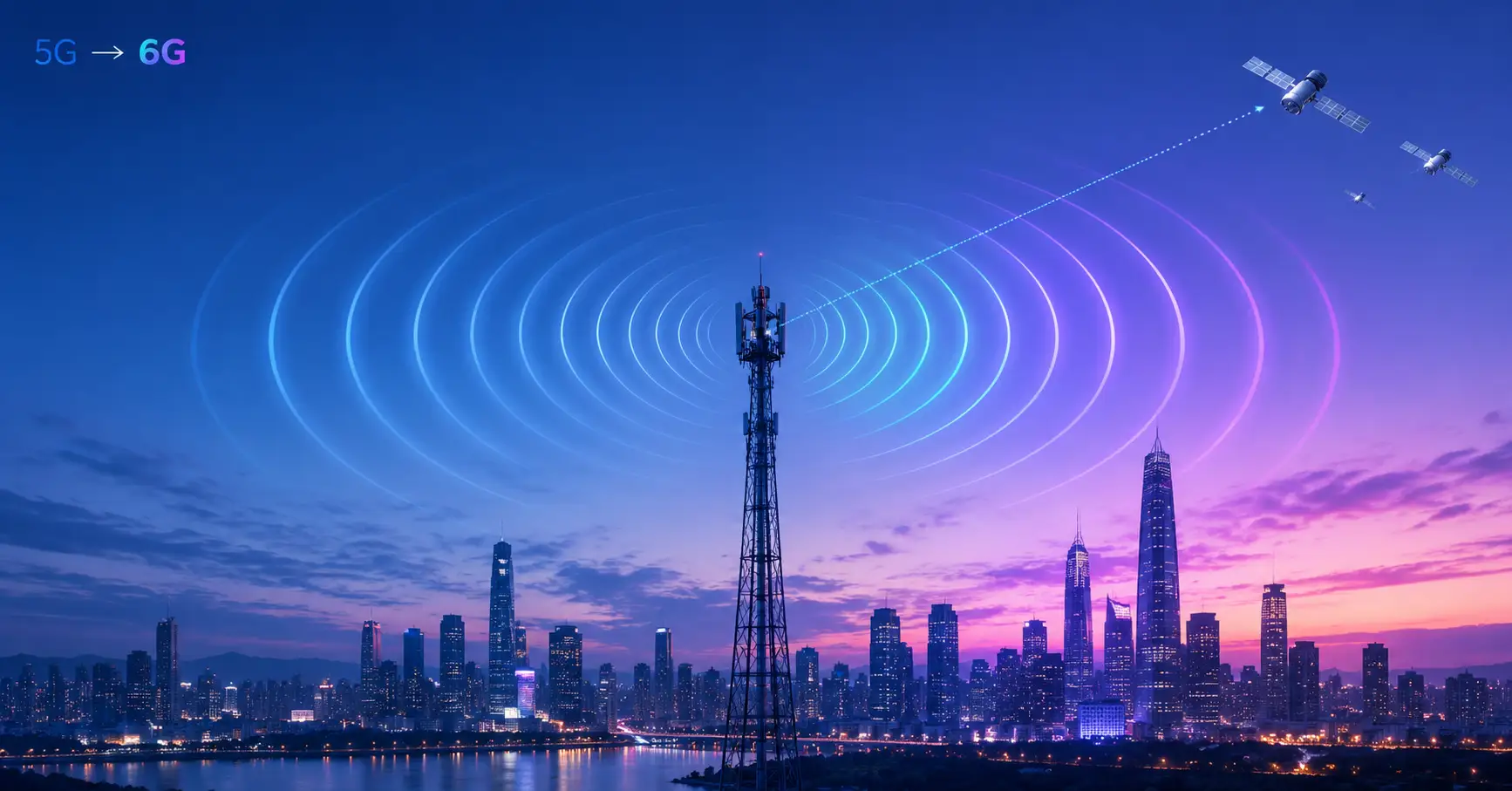
What Comes After 5G? The Road to 6G Technology
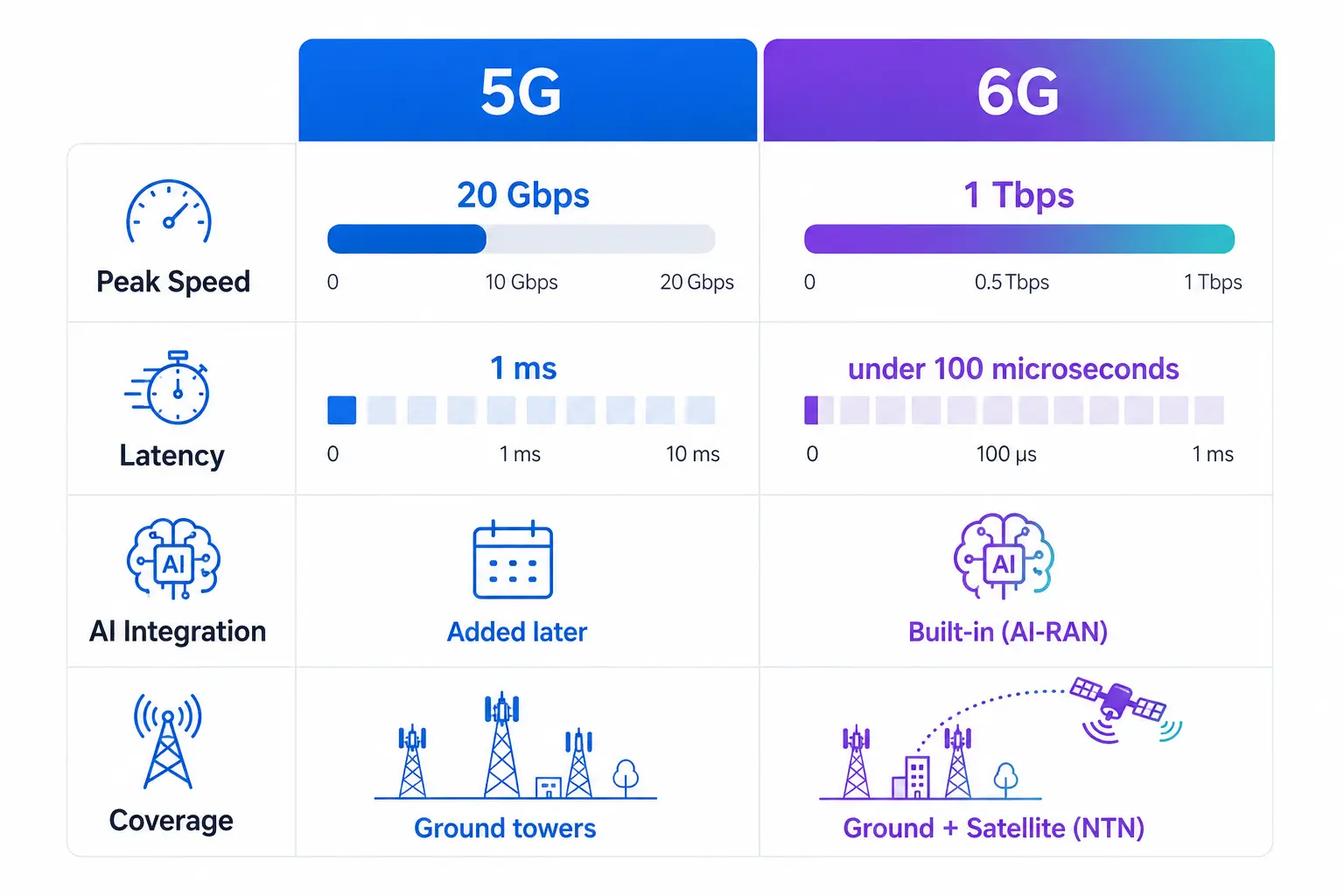
Researchers in China recently pushed data through the air at speeds close to one terabit per second during an early 6G technology trial. That figure is roughly ten times faster than the best commercial 5G connections available today. Numbers like this explain why governments, chip makers, and carriers are already racing toward the next wireless generation.
This guide explains what comes after 5G in plain language. It covers how 6G technology works, who is building it, and when ordinary people might use it. It also looks at the bridge technology, called 5G-Advanced, that connects today’s networks to tomorrow’s.
Now, before diving into specifications and timelines, it helps to understand why 5G alone cannot meet future demand.
What Is 6G Technology and Why Does It Matter
6G technology refers to the sixth generation of wireless communication, and it is the planned successor to 5G. The International Telecommunication Union (ITU) coordinates this work under a framework called IMT-2030, which sets the global rules every network must follow. Because 5G already struggles in crowded city centers and stadiums, engineers see 6G as the answer to growing data demand.
Additionally, 6G aims to deliver far lower latency, which is the delay between sending and receiving a signal. This means devices could react in close to real time, opening the door to remote surgery, autonomous vehicles, and instant holographic calls. The ITU defined its official technical framework for this next generation in late 2023, giving standards bodies a clear target to design around.
5G-Advanced: The Bridge Between Today’s Networks and 6G
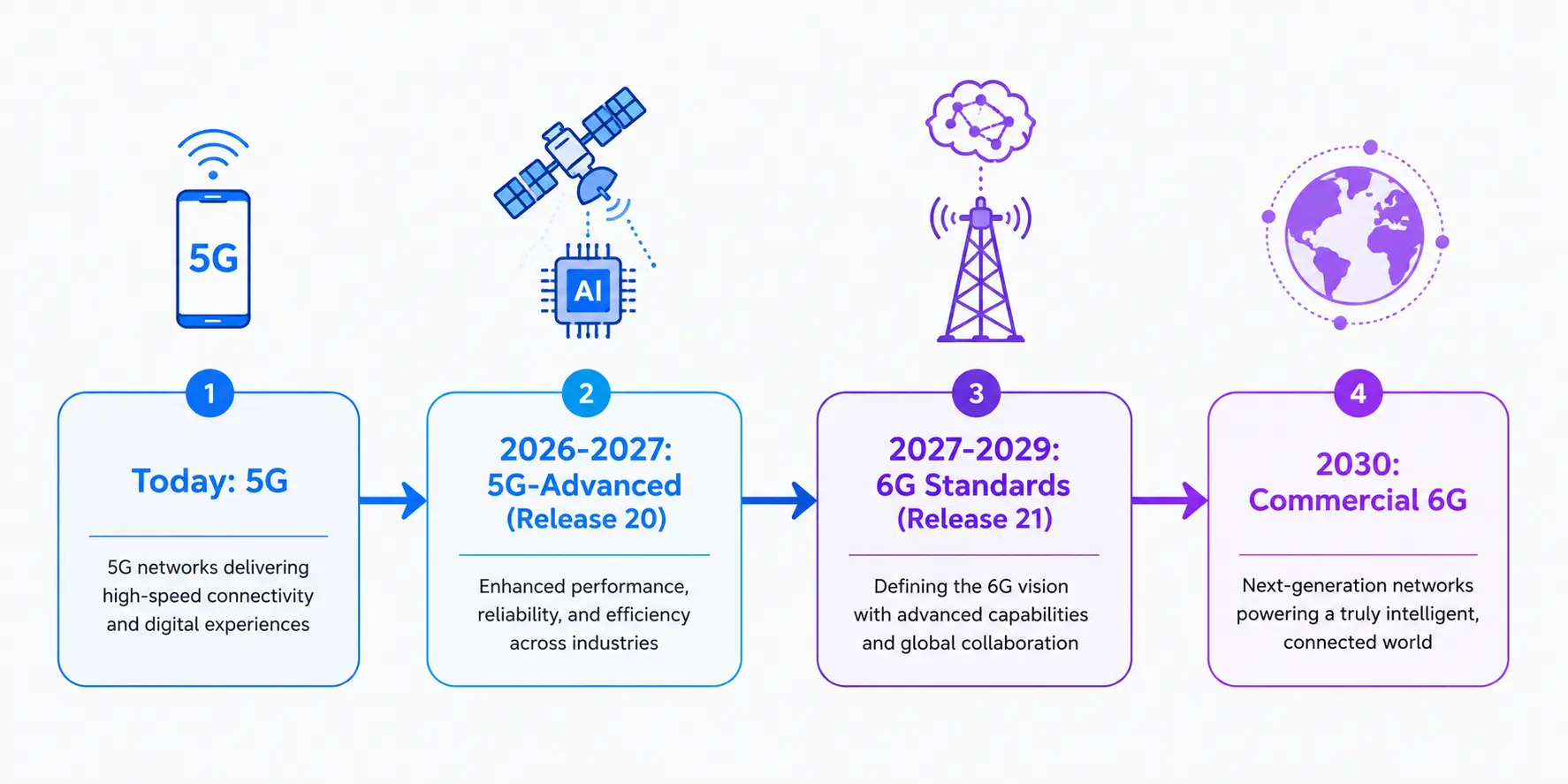
Before 6G technology arrives, most carriers will roll out a stepping stone called 5G-Advanced. This upgrade improves existing 5G hardware through software updates rather than entirely new equipment. Therefore, it acts as both a technical and economic bridge between generations.
5G-Advanced is expected to reach commercial availability around 2025 and 2026, according to an industry roadmap covering the evolution of wireless networks. It brings tighter artificial intelligence integration and lower energy use to existing 5G infrastructure. This means networks become smarter and cheaper to run while engineers finish designing full 6G systems.
In practice, most people will not notice a dramatic jump when 5G-Advanced launches. However, it quietly prepares the ground for the bigger leap that follows.
Terahertz Frequencies: The Engine Behind 6G Speed
Why Higher Frequencies Matter
One of the biggest changes in 6G technology involves a move toward terahertz, or THz, frequencies. These sit far higher on the radio spectrum than anything 4G or 5G currently uses. Because higher frequencies can carry more data at once, they unlock dramatically faster speeds.
However, terahertz waves travel shorter distances and struggle to pass through walls. This means 6G networks will likely need many more small antennas placed closer together. The result is a denser, smarter network rather than a few large towers covering wide areas.
Real-World Speed Records
Now, the numbers behind this shift are striking. Beijing researchers reportedly ran the world’s first 6G terahertz trial network near the city of Huairou, reaching a peak download speed of around one terabit per second. Meanwhile, teams in South Korea demonstrated terahertz transmission over a distance of 500 meters in real urban conditions.
These tests remain experimental. Still, they prove that terahertz communication works outside a laboratory, which is a critical step toward commercial 6G technology.
AI-Native Networks: How Artificial Intelligence Powers 6G Technology
Every previous wireless generation added artificial intelligence as an afterthought. By contrast, 6G technology is being designed with AI built into its core from day one. Industry insiders call this concept AI-native networking, sometimes shortened to AI-RAN, where RAN stands for radio access network.
By 2026, an estimated 40 percent of early 6G network designs are expected to integrate AI and machine learning for autonomous management, according to recent market research on 6G adoption trends. This means networks could automatically detect problems, reroute traffic, and optimize signal strength without human engineers stepping in.
Also, AI helps solve a major hardware challenge. Mobile devices have limited processing power, so AI running inside the network can handle heavy computing tasks remotely. The result is longer battery life and smoother performance on everyday smartphones.
- Self-healing networks that detect and fix faults automatically
- Smarter spectrum sharing that reduces congestion
- Predictive maintenance for towers and base stations
- Real-time traffic balancing during major events
The Global Race: Who Is Leading 6G Development
China’s Aggressive Trial Program
China has moved faster than most countries on early 6G technology testing. The Ministry of Industry and Information Technology approved trial spectrum in the 6 GHz band, often nicknamed the golden spectrum because it balances range, bandwidth, and low latency. This authorization lets a national 6G promotion group run live trials across selected regions.
Furthermore, China has already launched a national 6G pilot program as field trials accelerate throughout 2026. This gives Chinese carriers and equipment makers a head start on real-world data before global standards are finalized.
South Korea, Japan, and the Alliance Approach
South Korea and Japan are taking a different path by teaming up. Because Japan and South Korea each hold a relatively small share of global 6G patents on their own, neither country can compete alone against larger players. Therefore, several Japanese operators and a major South Korean carrier issued joint statements on 6G cooperation, while leading device makers signed research agreements together.
Samsung and a Korean carrier also validated 6G signals in the 7 GHz band during recent field trials. This means the alliance is testing practical spectrum choices rather than only theoretical designs.
New Possibilities 6G Could Unlock
Finally, it helps to picture what 6G technology actually enables once it reaches consumers. Many of these ideas sound futuristic today, yet engineers are actively building toward them.
- Holographic video calls that project a three-dimensional image of the person you are speaking to
- Fully connected smart cities where traffic lights, sensors, and vehicles share data instantly
- Remote surgery performed by doctors operating robotic tools from another country
- Massive Internet of Things support, connecting far more devices per square mile than 5G allows
- Integrated satellite coverage that fills connectivity gaps in rural and remote areas
This means 6G is not simply a faster phone connection. Instead, it functions as a shared digital nervous system for entire cities and industries.
The Official Timeline: When Will 6G Technology Arrive
So when does 6G actually launch? The honest answer is that it depends on which milestone you mean. Standards bodies have already mapped out a multi-year process.
- 2024 to 2026: Defining technical performance requirements under the IMT-2030 framework
- 2025 to 2027: Technical studies and candidate technology testing within early 3GPP release work
- 2027 to 2028: Formal specification work begins under 3GPP Release 21
- 2028 to 2029: Self-evaluation results submitted to the ITU for review
- 2030: The ITU finalizes the official IMT-2030 designation and early commercial rollouts begin
According to Ericsson’s published standardization roadmap, the first 6G specifications should be ready by the end of 2028. This timeline allows the first commercial 6G systems to reach the market around 2030. Meanwhile, Qualcomm’s research team expects the first official 6G standards to be completed in 2029 or 2030, which aligns closely with Ericsson’s projections.
Challenges That Could Slow 6G Down
Despite the excitement, 6G technology faces real obstacles before it becomes everyday infrastructure. Because every country wants a say in how 6G works, agreement does not come quickly.
One challenge involves geopolitics. Thales Group’s analysis of 6G development notes ongoing debates over spectrum allocation between competing nations. This means global cooperation on a single unified standard becomes harder when major economies push different priorities.
Another challenge involves materials science. Terahertz components require new chip designs that can handle extremely high frequencies without overheating. Therefore, several network equipment makers have made direct acquisitions specifically to strengthen their terahertz hardware capabilities.
A third challenge involves cost. Denser antenna networks require more physical infrastructure, which means higher installation expenses for carriers. As a result, many operators will lean heavily on 5G-Advanced for as long as possible before committing fully to 6G hardware.
Frequently Asked Questions
What comes after 5G in simple terms?
After 5G, networks move through an upgrade phase called 5G-Advanced before reaching full 6G technology. 6G adds higher speeds, lower latency, and built-in artificial intelligence across the entire network.
When will 6G technology be available to consumers?
Most industry roadmaps point to commercial 6G availability starting around 2030. However, some countries like South Korea and China expect early pilot networks as soon as 2028.
How much faster is 6G compared to 5G?
Early terahertz trials have reached speeds close to one terabit per second, which is roughly 100 times faster than typical 5G speeds today. Real-world consumer speeds will likely be lower once networks scale up.
Will I need a new phone for 6G?
Yes, 6G technology requires new chipsets and antennas designed for terahertz frequencies. Samsung has already introduced early 6G-ready chipsets that offer roughly ten times the data throughput of current 5G chips.
Which countries are leading 6G development?
China, South Korea, Japan, and the United States currently lead most public 6G trials. China has run large terahertz field tests, while South Korea and Japan are pooling resources through joint research agreements.
Is 5G-Advanced the same as 6G?
No, 5G-Advanced is an upgrade to existing 5G networks, not a new generation. It acts as a bridge that improves efficiency and AI integration while full 6G standards are finalized.
Why 6G Technology Will Define the Next Decade of Connectivity
Looking at everything covered here, one theme stands out clearly. 6G technology is not a sudden leap but a carefully planned evolution built on terahertz frequencies, AI-native design, and global cooperation. This means the transition will feel gradual at first, then transformative once networks reach critical mass.
Therefore, the years between now and 2030 matter enormously. 5G-Advanced will quietly improve everyday connections while labs in China, South Korea, and beyond push speed records higher. The result is a foundation strong enough to support holographic communication, smart cities, and devices we have not imagined yet.
For readers wondering what comes after 5G, the honest answer is that the next generation is already under construction. It simply needs a few more years of testing and standardization before it reaches your pocket.
Finally, anyone curious about the deeper technical roadmap can explore Light Reading’s ongoing coverage of global 6G standardization efforts and IEEE’s analysis of what 2026 means for the future of 6G. Staying informed now means being ready when 6G technology finally arrives.

Prince Anichi
Founder and Lead Technology Editor at Ortechy. Covering digital economy shifts, tech ecosystems across Africa, cybersecurity intelligence, and emerging software platforms.