In this article30 sections
- 01.What Is Generative AI? A Clear Definition
- ↳The Difference Between Generative and Traditional AI
- ↳A Simple Analogy That Makes It Click
- 02.How Generative AI Actually Works
- ↳Training on Large Datasets
- ↳How the Model Generates New Content
- ↳What Are Neural Networks and Why Do They Matter?
- 03.The Main Types of Generative AI Models
- ↳Large Language Models for Text
- ↳Image Generation Models
- ↳Audio and Music Generation Models
- ↳Video Generation Models
- ↳Code Generation Models
- 04.Real-World Uses of Generative AI in 2026
- ↳In Business and the Workplace
- ↳In Healthcare and Science
- ↳In Education and Learning
- ↳In Creative Industries
- 05.The Limitations of Generative AI Every User Should Know
- ↳Hallucinations: When AI Invents Facts
- ↳Bias in Training Data
- ↳Privacy and Data Concerns
- 06.Frequently Asked Questions
- ↳Is generative AI the same as ChatGPT?
- ↳Do I need technical skills to use generative AI tools?
- ↳Can generative AI replace human jobs?
- ↳Is generative AI content always accurate?
- ↳How is generative AI different from a search engine?
- ↳Is generative AI safe to use?
- 07.Final Thoughts
What Is Generative AI? A Beginner’s Guide to How It Works
Generative AI is one of the most talked-about technologies in the world right now, and for good reason. The global generative AI market reached $67 billion in 2024 and is projected to surpass $1.3 trillion by 2032, according to Bloomberg Intelligence research. That growth is being driven by real adoption across industries, not just headlines. Millions of people use generative AI tools every single day to write, design, code, analyse data, and communicate, often without fully understanding what they are actually using.
Most explanations of generative AI either go too deep into the technical detail or stay too vague to be useful. This guide sits between those two extremes. It explains clearly what generative AI is, how it works in plain terms, what the main types of models do, and where you encounter them in real life. No prior technical knowledge is needed.
By the end, you will have a solid working understanding of generative AI that makes sense of the tools you may already be using and gives you a foundation for following where the technology is heading. Start with the definition, because the word “generative” is the key to understanding everything else.
What Is Generative AI? A Clear Definition
The Difference Between Generative and Traditional AI
Artificial intelligence (AI) is a broad term for software that can perform tasks that normally require human intelligence. Most traditional AI is analytical. It looks at existing data and makes decisions or predictions based on patterns it has learned. A spam filter is a simple example. It classifies incoming emails as spam or not spam based on patterns it was trained to recognise. It does not create anything new.
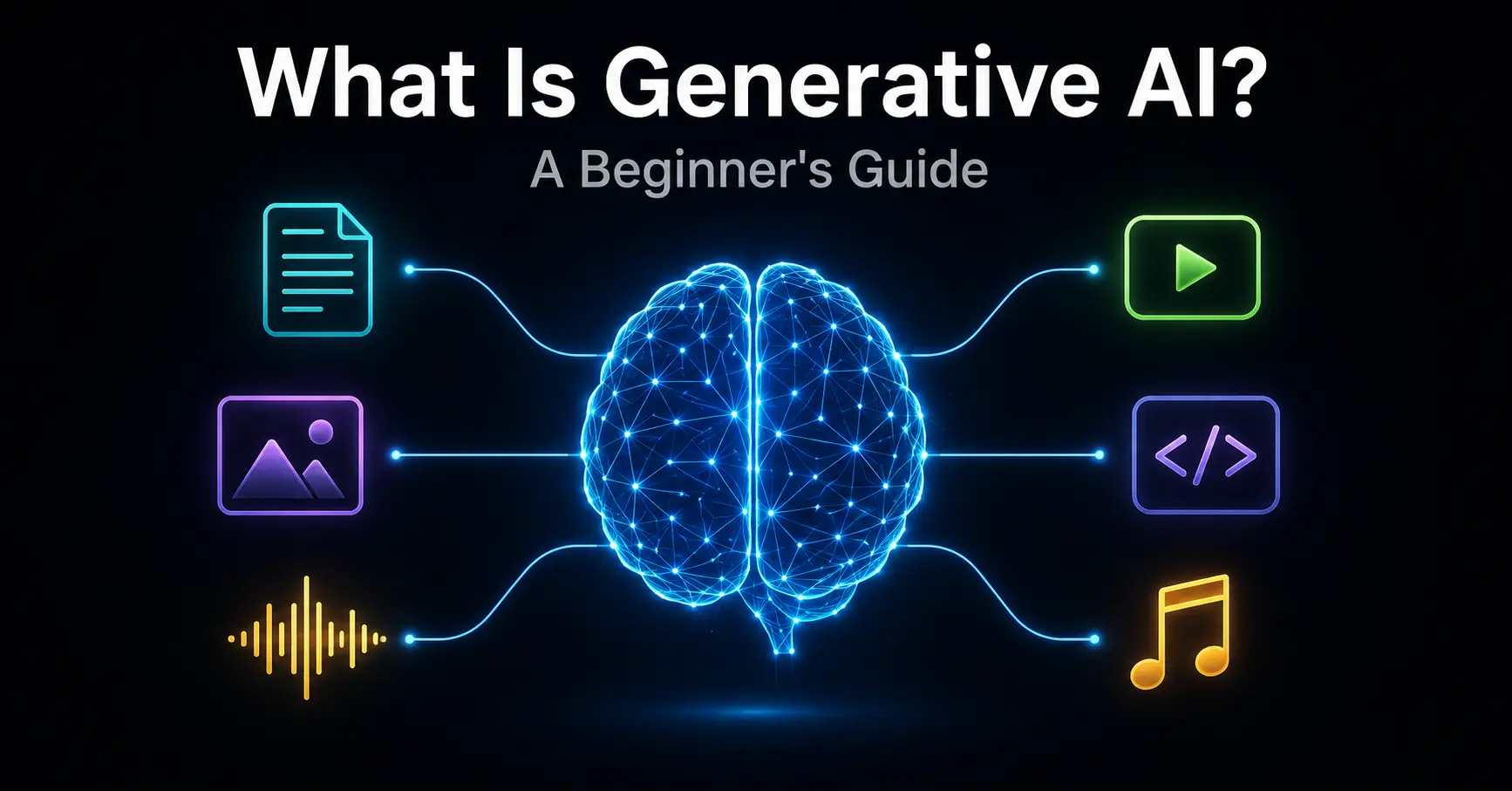
Generative AI works differently. Instead of classifying or predicting, it creates. Generative AI is software that produces new content, including text, images, audio, video, and code, by learning patterns from large amounts of existing data and then generating new examples that follow those patterns. When you ask ChatGPT a question and it writes a response, it is not retrieving a stored answer. It is generating new text in real time based on everything it learned during training.
The word “generative” is what separates this category from other forms of AI. It points to the output: something that did not exist before the model produced it. That single distinction explains why generative AI tools feel qualitatively different from older software. They do not just process information. They make something new from it.
A Simple Analogy That Makes It Click
Think of a musician who has listened to thousands of songs across dozens of genres over their lifetime. When they sit down to compose a new piece, they are not copying any one song. They draw on all the patterns, structures, and styles they have absorbed and combine them into something original. That output is new, but it is clearly shaped by everything they have heard before.
Generative AI works on the same principle. The model absorbs enormous amounts of existing content during training, finds the underlying patterns, and learns to produce new content that follows those patterns. The training data is the equivalent of all those thousands of songs. The generated output is the new composition.
How Generative AI Actually Works
Training on Large Datasets
The foundation of any generative AI model is its training data. To build a model that can write convincingly in English, for example, developers feed it enormous quantities of text: books, articles, websites, forums, scientific papers, and much more. The model processes all of that text and gradually learns the statistical relationships between words, phrases, and ideas.
This process is called training, and it requires significant computing power. Modern large language models (LLMs) like GPT-4 and Claude were trained on datasets containing hundreds of billions of words. The training process for a frontier AI model can cost tens of millions of dollars in computing resources alone. That is why access to these models typically comes through cloud-based products rather than software you install locally.
How the Model Generates New Content
After training, the model contains a mathematical representation of the patterns it learned. When you give it a prompt, the model uses those patterns to generate a response. For a text model, this happens one word at a time. The model calculates which word is statistically most likely to come next given everything that has come before, then adds that word and repeats the process until the response is complete.
This is a simplified description of a complex process, but it captures the core idea accurately. The model is not reasoning the way a human does. It is performing sophisticated pattern completion at enormous speed, which produces outputs that often read as if they came from a thoughtful human writer.
What Are Neural Networks and Why Do They Matter?
Generative AI models run on a type of software architecture called a neural network, loosely inspired by how neurons connect in the human brain. A neural network consists of layers of mathematical nodes that process information and pass signals forward. Each layer learns to detect increasingly abstract patterns in the data.
The most important architecture for modern generative AI is the transformer, introduced by Google researchers in a 2017 paper titled “Attention Is All You Need.” Transformers use a mechanism called attention, which allows the model to weigh the relevance of every word in a context window against every other word. This attention mechanism is what allows large language models to maintain coherent context across long conversations and documents, as described in the original transformer research paper published on arXiv.
The Main Types of Generative AI Models
Large Language Models for Text
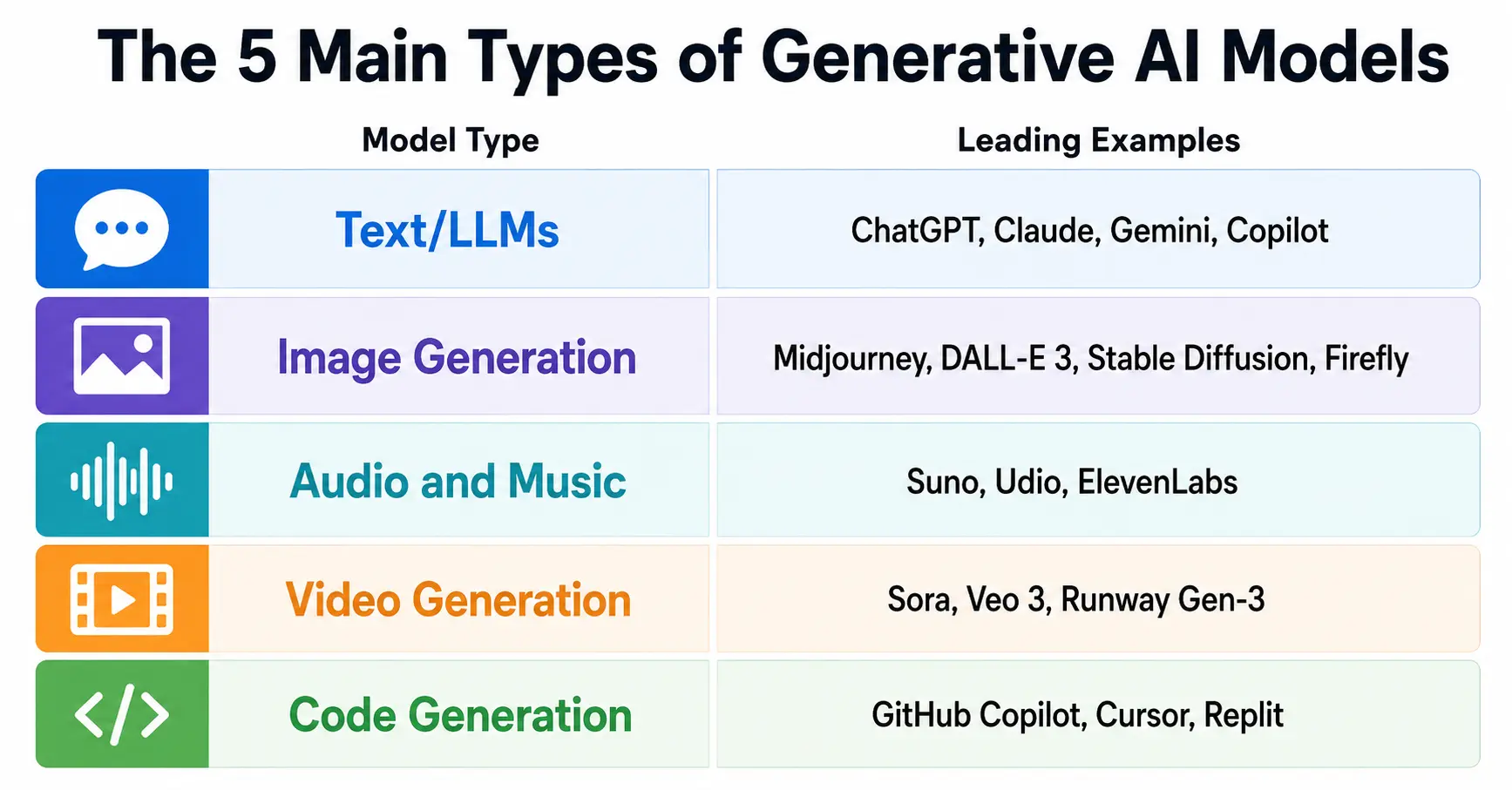
Large language models (LLMs) are the most widely used type of generative AI in 2026. They generate text and are the technology behind tools like ChatGPT, Claude, Google Gemini, and Microsoft Copilot. LLMs can write, summarise, translate, answer questions, write code, and carry on extended conversations.
The scale of these models is what makes them capable. GPT-4, released by OpenAI, was trained on trillions of tokens of text data. Claude, built by Anthropic, is designed with a strong emphasis on safety and factual accuracy alongside generation quality. Gemini, from Google DeepMind, is multimodal, meaning it can handle text, images, and audio together in the same model.
Image Generation Models
Image generation models create visual content from text descriptions. You type a prompt describing what you want, and the model produces an image matching that description. The leading examples in 2026 include Midjourney, DALL-E 3 from OpenAI, Stable Diffusion, and Adobe Firefly.
Most modern image generation models use a technique called diffusion. The model starts with a random noise pattern and gradually refines it, step by step, until it resolves into a coherent image that matches the prompt. Diffusion models can produce photorealistic images, illustrations, paintings, and graphic designs from a single sentence of description, according to Wired’s coverage of how AI image generation works.
Audio and Music Generation Models
Audio generation models produce speech, sound effects, and music from text prompts or other inputs. Text-to-speech tools powered by generative AI can now produce voices that are nearly indistinguishable from human speakers, complete with natural intonation and pacing. Music generation tools like Suno and Udio can compose full songs with vocals, instruments, and lyrics from a short text description.
Additionally, voice cloning models can replicate a specific person’s voice from a short audio sample. This technology has clear legitimate uses in content production and accessibility tools, and equally clear misuse potential for fraud and disinformation, which is why companies like Google are now embedding inaudible watermarks into AI-generated audio.
Video Generation Models
Video generation is the newest frontier in generative AI. Models like Sora from OpenAI, Veo 3 from Google DeepMind, and Runway Gen-3 can produce short video clips from text descriptions, extending or editing existing footage, or generating entirely new scenes. The outputs in 2026 are not yet production-ready for all professional contexts, but the pace of improvement has been rapid. Video generation that would have seemed like science fiction in 2022 is now available through consumer tools.
Code Generation Models
Code generation models help software developers write, complete, debug, and explain code. GitHub Copilot, powered by OpenAI, is the most widely adopted example. It integrates directly into development environments and suggests code completions in real time as a developer types. GitHub reported that developers using Copilot complete tasks up to 55 percent faster on average, according to GitHub’s research on Copilot’s impact on developer productivity.
Real-World Uses of Generative AI in 2026
In Business and the Workplace
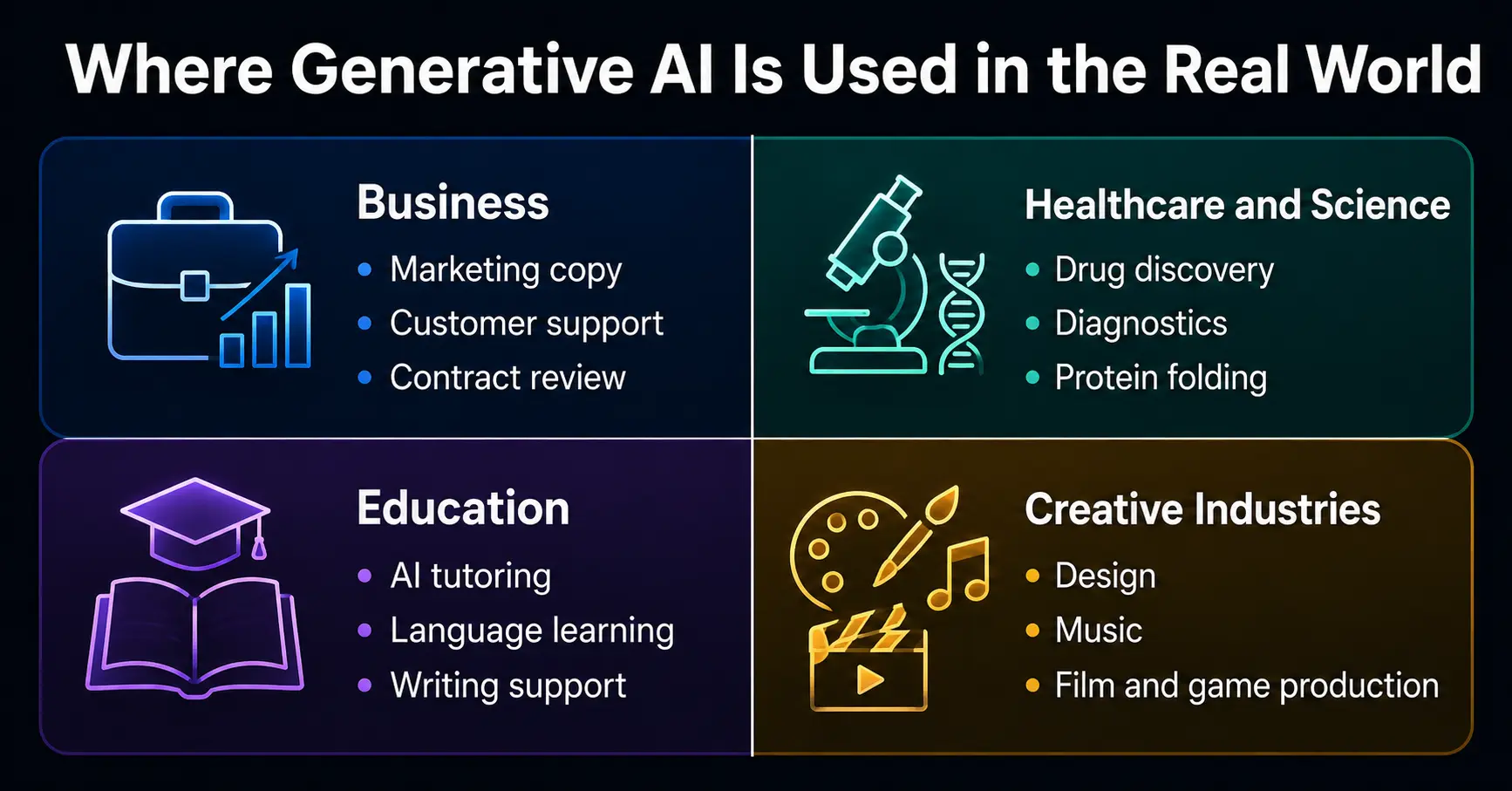
Generative AI tools now appear across nearly every business function. Marketing teams use them to draft content, generate ad copy, and personalise communications at scale. Customer support operations use LLM-powered chatbots to handle routine queries without human involvement. Legal teams use them to summarise contracts and flag risks. Finance analysts use them to generate reports from raw data.
The productivity impact is measurable. A 2024 study by economists at MIT found that workers using generative AI tools for writing tasks completed work 37 percent faster and rated the output quality as higher than their unassisted work, as reported in Science magazine’s coverage of the MIT generative AI productivity research. The gains were largest for workers who started with lower baseline writing skills, suggesting the technology raises the floor more than it raises the ceiling.
In Healthcare and Science
Healthcare is one of the most significant application areas for generative AI. Models trained on medical literature help clinicians identify potential diagnoses, flag drug interactions, and summarise patient records. In drug discovery, generative AI models design new molecular structures with specific properties, dramatically reducing the time needed to identify candidate compounds for testing.
AlphaFold 3, released by Google DeepMind in 2024, can predict the three-dimensional structure of proteins and their interactions with other molecules. This capability has direct applications in understanding disease mechanisms and designing new treatments. The scientific community has called AlphaFold one of the most significant research tools to emerge in decades.
In Education and Learning
Generative AI is changing how people learn. AI tutoring tools can adapt explanations to a student’s current level of understanding, identify where they are struggling, and provide tailored practice questions. Language learning apps use generative models to simulate realistic conversations with native speakers. Research and writing assistance tools help students understand complex topics more quickly, though they also raise well-documented concerns about academic integrity.
Now, the debate around generative AI in education is not primarily about whether students will use it. They already do. The more productive question is how educators can design assessments and learning experiences that develop genuine skills in a world where these tools are freely available.
In Creative Industries
Generative AI has become a working tool in creative fields including graphic design, music, film production, and game development. Designers use AI image tools for rapid concept generation and mood boards. Game studios use procedural generation models to create vast landscapes, dialogue, and assets without building each element manually. Film productions use AI to generate storyboards, extend shots, and clean up footage.
The creative industry response is genuinely divided. Many professionals see these tools as productivity accelerators that handle repetitive work. Others see them as a threat to livelihoods, particularly for illustrators, stock photographers, voice actors, and composers whose work is most directly substitutable by the current generation of models. Both concerns are legitimate.
The Limitations of Generative AI Every User Should Know
Hallucinations: When AI Invents Facts
Generative AI models sometimes produce confident-sounding outputs that are factually wrong. This is called hallucination, and it is one of the most important limitations to understand. Because the model generates text by predicting plausible continuations rather than retrieving verified facts, it can produce false information with the same fluent, authoritative tone it uses for accurate information.
Never rely on generative AI output for medical, legal, financial, or safety-critical decisions without verifying against authoritative sources. The models are useful as a starting point for research and a tool for drafting, but they are not reliable fact-checkers of their own outputs. Always verify specific claims, statistics, and citations before using them in consequential contexts.
Bias in Training Data
Generative AI models learn from the data they are trained on. If that data contains biases, the model reflects and sometimes amplifies them. Language models trained predominantly on English-language internet text will perform better on English and worse on lower-resource languages. Image generation models have shown documented tendencies to associate certain professions with particular genders or ethnicities because those associations appear more frequently in the training data.
Responsible AI development involves auditing for these biases and implementing mitigations, but no model is free of them entirely. Users should approach AI-generated content with the same critical eye they would apply to any source that reflects a particular perspective or dataset.
Privacy and Data Concerns
Many generative AI tools process your inputs on remote servers. For business and professional use, this raises questions about data confidentiality. Several major companies have restricted or banned employees from entering proprietary information into public AI tools because of uncertainty about how that data might be used in model training. Before using any generative AI tool with sensitive information, check the provider’s data handling policies carefully.
Frequently Asked Questions
Is generative AI the same as ChatGPT?
No. ChatGPT is one specific product built on generative AI technology. Generative AI is the broader category of models that can create new content. ChatGPT is an LLM-based chatbot made by OpenAI, but there are hundreds of other generative AI tools covering text, images, audio, video, and code from many different companies.
Do I need technical skills to use generative AI tools?
No. Most consumer generative AI tools are designed for everyday users with no technical background. You interact with them through natural language: you type or speak a request and the tool responds. Learning to write effective prompts, meaning clear and specific instructions, improves your results but requires no programming knowledge.
Can generative AI replace human jobs?
Generative AI is automating specific tasks rather than entire jobs in most cases so far. Roles that consist largely of repetitive writing, basic design work, or routine data analysis face the greatest disruption. Most knowledge workers are experiencing AI as a tool that changes what they do rather than one that eliminates their role entirely, though the long-term trajectory is genuinely uncertain and varies significantly by industry.
Is generative AI content always accurate?
No. Generative AI models can and do produce factually incorrect content, a problem called hallucination. The models generate plausible-sounding text based on patterns, not verified facts, which means they can state false information with apparent confidence. Always verify specific facts, statistics, and citations from AI output before relying on them.
How is generative AI different from a search engine?
A search engine retrieves existing web pages that match your query. Generative AI creates a new response based on patterns learned during training. Search gives you links to sources. Generative AI synthesises an answer directly. The key advantage of search is verifiable sourcing. The key advantage of generative AI is that it can reason, summarise, write, and explain rather than simply retrieving documents.
Is generative AI safe to use?
For everyday tasks, yes. The main risks to understand are relying on hallucinated outputs for important decisions, entering sensitive personal or business data into tools without understanding their privacy policies, and the potential for misuse in creating misleading content. Using reputable tools from established providers and verifying important outputs reduces these risks significantly.
Final Thoughts
Generative AI is not a passing trend. It is a fundamental shift in what software can do. The ability to produce new, coherent, contextually relevant content across text, images, audio, code, and video changes the relationship between people and the tools they use to work, learn, and create. Understanding generative AI does not require a technical background. It requires understanding what the technology does, where it performs well, and where it falls short.
The most important things to remember are straightforward. Generative AI creates new content by learning patterns from training data. It does not retrieve stored answers or access verified facts in real time. That is why outputs need verification for anything important. The tools are genuinely useful for drafting, summarising, brainstorming, and automating repetitive tasks. They are not reliable oracles. Using them effectively means understanding both the capability and the limitation.
Generative AI is already part of the tools most knowledge workers use, whether they recognise it or not. The applications are expanding across healthcare, education, business, creative work, and scientific research at a pace that makes staying informed genuinely worthwhile. The goal is not to predict where the technology ends up but to understand it well enough to use it thoughtfully today.
For a deeper dive into the research and policy landscape around generative AI, the Stanford HAI AI Index Report is the most comprehensive annual overview of AI progress across research, industry, and society, and it is free to access. It is the best single resource for anyone who wants to move beyond beginner-level understanding into the broader picture.

Prince Anichi
Founder and Lead Technology Editor at Ortechy. Covering digital economy shifts, tech ecosystems across Africa, cybersecurity intelligence, and emerging software platforms.