In this article27 sections
- 01.The Financial Mechanics Behind Subscription Business Dominance
- ↳Recurring Revenue Changes Everything
- ↳Annual Recurring Revenue as a Business Valuation Driver
- 02.Why Customers Choose Subscription Businesses Over Ownership
- ↳1. Lower Upfront Cost and Continuous Access
- ↳2. The Shift From Ownership to Access
- 03.The Sectors Where Subscription Businesses Dominate Most
- ↳1. Software and SaaS
- ↳2. Media and Entertainment Streaming
- ↳3. Consumer Products and Physical Subscriptions
- 04.The Key Metrics That Drive Subscription Business Success
- ↳Customer Lifetime Value and Churn Rate
- ↳Customer Acquisition Cost and Payback Period
- 05.The Real Challenges Subscription Businesses Face
- ↳Subscriber Fatigue and Market Saturation
- ↳Pricing Pressure and Tier Proliferation
- 06.How Subscription Businesses Build Long-Term Competitive Moats
- ↳Data Advantages That Compound Over Time
- ↳Switching Costs and Habit Formation
- 07.Frequently Asked Questions
- ↳What is a subscription business model?
- ↳Why do subscription businesses grow faster than traditional companies?
- ↳What is churn and why does it matter so much?
- ↳How do subscription businesses make money if the price seems so low?
- ↳What industries are most affected by the subscription economy?
- ↳What are the risks of building a subscription business?
- 08.Why Subscription Businesses Will Keep Winning and What It Means for You
Subscription Business Model: Why It Dominates the Digital Economy
The subscription business model has quietly become the engine of the modern digital economy. The global subscription economy grew by more than 435 percent over the past decade, and companies running recurring revenue models now consistently outperform their transactional peers on Wall Street, as tracked by the Zuora Subscription Economy Index. From software and streaming to physical product boxes and automotive features, subscription businesses have fundamentally changed the relationship between companies and their customers. Revenue that once arrived in unpredictable spikes now flows in reliable monthly increments.
This shift is not accidental and it is not a fad. It reflects a structural change in how value is delivered, how customers prefer to consume products and services, and how investors reward predictable cash flows. Understanding why subscription businesses dominate today illuminates not just a business trend but a deeper change in the economics of the digital age.
This post covers the key reasons subscription businesses win, the financial mechanics that make the model so powerful, the sectors where it has taken the deepest hold, the real challenges companies face, and what the next phase of the subscription economy looks like. Start with the financial foundation, because that is where the dominance begins.
The Financial Mechanics Behind Subscription Business Dominance
Recurring Revenue Changes Everything
The core advantage of the subscription business model is predictable recurring revenue. A traditional transactional business sells a product once and then must find new customers or convince existing ones to buy again. Every month, the revenue counter resets to zero. A subscription business starts each month with a known base of committed paying customers before it acquires a single new one.
This predictability changes how a company plans, hires, and invests. Businesses with recurring revenue can model forward cash flows with significantly higher confidence than transactional companies, which allows them to invest ahead of growth rather than reacting to it. The result is a compounding dynamic: stable revenue enables investment, investment drives growth, and growth builds a larger stable revenue base.
Annual Recurring Revenue as a Business Valuation Driver
Annual recurring revenue (ARR) is the metric subscription businesses use to express the annualised value of their current subscription contracts. Unlike traditional revenue measures, ARR explicitly captures the forward-looking value of the customer base rather than only backward-looking sales. This is why investors value subscription businesses so differently from product-centric ones.
Software-as-a-service (SaaS) companies, meaning software delivered through a subscription rather than a one-time purchase, typically trade at revenue multiples several times higher than equivalent transactional software companies. The premium reflects the predictability and durability of recurring revenue. Companies like Salesforce, ServiceNow, and Workday, all of which run on subscription models, have become some of the most valuable businesses on the S&P 500, demonstrating that Wall Street consistently rewards recurring revenue structures over transactional ones, as detailed in Zuora’s Subscription Economy research and index.
Why Customers Choose Subscription Businesses Over Ownership
1. Lower Upfront Cost and Continuous Access
For consumers, subscriptions solve a real friction point: the large upfront payment. Buying software outright once required a significant purchase that might go out of date within a year. Buying a music collection meant investing hundreds of dollars in albums that could be lost or damaged. Subscriptions spread cost across time, making high-quality products and services accessible to people who could never afford the full purchase price at once.
Additionally, subscriptions typically include continuous access to updates, improvements, and new content. A customer paying $15 per month for a streaming service receives every new release automatically. A business paying for a cloud software subscription gets every security patch and feature update as part of the fee. The value of the product improves over time without requiring an additional purchase decision.
2. The Shift From Ownership to Access
There is also a broader cultural shift at work. Younger consumers, in particular, show a clear preference for access over ownership across many product categories. Research consistently shows that millennials and Generation Z place lower value on owning physical goods than previous generations did. This generational preference for access aligns almost perfectly with the subscription model’s core value proposition.
The rise of the sharing economy in transport, accommodation, and tools accelerated this shift. Once people became comfortable with not owning a car or a hotel room, the idea of not owning software, music, or video content felt natural rather than like a compromise. Subscription businesses stepped into a consumer mindset already primed to accept the model.
The Sectors Where Subscription Businesses Dominate Most
1. Software and SaaS
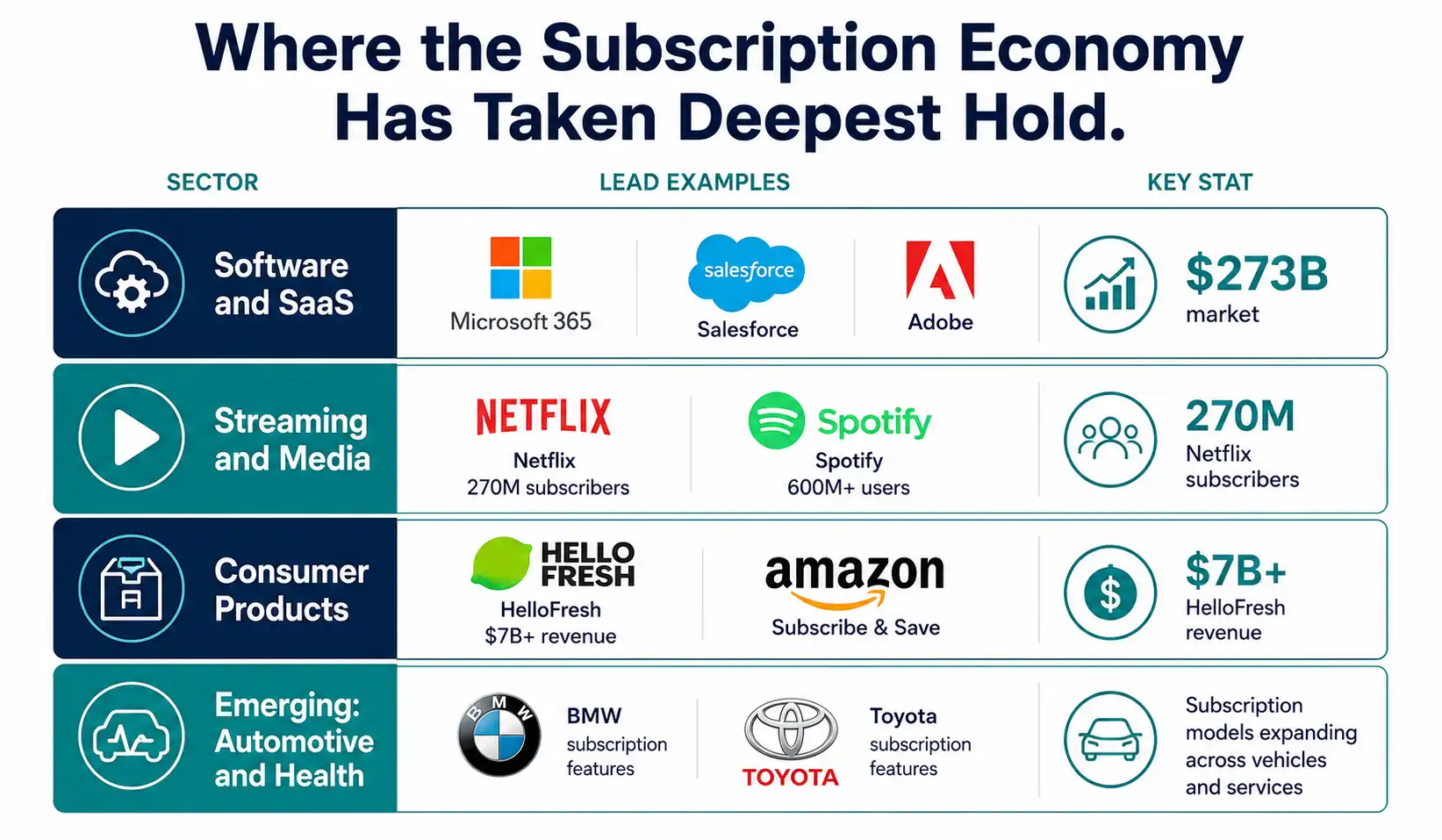
Software was the first major industry to fully embrace recurring revenue, and it remains the sector where subscription economics are most mature. The transition from packaged software to SaaS began in earnest in the early 2000s with companies like Salesforce. By the mid-2010s, it had become the dominant delivery model for enterprise software. By 2020, even consumer software giants like Microsoft and Adobe had moved their flagship products to subscriptions.
Microsoft 365 has over 400 million paid seats globally. Adobe Creative Cloud generates over $5 billion annually from subscription revenue. The SaaS market reached $273 billion in 2023 and is projected to exceed $1 trillion by 2032, according to analysis from Grand View Research, as cited in Forbes Technology Council’s analysis of the evolving subscription economy. Those numbers reflect an industry that has fully completed its structural transition to recurring revenue.
2. Media and Entertainment Streaming
Streaming transformed the entertainment industry in less than 15 years. Netflix launched its streaming service in 2007 with a library that looked modest by today’s standards. By 2024, it had over 270 million paid subscribers globally and generated more than $33 billion in annual revenue, a complete reinvention of a company that started mailing DVDs.
The streaming model spread to music through Spotify, to podcasting through subscription tiers, to news through digital publication memberships, and to live sports through league-owned streaming platforms. Every entertainment vertical has been reshaped by the move from transaction to subscription. Traditional pay-TV bundles are declining as subscription streaming services absorb their audience segment by segment.
3. Consumer Products and Physical Subscriptions
Subscriptions have extended well beyond digital products. Dollar Shave Club disrupted the razor industry with a direct-to-consumer subscription model before its $1 billion acquisition by Unilever in 2016. HelloFresh turned meal kits into a subscription category and now generates over $7 billion annually. Amazon Subscribe and Save locks millions of customers into recurring orders for everyday household goods.
Additionally, automotive manufacturers have begun experimenting with subscription features. BMW, Toyota, and General Motors have all trialled subscriptions for vehicle features like heated seats, enhanced driver assistance systems, and remote start functions. This represents the subscription model reaching into product categories that seemed immune to it just a decade ago.
The Key Metrics That Drive Subscription Business Success
Customer Lifetime Value and Churn Rate
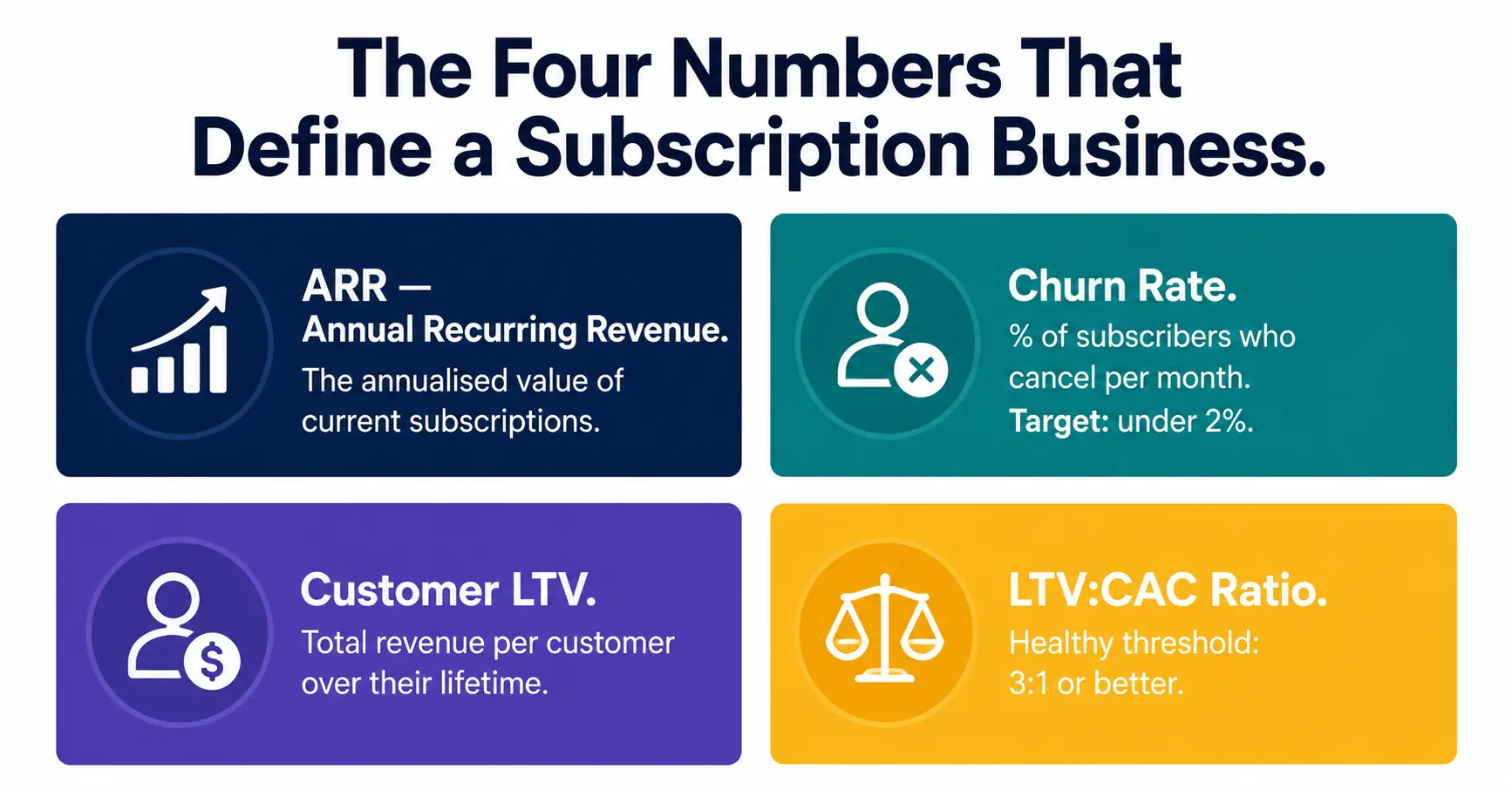
Two metrics define the health of any subscription business above all others: customer lifetime value (LTV) and churn rate. LTV is the total revenue a company expects to generate from a single customer over their entire relationship. Churn rate is the percentage of customers who cancel their subscription in a given period. These two numbers are directly connected, and managing their relationship is the central operational challenge of running a subscription business.
A business with a monthly churn rate of five percent loses more than half its customer base every year. At two percent monthly churn, the average customer stays for over four years. That difference has enormous implications for profitability. Reducing monthly churn by even one percentage point can double or triple the lifetime value of each customer. This is why subscription companies invest so heavily in onboarding, customer success, and engagement features. Retention spending generates higher returns than acquisition spending in most mature subscription businesses.
Customer Acquisition Cost and Payback Period
Customer acquisition cost (CAC) is what it costs to sign up a new subscriber, including all marketing and sales expenses. The payback period is how many months of subscription revenue it takes to recover that cost. In healthy subscription businesses, the LTV-to-CAC ratio is typically three to one or better, meaning a customer generates at least three times what it cost to acquire them.
This ratio is what makes the subscription model so attractive to investors. Once a subscription business reaches a stable, low-churn customer base, each incremental subscriber adds reliable long-term value at a cost that is well understood. The model rewards patient, long-term investment in customer relationships rather than short-term transactional thinking.
The Real Challenges Subscription Businesses Face
Subscriber Fatigue and Market Saturation
The success of the subscription model has created its own headwind: consumers now manage more subscriptions than at any point in history. A Deloitte survey found that the average US household spends over $200 per month on subscriptions across streaming, software, fitness, and products. Growing subscription fatigue is leading consumers to audit and cancel services they find low value, and this churn pressure is particularly acute for newer entrants competing in already crowded categories, according to Deloitte’s Digital Media Trends consumer subscription research.
This saturation means that simply offering a subscription is no longer a competitive advantage. The quality of the subscription experience, the clarity of its value proposition, and the depth of its integration into daily life increasingly determine whether customers keep paying month after month.
Pricing Pressure and Tier Proliferation
Another challenge is pricing complexity. Many subscription businesses have responded to pressure by introducing multiple tiers, ad-supported options, and annual versus monthly pricing structures. While this captures more customers at different price points, it creates significant communication and positioning challenges. Customers find it harder to understand what they are paying for, and the value of each tier becomes harder to articulate clearly.
Netflix’s introduction of an ad-supported tier, Disney Plus’s multiple plan levels, and Spotify’s varied pricing across markets all reflect attempts to hold subscriber numbers while protecting average revenue per user (ARPU). Managing this complexity without eroding brand trust is one of the defining operational challenges of the current phase of the subscription economy.
How Subscription Businesses Build Long-Term Competitive Moats
Data Advantages That Compound Over Time
Subscription businesses accumulate something transactional businesses do not: a continuous stream of customer behaviour data. Every interaction a subscriber has with the product generates data about preferences, usage patterns, and engagement levels. Over months and years, this data builds into a profile that allows the company to personalise the experience, predict churn, and surface the right features at the right time.
Spotify’s Discover Weekly playlists are a direct product of years of listener behaviour data from hundreds of millions of subscribers. Netflix’s recommendation engine, which influences 80 percent of the content its subscribers watch, runs on a decade of viewing data. These data-driven personalisation capabilities are extremely difficult for new entrants to replicate because they are built from scale and time, not just technology.
Switching Costs and Habit Formation
Subscription businesses also benefit from the switching costs they create over time. When a customer has stored years of playlists, saved projects, personalised settings, or purchase history inside a subscription service, leaving means losing all of that accumulated value. These switching costs are not always visible to consumers when they first subscribe, but they become significant retention forces over time.
Additionally, subscriptions build habits. A daily news briefing, a weekly meal kit, a monthly beauty box: each creates a routine that becomes part of the subscriber’s life. Habits are among the most powerful retention mechanisms a subscription business can develop because they transform the service from something the customer chooses to something the customer does automatically.
Frequently Asked Questions
What is a subscription business model?
A subscription business model charges customers a recurring fee, typically monthly or annually, in exchange for continuous access to a product or service. Instead of a one-time purchase, subscribers pay regularly as long as they find value in the offering. Examples include Netflix, Spotify, Microsoft 365, and Amazon Prime.
Why do subscription businesses grow faster than traditional companies?
Subscription businesses benefit from compounding revenue growth. Each new subscriber adds to the existing base rather than replacing a one-off sale, so revenue builds cumulatively over time. Additionally, the predictability of recurring revenue allows subscription companies to invest ahead of growth, which accelerates their expansion relative to transactional businesses that must wait for revenue to arrive before investing.
What is churn and why does it matter so much?
Churn is the rate at which subscribers cancel their subscriptions in a given period, usually expressed as a monthly or annual percentage. It matters because even a small churn rate compounds over time into large customer losses. A business with five percent monthly churn loses more than half its customers every year, which means it must constantly replace departing subscribers just to maintain its current size.
How do subscription businesses make money if the price seems so low?
Subscription businesses make money through volume and duration. A $10 per month subscriber who stays for three years generates $360. That is significantly more than a one-time purchase would have captured from the same customer. The model relies on keeping customers long enough for their lifetime value to exceed the cost of acquiring and serving them.
What industries are most affected by the subscription economy?
Software, media and entertainment, consumer products, and increasingly automotive and healthcare have seen the deepest impact. Software-as-a-service is the most mature subscription sector. Streaming media completely displaced physical and transactional media delivery. Consumer product subscriptions grew rapidly through direct-to-consumer brands. Automotive and healthcare represent the frontier of subscription expansion.
What are the risks of building a subscription business?
The main risks are high churn, subscriber acquisition costs that exceed lifetime value, and market saturation in crowded categories. Subscription businesses also face pricing pressure from competitors and growing consumer fatigue from managing too many recurring payments. Success requires sustained investment in customer experience and retention, not just acquisition.
Why Subscription Businesses Will Keep Winning and What It Means for You
The subscription business model dominates the digital economy because it aligns the interests of companies and customers in a way that transactional models cannot match. Companies earn predictable, compounding revenue that funds long-term investment. Customers get continuous access, regular improvements, and lower upfront costs. Investors reward the model with premium valuations that give subscription businesses a structural advantage in capital markets.
The structural forces driving this dominance are not weakening. Consumer preference for access over ownership continues to grow. Data advantages compound for established subscription players. Switching costs deepen over time. And the sectors where subscription has not yet fully taken hold, including automotive, healthcare, and physical retail, are entering their own subscription transitions now. The subscription economy’s next decade of growth will come from these late-adopter industries as much as from the digital sectors where the model is already mature.
However, the model is not frictionless. Subscriber fatigue is real. Pricing complexity is growing. And the companies that win the next phase will be those that earn their subscribers’ continued payment through genuine, demonstrable value rather than lock-in and inertia. The question for any business considering the subscription model is not whether recurring revenue is attractive. It clearly is. The question is whether the product delivers enough sustained value to make customers want to keep paying.
For anyone building or investing in a subscription business, the Zuora Subscription Economy Index is the most consistently rigorous benchmark of how subscription businesses perform relative to the broader market, and it publishes updated data regularly. For a broader strategic perspective on the recurring revenue model, Harvard Business Review’s foundational analysis of the subscription economy remains one of the clearest explanations of why this model reshapes every industry it enters.

Prince Anichi
Founder and Lead Technology Editor at Ortechy. Covering digital economy shifts, tech ecosystems across Africa, cybersecurity intelligence, and emerging software platforms.