In this article21 sections
- 01.Who Built Bumpa and Why It Exists
- 02.What Bumpa Does: A Complete Feature Breakdown
- ↳1. Online Store Creation
- ↳2. Social Commerce Management
- ↳3. Inventory and Order Management
- ↳4. Bumpa POS: In-Store and Offline Selling
- ↳5. Payments and Multi-Currency Support
- ↳6. Sales Reports and Financial Tracking
- ↳7. Customer Management and Notifications
- 03.Bumpa Capital: Solving the Credit Problem for Nigerian SMEs
- 04.Bumpa’s Funding Journey and Investor Confidence
- 05.Bumpa’s Growth: The Numbers That Tell the Story
- 06.Bumpa vs Shopify vs Other Alternatives
- 07.Frequently Asked Questions About Bumpa
- ↳What is Bumpa and who is it for?
- ↳How much does Bumpa cost?
- ↳Who founded Bumpa?
- ↳How many merchants use Bumpa?
- ↳Does Bumpa work for businesses outside Nigeria?
- ↳What is Bumpa Capital?
- 08.Bumpa Is Building the Infrastructure Nigerian Commerce Needed
Inside Bumpa: The Platform Helping Small Businesses Sell More Online in Nigeria
There is a problem that every small business owner in Nigeria knows intimately. Your customers find you on Instagram. They place orders via WhatsApp DM. They pay by bank transfer. And you track everything in a notebook or a spreadsheet that you update manually at the end of every exhausting day. Bumpa was built specifically to fix that problem, and it has become one of the most important business tools in Nigeria’s growing digital commerce ecosystem.
Founded in 2021 by Kelvin Umechukwu and Adetunji Opayele, Bumpa has grown to serve over 136,000 merchants across Nigeria, processed over ₦160 billion in transactions, and raised a total of $4.2 million in funding from investors including Base10 Partners, Plug and Play Ventures, Visa Africa Accelerator, DFS Lab, and Jobtech Alliance. It has been called “Shopify for Africa” by its own co-founder, and the comparison is intentional. Shopify built infrastructure for Western e-commerce behaviour. Bumpa built infrastructure for how African businesses actually operate.
This article covers everything you need to know about Bumpa — who built it, how it works, what it offers merchants today, how it compares to alternatives, and where it is headed.
Who Built Bumpa and Why It Exists
Bumpa began as SalesCabal, an online store and inventory management system built by Kelvin Umechukwu and Adetunji Opayele. The two founders first encountered the problem they would eventually build Bumpa to solve while working at CcHub and E-Settlement, where they interacted regularly with small businesses and startups navigating Nigeria’s digital commerce landscape.
What they observed repeatedly was a gap that no existing platform adequately filled. Nigerian merchants were not operating like Western e-commerce businesses. They were selling through Instagram stories, taking orders in WhatsApp chats, confirming payments by checking bank alerts on their phone, and fulfilling deliveries through informal logistics networks. They were genuinely entrepreneurial and increasingly digitally savvy. They simply had no tools built around the way they actually worked.
Global platforms like Shopify and WooCommerce were designed around credit card payments, email-based order management, and consumer behaviour shaped by Amazon’s fulfilment model. None of that matched what a Lagos fashion vendor, Abuja food seller, or Port Harcourt accessories brand actually experienced every day. As Bumpa’s own blog put it directly: “Shopify was not built for a business owner in Lagos whose customers pay by bank transfer, discover products through Instagram, order via DM, and expect a rider at their door the same day.”
The founders relaunched SalesCabal as Bumpa in February 2021 with a clearer mission: build the infrastructure to fuel online commerce and empower African small business owners to start, run, and grow their businesses entirely from their mobile devices. The rebranding reflected a sharper product focus and a stronger brand identity suited to the market they were serving. Read more about Bumpa’s founding story on Techpoint Africa’s coverage of the $4 million seed round which contains direct quotes from the founding team about the platform’s vision.
What Bumpa Does: A Complete Feature Breakdown
Bumpa is a business management platform that gives small and medium-sized businesses every tool they need to sell online, manage their operations, and grow their customer base from a single mobile app. Its feature set is deliberately comprehensive because the merchants it serves cannot afford to pay for five separate tools that do not talk to each other.
1. Online Store Creation
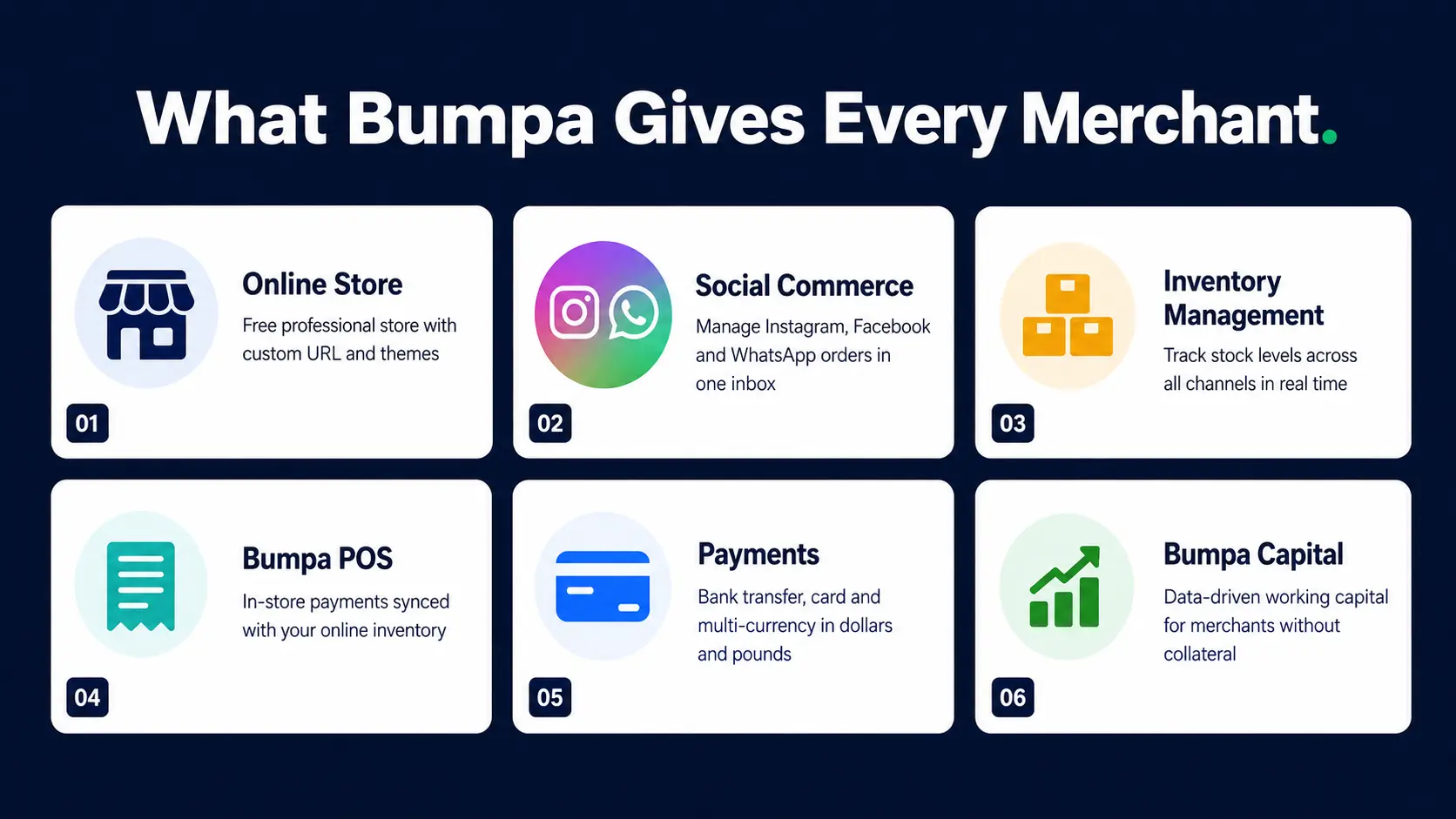
Every Bumpa merchant gets a free professional online store with a custom URL that they can share with customers, post on social media, and use as their primary selling destination. The store supports product listings with images, descriptions, prices, and variants. Customers can browse, add items to a cart, and check out directly without the merchant needing any technical knowledge to set it up.
In 2026, Bumpa introduced professional website themes comparable in quality to what Shopify and Wix offer their users, but built specifically for Nigerian e-commerce needs. The themes support extensions including blogs, countdown timers for sales, back-in-stock alerts, product add-ons, and custom checkout flows. Merchants who previously had to hire a web developer to get a professional-looking online presence can now have one in under thirty minutes.
2. Social Commerce Management
This is one of Bumpa’s most distinctive and genuinely useful features. The platform allows merchants to manage direct messages and orders arriving from Instagram, Facebook, and WhatsApp directly inside the Bumpa app without having to switch between multiple platforms. A customer who DMs an order on Instagram at 11pm triggers a notification in the merchant’s Bumpa dashboard. The merchant confirms, processes the order, and sends an update, all without opening Instagram separately.
Product sharing to Facebook, Instagram, and Twitter happens with a single tap from inside the platform. When a merchant uploads a new product, they can push it to all three social channels instantly with auto-generated captions and product images formatted for each platform’s requirements. For merchants who run their entire business through social media, this integration removes the most time-consuming part of their daily workflow.
3. Inventory and Order Management
Bumpa gives every merchant a full inventory management system that tracks stock levels in real time across every channel simultaneously. When a customer purchases through the online store, through Instagram, or in person using Bumpa POS, the inventory count updates automatically across all channels. Low stock alerts notify merchants before they run out of popular items. Inventory reports show which products sell fastest, which sit slowest, and how stock levels trend over time.
Order management covers the full fulfilment cycle from the moment an order is placed to the moment it is delivered. Merchants can update order status, send customers automated notifications at each stage, manage refunds and exchanges, and view their complete order history in one dashboard.
4. Bumpa POS: In-Store and Offline Selling
Bumpa POS brings the same inventory and order management system into physical retail environments. Merchants who operate both an online store and a physical market stall, boutique, or pop-up shop can use Bumpa POS to accept in-store payments, track sales, and keep their inventory automatically synchronised with their online store. Cash, bank transfer, and card payments are all supported. Every sale made in-store updates the same inventory and reporting system as every online sale, giving merchants one complete picture of their business regardless of where the sale happened.
5. Payments and Multi-Currency Support
Bumpa integrates payment processing directly into the platform, allowing customers to pay by card, bank transfer, or USSD without the merchant needing a separate payment gateway account. Customers get a smooth checkout experience and merchants get faster settlement.
In 2026, Bumpa expanded to support multi-currency payments, allowing merchants to accept transactions in US dollars and British pounds. This is a significant development for Nigerian businesses with diaspora customers in the UK, US, and Canada who previously had to navigate friction-heavy international transfer options. A Lagos fashion brand can now sell to a customer in London who pays in pounds and receives an order in Nigeria, with the currency conversion and settlement handled automatically inside Bumpa.
6. Sales Reports and Financial Tracking
Every merchant on Bumpa gets automated sales reports covering revenue, order volumes, best-selling products, customer purchase patterns, and profit margins. The reporting system eliminates the manual spreadsheet work that consumes enormous time for small business owners who were previously doing all their financial tracking by hand. Tax compliance features were added specifically for Nigeria’s 2026 tax regulations, helping Bumpa merchants understand their VAT obligations, stamp duty requirements, and recordkeeping responsibilities without needing to hire an accountant for routine compliance questions.
7. Customer Management and Notifications
Bumpa includes a built-in customer relationship management system that builds a database of every customer who has placed an order, tracks their purchase history, and enables merchants to send direct notifications and updates. Merchants can reach their customer base with new product announcements, restock notifications, promotional offers, and order updates directly through the app, without needing a separate email marketing tool or SMS gateway.
Bumpa Capital: Solving the Credit Problem for Nigerian SMEs
One of the most significant recent developments at Bumpa is the launch of Bumpa Capital, a working capital financing product built in partnership with fintech infrastructure provider Vendorcredit.
Access to credit has been one of the most persistent and damaging constraints on small business growth in Nigeria for decades. Traditional banks require collateral, audited financial statements, and credit histories that most informal small businesses simply do not have. The result is that merchants who are generating real revenue and growing their customer base have no reliable way to access the working capital they need to buy more stock, expand their operations, or survive a slow season.
Bumpa Capital changes this by using real-time business performance data from the Bumpa platform itself as the basis for lending decisions. Instead of asking for a land title or three years of audited accounts, Bumpa evaluates a merchant’s actual transaction history, order volumes, revenue trends, and inventory turnover to determine their creditworthiness. This is a far more accurate picture of a business’s financial health than any document a traditional bank requests, and it makes credit accessible to merchants who have never had a formal bank loan in their lives.
The financing solution is embedded directly into the Bumpa dashboard, so merchants can access and manage capital without leaving their business management tools. As Naijapreneur reported in its coverage of the Bumpa Capital launch, the system is designed to reduce friction in SME financing while improving repayment reliability through data-driven underwriting.
Bumpa’s Funding Journey and Investor Confidence
Bumpa has raised a total of $4.2 million across two confirmed funding rounds since launching in 2021. The first round was a seed investment in September 2021. The larger $4 million seed round closed in October 2022, led by Base10 Partners and including Plug and Play Ventures, SHL Capital, Magic Fund, Jedar Capital, DFS Labs, FirstCheck Africa Angel Program, E62 Ventures, Club14, and Fast Forward Ventures.
In March 2026, Bumpa received an additional undisclosed funding from Jobtech Alliance, a pan-African investment vehicle that simultaneously funded Kenyan startup Flowcart. Jobtech Alliance explained its investment thesis clearly: “Platforms built to introduce structure beneath that existing behaviour, rather than replace it with new marketplaces, are the ones that will scale, improve merchant incomes and unlock financial inclusion. Bumpa does this at the point of sale.” The Tracxn company profile maintains current funding details and is available at Tracxn’s Bumpa company profile.
The investor profile tells an important story about how the platform is perceived by those who have seen its data. Base10 Partners is a US-based venture firm with a thesis focused on automation for the real economy. DFS Lab focuses specifically on digital financial services in emerging markets. Visa Africa Accelerator participation brought global payments infrastructure expertise into Bumpa’s orbit. This is not a list of investors who bet on Nigerian startups speculatively. It is a list of investors with deep domain expertise in the specific problems Bumpa is solving.
Bumpa’s Growth: The Numbers That Tell the Story
The scale of Bumpa’s merchant base and transaction volume as of 2026 demonstrates that the platform is solving a genuine, widely felt problem.
Over 136,000 merchants now run their businesses on Bumpa. More than ₦160 billion in transactions have been processed through the platform. Individual merchants on the platform have scaled from their first order to 20,000 orders in a single year. As TechCabal’s January 2026 milestone feature reported, Bumpa’s Growth Manager Ayodele described 2025 as a turning point for digital commerce in Nigeria, noting that seeing merchants scale from their first order to 20,000 orders proves that the right tools can turn a local hustle into a national powerhouse.
Bumpa also acquired Fyyne, a beauty tech startup, in December 2023, adding specialised features for beauty and personal care merchants to its platform. This acquisition reflected a deliberate strategy of deepening vertical features for the specific merchant categories most active on the platform rather than remaining a generic horizontal tool.
The platform is available as a mobile app on both Android through the Google Play Store and iOS through the Apple App Store, reflecting the founders’ original vision of a business management platform that runs entirely on a smartphone. The Bumpa website, accessible at getbumpa.com, provides the full feature overview and getting-started resources for new merchants.
Bumpa vs Shopify vs Other Alternatives
The most honest comparison for Bumpa is not Shopify in a direct feature battle. It is a question of whether you are building a business for a Nigerian and African market or a Western one. The two platforms are built for fundamentally different commercial realities.
Shopify is a world-class platform with a vast app marketplace, multi-channel selling tools, and deep integrations with global logistics and payment networks. It is the right choice for a Nigerian brand that sells primarily to international customers and operates with payment flows and fulfilment infrastructure that mirror Western e-commerce. A merchant who processes the majority of orders through credit card payments from US or European customers will find Shopify’s infrastructure well suited to their needs.
Bumpa is the right choice for a merchant whose primary market is Nigeria. Bank transfer payment acceptance is native, not an add-on. Social DM order management is built in, not a third-party integration. The inventory system is designed around the informal multi-channel selling patterns of Nigerian commerce. Customer notifications work through the channels Nigerian customers actually use. And the pricing is accessible for merchants who are building their first formal business infrastructure rather than scaling an already established global brand.
Alternatives in the Nigerian market include Paystack Storefront, which offers a lighter product-focused storefront experience tied to Paystack’s payment infrastructure, and Flutterwave Store, which similarly provides a storefront layer on top of payment processing. Both are strong for specific merchant types but neither offers the full suite of inventory management, social commerce, POS, customer management, and financial reporting that Bumpa combines in a single platform.
Frequently Asked Questions About Bumpa
What is Bumpa and who is it for?
Bumpa is a business management platform built for small and medium-sized businesses in Nigeria and Africa. It provides an online store, inventory and order management, social commerce tools, a POS system, payment processing, customer management, and financial reporting in a single mobile application. It is designed specifically for merchants who sell through Instagram, WhatsApp, and Facebook as well as through a dedicated online store and in physical retail settings.
How much does Bumpa cost?
Bumpa offers a free plan that gives merchants access to core features including the online store, inventory management, and order tracking. Paid plans unlock advanced features including extensions, multi-currency support, higher transaction volumes, and priority support. Pricing details for current plans are available directly at getbumpa.com.
Who founded Bumpa?
Bumpa was founded by Kelvin Umechukwu, who serves as CEO, and Adetunji Opayele, who serves as CTO. Both founders previously worked at CcHub and E-Settlement where they observed the gap in business management tools available to Nigerian small business owners. They originally launched the platform as SalesCabal before rebranding to Bumpa in February 2021.
How many merchants use Bumpa?
Bumpa has over 136,000 merchants using the platform as of early 2026, with over ₦160 billion in transactions processed across the platform. Individual merchants have scaled from their first order to 20,000 orders in a single year using Bumpa’s tools.
Does Bumpa work for businesses outside Nigeria?
Bumpa’s primary market is Nigeria but the platform supports multi-currency payments in dollars and pounds, making it useful for Nigerian businesses with diaspora customers in the UK, US, and Canada. The founders have stated expansion into additional African markets as a long-term goal since the $4 million seed round was announced in 2022.
What is Bumpa Capital?
Bumpa Capital is a working capital financing product launched in partnership with Vendorcredit that uses real-time business performance data from the Bumpa platform to assess SME creditworthiness. It allows merchants to access funding without traditional bank collateral requirements and is embedded directly into the Bumpa business dashboard.
Bumpa Is Building the Infrastructure Nigerian Commerce Needed
Bumpa’s story is ultimately a story about what happens when builders who understand a market deeply create tools specifically for that market rather than adapting tools built for somewhere else. Over 136,000 Nigerian merchants are not using Bumpa because it is the only option available. They are using it because it is the option that actually fits the way they work.
The addition of Bumpa Capital solves the credit access problem that has constrained small business growth in Nigeria for generations. The multi-currency expansion opens diaspora markets that were previously inaccessible without complex financial workarounds. The POS integration bridges the offline-online gap that most Nigerian merchants live in every day. Each of these additions reflects a platform that is listening to its merchants and building in response to their actual needs rather than following a generic e-commerce product roadmap.
Whether you are a merchant looking for a better way to run your business or an observer of Nigeria’s digital commerce evolution, Bumpa represents something genuinely important. It is proof that the right infrastructure, built by people who understand the context, can unlock commercial activity at a scale that imported solutions cannot reach. That is a lesson with implications far beyond one platform in one country.
Visit getbumpa.com to explore the platform and see how it compares to what you are currently using to manage your business.

Prince Anichi
Founder and Lead Technology Editor at Ortechy. Covering digital economy shifts, tech ecosystems across Africa, cybersecurity intelligence, and emerging software platforms.