In this article15 sections
- 01.What Are Quantum Satellites and How Do They Work
- 02.Why Governments Are Investing Billions in Quantum Satellites Right Now
- 03.China’s Quantum Satellite Programme: The World’s Current Leader
- 04.The United States: Leading in Computing, Racing to Catch Up in Communication
- 05.Europe: Collective Investment, Strategic Catch-Up
- 06.Other Countries Racing to Join the Quantum Satellite Club
- 07.What Quantum Satellites Will Change and When
- 08.The Challenges That Still Stand Between Ambition and Reality
- 09.Frequently Asked Questions About Quantum Satellites
- ↳What is a quantum satellite in simple terms?
- ↳Which country leads in quantum satellite technology?
- ↳Why can’t governments just upgrade normal encryption instead?
- ↳How much are governments spending on quantum satellites?
- ↳When will quantum satellites be available commercially?
- 10.The Quantum Satellite Race Is Already Underway
Why Governments Are Investing Billions in Quantum Satellites: The Space Race That Will Define the Future of Security
Governments are investing billions in quantum satellites because whoever builds the first truly unhackable global communication network will hold one of the most consequential strategic advantages in modern history. This is not a theoretical future concern. It is a race that is happening right now, measured in satellite launches, fibre kilometres, and research paper counts, and the stakes involve the security of military communications, financial systems, government secrets, and national infrastructure across every major power on earth.
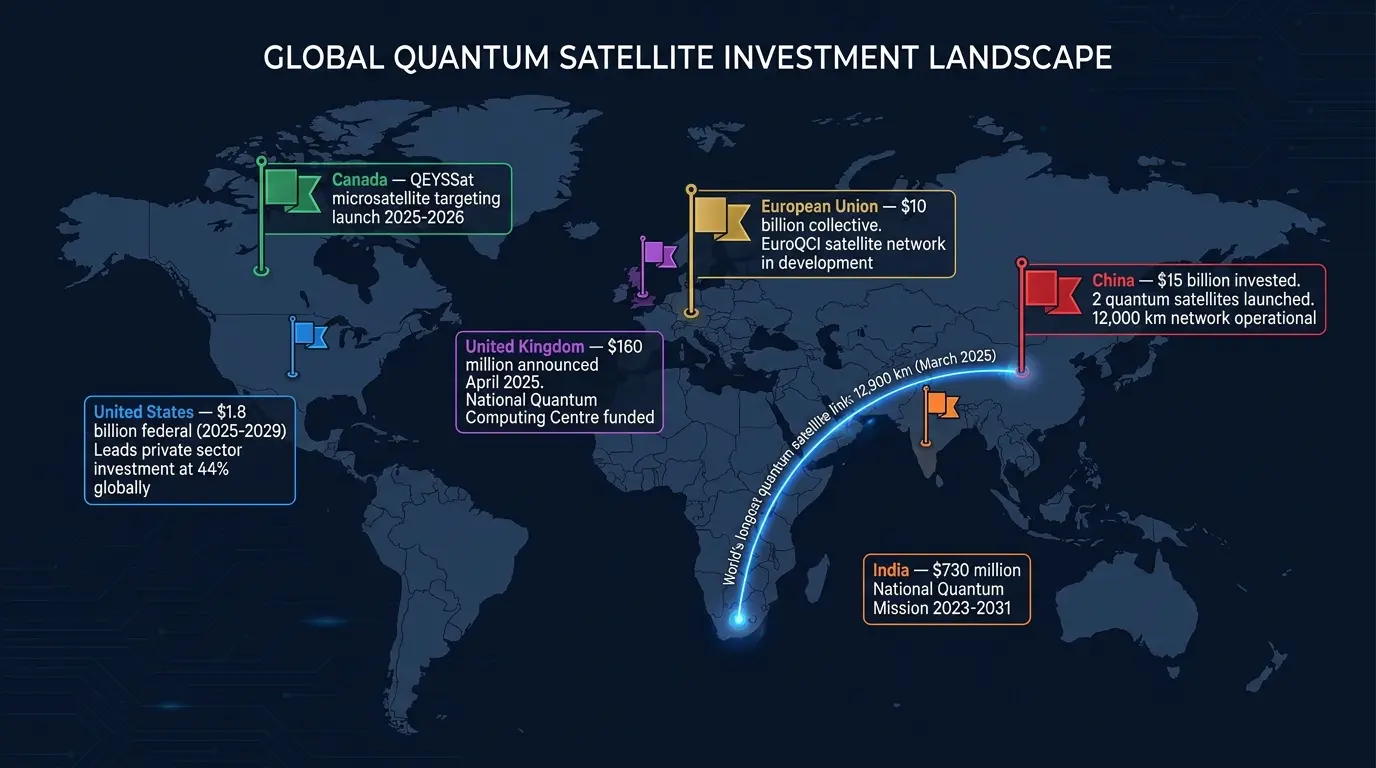
China has already launched two quantum satellites and operates the world’s largest quantum communication network stretching over 12,000 kilometres. The United States has committed $1.8 billion in new federal quantum funding through 2029. The European Union has invested a combined $10 billion across member states. The UK announced $160 million in new quantum investment in April 2025. Canada, Japan, India, and Australia are all accelerating programmes of their own.
This article explains exactly what quantum satellites are, how they work, why governments are spending at this scale, which countries are leading, and what the outcome of this race means for everyone who uses the internet, a bank account, or a smartphone.
What Are Quantum Satellites and How Do They Work
A quantum satellite is a spacecraft that uses the principles of quantum physics to enable communication that is fundamentally impossible to intercept without detection. To understand why that matters, you first need to understand the problem that quantum satellites solve.
Every piece of data transmitted over the internet today, including your banking transactions, your private messages, and your government’s classified communications, is protected by mathematical encryption. That encryption works because the calculations required to crack it would take even the most powerful classical computers thousands of years to complete. Quantum computers change this equation entirely. A sufficiently powerful quantum computer running an algorithm called Shor’s Algorithm could crack today’s strongest encryption in hours or even minutes.
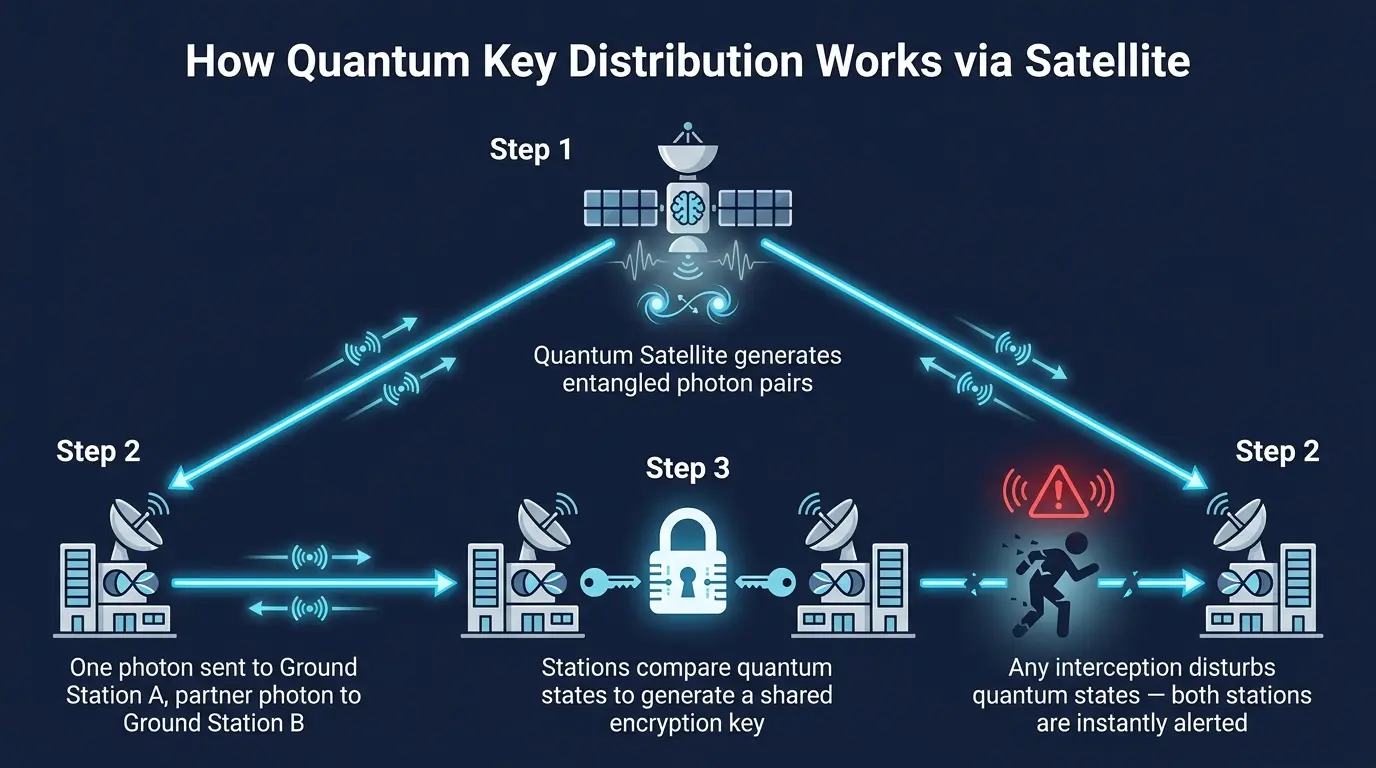
Quantum satellites solve this with a completely different approach. Instead of using mathematical difficulty as a shield, they use the laws of physics themselves. The technology is called Quantum Key Distribution (QKD), and it works through a property of quantum mechanics called the no-cloning theorem. This theorem states that it is physically impossible to copy an unknown quantum state without disturbing it. In practice, this means that if an eavesdropper tries to intercept the quantum-encoded encryption key being transmitted between a satellite and a ground station, the act of intercepting it automatically changes the quantum state and instantly alerts both parties that the communication has been compromised.
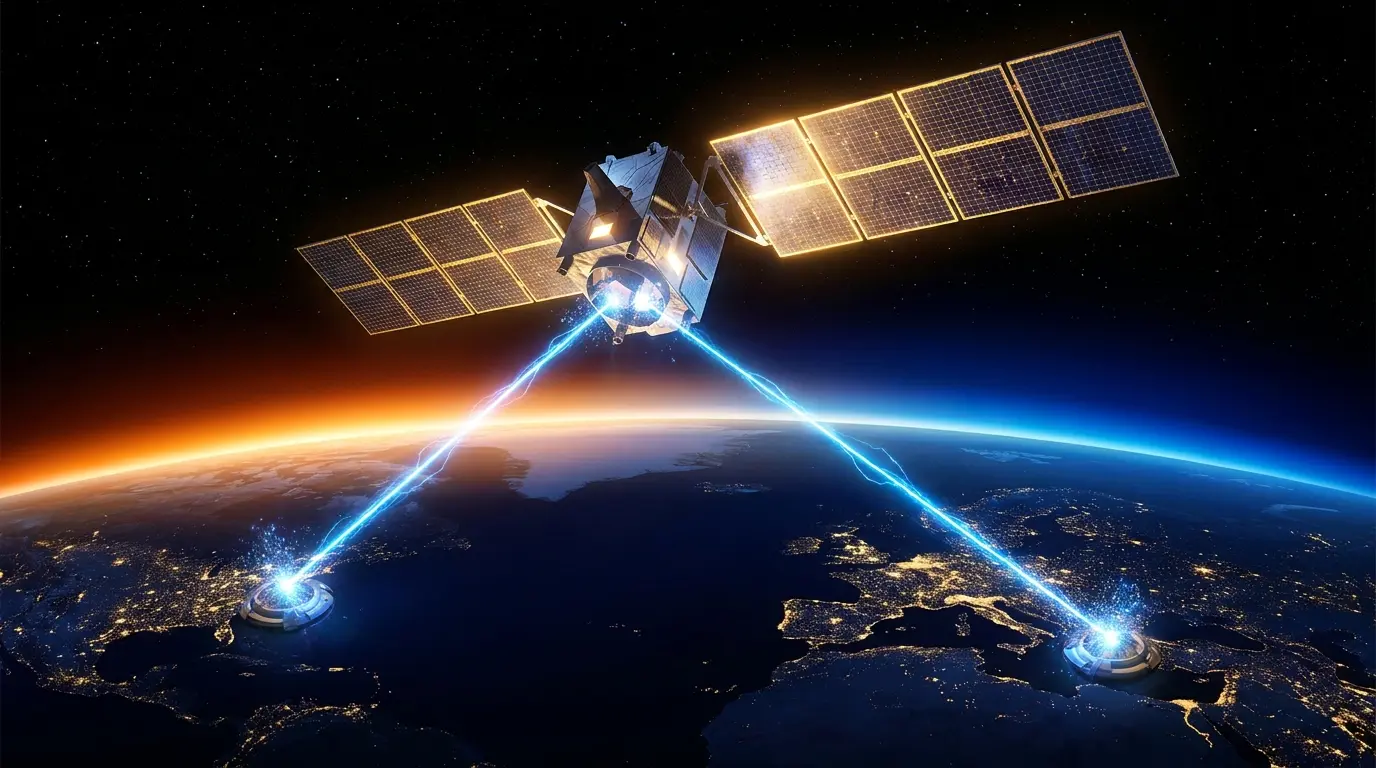
The satellite works by generating pairs of entangled photons, particles of light whose quantum states are linked regardless of the distance between them. It sends one photon of each pair to one ground station and the other photon to a second ground station. The two ground stations then use the correlated quantum states of their received photons to generate a shared encryption key. Because any eavesdropper would disturb the quantum states by attempting to intercept the transmission, both parties know immediately if the key has been compromised and discard it.
The result is encryption that is not just computationally difficult to break. It is physically impossible to break without detection. This is the property that makes quantum satellites worth billions of dollars to governments whose secrets, military communications, and financial systems depend on unbreakable security. For a deeper technical understanding of how quantum key distribution works over satellite links, the research published in Nature’s peer-reviewed paper on microsatellite-based real-time quantum key distribution covers the engineering challenges and achievements in detail.
Why Governments Are Investing Billions in Quantum Satellites Right Now
The urgency behind government investment in quantum satellites comes from a threat that exists today, not in some distant future. Security agencies and intelligence communities worldwide are operating under a strategy called “harvest now, decrypt later.” Nation-state actors are actively intercepting and storing encrypted communications now, with the explicit plan to decrypt them once quantum computers become powerful enough to break current encryption.
This means that sensitive communications transmitted today using conventional encryption may be exposed within the next decade regardless of how strong today’s encryption appears. Military plans, diplomatic negotiations, intelligence sources, infrastructure blueprints, and financial systems are all potentially at risk from data that has already been collected but not yet deciphered.
Quantum satellites are the only communication technology that provides mathematically provable security against this threat regardless of future computing power. You cannot harvest and decrypt later what was never interceptable in the first place. This strategic imperative, combined with the competitive dynamics of who builds it first, explains why national governments treat quantum satellite programmes with the same urgency and secrecy historically reserved for nuclear weapons development.
The US-China Economic and Security Review Commission delivered one of the clearest public statements of this urgency in its November 2025 report to Congress, warning that quantum technology has moved from long-term research to a near-term strategic race with irreversible consequences. The commission concluded that the first nation to achieve operational quantum communication dominance gains advantages in cryptography, intelligence, and military coordination that its rivals cannot easily overcome. You can read the full commission analysis at the US-China Economic and Security Review Commission’s full report on vying for quantum supremacy.
China’s Quantum Satellite Programme: The World’s Current Leader
China is further ahead in quantum satellite communication than any other country on earth. Its dominance rests on a decade of sustained, heavily funded, state-coordinated investment that western democracies with more fragmented research ecosystems have struggled to match.
China launched Micius, the world’s first quantum communication satellite, in August 2016. Developed by a team from the University of Science and Technology of China led by quantum physicist Professor Jian-Wei Pan, Micius immediately achieved a series of world firsts. In 2017 it demonstrated quantum key distribution over 1,200 kilometres. That same year it achieved quantum teleportation from ground to space. In 2018 it enabled the first quantum-encrypted intercontinental video call between the Chinese and Austrian Academies of Sciences, with the two parties separated by 7,600 kilometres.
In March 2025, a research team led by USTC and Chinese Academy of Sciences institutes, in collaboration with Stellenbosch University in South Africa, used Micius to establish the world’s longest intercontinental quantum satellite link, connecting Beijing with Stellenbosch across a distance of 12,900 kilometres. This achievement, reported by ScienceDaily’s coverage of the record-breaking quantum satellite link, represents the most significant demonstration of satellite-based quantum communication ever achieved.
China launched its second quantum satellite, Jinan-1, in July 2022. This microsatellite weighs one sixth of Micius but achieves two to three orders of magnitude better accuracy in quantum communication, demonstrating the miniaturisation progress that makes constellation-scale deployment practical. A third quantum satellite, planned for higher altitude operation and requiring stronger lasers, was targeted for launch by 2026.
On the ground, China has built the world’s largest operational quantum communication network, stretching over 12,000 kilometres. As of August 2025, this network incorporates 145 backbone nodes, 20 metropolitan networks, and six ground stations connected to the Jinan-1 microsatellite. It covers 17 provinces and 80 cities and connects government, military, and financial users in a continuously operating quantum-encrypted communications infrastructure. No other country comes close to this scale of deployed operational quantum communication. The CSIS analysis of China’s quantum programme, available at CSIS’s report on understanding China’s quest for quantum advancement, provides the most comprehensive English-language assessment of what China has built and where it is headed.
The United States: Leading in Computing, Racing to Catch Up in Communication
The United States leads the world in quantum computing but trails China significantly in quantum communication and satellite deployment. This division reflects fundamentally different strategic priorities: the US bet heavily on quantum computing through private sector investment from companies including IBM, Google, and dozens of well-funded startups, while China focused its state resources on quantum communication infrastructure with immediate national security applications.
Federal quantum funding in the US follows a multi-agency structure. The National Quantum Initiative Act was originally authorised in 2019 with $1.2 billion over five years. It was reauthorised in 2025 with $1.8 billion in additional funding covering 2025 to 2029. The Department of Energy operates five quantum research centres with $625 million in dedicated funding. DARPA, IARPA, NSF, and NIST all run parallel quantum programmes adding hundreds of millions more.
The US-China Economic and Security Review Commission’s November 2025 report called for a “Quantum First” national goal by 2030 and recommended that Congress set specific, measurable objectives in quantum cryptography, drug discovery, and materials science. Analysts involved in the report warned that the race is tightening as China continues to invest in communications satellites, sensing systems, and quantum materials research at a pace that US federal investment has not yet matched.
Private sector investment partially compensates for this gap. According to data compiled by The Quantum Insider’s analysis of leading quantum computing countries in 2026, the US leads global private sector quantum investment with 44 percent of cumulative worldwide private funding, far ahead of any other nation. But private investment flows toward commercially viable quantum computing applications rather than toward the classified military and government communication infrastructure where satellite QKD delivers its most strategic value.
Europe: Collective Investment, Strategic Catch-Up
The European Union has committed a combined $10 billion to quantum technologies across member states, making it collectively the second largest public investor in quantum globally after China and ahead of the United States in government spending. Germany leads within Europe in quantum research output and funding, followed by France, the Netherlands, and the United Kingdom.
France committed 1.8 billion euros to a five-year quantum investment plan announced by President Macron in January 2021, explicitly targeting a position among the world’s top three quantum powers. The EU’s Quantum Flagship programme, launched in 2018 with initial funding of one billion euros over ten years, coordinates research across member states on quantum computing, communication, simulation, and sensing.
The United Kingdom, now outside the EU, announced $160 million in new quantum investment in April 2025, including $63 million to Innovate UK for commercial quantum deployment and $30 million for the National Quantum Computing Centre. The UK government specifically highlighted quantum technology’s role in protecting national financial security and reducing fraud, which costs the UK economy an estimated $3.5 billion annually. Details of this investment are available through the US Trade Department’s market intelligence report on UK quantum investment in 2025 to 2026.
Europe’s quantum satellite ambitions centre on the EuroQCI initiative, a European Quantum Communication Infrastructure project designed to create a pan-European quantum communication network by the end of the decade. EuroQCI combines satellite links with terrestrial fibre connections to deliver end-to-end quantum-encrypted communications across all EU member states. Several national satellite QKD demonstration missions are underway in parallel, including missions led by Germany, Italy, and Spain.
Other Countries Racing to Join the Quantum Satellite Club
Beyond the three major blocs, a growing list of nations are pursuing their own quantum satellite programmes with genuine urgency.
Canada is developing the QEYSSat satellite, a quantum encryption microsatellite funded by the Canadian Space Agency and designed by Honeywell. QEYSSat weighs approximately 100 kilograms, one fifth the weight of Micius, and was targeting a launch window between 2025 and 2026. Canada’s approach to QKD involves generating a shared key between a satellite and two ground stations, then encrypting messages using that key through conventional transmission channels. The global quantum space race, including QEYSSat’s development, is covered in detail by SPIE’s Photonics Focus report on racing for quantum supremacy in space.
Japan has integrated quantum technology into its national security strategy and is investing in both quantum computing and quantum cryptography for satellite and ground network applications. Japan’s NICT research institute has demonstrated QKD over terrestrial networks and is developing satellite-based extensions of that capability.
India launched its National Quantum Mission in 2023 with $730 million in funding over eight years covering quantum computing, communication, sensing, and materials. Satellite-based QKD is a specific component of the mission’s communications workstream.
Russia has allocated at least 100 billion rubles to quantum technology development and demonstrated a quantum communication link with China over 3,800 kilometres using China’s Micius satellite, confirming its interest in integrating with quantum satellite infrastructure even before it builds its own operational constellation.
What Quantum Satellites Will Change and When
The practical applications of quantum satellite communication reach far beyond government secrecy. Every sector that depends on secure data transmission has a direct stake in the outcome of this technology race.
Financial services stand to benefit enormously. Global banking and financial markets transmit trillions of dollars in transactions daily using encryption that quantum computers will eventually be able to break. Quantum-secured channels between major financial centres, delivered via satellite for intercontinental transactions, would make financial infrastructure immune to this threat permanently regardless of future computational advances.
Healthcare generates increasingly large volumes of sensitive patient data transmitted between hospitals, research institutions, pharmaceutical companies, and insurers across international boundaries. Quantum-encrypted satellite channels would protect this data against the harvest-now-decrypt-later threat that makes even today’s encrypted health records potentially vulnerable within the next decade.
Critical infrastructure including power grids, water systems, transportation networks, and telecommunications backbone connections all use networked control systems that are increasingly exposed to cyberattacks. Quantum-secured communication channels between critical infrastructure nodes remove the largest remaining vulnerability in infrastructure protection.
The quantum internet, a global network connecting quantum computers and quantum sensors through quantum communication channels, depends entirely on satellite infrastructure to bridge the distances between continents where terrestrial fibre-based quantum repeaters cannot yet operate reliably. The nation that builds the dominant quantum satellite constellation effectively owns the physical infrastructure of the quantum internet.
The Challenges That Still Stand Between Ambition and Reality
Quantum satellites face real engineering challenges that explain why the timelines involved span decades rather than years. Understanding these challenges provides important context for the scale of investment required and the difficulty of what governments are attempting to build.
The most significant limitation of current quantum satellites is atmospheric loss. Photons transmitted from a satellite to a ground station are scattered and absorbed by the atmosphere, which severely limits the rate at which secure key bits can be generated during each satellite pass. The Micius satellite operates only at night to minimise background light interference, which further limits its operational window to approximately five minutes per pass over a given ground station.
Miniaturisation is a second major challenge. Micius weighed 640 kilograms and required a large, specialised launch vehicle. Building a constellation of quantum satellites requires dramatically smaller, lighter, cheaper spacecraft. The Jinan-1 microsatellite at approximately 100 kilograms and the QEYSSat design at a similar weight represent significant progress toward constellation-viable form factors, but further miniaturisation is needed to make large constellations economically practical.
A May 2025 paper published on arXiv, titled “Micius, the world’s first quantum communication satellite, was hackable,” highlighted an important nuance: while the quantum physics of QKD is theoretically unbreakable, the physical implementation of quantum satellite systems can still be vulnerable to side-channel attacks that exploit flaws in hardware rather than the quantum protocol itself. This distinction between theoretical security and implementation security is a critical engineering challenge that the next generation of quantum satellites must address.
Frequently Asked Questions About Quantum Satellites
What is a quantum satellite in simple terms?
A quantum satellite is a spacecraft that uses the laws of quantum physics to transmit encryption keys that are physically impossible to steal without detection. It works by sending particles of light called photons in quantum states to ground stations. Because quantum physics makes it impossible to copy or intercept a quantum state without disturbing it, any eavesdropping attempt is instantly detectable. This makes communications secured through quantum satellites unbreakable by any computer, including future quantum computers.
Which country leads in quantum satellite technology?
China currently leads the world in operational quantum satellite communication. It launched the first quantum satellite, Micius, in 2016 and followed with the Jinan-1 microsatellite in 2022. In March 2025, China demonstrated the world’s longest quantum satellite link at 12,900 kilometres between Beijing and South Africa. China also operates the world’s largest quantum communication network at 12,000 kilometres on the ground. No other country has yet achieved an operational quantum satellite constellation, though the US, EU, Canada, and others are accelerating their programmes.
Why can’t governments just upgrade normal encryption instead?
Conventional encryption, no matter how strong mathematically, cannot protect against the harvest-now-decrypt-later threat. Nation-state actors are intercepting and storing encrypted data today with the plan to decrypt it once quantum computers become powerful enough. Quantum satellite communication eliminates this threat entirely because the physics of quantum transmission makes interception detectable in real time. Data that cannot be secretly intercepted cannot be harvested for future decryption.
How much are governments spending on quantum satellites?
Total global government investment in quantum technologies, which includes satellite programmes, has crossed $40 billion cumulatively. China has invested an estimated $15 billion across its quantum programme, making it the largest single public investor. The EU collectively has invested approximately $10 billion. The US has committed $1.8 billion through federal programmes in the current funding cycle, with significantly more flowing through defence agencies and classified programmes. The UK invested $160 million in 2025 alone.
When will quantum satellites be available commercially?
Government and defence applications of quantum satellite communication are expected within this decade for the leading nations. China already operates a limited operational quantum network using its existing satellites. Broader commercial availability, including for enterprise financial and healthcare applications, is more likely in the 2030s as miniaturisation advances make constellation deployment economically viable and as terrestrial quantum repeater technology matures to bridge the coverage gaps between satellite passes.
The Quantum Satellite Race Is Already Underway
The billions that governments are investing in quantum satellites reflect a clear-eyed understanding of what is at stake. The nation that builds the dominant quantum satellite infrastructure first gains a communication security advantage that its rivals cannot overcome through conventional means. Every military command, every diplomatic negotiation, every financial system, and every critical infrastructure network connected through that infrastructure becomes immune to interception regardless of how powerful future quantum computers become.
China is currently the only country with operational quantum satellites and a functioning national quantum communication network. The United States, Europe, Canada, and others are investing at unprecedented scale to close that gap. The outcome of this race will shape the global balance of power in intelligence, military capability, and economic security for generations.
This is not a distant technology story. It is a present strategic reality that is already influencing policy decisions, defence budgets, research priorities, and diplomatic relationships between the world’s major powers. Understanding it gives you a clearer picture of why space has become the newest and perhaps most consequential frontier in national security competition.
For comprehensive global tracking of quantum investment and initiatives across every major country, the regularly updated resource at Qureca’s Quantum Initiatives Worldwide database provides the most complete publicly available picture of where governments are putting their quantum funding and what strategic goals they are pursuing.

Prince Anichi
Founder and Lead Technology Editor at Ortechy. Covering digital economy shifts, tech ecosystems across Africa, cybersecurity intelligence, and emerging software platforms.