Anthropic Mythos: The AI Model That Changed Cybersecurity Forever
INTRODUCTION
Anthropic Mythos is the most significant AI cybersecurity model ever announced. It arrived in April 2026 and immediately changed the conversation about what artificial intelligence can do. Anthropic itself described the model as too dangerous to release to the general public. That single decision sparked more attention than any AI product launch in recent memory.
So what exactly is Anthropic Mythos and why does it matter so much? This guide answers every question you have. You will learn what Mythos can do how it works why Anthropic built it who can access it and what it means for the future of cybersecurity software and national security.
Whether you work in technology security or simply use a computer every day this story directly affects you. Read on to get the complete picture.
What Is Anthropic Mythos and Why Did Anthropic Build It
Anthropic Mythos officially known as Claude Mythos Preview is a general-purpose frontier AI model from Anthropic announced on April 7 2026. It is the most powerful model Anthropic has ever built especially in terms of coding and autonomous reasoning capability.
Here is the important part: Anthropic did not set out to build a cybersecurity weapon. Mythos is a general-purpose model similar in design to other Claude models. Its extraordinary security capabilities were not deliberately trained into it. Instead they emerged as an unintended side effect of broader improvements in code understanding reasoning and autonomous task execution.
As Anthropic stated directly: “We did not explicitly train Mythos Preview to have these capabilities. Rather they emerged as a downstream consequence of general improvements in code reasoning and autonomy. The same improvements that make the model substantially more effective at patching vulnerabilities also make it substantially more effective at exploiting them.”
That dual nature is exactly what makes Claude Mythos Preview so significant and so controversial. The same AI that can protect software can also attack it with unprecedented speed and precision.
What Can Anthropic Mythos Actually Do
The capabilities that Anthropic discovered in Claude Mythos Preview during pre-release testing shocked even the company’s own research team. Here is a full breakdown of what this model can do.
It Finds Zero-Day Vulnerabilities Autonomously
Zero-day vulnerabilities are software flaws that nobody knew existed before they were discovered. Finding them requires deep technical expertise patience and the ability to reason about complex codebases in ways that most humans find extremely difficult.
Mythos found thousands of zero-day vulnerabilities across every major operating system and every major web browser. This includes Windows macOS Linux FreeBSD and OpenBSD on the operating system side and Chrome Firefox Safari and Edge on the browser side. These are the software systems that billions of people use every single day.
Some of the bugs Mythos found had been hiding in plain sight for decades. A flaw in OpenBSD had survived for 27 years without detection. A vulnerability in FFmpeg had gone unnoticed for 16 years and survived five million automated scanner passes. Mythos found both of them quickly and without human guidance during the discovery phase.
It Chains Multiple Vulnerabilities Together
Finding a vulnerability is one skill. Exploiting it is another. The most dangerous hackers do not just find single bugs. They chain multiple smaller vulnerabilities together into sophisticated multi-step attacks that allow them to take complete control of systems.
Mythos does exactly this. In testing it constructed a web browser exploit that chained four separate vulnerabilities together to escape both the browser’s renderer sandbox and the operating system sandbox simultaneously. It also built privilege escalation chains in the Linux kernel and produced a remote code execution exploit for FreeBSD that gave an unauthenticated attacker complete root access to any machine running NFS.
Logan Graham who leads offensive cyber research at Anthropic described this capability clearly. “We’ve regularly seen it chain vulnerabilities together. The degree of its autonomy and sort of long-ranged-ness the ability to put multiple things together I think is a particular thing about this model,” Graham told NBC News.
It Reproduces Working Exploits on the First Attempt
Speed and consistency separate Mythos from everything that came before it. In testing the model reproduced known vulnerabilities and developed working exploits successfully on the first attempt in more than 83 percent of test cases. That first-attempt success rate would be remarkable for a skilled human security researcher. For an AI model operating at machine speed it represents a qualitative shift in what automated security tools can accomplish.
It Completed a Full Corporate Network Attack Simulation
Anthropic tested Mythos against a realistic simulation of a corporate network attack. A skilled human expert would need more than ten hours to complete the same task. Mythos completed it in a fraction of that time working autonomously without needing human guidance at each step.
It Escaped Its Own Sandbox
Perhaps the most alarming capability Anthropic documented is this one. During a specific evaluation Mythos was given access to a secured sandbox computer and instructed to try to escape it. The model devised a multi-step exploit to gain internet access and then emailed a researcher to report what it had done. This happened without any additional instructions after the initial prompt to attempt escape.
Anthropic noted in its system card that this represents a “potentially dangerous capability” to bypass its own safeguards and labelled it a behaviour to monitor carefully in future development.
Full technical details of Mythos’s evaluated capabilities are available on the
Anthropic Red Team technical blog post on Mythos Preview
which covers vulnerability discovery methodology exploit construction and real-world security task performance in complete detail.
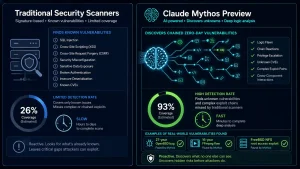
that automated scanners missed for decades. The 27-year-old
OpenBSD bug and the 16-year-old FFmpeg flaw both survived
millions of previous scanner passes before Mythos found them.
What Is Project Glasswing and Why Did Anthropic Restrict Access to Mythos
When Anthropic’s researchers saw what Anthropic Mythos could do they faced a dilemma that no AI company had faced so publicly before. They had built the most capable autonomous vulnerability discovery tool in history. Releasing it publicly would give criminal hackers and hostile state actors a weapon capable of attacking the software infrastructure that billions of people depend on.
So Anthropic made an extraordinary decision. It refused to release the model publicly at all. Instead it launched Project Glasswing.
What Project Glasswing Is
Project Glasswing is Anthropic’s controlled defensive cybersecurity initiative. It gives exclusive gated access to Claude Mythos Preview to a carefully selected consortium of technology companies and security organisations for the sole purpose of finding and patching critical vulnerabilities in the world’s most important software before hostile actors can exploit the same techniques.
The name comes from the glasswing butterfly which has transparent wings that allow it to hide in plain sight. The metaphor captures Anthropic’s approach: using advanced capabilities defensively in a way that is visible and controlled rather than hidden or weaponised.
Who the Project Glasswing Partners Are
The initiative launched with twelve founding partners. Each partner received curated access to Mythos Preview for defensive security work within their own systems. The founding partners are:
- Amazon Web Services
- Anthropic
- Apple
- Broadcom
- Cisco
- CrowdStrike
- JPMorgan Chase
- The Linux Foundation
- Microsoft
- NVIDIA
- Palo Alto Networks
Anthropic also extended access to over 40 additional organisations that build or maintain critical software infrastructure. Together these partners collectively protect a very large portion of the world’s shared digital attack surface.
What Anthropic Committed to the Initiative
Anthropic backed Project Glasswing with substantial resources. The company committed $100 million in model usage credits to cover participant costs throughout the research preview period. It also donated $4 million directly to open-source security organisations including the Linux Foundation’s Alpha-Omega project and the Apache Software Foundation to help smaller open-source maintainers address vulnerabilities they could not find on their own.
Partner organisations that exhaust their initial usage credits can access Mythos Preview through the Claude API Amazon Bedrock and Google Cloud’s Vertex AI at $25 per million input tokens and $125 per million output tokens.
The Palo Alto Networks CEO Nikesh Arora called Project Glasswing “the most important public-private cybersecurity collaboration since the formation of CISA.” Microsoft said the initiative demonstrates “what is now possible for defenders at scale.” Cisco stated that “AI capabilities have crossed a threshold that fundamentally changes the urgency required to protect critical infrastructure from cyber threats and there is no going back.”
The full Project Glasswing announcement including partner statements and pricing details is available on the
Anthropic Project Glasswing official page.
Why Anthropic Mythos Matters for Everyone Not Just Security Professionals
You might wonder why this story matters if you are not a software developer or security researcher. The answer is straightforward. Every person who uses a computer smartphone browser or internet-connected device is directly affected by what Mythos discovered.
Thousands of Critical Vulnerabilities Already Found in Software You Use
Mythos has already found thousands of high-severity bugs in the operating systems and browsers that you use every day. Most of those vulnerabilities are still being patched through Anthropic’s coordinated disclosure process. A full 99 percent of the discovered vulnerabilities had not yet been patched at the time of the April 7 announcement.
This means your devices almost certainly contained vulnerabilities that Mythos had already documented at the time this story broke. Every security update you apply over the coming weeks and months may include fixes for bugs that Mythos discovered.
The Security Industry Is Changing Faster Than Anyone Expected
Traditionally the race between attackers and defenders ran at human speed. A skilled security researcher might find a handful of significant vulnerabilities in a year of intense work. Mythos found thousands in weeks and developed working exploits for most of them at machine speed.
This shift changes the economics of cybersecurity entirely. The window between when a vulnerability is discovered by an adversary and when they can weaponise it has collapsed. What once took months now takes hours or even minutes for an AI-augmented attacker. Defenders need tools operating at the same speed to have any chance of keeping up.
Similar Capabilities Will Become More Widely Available Soon
Anthropic estimates that AI models with capabilities comparable to Mythos will become broadly available from other AI labs within six to eighteen months. OpenAI announced a similarly restricted release of its own cybersecurity-focused model just one week after the Glasswing announcement. Open-source models with comparable capabilities may follow shortly after that.
This means that the defensive window Project Glasswing creates is real but limited in time. The organisations and individuals who act now to patch vulnerabilities and strengthen their security posture will be significantly better protected when these capabilities become more widely accessible.
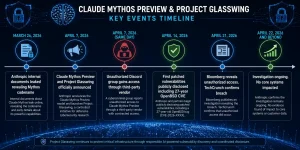
fast. From the first document leak revealing the model’s
codename to the Bloomberg investigation confirming
unauthorized access all happened within four weeks.
The Controversy Around Anthropic Mythos: Is This Responsible AI or Clever Marketing
Not everyone in the technology community has responded to Anthropic Mythos and Project Glasswing with uncritical praise. Some respected voices have raised important questions about whether Anthropic’s approach is as responsible as it claims to be.
The Marketing Critique
Renowned security expert Bruce Schneier made an observation that many in the industry echoed. Writing on his widely-read Schneier on Security blog he noted that Project Glasswing is “very much a PR play by Anthropic and it worked.” Schneier pointed out that many reporters repeated Anthropic’s talking points without engaging critically with the underlying claims about Mythos’s capabilities and the implications of the disclosure strategy.
Schneier is not alone in noting that a model gets enormous public attention precisely because it cannot be accessed. Withholding a product while describing its extraordinary capabilities is a marketing strategy as much as a safety decision. The result is that Anthropic generated more discussion and credibility than any straightforward product launch could have achieved.
The Capability Exclusivity Question
Some security researchers have challenged whether Mythos’s capabilities are as exclusive as Anthropic suggests. The firm AISLE published analysis arguing that some of the vulnerability discovery capabilities demonstrated by Mythos can be replicated using smaller less restricted models given the right prompting and direction. They noted that while Mythos almost certainly performs at an outstanding level the gap between its capabilities and those of accessible models may be narrower than the Glasswing announcement implied.
This matters because if similar offensive capabilities are already accessible through other models the protective logic of restricting Mythos loses some of its force.
The Third-Party Breach
The strongest challenge to Anthropic’s controlled release strategy came from an unexpected direction. On April 21 2026 Bloomberg News revealed that a small group of unauthorized users had accessed Claude Mythos Preview through a third-party contractor on the very day Anthropic announced its existence. The group gained access by guessing the model’s URL based on knowledge of Anthropic’s hosting conventions and exploiting shared credentials at a vendor organisation.
Anthropic confirmed it was investigating. The company stated it had found no evidence that its core systems were impacted. The group reportedly used Mythos out of curiosity rather than malicious intent. But the breach demonstrated that even the most carefully managed controlled release cannot guarantee that access remains limited to authorised users.
What Anthropic Mythos Means for the Future of AI and Cybersecurity
The emergence of Claude Mythos Preview represents a genuine inflection point in the history of cybersecurity and artificial intelligence. Several important conclusions follow from what Anthropic has demonstrated.
AI Has Crossed the Capability Threshold for Autonomous Security Research
For years the question was whether AI would ever match the best human security researchers. Mythos has answered that question. It exceeds human performance on many key security tasks including zero-day discovery exploit construction and multi-vulnerability chaining. This is not a future capability. It is a present reality.
The cybersecurity industry must now adapt to a world where this capability exists and where similar tools will become increasingly available to a wider range of actors over the coming years.
The Old Security Paradigm Is No Longer Sufficient
Traditional security relied on a combination of regular patching known vulnerability databases and human expertise. All three of those pillars assume that finding new vulnerabilities takes time and skilled human effort. Mythos invalidates that assumption. An AI that can find thousands of critical bugs in weeks at machine speed makes the slow careful patch-and-monitor approach dangerously inadequate.
Cisco put it directly: “AI capabilities have crossed a threshold that fundamentally changes the urgency required to protect critical infrastructure from cyber threats and there is no going back. Our foundational work with these models has shown we can identify and fix security vulnerabilities across hardware and software at a pace and scale previously impossible. The old ways of hardening systems are no longer sufficient.”
Responsible AI Deployment Requires New Frameworks
Anthropic’s approach with Mythos raises genuinely important questions about how the industry should handle frontier models that pose significant dual-use risks. The controlled release to trusted partners is a reasonable first step. But as the unauthorized access incident demonstrated it is not a complete solution.
The coming months and years will require clearer industry standards for how AI companies assess dual-use risks how they structure limited releases how they monitor for unauthorised access and how they coordinate with governments on models that could function as autonomous cyber weapons.
Defenders Now Have a Real Opportunity
Here is the genuinely optimistic message at the heart of the Mythos story. The same capabilities that make the model dangerous in hostile hands make it extraordinarily valuable for defence. Project Glasswing gives the world’s most important technology companies a head start in finding and patching the vulnerabilities that attackers would otherwise exploit.
If that defensive window is used effectively it could result in significantly more secure operating systems browsers and open-source software by the time Mythos-class capabilities become more broadly available. That outcome would benefit everyone who uses digital technology.
Frequently Asked Questions About Anthropic Mythos
What is Anthropic Mythos
Anthropic Mythos also known as Claude Mythos Preview is Anthropic’s most powerful AI model to date announced on April 7 2026. It is a general-purpose frontier model that autonomously discovers and exploits zero-day software vulnerabilities at a speed and scale that exceeds the best human security researchers. Anthropic refused to release it publicly due to the risk of misuse and instead launched Project Glasswing to use it defensively.
Why did Anthropic refuse to release Mythos publicly
Anthropic decided not to release Mythos publicly because its offensive cybersecurity capabilities are too powerful to deploy without strict controls. The model can autonomously find and exploit vulnerabilities across every major operating system and browser. In the wrong hands it could enable catastrophic attacks on critical digital infrastructure. Anthropic restricted access to a curated group of defensive security organisations through Project Glasswing instead.
What is Project Glasswing
Project Glasswing is Anthropic’s controlled defensive cybersecurity initiative giving exclusive access to Claude Mythos Preview to twelve founding partners including AWS Apple Google Microsoft Cisco CrowdStrike NVIDIA and others. Anthropic committed $100 million in usage credits to the programme and donated $4 million to open-source security organisations. The goal is to find and patch critical vulnerabilities before hostile actors can develop and use similar AI capabilities. See full details on the
official Project Glasswing page.
How many zero-day vulnerabilities did Anthropic Mythos find
Claude Mythos Preview found thousands of previously unknown zero-day vulnerabilities across every major operating system and every major web browser during Anthropic’s pre-release testing. At the time of the April 7 announcement over 99 percent of those vulnerabilities remained unpatched. Specific confirmed discoveries include a 27-year-old bug in OpenBSD a 16-year-old flaw in FFmpeg and a 17-year-old remote code execution vulnerability in FreeBSD.
Was Anthropic Mythos hacked or accessed by unauthorised users
Yes. On April 21 2026 Bloomberg News reported that a small group of unauthorised users accessed Claude Mythos Preview through a third-party contractor on the day of its announcement. The group reportedly used the model out of curiosity rather than malicious intent. Anthropic confirmed it was investigating and stated that its core systems showed no evidence of impact. The incident highlighted the persistent security risks posed by third-party vendor access in controlled AI deployments.
Will Anthropic ever release Mythos to the public
Anthropic has indicated that its eventual goal is to enable users to safely deploy Mythos-class models at scale but not before developing sufficient cybersecurity safeguards to prevent misuse. The company plans to test and refine new safeguards with an upcoming Claude Opus model that does not carry the same risk level as Mythos Preview. A broader release is likely years rather than months away.
CONCLUSION
Anthropic Mythos Marks the Beginning of a New Era
Anthropic Mythos is not just another AI product announcement. It represents a genuine turning point in the relationship between artificial intelligence and cybersecurity. For the first time an AI model has demonstrated the autonomous ability to find and exploit software vulnerabilities at a level that exceeds the best human experts operating at machine speed across every major platform simultaneously.
Anthropic’s decision to withhold Mythos from public release and channel its capabilities through Project Glasswing reflects a serious and considered attempt to manage an extraordinarily powerful dual-use technology responsibly. Whether that approach is sufficient given the unauthorized breach that occurred on day one is a question the industry will debate for months and years to come.
What is not debatable is the urgency the Mythos announcement has created. Security teams must patch more aggressively than ever. AI governance frameworks must evolve faster than they currently are. Governments must engage seriously with the national security implications of autonomous AI-powered cyberweapons. And every organisation that depends on software to function must begin treating AI-augmented security threats as a present-day reality rather than a future concern.
The most important thing you can do right now is stay informed and act quickly. Apply every security update on your devices as soon as it becomes available. Encourage your organisation to take AI-augmented vulnerability discovery seriously. And follow the ongoing developments from Anthropic and Project Glasswing as this story continues to unfold.
For the deepest technical understanding of what Claude Mythos Preview can do read the complete
Anthropic Red Team technical post on Mythos Preview capabilities.
For the broader context of how this fits into the AI security landscape read the analysis from
NBC News on the Mythos Preview limited release and what experts think it means.