In this article22 sections
- 01.The Anthropic IPO Filing: What Has Actually Been Confirmed
- 02.The Numbers Behind Anthropic’s IPO: Revenue, Valuation, and Funding History
- ↳1. Revenue Growth That Defies Conventional Benchmarks
- ↳2. The $965 Billion Valuation and Series H Round
- ↳3. The Complete Funding Journey
- ↳Strategic Compute Partnerships
- 03.What Anthropic Has Built: Claude, Claude Code, and the AI Safety Mission
- 04.Anthropic vs OpenAI: The IPO Race That Defines the AI Era
- 05.The Risks Investors Will Scrutinise in the S-1
- ↳Losses Despite Record Revenue
- ↳The Valuation Question
- ↳The PBC Structure and Safety Mission
- ↳Regulatory and Geopolitical Exposure
- 06.What the Anthropic IPO Means for the Broader AI Industry
- 07.Frequently Asked Questions About the Anthropic IPO
- ↳Has Anthropic officially filed for an IPO?
- ↳What is Anthropic’s current valuation?
- ↳How much revenue does Anthropic generate?
- ↳Who are the lead underwriters for the Anthropic IPO?
- ↳What is Anthropic’s PBC structure and why does it matter for the IPO?
- ↳Is Anthropic profitable?
- 08.Anthropic’s IPO Is the AI Industry’s Biggest Test Yet
Anthropic Officially Files for IPO Amid Explosive AI Boom: Everything You Need to Know
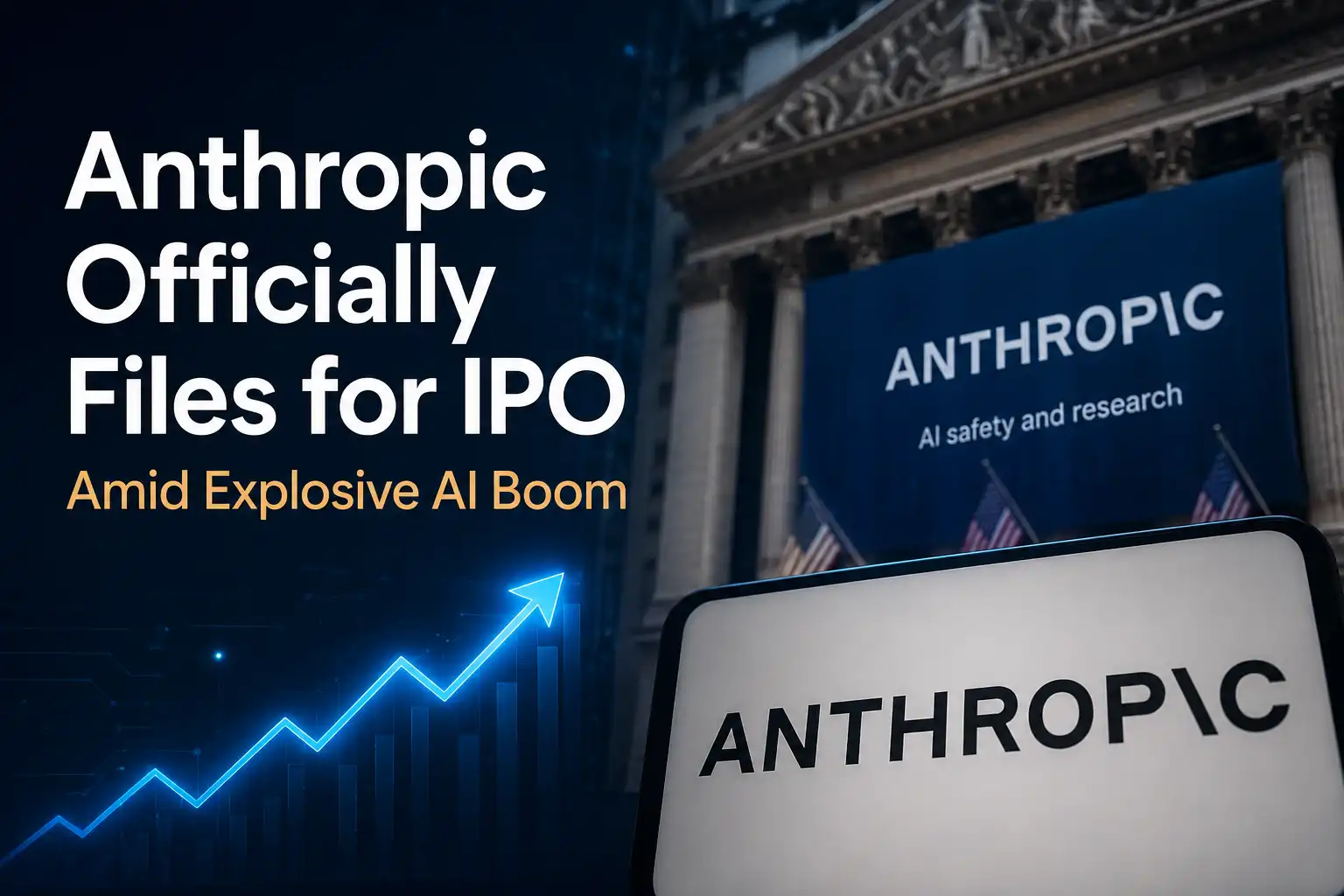
Anthropic has officially filed for an IPO, making one of the most consequential financial announcements in the history of artificial intelligence. The company behind Claude confidentially submitted a draft S-1 registration statement to the SEC on June 1, 2026, setting the stage for a public market debut that could value it at nearly one trillion dollars. The filing comes days after Anthropic closed a $65 billion Series H funding round at a $965 billion post-money valuation, surpassing rival OpenAI’s $852 billion private valuation for the first time.
Anthropic is racing OpenAI to become the first frontier AI company to list on a public exchange. If the listing proceeds at its current private valuation, it would be one of the largest IPOs in US market history. The company’s annualised revenue reached $47 billion in May 2026, up from just $9 billion at the end of 2025, a staggering pace of growth that has drawn the largest concentration of institutional capital ever assembled around a pre-IPO AI company.
This article covers every confirmed detail of the Anthropic IPO filing, what the company has built, who backed it, what the risks are, and what this moment means for the broader AI industry.
The Anthropic IPO Filing: What Has Actually Been Confirmed
Anthropic confirmed its IPO filing in a blog post published on June 1, 2026. The company stated clearly that the number of shares to be offered and the price range have not yet been set. This is standard practice for a confidential S-1 submission, which allows a company to complete the SEC review process privately before making the filing public and launching a formal roadshow.
The target for a public listing is as soon as this autumn, with October 2026 widely cited as the intended window. Goldman Sachs, JPMorgan Chase, and Morgan Stanley are named as lead underwriters. Wilson Sonsini, one of Silicon Valley’s most respected law firms in technology IPO transactions, has been serving as Anthropic’s legal counsel throughout the preparation process.
Fortune’s original reporting on the Anthropic IPO filing confirmed that the S-1 submission follows Anthropic’s Series H round closing, which it described as likely to be the company’s final private fundraising before a public debut. The filing puts Anthropic ahead of OpenAI in the race to tap public capital markets, with both companies expected to list before the end of 2026.
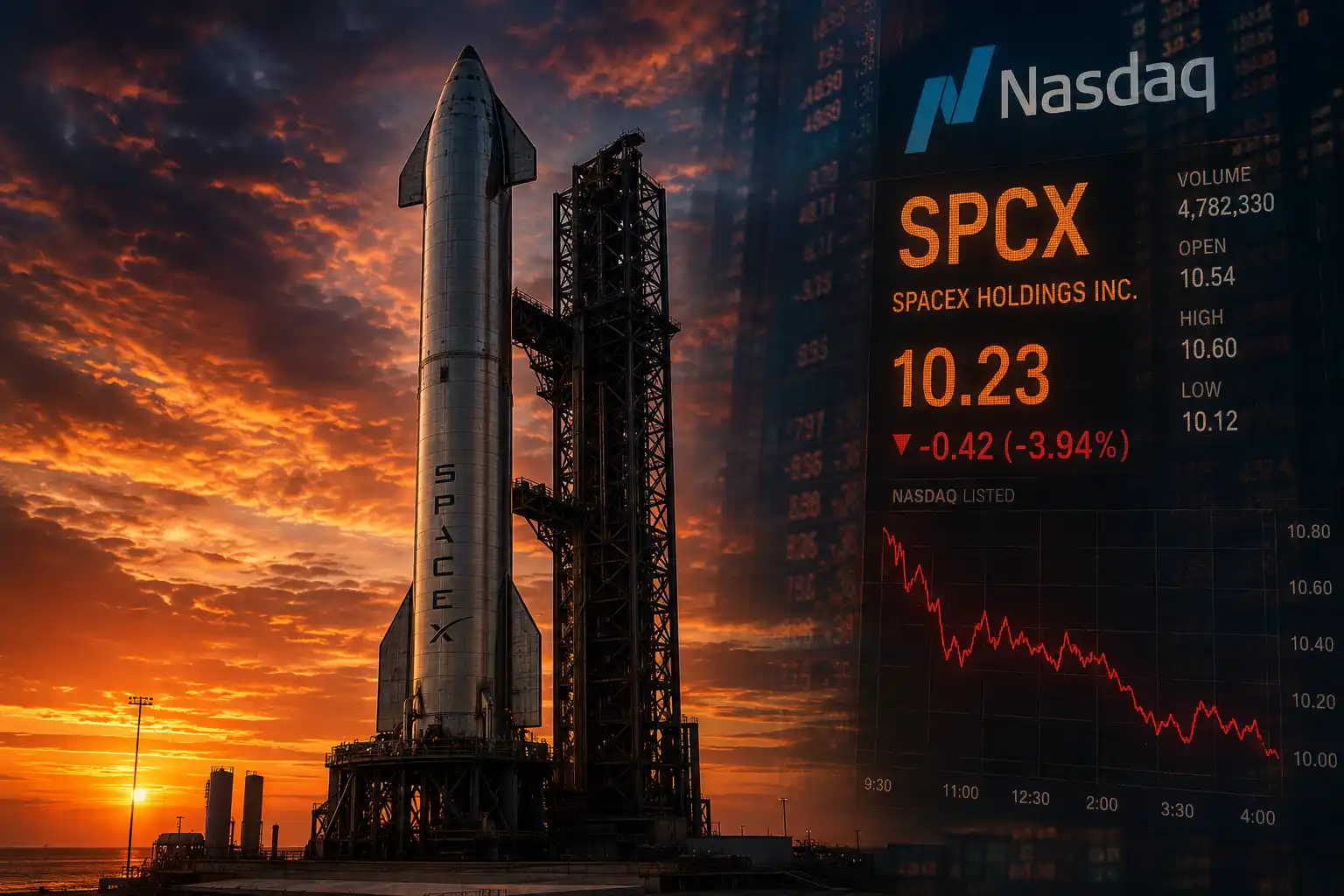
SpaceX is also preparing for its own public listing in the same window, meaning that the second half of 2026 could see more than $150 billion in new tech IPO proceeds, a concentration of new public market capital not seen since the peak of the dotcom era in 1999.
The Numbers Behind Anthropic’s IPO: Revenue, Valuation, and Funding History
The financial picture behind Anthropic’s IPO filing is extraordinary by any historical measure. Understanding the numbers requires looking at how rapidly the company has grown and how its funding has scaled over just five years of operation.
1. Revenue Growth That Defies Conventional Benchmarks
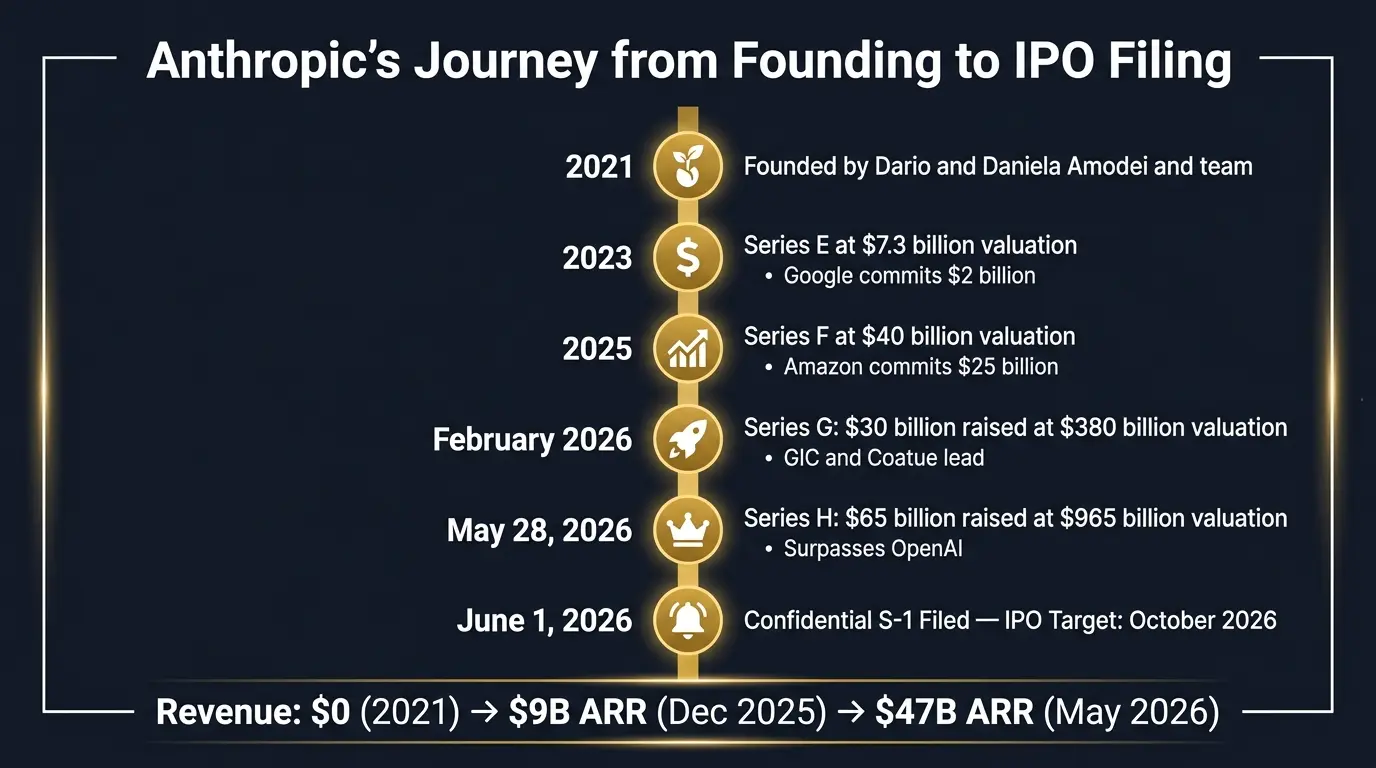
Anthropic’s revenue trajectory in 2026 has been exceptional. The company closed 2025 with a $9 billion annualised run rate. By January 2026 that figure had reached $9 billion again as a confirmed baseline. By March 2026 it had surpassed $19 billion following the launch of Claude Code’s general availability and rapid enterprise adoption. By May 2026 the annualised run rate reached $47 billion according to figures cited in reporting around the IPO filing.
Claude Code alone crossed $2.5 billion in annualised run-rate revenue after becoming generally available in May 2025. Anthropic estimated in March 2026 that four percent of all public GitHub commits worldwide are now authored by Claude Code, a figure that gives a sense of how deeply the company’s AI tools have penetrated professional software development globally.
2. The $965 Billion Valuation and Series H Round
On May 28, 2026, Anthropic closed its Series H funding round, raising $65 billion at a $965 billion post-money valuation. The round was led by Altimeter Capital, Dragoneer, Greenoaks, and Sequoia Capital. A large group of co-investors included sovereign wealth funds, global asset managers, and growth equity firms spanning GIC, Coatue, Baillie Gifford, Blackstone, Fidelity Management and Research, T. Rowe Price, and Temasek.
As InvestmentNews confirmed in its coverage of the IPO filing, the Series H is expected to be Anthropic’s last private fundraising round before its public market debut. The round leapfrogged OpenAI’s private valuation of $852 billion, making Anthropic the most highly valued private AI company in the world at the time of filing.
3. The Complete Funding Journey
Anthropic’s funding history tells the story of how quickly investor confidence in frontier AI has scaled. The company launched in 2021 with a seed round and grew through a Series E at $7.3 billion, a Series F at $40 billion, a $30 billion Series G in February 2026 at a $380 billion post-money valuation led by GIC and Coatue, and now the $65 billion Series H at $965 billion. Total funding raised to date is approximately $133 billion, making it the most heavily funded pre-IPO company in technology history. Forge Global’s Anthropic IPO tracker maintains the most current and complete funding history with secondary market data for accredited investors.
Strategic Compute Partnerships
A significant feature of Anthropic’s financial structure is the deeply intertwined relationship between its investors and its infrastructure spending. Amazon has committed $25 billion in investment. Anthropic has committed $100 billion in spending on AWS. Google has provided capital and receives multi-hundred-billion dollar compute commitments. In May 2026, Anthropic announced a SpaceX compute agreement giving it access to more than 300 megawatts of capacity and over 220,000 NVIDIA GPUs within the month.
This structure means that a substantial portion of each new funding round is pre-committed to infrastructure spending with the same companies providing the capital. Analysts tracking the filing have noted that the “real” incremental new capital available after netting out pre-committed infrastructure obligations is meaningfully less than the headline funding figures suggest. This is not a red flag but it is an important nuance for any investor evaluating the IPO prospectus.
What Anthropic Has Built: Claude, Claude Code, and the AI Safety Mission
Anthropic’s product portfolio centres on its Claude family of AI models, which are among the most widely deployed large language model systems in the world for enterprise, developer, and consumer applications.
Claude is Anthropic’s flagship conversational AI available to consumers and businesses through claude.ai and through API access. Claude Code, the AI coding assistant built on the same foundation, has become the company’s fastest-growing revenue driver and its most strategically important product in the enterprise market. The fact that four percent of all public GitHub commits globally are now attributed to Claude Code speaks to the depth of its penetration in professional software development, a user base that is both highly engaged and willing to pay significant per-seat enterprise pricing.
Claude Cowork, Anthropic’s AI workplace agent for non-technical users, is now generally available on both macOS and Windows through the Claude Desktop app. It reads files, drafts documents, creates presentations, and automates multi-step workflows. The broader Claude product suite positions Anthropic as a platform company rather than just a model provider, building toward the kind of diversified enterprise revenue base that public market investors in software companies understand and reward.
Anthropic’s stated mission is the responsible development of AI for the long-term benefit of humanity. The company is structured as a Public Benefit Corporation, which means its legal obligations include both financial returns to shareholders and the pursuit of its stated social mission. The Long-Term Benefit Trust holds authority to elect certain board seats and exists specifically to protect the safety mission under future public market pressure. This governance structure is unusual for a technology company seeking a public listing and will be a significant point of attention for institutional investors reading the S-1.
Anthropic vs OpenAI: The IPO Race That Defines the AI Era
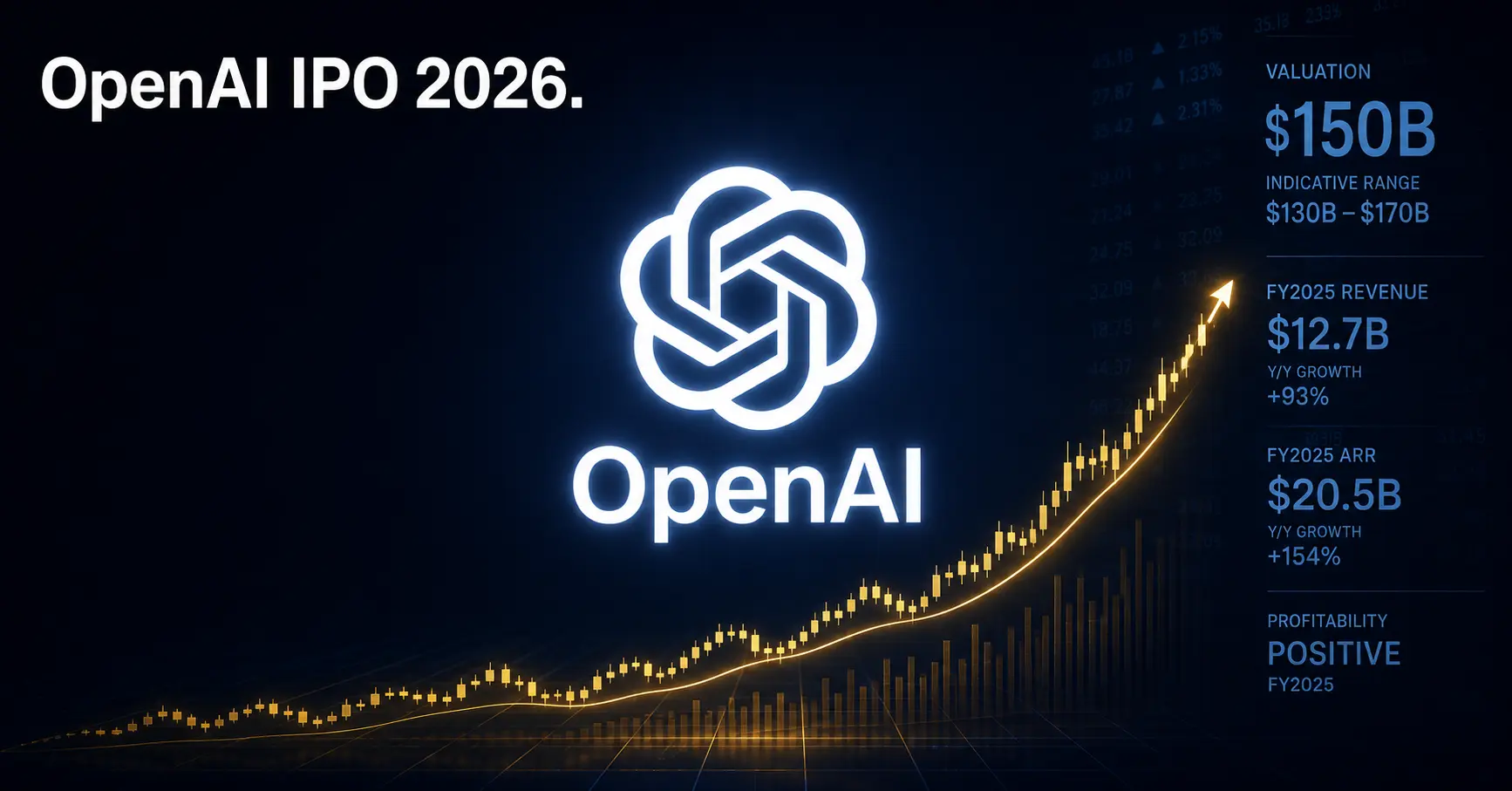
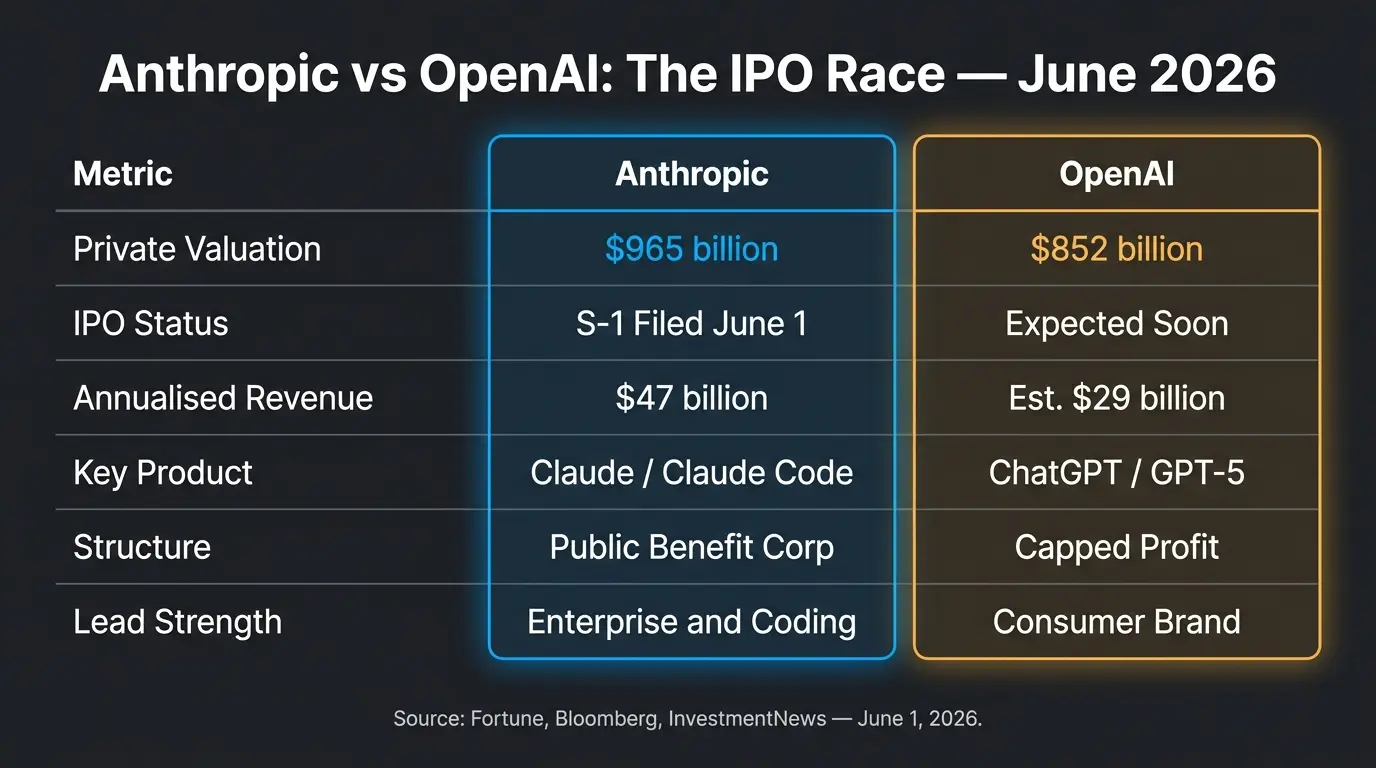
The Anthropic IPO filing is as much a competitive move as it is a financial one. OpenAI is widely expected to file its own S-1 confidentially in the near term, and both companies have been explicitly racing to be the first frontier AI company to achieve a public market listing.
Anthropic’s filing puts it in the lead for now. Being first to list carries real advantages in the current market environment: institutional investors allocating to the AI theme have a finite appetite in any given quarter, and the first major AI IPO to clear the market defines the pricing benchmarks that its rivals will be measured against. A successful Anthropic debut at or near its $965 billion private valuation sets a strong precedent for OpenAI’s eventual listing. A discounted debut creates downward pressure on how public markets value the entire sector.
The competitive dynamics between Claude and GPT-4o and its successors are real and intensifying. Anthropic’s revenue growth from $9 billion to $47 billion in annualised terms within six months suggests it is capturing significant enterprise share, particularly in coding, document analysis, and agentic workflow automation. OpenAI remains the more widely recognised consumer brand globally, but Anthropic has built a stronger position in the enterprise and developer segments that typically command higher contract values and lower churn rates.
The Risks Investors Will Scrutinise in the S-1
The Anthropic IPO carries a set of risks that are significant and specific to frontier AI companies. These are not conventional technology company risks and any investor in the IPO needs to understand them clearly.
Losses Despite Record Revenue
Anthropic generates substantial and growing revenue but continues to operate at a loss. Building and running frontier AI models requires enormous ongoing compute spend that has not yet been offset by revenue, even at $47 billion in annualised terms. The company’s infrastructure commitments to AWS and Google, running into hundreds of billions of dollars, represent long-term obligations that constrain financial flexibility regardless of how quickly revenue grows.
The Valuation Question
Investor Michael Burry posted publicly that there is “no guarantee” Anthropic achieves a valuation anywhere close to $1 trillion in public markets. He argued that building frontier AI models is “far too expensive” and warned that compute could end up as a commodity, compressing margins across the entire sector. This argument, that the structural costs of frontier model development prevent any single company from achieving the high-margin software economics that justify trillion-dollar public market valuations, is the central bear case for the Anthropic IPO.
As TS2 Tech’s analysis of the Anthropic IPO valuation challenge notes, questions are piling up around whether public investors will match the high private-market prices paid by sovereign wealth funds and strategic corporate investors whose motivations for investing in Anthropic include platform positioning and compute commitments rather than purely financial return.
The PBC Structure and Safety Mission
Anthropic’s Public Benefit Corporation structure and its Long-Term Benefit Trust create governance arrangements that limit what public market investors can demand. The board’s obligation to the safety mission rather than purely to shareholder returns is a genuinely unusual commitment for a public company. Some institutional investors will view this as a feature that protects long-term value. Others will view it as a constraint on management’s ability to maximise financial outcomes when safety and profit conflict.
Regulatory and Geopolitical Exposure
Anthropic operates in the most heavily scrutinised sector of the technology industry. Governments in the United States, the European Union, the United Kingdom, and China are all developing AI governance frameworks that could impose compliance costs, usage restrictions, or liability regimes that do not yet exist. A company whose commercial model depends on widespread deployment of powerful AI systems faces regulatory uncertainty that is genuinely difficult to price at the time of a public offering.
What the Anthropic IPO Means for the Broader AI Industry
The Anthropic IPO is the most significant test that public markets have yet faced of how much they are willing to pay for frontier AI. Every AI startup, every private investor, and every public market fund with technology exposure has a direct stake in the outcome.
If Anthropic lists at or near $965 billion and trades at that level or higher in the weeks following its debut, it validates the private market valuations that AI companies have accumulated over the past three years and opens the door to a wave of subsequent AI IPOs that have been waiting for public market proof of concept. It also signals to institutional allocators that frontier AI is a durable public market category rather than a private market novelty.
If Anthropic lists at a significant discount to its private valuation or struggles in secondary market trading, it creates significant mark-to-market pressure across the AI startup ecosystem, raises questions about the valuations of OpenAI and other frontier AI companies still in private hands, and potentially delays the broader tech IPO revival that market participants have been anticipating for two years.
The IPO is also an important moment for AI safety as a serious commercial concept. Anthropic has built its entire brand around the argument that responsible AI development is both the right approach ethically and a viable commercial strategy. A successful public listing at a frontier valuation would be the most powerful real-world endorsement that argument has ever received.
Frequently Asked Questions About the Anthropic IPO
Has Anthropic officially filed for an IPO?
Yes. Anthropic confidentially submitted a draft S-1 registration statement to the SEC on June 1, 2026. The confidential filing allows the company to complete the SEC review process privately before making the document public. The number of shares and price range have not yet been set. The company is targeting a public listing as soon as autumn 2026, with October 2026 as the widely cited target window.
What is Anthropic’s current valuation?
Anthropic’s most recent private valuation is $965 billion, set by the $65 billion Series H funding round that closed on May 28, 2026. This makes Anthropic the most highly valued private AI company in the world at the time of the IPO filing, surpassing rival OpenAI’s $852 billion private valuation for the first time.
How much revenue does Anthropic generate?
Anthropic’s annualised revenue reached $47 billion in May 2026, up from $9 billion at the end of 2025. This represents one of the fastest revenue scale-ups in enterprise technology history. Claude Code alone contributes $2.5 billion in annualised run-rate revenue. The company continues to operate at a loss despite its revenue scale due to the enormous ongoing compute costs of building and running frontier AI models.
Who are the lead underwriters for the Anthropic IPO?
Goldman Sachs, JPMorgan Chase, and Morgan Stanley are named as the lead underwriters for the Anthropic IPO. Wilson Sonsini has served as legal counsel throughout the IPO preparation process. These are the most prestigious names available in technology IPO execution, reflecting both the scale of the offering and Anthropic’s intent to attract the broadest possible institutional investor base at launch.
What is Anthropic’s PBC structure and why does it matter for the IPO?
Anthropic is structured as a Public Benefit Corporation rather than a standard C-Corporation. This means its legal obligations include both financial returns to shareholders and the pursuit of its stated mission of responsible AI development for the long-term benefit of humanity. The Long-Term Benefit Trust holds authority over certain board seats to protect the safety mission under future public market pressure. This governance structure is highly unusual for a company seeking a public listing and will be a significant subject of scrutiny in the S-1 and investor roadshow materials.
Is Anthropic profitable?
Anthropic is not yet profitable despite its rapid revenue growth. The company continues to operate at a loss because building and running frontier AI models requires compute spending that has not yet been fully offset by revenue even at the current $47 billion annualised revenue run rate. The scale of its infrastructure commitments to Amazon Web Services, Google Cloud, and SpaceX represents long-term spending obligations that add further pressure on the path to profitability.
Anthropic’s IPO Is the AI Industry’s Biggest Test Yet
The Anthropic IPO filing marks the moment when the most consequential bet in modern technology moves from private markets to public ones. A company that was founded just five years ago, that has raised more capital than any pre-IPO technology company in history, that has grown from zero to $47 billion in annualised revenue in the time it takes most companies to find their first paying customer, is now asking public market investors to price that journey and commit to funding its next chapter.
The outcome of this IPO will define benchmarks, reshape valuations, and set the terms on which the entire frontier AI industry enters the public market era. It is the biggest financial test the AI boom has faced and the result will be studied and referenced for years regardless of which direction markets take it.
For the most current and complete analysis of the Anthropic IPO including S-1 timeline updates, pre-IPO share pricing on secondary markets, and investor breakdown, the detailed tracker at TECHi’s Anthropic IPO analysis page is one of the most rigorously maintained resources available to investors and observers following this story as it develops.

Prince Anichi
Founder and Lead Technology Editor at Ortechy. Covering digital economy shifts, tech ecosystems across Africa, cybersecurity intelligence, and emerging software platforms.