In this article29 sections
- 01.How Gemini Live Translate Works Under the Hood
- ↳Continuous Speech Translation, Not Turn-by-Turn
- ↳Voice Characteristics That Carry Across Languages
- ↳Automatic Language Detection
- 02.Where Gemini Live Translate Is Available Right Now
- ↳Google Translate App: Global, Free, Any Headphones
- ↳Google Meet: Enterprise Private Preview
- ↳Developer Access Through the Gemini Live API
- 03.The SynthID Watermark and Safety Features
- ↳Every Translation Gets an AI Marker
- ↳What the Safety Framework Does Not Yet Cover
- 04.Real-World Limitations You Should Know About
- ↳Translation Quality Is Not Uniform Across All 70 Languages
- ↳Background Noise and Rare Dialects
- 05.How Gemini Live Translate Compares to Apple and Microsoft
- ↳Apple’s Live Translation Feature
- ↳Microsoft Translator and Teams Integration
- 06.What This Means for Travellers, Businesses, and Developers
- ↳For Everyday Users and Travellers
- ↳For Businesses Running Multilingual Operations
- ↳For Developers Building Communication Apps
- 07.Frequently Asked Questions
- ↳Is Gemini 3.5 Live Translate free to use?
- ↳Does Gemini Live Translate work without an internet connection?
- ↳Which languages does Gemini 3.5 Live Translate support?
- ↳Can I use Gemini Live Translate without Pixel Buds or Google headphones?
- ↳What is SynthID and why does it matter?
- ↳When will Gemini Live Translate be available in Google Meet for all businesses?
- 08.Why Gemini 3.5 Live Is A Game Changer
Gemini Live Translate: Google’s Real-Time Interpreter for 70+ Languages
Google launched Gemini 3.5 Live Translate on 9 June 2026, and it is unlike anything the company has released in the translation space before. The new model translates spoken speech continuously across 70 languages, preserving the original speaker’s tone, pace, and pitch in real time, without waiting for a sentence to end. It is live now in the Google Translate app on both Android and iOS worldwide, entering private preview in Google Meet for enterprise customers, and available to developers through the Gemini Live API today.
For context, Google Meet previously supported speech translation in just five languages. With this update, that number jumps to over 70, unlocking more than 2,000 language combinations in a single meeting. For consumers, the translation feature now works through any pair of headphones, not just Pixel Buds as was the case before. The shift from specialist hardware to any headset is arguably as significant as the language expansion itself.
This post covers exactly how Gemini 3.5 Live Translate works, what makes it technically different from previous tools, where it is available right now, what the real limitations are, and how it stacks up against competing approaches from Apple and Microsoft. Start with the architecture, because that is where the most important changes happened.
How Gemini Live Translate Works Under the Hood
Continuous Speech Translation, Not Turn-by-Turn
Traditional translation tools, including earlier versions of Google Translate’s conversation mode, rely on a turn-by-turn model. One person speaks, the app waits for a pause or a sentence break, processes the input, and delivers the translation. The result is a conversation that feels like two people speaking through a radio operator. There is always a lag, and the rhythm of natural conversation breaks down.
Gemini 3.5 Live Translate takes a fundamentally different approach. The model processes speech as it streams, generating translated audio continuously rather than waiting for pauses. Google maintains a few seconds of contextual lag deliberately, which gives the model enough window to handle sentence structure differences between languages without losing accuracy. The result is a conversation flow that stays close to natural speech rather than resembling a formal interpreter setup.
Voice Characteristics That Carry Across Languages
The most technically striking feature of this release is voice fidelity. The model automatically detects and mirrors the speaker’s intonation, pacing, and pitch in the translated output. This means an excited speaker sounds excited in the translated version. A speaker with a slower, measured delivery retains that quality when the translation plays back.
This matters more than it might seem. Previous translation tools delivered output in a generic synthesised voice that bore no resemblance to the original speaker. The translated speech felt robotic and impersonal, which undermined trust and made conversations feel clinical. By preserving voice characteristics, Gemini 3.5 Live Translate makes the translated speech recognisably from the same person, even if the language has changed entirely, as confirmed in Google’s official Gemini 3.5 Live Translate announcement.
Automatic Language Detection
Additionally, users do not need to select which language they or the other person is speaking. The model detects languages automatically from the incoming audio stream. In a multilingual meeting where different participants speak different languages, the system identifies each speaker’s language without manual configuration and routes translations accordingly.
This automatic detection also handles code-switching, where a speaker moves between two languages mid-sentence, a common pattern in multilingual households and many business environments across South and Southeast Asia, Latin America, and parts of Africa.
Where Gemini Live Translate Is Available Right Now
Google Translate App: Global, Free, Any Headphones
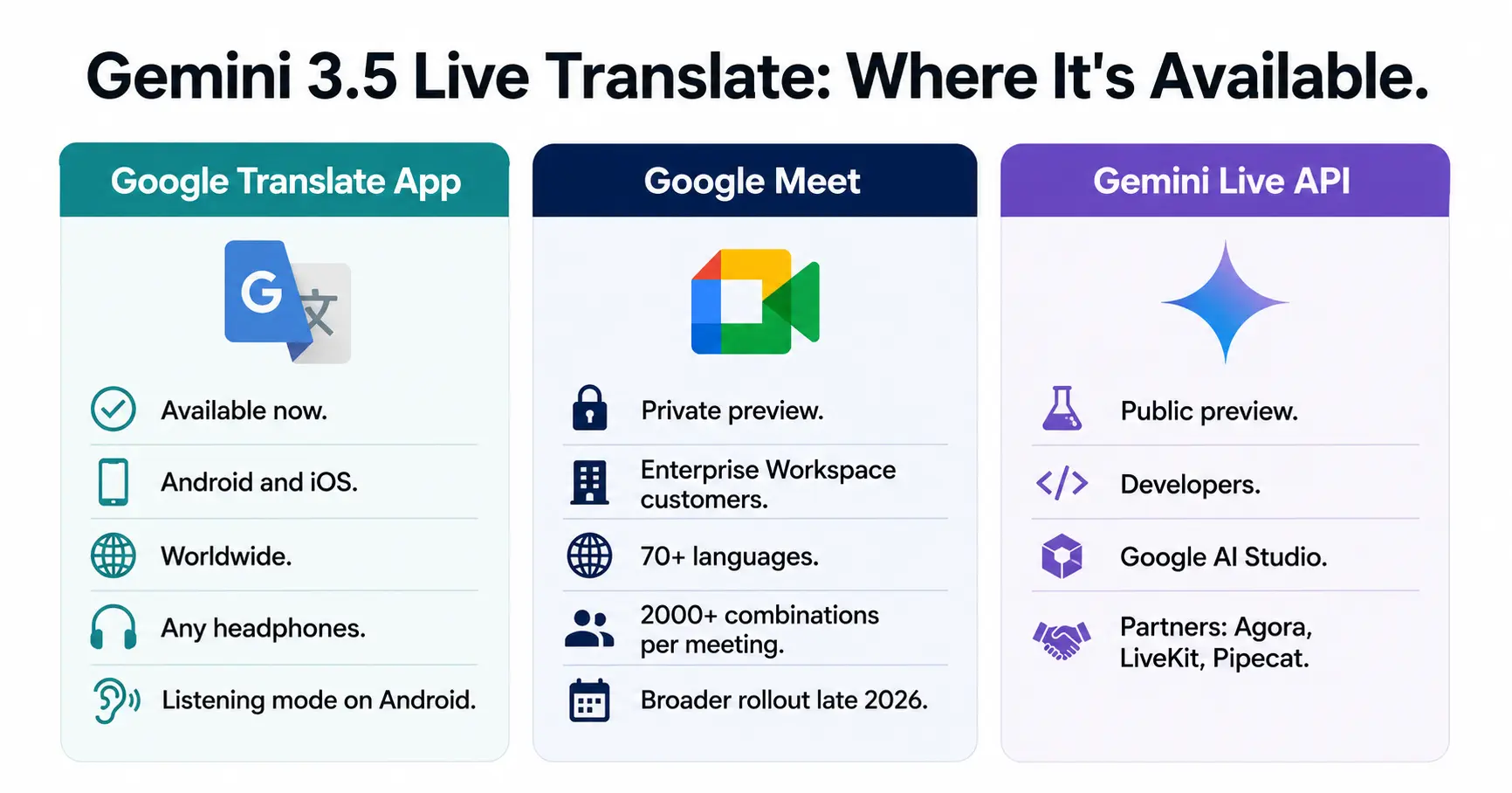
For everyday consumers, Gemini 3.5 Live Translate is available now in the Google Translate app on both Android and iOS, with no sign-up required and no geographic restriction. The feature works with any Bluetooth or wired headphones. The earlier version of live translation in the Translate app was limited to Pixel Buds and geographically restricted to the United States, Mexico, and India. This global rollout with universal headphone support removes both of those barriers.
Android users get one additional feature not yet on iOS. A new listening mode lets you hold your phone to your ear like a regular call and receive translated audio directly through the phone’s earpiece, with no headphones at all. Google frames this for situations like following a guided tour in a foreign language discreetly, without pulling out earbuds in a group setting, as described in 9to5Google’s coverage of the Gemini 3.5 Live Translate rollout.
Google Meet: Enterprise Private Preview
For enterprise customers, Google Meet’s speech translation feature previously covered just five languages, all of which involved translation to or from English. With Gemini 3.5 Live Translate, support expands to over 70 languages and more than 2,000 language pair combinations in a single meeting. This means non-English speakers can now communicate directly in meetings without routing everything through English as an intermediary language.
However, the Google Meet integration is currently in private preview for select Google Workspace enterprise customers, with a broader rollout planned later in 2026. General availability timing, pricing, and which Workspace tiers will include the feature have not been announced. Organisations evaluating this for procurement cannot yet assess licensing costs, which is a meaningful gap for enterprise planning.
Developer Access Through the Gemini Live API
Developers can access Gemini 3.5 Live Translate today through the Gemini Live API and Google AI Studio in public preview. Several major real-time communication platforms are already integrating it, including Agora, Fishjam, LiveKit, Pipecat, and Vision Agents. These integrations allow developers to build live voice translation applications using Google’s streaming infrastructure without managing the low-level audio processing themselves.
Ride-hailing company Grab is among the early testers. Grab handles over 10 million voice calls per month between drivers and passengers, and is testing the model specifically to handle real-time communication across the multiple languages spoken across Southeast Asian markets, according to Fone Arena’s detailed breakdown of Gemini 3.5 Live Translate’s features.
The SynthID Watermark and Safety Features
Every Translation Gets an AI Marker
All audio generated by Gemini 3.5 Live Translate carries an inaudible SynthID watermark embedded directly into the audio output. SynthID is Google DeepMind’s technology for marking AI-generated content in a way that is imperceptible to human listeners but detectable by verification tools. The purpose is to ensure that AI-generated speech remains identifiable, which reduces the risk of translated audio being presented as an unaltered human voice recording.
This is a meaningful inclusion given the obvious misuse risk. A model that can mirror a speaker’s tone and pitch in another language creates clear potential for voice-cloning fraud or disinformation. The SynthID watermark does not prevent misuse on its own, but it does provide a technical basis for detecting whether a piece of audio was AI-generated. Google is the first major translation provider to embed systematic AI audio watermarking at the infrastructure level.
What the Safety Framework Does Not Yet Cover
However, several unanswered questions remain around safety and privacy. Security researchers at Mandiant identified potential vulnerabilities in Gemini’s audio processing pipeline in a May 2026 audit. Google has not publicly disclosed what safeguards exist against misuse of the voice-mirroring capability for voice-cloning scams. Unlike Microsoft’s Translator, which offers end-to-end encryption for enterprise users, Google has not announced a comparable option for Gemini 3.5 Live Translate. For European customers subject to General Data Protection Regulation (GDPR) requirements, that gap in transparency could create compliance questions as the enterprise rollout progresses.
Real-World Limitations You Should Know About
Translation Quality Is Not Uniform Across All 70 Languages
Google’s materials do not specify whether all 70-plus language pairs perform at the same quality level. The 2,000-plus combination figure also does not indicate whether all pairs work equally well in both directions. A translation from English to Spanish may perform at a different level than one from Swahili to Korean. For languages with less training data available, particularly lower-resource languages and regional dialects, accuracy will lag behind the performance on major world languages.
This is not a criticism specific to Google. Every major translation model shows this pattern. The practical implication is that the feature works most reliably for the world’s most widely spoken languages and should be evaluated carefully before deployment in contexts where accuracy is critical, such as medical consultations, legal settings, or high-stakes business negotiations.
Background Noise and Rare Dialects
The model filters background noise to focus on the primary speaker, and Google describes it as robust to noisy real-world environments. However, very high ambient noise, unusual accents, or rare dialects with limited training data remain challenging for any speech model. The gap between demo-environment performance and performance in genuinely noisy conditions, such as a street market, a construction site, or a crowded event, will vary in ways that are hard to assess until the feature has been used at scale in those environments.
How Gemini Live Translate Compares to Apple and Microsoft
Apple’s Live Translation Feature
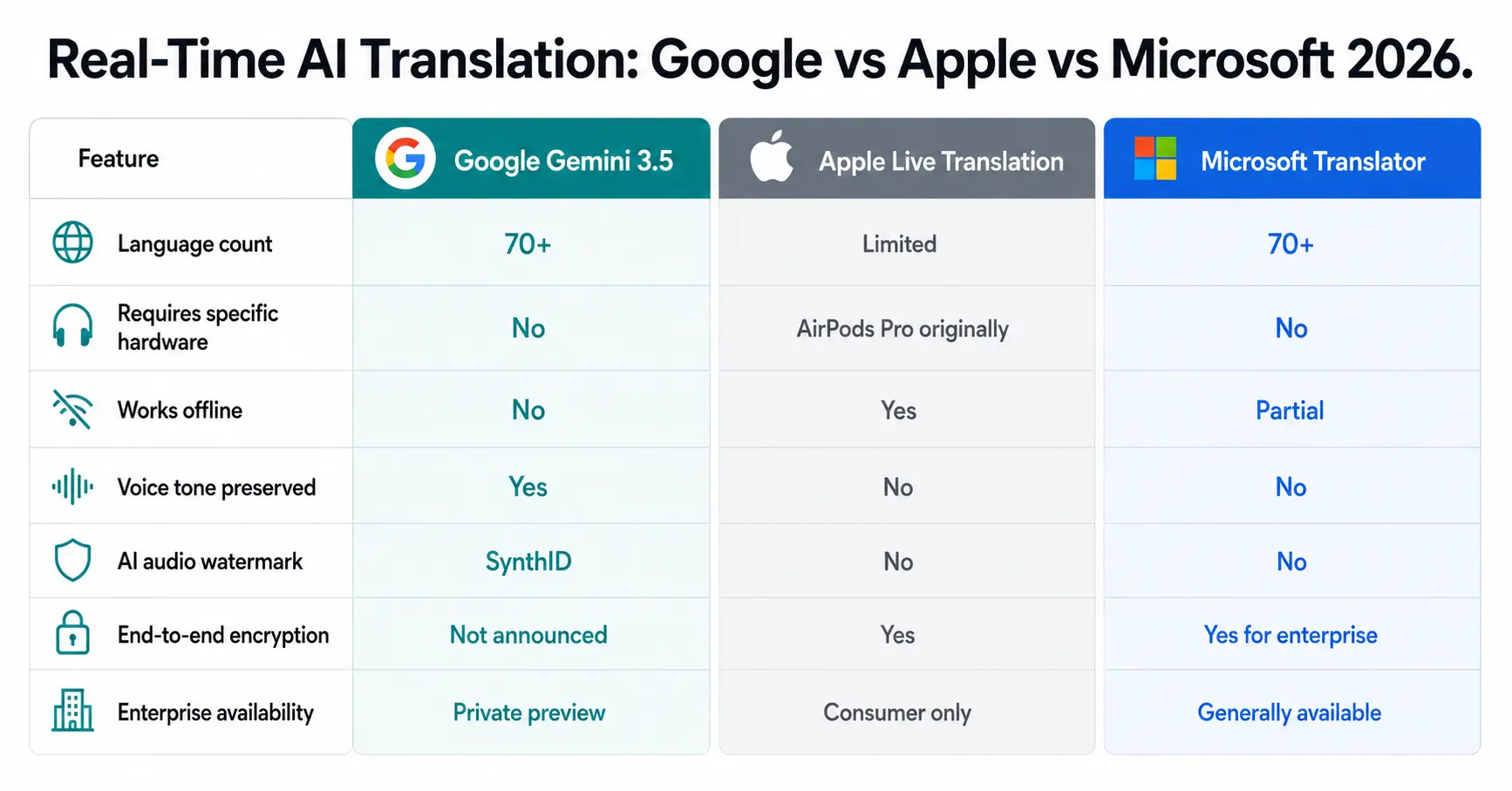
Apple introduced Live Translation in iOS 16 as a hardware-tied feature, initially requiring AirPods Pro. The feature performs on-device translation for a subset of languages, which gives it a meaningful privacy advantage because audio never leaves the device. However, on-device processing limits both the language count and the quality ceiling compared to a cloud-based model with the compute resources of a Gemini backend.
Google’s approach inverts that trade-off. By running on its cloud infrastructure, Gemini 3.5 Live Translate supports more languages, handles more complex translation pairs, and delivers better voice fidelity. The cost is that audio processing happens on Google’s servers rather than locally. For privacy-sensitive use cases, Apple’s on-device approach retains a clear advantage.
Microsoft Translator and Teams Integration
Microsoft’s Translator service and Teams Live Captions cover a broad range of languages and include end-to-end encryption for enterprise customers, a feature Google has not announced for Gemini 3.5 Live Translate at this stage. Microsoft’s enterprise translation tools are well-established and have several years of production use in large organisations. However, Microsoft has not yet matched the voice-characteristic preservation and continuous streaming approach that distinguishes Gemini 3.5 Live Translate technically.
The competitive picture heading into the second half of 2026 is a genuine three-way race among Google, Apple, and Microsoft for ownership of the real-time translation layer across consumer, enterprise, and developer contexts.
What This Means for Travellers, Businesses, and Developers
For Everyday Users and Travellers
Now, the practical impact for travellers is straightforward. Any Android or iOS user with the Google Translate app can conduct a real-time conversation in another language using any headphones they already own. The earlier version required Pixel Buds. That hardware barrier is gone. The listening mode on Android adds a further layer of utility for anyone who wants discreet in-ear translation without visibly wearing earbuds.
The feature works for tourist conversations, directions, restaurant interactions, and basic cross-language communication in real time. For longer or more complex exchanges where accuracy really matters, the tool should be treated as an assistive layer rather than a definitive interpreter.
For Businesses Running Multilingual Operations
For organisations with global teams, the Google Meet expansion from five to 70 languages is significant. The practical change is that non-English speaking team members can now participate in video meetings without the conversation being structurally routed through English at every step. That removes a real friction point for global collaboration. The private preview status in Google Meet means most businesses cannot access it yet, but the direction of travel is clear.
For Developers Building Communication Apps
The Gemini Live API access gives developers a translation primitive they can build into any real-time voice application today. The integration work happening at Agora, LiveKit, and Pipecat signals that this capability will appear in third-party communication platforms well before it reaches full availability in Google’s own products. Developers building multilingual consumer apps, customer service platforms, or educational tools have access to the model now through Google AI Studio.
Frequently Asked Questions
Is Gemini 3.5 Live Translate free to use?
Yes, for consumers. The feature is available at no charge in the Google Translate app on Android and iOS globally. Developer access through the Gemini Live API is in public preview, and pricing for API usage has not been fully announced. Enterprise access in Google Meet is in private preview, and enterprise pricing has not been confirmed.
Does Gemini Live Translate work without an internet connection?
No. Gemini 3.5 Live Translate runs on Google’s cloud infrastructure and requires a network connection to function. This is the main trade-off compared to Apple’s on-device Live Translation, which can operate offline for a smaller set of supported languages.
Which languages does Gemini 3.5 Live Translate support?
The model supports over 70 languages, including Arabic, French, Hindi, Korean, Spanish, Tamil, and many others. Google has not published a complete official list specifying all supported languages at launch. Translation quality may vary between language pairs, particularly for lower-resource languages with less training data available.
Can I use Gemini Live Translate without Pixel Buds or Google headphones?
Yes. The new version works with any Bluetooth or wired headphones on both Android and iOS. The listening mode on Android goes further, delivering translated audio directly through the phone’s earpiece with no headphones required at all. The earlier version was tied to Pixel Buds hardware.
What is SynthID and why does it matter?
SynthID is Google DeepMind’s system for embedding an inaudible watermark into AI-generated audio. All audio produced by Gemini 3.5 Live Translate carries this marker, making it detectable as AI-generated content. The purpose is to reduce the risk of translated audio being misrepresented as an unaltered human recording.
When will Gemini Live Translate be available in Google Meet for all businesses?
As of June 2026, the Google Meet integration is in private preview for select Google Workspace enterprise customers. A broader rollout is planned for later in 2026, but Google has not confirmed a specific general availability date, pricing structure, or which Workspace tiers will include the feature.
Why Gemini 3.5 Live Is A Game Changer
Gemini 3.5 Live Translate is a genuinely meaningful step forward in real-time machine translation, and not only because of the language count. The shift to continuous streaming rather than turn-by-turn processing, the preservation of voice characteristics across languages, and the removal of the Pixel Buds hardware requirement together make this a tool that people will actually use in real conversations rather than just in demos. The Google Meet expansion from five to 70-plus languages changes the calculus for multilingual organisations in a practical way.
The limitations are real and worth keeping in mind. Translation quality is not uniform across all 70 languages. Privacy and encryption capabilities for enterprise users lag behind Microsoft’s established offering. The listening mode is currently Android-only. Enterprise pricing and availability remain unannounced. None of these are deal-breakers for the consumer use case, but they matter for organisations evaluating the tool for production deployments.
The bigger picture is that Gemini Live Translate signals where the competitive battle in AI translation is heading. Google, Apple, and Microsoft are each building toward a real-time speech translation layer that becomes invisible infrastructure in everyday communication. Google’s move today sets a new benchmark for voice fidelity and language breadth at the consumer level. The enterprise and developer stories will take shape over the rest of 2026 as pricing, availability, and quality data from real-world deployments emerge.
For the most current information on language availability and feature rollout, the official Google Gemini 3.5 Live Translate announcement is the authoritative source. If you are a developer looking to build on the API, the Gemini Live API documentation in Google AI Studio is the right starting point for public preview access today.

Prince Anichi
Founder and Lead Technology Editor at Ortechy. Covering digital economy shifts, tech ecosystems across Africa, cybersecurity intelligence, and emerging software platforms.