In this article14 sections
- 01.What Google Ordered and Why It Matters
- 02.Intel’s Foundry Revival: The Strategy Behind the Victory
- 03.Why Google Is Turning to Intel for TPU Manufacturing
- 04.The NVIDIA Evaluation: Another Potential Foundry Win on the Horizon
- 05.What This Means for the Intel vs TSMC Foundry Competition
- 06.Intel’s Broader AI Infrastructure Momentum in 2026
- 07.Frequently Asked Questions About Intel’s Google Chip Order
- ↳What chips did Google order from Intel?
- ↳Why is this order significant for Intel?
- ↳What process node will Intel use to manufacture Google’s TPUs?
- ↳Is NVIDIA also ordering chips from Intel?
- ↳How does this affect Intel’s competition with TSMC?
- ↳How did Intel’s stock react to the Google order news?
- 08.Intel’s Foundry Comeback Just Got Its Biggest Endorsement
Intel Scores a Huge AI Victory as Google Orders 3 Million Chips for 2028 Production
Intel just received one of the most significant chip manufacturing orders in its recent history. Alphabet’s Google has placed an order with Intel to manufacture more than three million tensor processing units for production in 2028, according to a report published by The Information on June 8, 2026 and confirmed by Bloomberg and Reuters. Intel shares rose the most in a month following the news, reflecting how meaningful this single order is for a company that has spent two years rebuilding its foundry ambitions under CEO Lip-Bu Tan.
The order covers Google’s custom TPUs, the specialised AI accelerator chips that power Google Cloud’s AI infrastructure and every Google AI service from Search to Gemini. Manufacturing more than three million of them through Intel rather than through TSMC represents a decisive vote of confidence in Intel’s process technology at exactly the moment when the industry has been watching to see whether Intel’s foundry revival is real or aspirational.
This article covers every confirmed detail of the order, what it means for Intel’s foundry strategy, how it fits into Google’s broader chip manufacturing approach, and what the wider implications are for the AI chip supply chain and the ongoing race between Intel and TSMC for the world’s most valuable chip manufacturing contracts.
What Google Ordered and Why It Matters
Google’s TPUs are not off-the-shelf components. They are custom silicon designed entirely in-house by Google’s hardware team and manufactured by a foundry partner to Google’s own specifications. The first TPU was deployed internally in 2015 and the line has expanded through multiple generations into the primary AI accelerator infrastructure underlying every major Google AI system including Google Cloud’s AI compute offerings and the training infrastructure for Gemini models.
An order for more than three million TPUs from a single manufacturing partner in a single production year is an extraordinary volume commitment. For context, this is not a test run or a pilot programme. A commitment of this scale, confirmed for 2028 production, requires Intel to allocate significant fab capacity, validate process compatibility with Google’s chip designs, and demonstrate the yield rates and reliability standards that Google’s AI infrastructure demands.
The order was first reported by The Information citing two people with direct knowledge of the discussions between Google and Intel. Bloomberg published its own confirmation the same day and Republic World confirmed the full details of the order including the NVIDIA evaluation connection</target=”blank”> in its coverage of the story.
The 2028 timeline is also significant. It gives Intel approximately two years to deliver, which means the production runs on Intel’s most advanced upcoming process nodes rather than on 18A, which is already in customer sampling. The 2028 window likely implies Intel’s 14A process node, which would position this Google order as a foundry validation for a node that has not yet entered mass production.
Intel’s Foundry Revival: The Strategy Behind the Victory
To understand why this Google order is so consequential, you need to understand the hole Intel has been digging out of for the past four years. Intel spent decades as both a chip designer and the manufacturer of its own chips, a vertically integrated model that made it the dominant force in semiconductors through the 1990s and 2000s. Then it fell behind TSMC on process node advancement and lost the manufacturing lead it had held for generations.
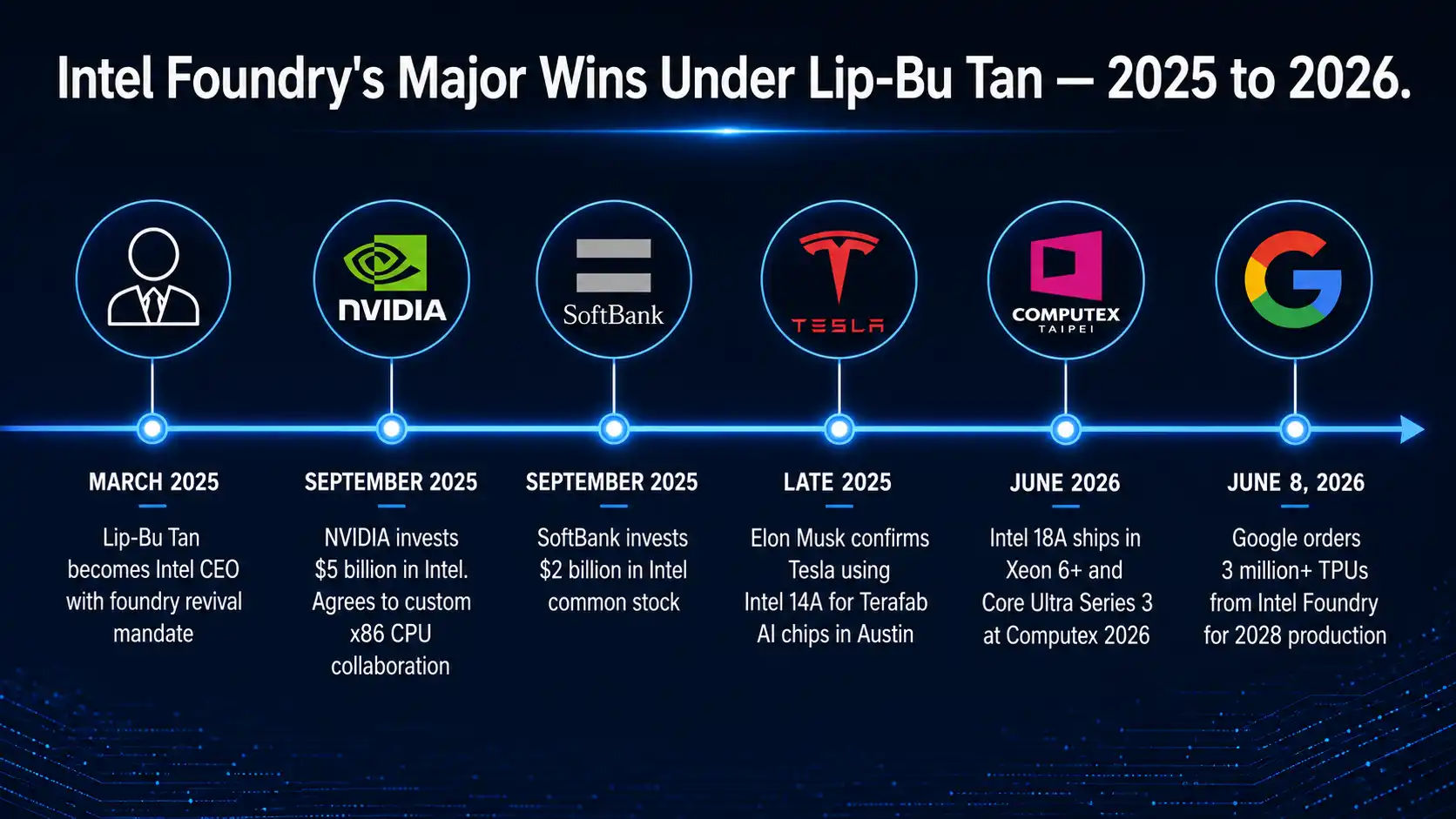
Lip-Bu Tan took over as Intel CEO in March 2025 with a clear mandate: rebuild Intel’s manufacturing credibility and transform Intel Foundry into a genuine contract manufacturing business capable of serving external customers at scale alongside Intel’s own chip designs. The strategy requires winning external foundry customers whose orders validate Intel’s process technology and demonstrate that the investments Intel has made in its fabs are producing silicon that the most demanding customers in the world are willing to trust with their most critical workloads.
In that context, a Google order for three million AI accelerator chips is as strong a validation signal as Intel Foundry could possibly receive. Google runs one of the world’s most demanding semiconductor supply chains. Its TPU designs push the boundaries of what advanced process nodes can deliver. Choosing Intel as a manufacturing partner for a production run of this scale means Google’s engineers have concluded that Intel’s process technology is ready to handle it.
The Google order also follows a remarkable series of foundry partnership announcements that Intel has accumulated since Lip-Bu Tan took charge. NVIDIA agreed to invest $5 billion in Intel common stock and is evaluating Intel’s manufacturing technology for a future processor design that could combine four graphics chips into a single package, as Yahoo Finance confirmed in its coverage of the Google order. Tesla CEO Elon Musk revealed plans to use Intel’s 14A manufacturing process for chips powering the Terafab AI infrastructure project in Austin, Texas. Intel joined the Terafab project as a strategic partner alongside SpaceX, xAI, and Tesla. And SoftBank invested $2 billion in Intel common stock in a separate vote of confidence in Intel’s foundry future.
Why Google Is Turning to Intel for TPU Manufacturing
Google’s decision to place this order with Intel rather than expanding its existing relationship with TSMC raises important strategic questions. TSMC manufactures the majority of advanced chips in the world including Nvidia’s GPUs, Apple’s A-series and M-series processors, AMD’s Ryzen and EPYC chips, and previous generations of Google’s own TPUs. TSMC’s dominance in advanced semiconductor manufacturing is so complete that a significant Google order going to Intel represents a genuine diversification rather than simply vendor rotation.
The diversification motive is real and increasingly important for every large-scale AI chip buyer. TSMC’s manufacturing capacity is concentrated in Taiwan, which introduces geopolitical concentration risk that every major technology company with a long-range AI infrastructure plan is actively managing. Intel’s US-based manufacturing facilities, particularly its fabs in Oregon, Arizona, Ohio, and New Mexico, provide a supply chain diversification that manufacturing entirely through TSMC cannot offer.
Google’s existing relationship with Intel is also deeper than many outside observers realise. Intel’s own SEC filings confirm a multiyear collaboration between Intel and Google for the continued deployment of Intel Xeon processors across Google’s workload-optimised cloud instances, including Intel Xeon 6 processors powering Google Cloud’s C4 and N4 instances. The collaboration also includes co-development of custom ASIC infrastructure processing units designed to improve utilisation, reduce complexity, and scale AI workloads. The TPU manufacturing order extends this relationship into Intel’s foundry business, moving from a CPU supply relationship into full custom chip manufacturing.
The NVIDIA Evaluation: Another Potential Foundry Win on the Horizon
The Google order arrived alongside a separate but equally significant piece of news. The same Information report that broke the Google TPU story also confirmed that NVIDIA is evaluating Intel’s manufacturing technology for a future processor design that would combine four graphics chips into a single package.
NVIDIA has not placed an order. But the evaluation itself is meaningful industry intelligence. NVIDIA’s chip architecture is the backbone of the global AI training infrastructure. Virtually every major AI model including GPT-5, Claude, Gemini, and the AI systems being built at hundreds of startups and enterprises worldwide runs on NVIDIA GPUs. The volume of chips NVIDIA moves through its manufacturing partners is enormous and the margins on manufacturing them are correspondingly attractive.
If NVIDIA places a future order with Intel following this evaluation, it would represent an even larger foundry win than the Google TPU order. For now, the evaluation signals that NVIDIA’s engineers are taking Intel’s manufacturing capabilities seriously enough to conduct the detailed technical assessment that precedes a manufacturing partnership decision. That evaluation would not be happening if Intel’s process technology had not reached a threshold of credibility that NVIDIA considers worth investigating.
Mizuho raised its price target on Intel to $128 from $124 following the Google order news, maintaining a Neutral rating while noting that agentic AI demand is strong across the CPU ecosystem. The analyst noted that suppliers remain supply-constrained into 2027, indicating upside in servers, and that agentic AI is driving demand higher even as memory and CPU supply could potentially limit upside in the second half of 2026.
What This Means for the Intel vs TSMC Foundry Competition
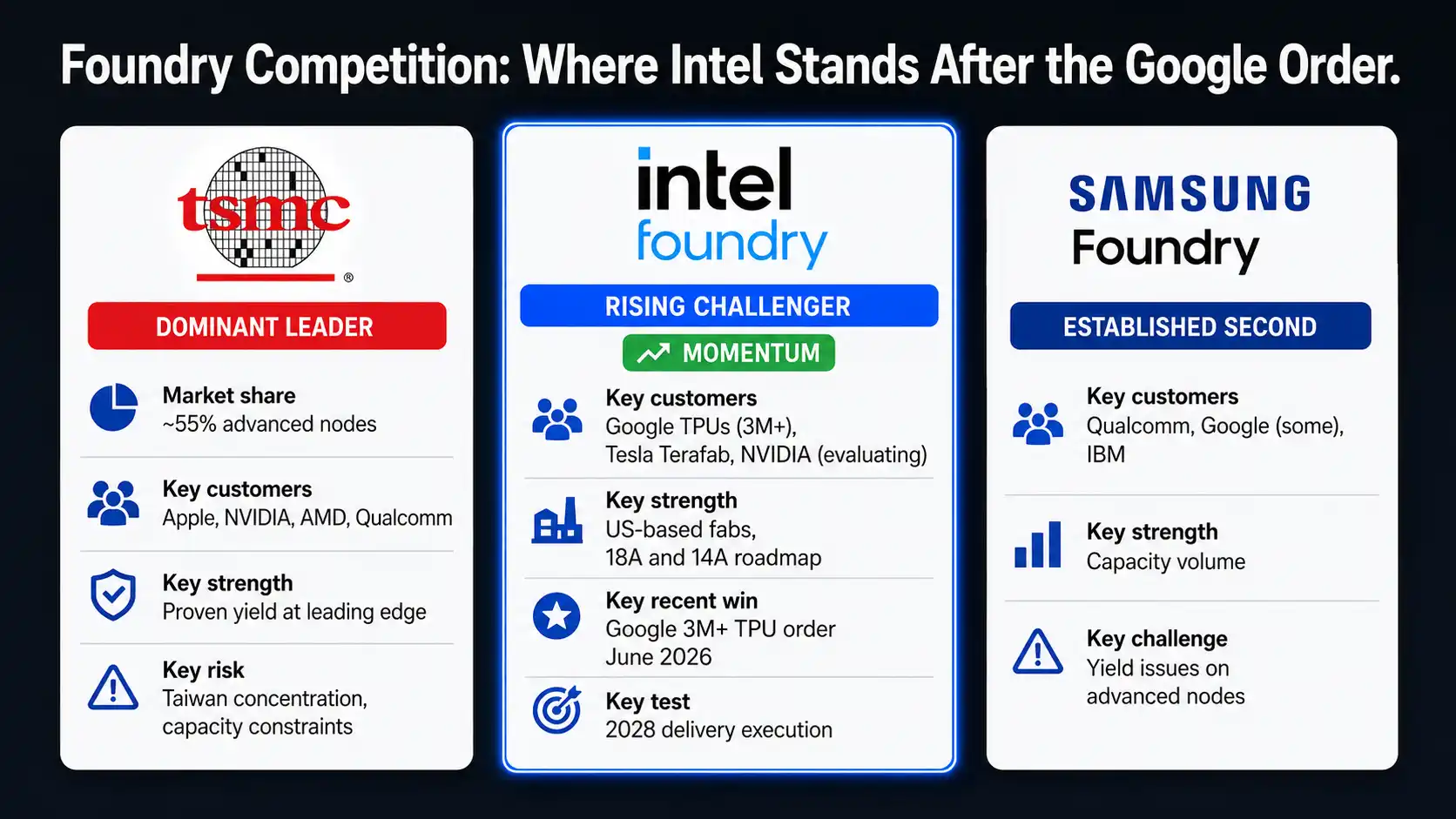
The semiconductor foundry market has been a TSMC near-monopoly in advanced nodes for years. Samsung has maintained a second position but has struggled with yield and reliability issues on its most advanced process nodes. Intel’s entry as a serious third competitor in advanced foundry manufacturing would fundamentally change the dynamics of a market that the entire global technology industry depends on.
Intel’s 18A process node, which entered customer sampling in 2026 and is powering the Xeon 6+ Clearwater Forest data centre CPU and the Core Ultra Series 3 consumer AI PC platform, has demonstrated that Intel can manufacture advanced silicon that sophisticated customers are willing to evaluate and adopt. The 2028 Google TPU production timeline most likely implies Intel’s 14A node, which represents the next step in Intel’s process roadmap beyond 18A.
If Intel delivers three million Google TPUs successfully in 2028 on 14A with acceptable yield rates and on schedule, it will have demonstrated something the industry has been waiting to see for years: that Intel Foundry can execute a large-scale custom chip production run for an external customer at the leading edge of semiconductor manufacturing. That demonstration, if it comes, would be worth more in foundry customer development than any marketing campaign Intel could run.
The competitive response from TSMC is also worth watching. TSMC does not publicly discuss individual customer relationships but its pricing, capacity allocation, and technology roadmap acceleration decisions will reflect the new competitive reality that a credible Intel Foundry alternative creates. Competition at the foundry level ultimately benefits every chip buyer including the hyperscalers, AI companies, and device manufacturers whose silicon supply chains depend on foundry manufacturing.
Intel’s Broader AI Infrastructure Momentum in 2026
The Google TPU order does not exist in isolation. It is the most prominent data point in a broader pattern of Intel AI infrastructure wins that have accumulated throughout 2025 and 2026 under Lip-Bu Tan’s leadership.
Intel Xeon 6 was selected as the host CPU for NVIDIA’s DGX Rubin NVL8 systems, cementing Intel’s continued role at the centre of leading AI infrastructure deployments even as GPU suppliers grow. Intel and SambaNova announced a blueprint for a heterogeneous hardware solution combining GPUs, SambaNova RDUs, and Intel Xeon 6 processors as host and action CPUs for enterprise and cloud provider AI workloads. Intel expanded its assembly and test capacity in Penang, Malaysia to support customer products amid rising global demand for packaging solutions.
Taken together, these wins describe a company that has successfully repositioned itself from a struggling legacy chip manufacturer into a credible AI infrastructure partner. The repositioning is not complete and the execution risks ahead are significant. But the trajectory is clear and the Google order for three million TPUs is the strongest external validation that trajectory has received.
Intel’s stock market reaction to the news captured the industry sentiment precisely. Shares rose the most in a month on the day of the report, reflecting investor recognition that a three-million-unit TPU order from one of the world’s most demanding chip buyers is not a routine customer win. It is a foundry credibility milestone that changes how the semiconductor industry assesses Intel’s manufacturing future. The full Bloomberg confirmation of the order details is available at Bloomberg’s breaking coverage of the Google and Intel chip order.
Frequently Asked Questions About Intel’s Google Chip Order
What chips did Google order from Intel?
Google ordered more than three million Tensor Processing Units, or TPUs, from Intel for production in 2028. TPUs are Google’s custom-designed AI accelerator chips used across Google Cloud infrastructure and all of Google’s AI services. The order was first reported by The Information on June 8, 2026 and confirmed by Bloomberg and Reuters citing sources with direct knowledge of the discussions.
Why is this order significant for Intel?
The Google TPU order is one of the most significant external foundry validations Intel has received in years. It demonstrates that Google, one of the world’s most demanding semiconductor buyers, has concluded that Intel’s manufacturing process technology is advanced and reliable enough for a production run of more than three million custom AI accelerator chips. The order directly supports Intel CEO Lip-Bu Tan’s strategy of transforming Intel Foundry into a contract manufacturer capable of serving major external customers alongside Intel’s own chip designs.
What process node will Intel use to manufacture Google’s TPUs?
The specific process node has not been confirmed publicly. The 2028 production timeline suggests the order may run on Intel’s 14A process node, the next step in Intel’s manufacturing roadmap beyond the 18A node that is currently in customer sampling. Intel’s 18A is already powering the Xeon 6+ Clearwater Forest data centre CPU and the Core Ultra Series 3 consumer AI PC platform confirmed at Computex 2026.
Is NVIDIA also ordering chips from Intel?
NVIDIA has not placed an order but is evaluating Intel’s manufacturing technology for a future processor design that would combine four graphics chips into a single package, according to The Information’s report. NVIDIA also agreed to invest $5 billion in Intel common stock as part of a broader collaboration agreement that includes Intel building NVIDIA-custom x86 CPUs for AI infrastructure platforms.
How does this affect Intel’s competition with TSMC?
A successful Google TPU production run in 2028 would establish Intel as a credible alternative to TSMC in advanced foundry manufacturing for the first time in years. TSMC currently dominates advanced chip manufacturing globally. Intel winning a large-scale custom chip order from Google signals to every other potential foundry customer that Intel’s process technology is worth evaluating seriously as an alternative or supplementary manufacturing partner alongside TSMC.
How did Intel’s stock react to the Google order news?
Intel shares rose the most in a month on June 8, 2026, the day The Information published the report. Mizuho raised its Intel price target from $124 to $128 following the news, maintaining a Neutral rating. The analyst noted strong agentic AI demand across the CPU ecosystem and supply constraints into 2027 suggesting continued server upside.
Intel’s Foundry Comeback Just Got Its Biggest Endorsement
The Google order for more than three million AI chips is the clearest signal yet that Intel’s foundry revival under Lip-Bu Tan is producing results that the semiconductor industry’s most demanding customers are willing to act on with real money and real production commitments. A three-million-unit TPU order is not a courtesy pilot. It is a commercial bet that Intel’s manufacturing process technology is ready for the AI era’s most demanding workloads.
The timing matters enormously. The global AI infrastructure buildout is consuming semiconductor manufacturing capacity at a pace that no single foundry can sustainably supply alone. Every major hyperscaler including Google, Microsoft, Amazon, and Meta is managing foundry concentration risk as a strategic priority. Intel offering credible advanced manufacturing capacity at scale in US-based facilities addresses that risk directly.
What Intel needs to do now is deliver. Three million TPUs in 2028 on schedule with acceptable yield is the test that will determine whether this order is the beginning of a genuine Intel Foundry revival or a one-cycle win that does not replicate. Based on the momentum Intel has built through 2025 and 2026, the trajectory looks more promising than at any point in the past five years. But the semiconductor industry rewards execution, not momentum, and the proof will come in 2028.
For the full confirmed details of the Google and Intel order as reported at the time of publication read the original coverage at Investing.com’s report on Google’s three million AI chip order from Intel.

Prince Anichi
Founder and Lead Technology Editor at Ortechy. Covering digital economy shifts, tech ecosystems across Africa, cybersecurity intelligence, and emerging software platforms.