In this article22 sections
- 01.The SpaceX IPO: What Has Actually Been Confirmed
- 02.Why SpaceX Already Cut Its Valuation by $200 Billion
- 03.The Financial Reality Behind the Headline Numbers
- ↳Revenue: Strong Growth but Heavy Concentration
- ↳Losses: The xAI Effect on the P&L
- ↳Revenue Growth Slowdown
- 04.What SpaceX Has Actually Built: The Bull Case in Plain Language
- 05.The Key Risks Every Investor Must Understand Before Buying SPCX
- ↳The Valuation Maths Problem
- ↳The Elon Musk Concentration Risk
- ↳The Starship Risk
- ↳The AI Bet Going Wrong
- 06.How the SpaceX IPO Compares to Other Major Listings
- 07.The Starlink Opportunity: The Only Part That Makes Clear Financial Sense
- 08.Frequently Asked Questions About the SpaceX IPO
- ↳When is the SpaceX IPO date?
- ↳What is SpaceX’s IPO valuation?
- ↳Is SpaceX profitable?
- ↳What does SpaceX do and how does it make money?
- ↳Why did SpaceX lower its IPO valuation?
- ↳Should I invest in the SpaceX IPO?
- 09.The Biggest IPO in History Carries the Biggest Questions
SpaceX’s $2 Trillion IPO Faces First Major Roadblock as Investor Scrutiny Grows
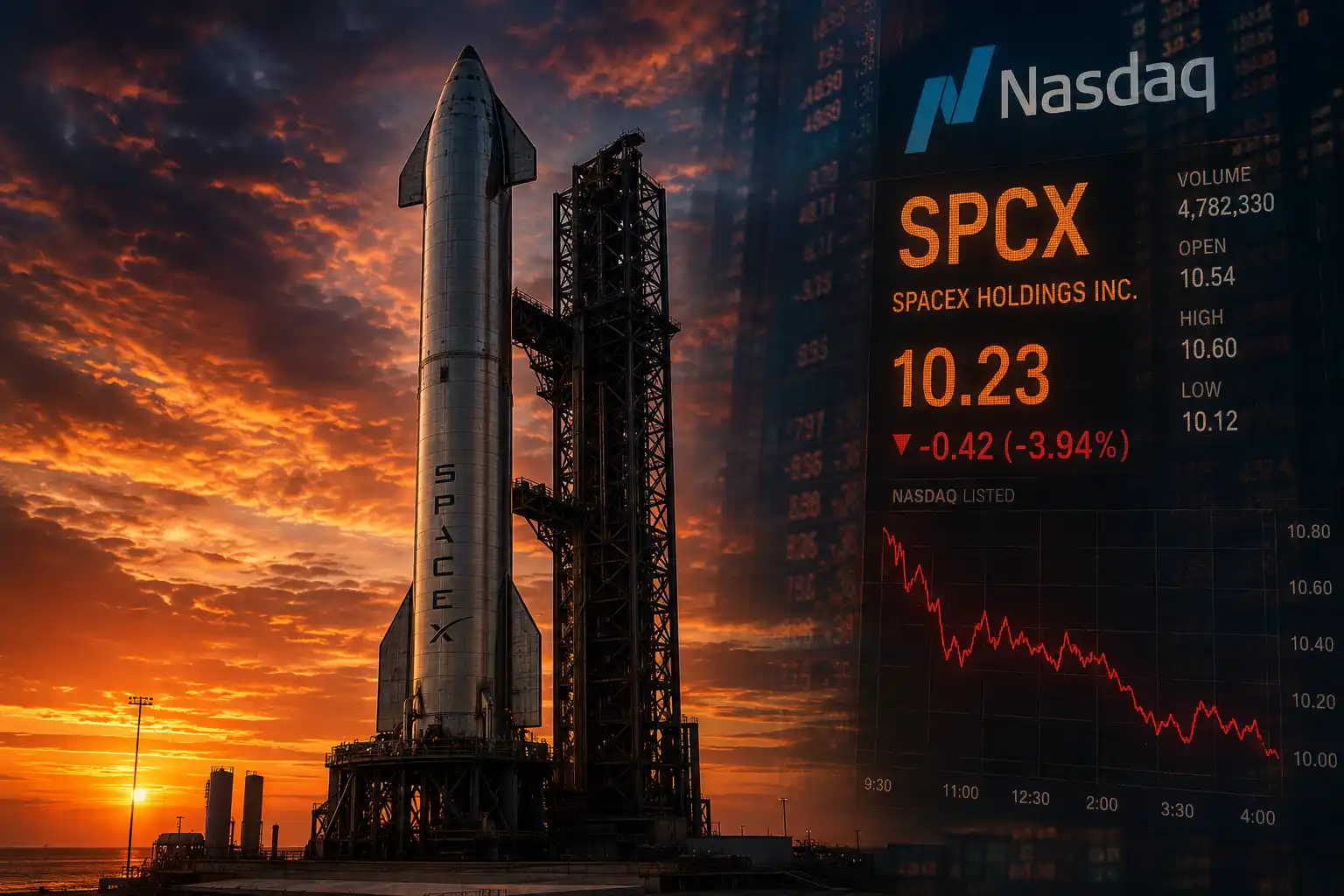
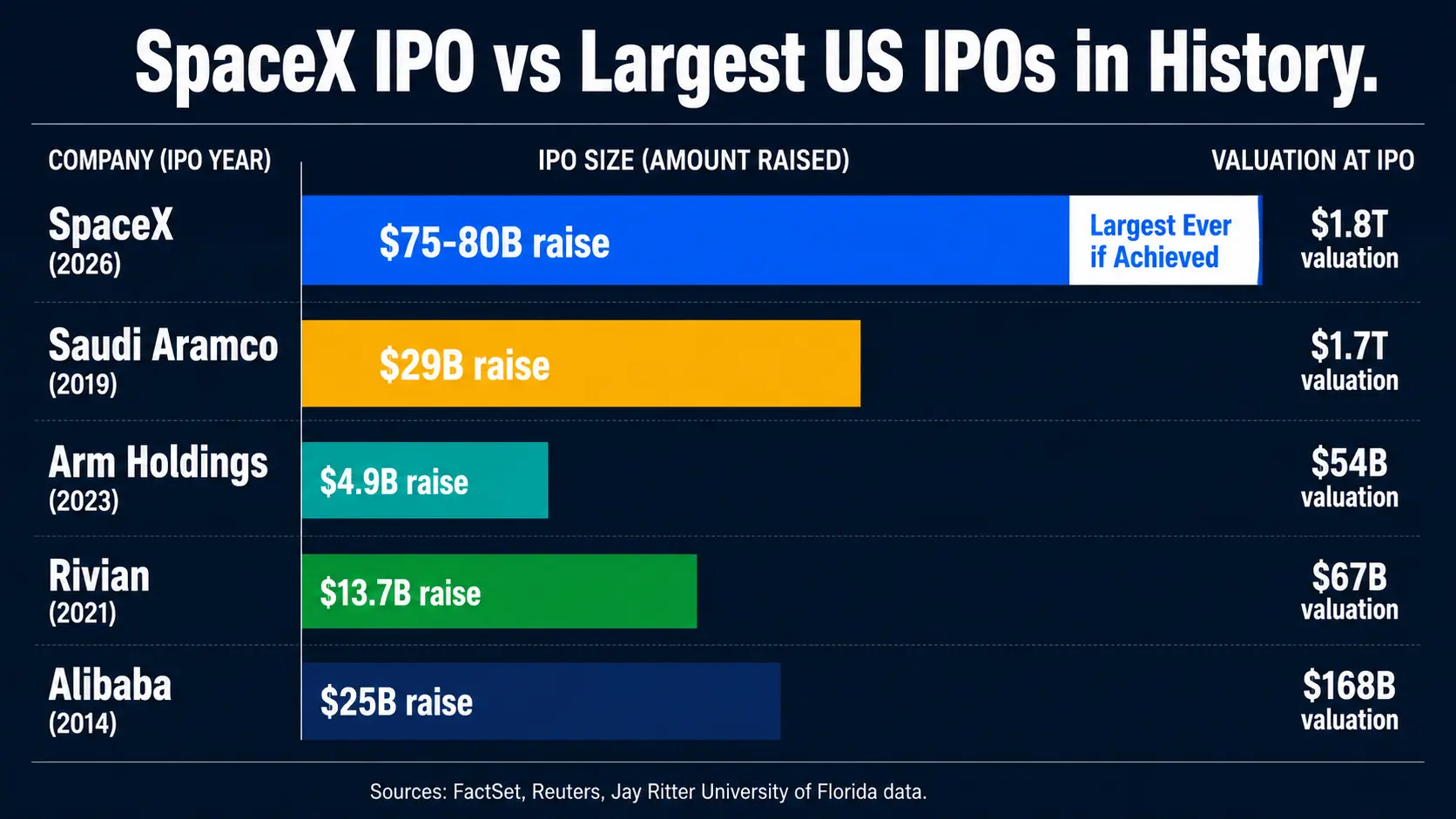
SpaceX is heading toward what could be the largest IPO in American history. The company plans to debut on the Nasdaq under the ticker SPCX around June 12, 2026, targeting a valuation that has already dropped from $2 trillion to approximately $1.8 trillion following early investor pushback. The fundraise alone, targeting $75 billion to $80 billion, would eclipse Saudi Aramco’s $29 billion 2019 record by nearly three times. But as the listing date approaches, serious questions from analysts and investors are piling up about whether the numbers actually justify the price.
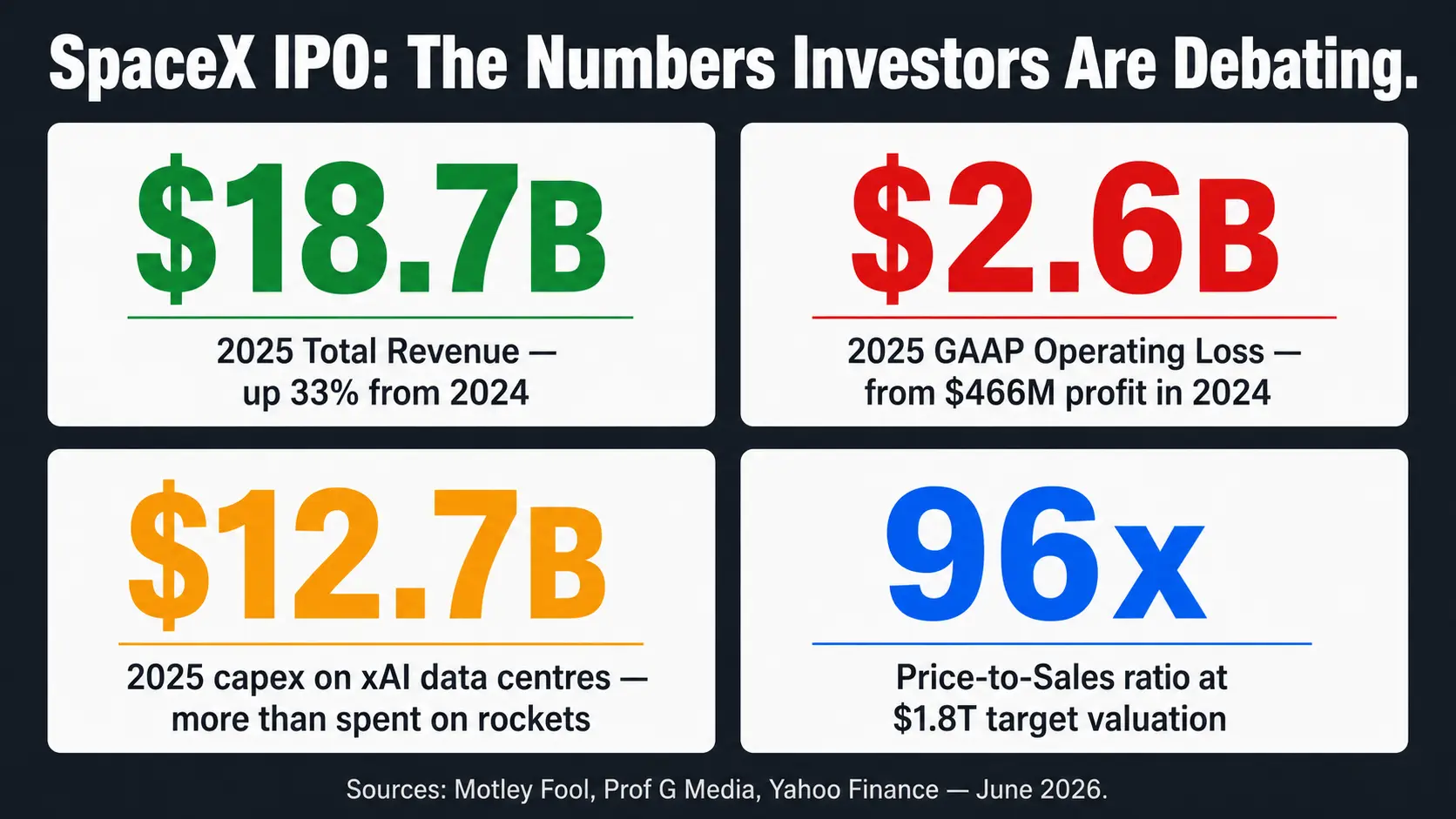
SpaceX generated $18.7 billion in revenue in 2025, up 33 percent from the year before. In the same year the company swung from a $466 million operating profit in 2024 to a $2.6 billion operating loss, driven almost entirely by an explosion in research and development spending tied to its AI division, formerly known as xAI. In the first quarter of 2026, revenue growth slowed to 15.4 percent and the operating loss deepened to $1.94 billion. At the current $1.8 trillion target valuation, SpaceX trades at a price-to-sales ratio of 96, a figure that no major technology company in modern market history has sustained.
This article covers every major concern analysts are raising about the SpaceX IPO, what the company has actually built, why the valuation has already been cut, and what investors need to understand before June 12.
The SpaceX IPO: What Has Actually Been Confirmed
SpaceX filed its S-1 registration statement with the SEC in May 2026, confirming plans for a Nasdaq listing under the ticker SPCX. The company is targeting a debut around June 12, 2026. Goldman Sachs and Morgan Stanley are serving as lead underwriters. The filing contained a number of extraordinary claims about SpaceX’s future market opportunity that immediately became a focal point for investor analysis.
SpaceX stated in its S-1 that it has identified “the largest actionable total addressable market in human history,” estimating a quantifiable TAM of $28.5 trillion. That figure breaks down as $370 billion from space-enabled solutions, $1.6 trillion from connectivity, $3.8 trillion from energy, and $22.7 trillion from AI enterprise applications. SpaceX values that last category at the estimated size of the entire global digital economy according to the Digital Cooperation Organization.
The company also confirmed its plan to raise $75 billion to $80 billion in the offering. If achieved, that fundraise alone would be three times larger than the previous all-time record for an IPO. SpaceX’s filing and updated valuation target were first reported widely by Motley Fool, whose analysts published a detailed breakdown at The Motley Fool’s SpaceX IPO valuation analysis.
Why SpaceX Already Cut Its Valuation by $200 Billion
The first major sign of investor scrutiny came when SpaceX lowered its IPO valuation target from $2 trillion to approximately $1.8 trillion, a $200 billion reduction before trading had even begun. The cut reflects a reality that analysts have been pointing to since the IPO was announced: the numbers in SpaceX’s own financial statements do not currently support a $2 trillion price tag.
At $2 trillion against $18.7 billion in trailing 2025 revenue, SpaceX would carry a price-to-sales ratio of 107. Even at the revised $1.8 trillion target, the P/S ratio of 96 is extraordinary. As Motley Fool analyst coverage noted, companies at the forefront of genuinely game-changing technologies have consistently been unable to sustain P/S ratios above 30 in public markets. For SpaceX’s valuation to fall to a P/S ratio of 30, its market cap would need to drop to approximately $560 billion, which represents a 69 percent decline from the $1.8 trillion target.
The valuation cut also reflects the complexity of what SpaceX actually is as a business. The company is simultaneously a rocket launch provider, a satellite internet operator, an AI infrastructure company, and a stated mission to colonise Mars and the Moon. Each of these components attracts a different type of investor with different valuation frameworks, and combining them into a single S-1 creates significant analytical complexity for institutional investors trying to decide what an appropriate price looks like.
The Financial Reality Behind the Headline Numbers
SpaceX’s financial profile heading into its IPO is more complicated than its revenue growth rate suggests. Understanding the actual composition of the business is essential for any investor evaluating the offering.
Revenue: Strong Growth but Heavy Concentration
Starlink, the satellite internet division, generated $11.4 billion in 2025 revenue, representing 61 percent of SpaceX’s total. It is the only segment of the business currently operating profitably. The core rocket launch business accounted for approximately 22 percent of total revenue. The AI and data centre segment, formerly xAI, generated $3.2 billion in 2025 revenue but grew at only 12.5 percent in the first quarter of 2026, lagging behind competitors Anthropic and OpenAI in both scale and growth rate.
The revenue concentration in Starlink creates a specific risk that analysts are flagging. Starlink is seeing declining average revenue per user as it expands internationally into lower-income markets. This ARPU compression suggests that margins in the company’s only profitable division are likely to tighten even as user numbers grow. A business whose profitability depends on one segment that is simultaneously its fastest-growing and its margin-compressing segment faces a structural challenge that revenue figures alone do not capture.
Losses: The xAI Effect on the P&L
SpaceX’s swing from a $466 million operating profit in 2024 to a $2.6 billion operating loss in 2025 is one of the most significant investor concerns surrounding the IPO. The cause is almost entirely the company’s decision to build out AI data centre infrastructure for xAI. Out of SpaceX’s nearly $21 billion in capital expenditure in 2025, $12.7 billion went to data centres for xAI. That is more than the company spent on rockets or satellites in the same year.
In Q1 2026, R&D spending more than doubled to $3.5 billion, producing an operating loss of $1.94 billion. The company is essentially funding an AI infrastructure business that is losing a race to larger, better-resourced competitors. As detailed analysis from the Motley Fool confirmed, xAI revenue of $3.2 billion in 2025 with a 12.5 percent Q1 2026 growth rate is “lagging behind leaders like Anthropic and OpenAI,” yet it is consuming the majority of SpaceX’s capital expenditure and turning a profitable aerospace business into a net money-loser.
Revenue Growth Slowdown
Investors pricing SpaceX at a triple-digit price-to-sales multiple are implicitly betting on sustained extraordinary revenue growth for years to come. The Q1 2026 slowdown to 15.4 percent revenue growth from 33 percent in full-year 2025 raises an immediate concern about whether the underlying business can sustain the trajectory that a $1.8 trillion valuation requires. As the HeyGoTrade analysis noted, “first-quarter 2026 revenue growth decelerated to 15%, raising near-term concerns for incoming SPCX shareholders.”
What SpaceX Has Actually Built: The Bull Case in Plain Language
To be fair to SpaceX and its investors, the company has built something genuinely extraordinary that no competitor comes close to replicating. The bull case for the IPO deserves honest examination alongside the risks.
SpaceX controls more than half of all global orbital launch capacity. It operates the Falcon 9, the most reliably reusable orbital launch vehicle ever built, and is developing Starship, the most powerful rocket ever constructed. No other private or government-owned entity has come close to matching SpaceX’s launch cadence, reliability record, or cost per kilogram to orbit. This market position is not easily replicated and has compounding value as demand for orbital access grows with the expansion of satellite communications, Earth observation, and national security space programmes.
Starlink’s 10 million-plus subscribers represent a genuine business with strong growth potential in underserved connectivity markets globally. The product works. Users in remote locations, maritime environments, aviation, and developing markets where terrestrial broadband is unavailable or unreliable pay for it consistently. The international expansion that is currently compressing ARPU is also significantly expanding the addressable market.
The TAM claim of $28.5 trillion is speculative but not irrational if you believe SpaceX’s vision of AI-powered space infrastructure, energy from space, and eventual planetary colonisation. These are very long-duration bets that are genuinely difficult to price using conventional financial analysis. As BanklessTimes noted in its SpaceX IPO analysis at BanklessTimes, Polymarket prediction market traders still believed the company’s valuation would exceed $2 trillion after going public, reflecting genuine market conviction that SpaceX’s long-term potential is real.
The Key Risks Every Investor Must Understand Before Buying SPCX
The risks surrounding the SpaceX IPO are specific, measurable, and worth understanding carefully before any investment decision.
The Valuation Maths Problem
The Motley Fool’s analysis identified that SpaceX’s valuation would need to fall by $1.25 trillion from its $1.8 trillion target just to reach a price-to-sales ratio below the historical threshold that indicates the presence of a valuation bubble. Historical data compiled by University of Florida professor Jay Ritter shows that the ten largest US IPO stocks have historically underperformed the S&P 500 by 127 percentage points on average. Motley Fool analyst Parkev Tatevosian published a piece titled “I’m Running, Not Walking Away From SpaceX at IPO,” arguing the valuation mathematics are fundamentally unsupportable at the offering price.
The Elon Musk Concentration Risk
SpaceX is operationally and reputationally inseparable from Elon Musk in a way that creates genuine investor risk. Musk simultaneously leads Tesla, xAI, X (formerly Twitter), The Boring Company, and Neuralink in addition to SpaceX. His attention is the scarcest resource in the entire SpaceX ecosystem and his public statements and actions regularly create significant volatility in Tesla’s stock price. A public SpaceX would face the same dynamic.
The S-1 lists Musk’s departure or reduced involvement as a material risk factor. It also discloses his complex web of related-party transactions across his companies, including the xAI data centre spending that caused SpaceX’s 2025 operating loss, which raises governance questions that institutional investors are actively evaluating.
The Starship Risk
SpaceX’s entire long-term growth thesis depends on Starship becoming operational at high cadence. As reported in recent launch coverage, Starship Flight 12 saw the Super Heavy booster suffer an engine anomaly during boostback and crash uncontrolled into the Gulf of Mexico, though the Ship second stage performed well and delivered 45 tons of cargo to low Earth orbit. Starship is still in active development, and the company’s ability to achieve its stated mission of Mars colonisation and Lunar transport depends on a vehicle that is not yet reliably operational.
The AI Bet Going Wrong
SpaceX spent $12.7 billion building AI data centres for xAI in 2025. xAI generated $3.2 billion in revenue and is growing more slowly than Anthropic and OpenAI. If the AI infrastructure build-out does not generate the returns SpaceX needs to justify the capital allocation, the company will have diverted enormous resources from its core aerospace business into a losing bet in a market it entered late.
How the SpaceX IPO Compares to Other Major Listings
Context matters when evaluating the SpaceX IPO, and the historical comparisons are instructive.
Saudi Aramco’s 2019 IPO raised $29 billion at a valuation of approximately $1.7 trillion, making it the previous record-holder for both fundraise size and initial valuation. SpaceX is targeting a $75 to $80 billion raise, nearly three times that record, at a valuation 6 percent higher than Aramco’s listing price. The difference is that Aramco is one of the most profitable companies in the world with established, predictable cash flows. SpaceX is currently operating at a significant loss.
The 2024 Reddit IPO, the 2023 Arm Holdings listing, and the 2021 cohort of high-profile tech IPOs all provide cautionary data points. Arm Holdings, which listed at a premium valuation justified by its AI chip architecture positioning, has outperformed in the years since its listing. Most other high-profile tech IPOs of the past three years have underperformed their listing price. SpaceX’s combination of extraordinary ambition and significant current-year losses puts it in a category that has rarely performed well for IPO investors, even when the underlying business eventually succeeds.
The most useful analysis of comparable valuation multiples has been done by the Motley Fool team, and their complete reasoning is available at The Motley Fool’s analysis of why SpaceX’s $2 trillion valuation could crash by 84 percent.
The Starlink Opportunity: The Only Part That Makes Clear Financial Sense
Strip away the Mars mission, the AI data centres, and the Starship development programme, and what you have at the core of SpaceX is Starlink. Starlink is the part of the SpaceX story that conventional investors can most easily understand and value.
More than 10 million subscribers pay recurring monthly fees for satellite internet. The service operates in over 100 countries. Aviation, maritime, and enterprise segments pay significantly higher monthly fees than residential consumers. The total addressable market for global connectivity in areas underserved by terrestrial broadband is enormous, and Starlink has no near-term competitor operating at comparable scale. OneWeb and Amazon’s Project Kuiper are years behind in both satellite count and subscriber base.
If Starlink were a standalone public company, analysts estimate it would command a valuation in the $200 billion to $400 billion range depending on growth assumptions and margin trajectory. The problem is that Starlink’s valuation within SpaceX is bundled with a rocket company reporting large losses, an AI division underperforming its peers, and a Mars colonisation mission that will require decades of additional capital before generating any return. The bundling makes it nearly impossible to value any single component accurately, which is precisely the environment where mispricing happens most easily.
Frequently Asked Questions About the SpaceX IPO
When is the SpaceX IPO date?
SpaceX is targeting a Nasdaq debut around June 12, 2026, under the ticker SPCX. The company filed its S-1 registration statement in May 2026. Goldman Sachs and Morgan Stanley are serving as lead underwriters. The exact first trading date is subject to SEC review completion and final pricing, which typically occurs the evening before trading begins.
What is SpaceX’s IPO valuation?
SpaceX originally targeted a $2 trillion IPO valuation but reduced the target to approximately $1.8 trillion following early investor feedback. At $1.8 trillion against $18.7 billion in 2025 revenue, SpaceX carries a price-to-sales ratio of approximately 96. The company is targeting a fundraise of $75 billion to $80 billion, which would be the largest IPO fundraise in history by a significant margin.
Is SpaceX profitable?
SpaceX was profitable in 2024 with a $466 million operating profit but swung to a $2.6 billion operating loss in 2025 due to $12.7 billion in capital expenditure on AI data centres for xAI. Starlink remains the only currently profitable business segment. In Q1 2026, the operating loss was $1.94 billion as R&D spending more than doubled. The company argues that current losses are investments in its long-term market opportunity.
What does SpaceX do and how does it make money?
SpaceX generates revenue from three primary sources. Starlink satellite internet contributes approximately 61 percent of total revenue at $11.4 billion in 2025. Rocket launch services for government and commercial customers contribute approximately 22 percent. The AI and data infrastructure segment, formerly xAI, contributed $3.2 billion. The company also has Starship development, which is not yet revenue-generating but is expected to become the primary launch vehicle for both Starlink expansion and commercial payload delivery.
Why did SpaceX lower its IPO valuation?
SpaceX reduced its IPO valuation target from $2 trillion to approximately $1.8 trillion following feedback from institutional investors who raised concerns about the price-to-sales ratio, the company’s recent swing from profitability to operating losses, the concentration of revenue in Starlink, and the performance of the xAI segment relative to peers. The $200 billion reduction happened before trading began, reflecting the difficulty of sustaining investor demand for a valuation that implies 107 times trailing revenue.
Should I invest in the SpaceX IPO?
This is a question that requires careful personal consideration rather than a general answer. Analysts are sharply divided as some believe SpaceX’s market position in orbital launch and Starlink’s global subscriber base justify a premium valuation. Others point to the price-to-sales ratio of 96, the current operating losses, the AI division underperformance, and the historical data showing that the largest IPOs consistently underperform the S&P 500. Any investor considering SPCX at its IPO price should understand the valuation concerns clearly and consult with a qualified financial adviser before making a decision.
The Biggest IPO in History Carries the Biggest Questions
SpaceX is a genuinely extraordinary company. It has transformed the global launch industry, built the largest satellite internet constellation in history, and is developing the most powerful rocket ever constructed. Elon Musk’s vision for what SpaceX could become over the next 20 to 50 years is not obviously wrong, and the total addressable market for space-based services, connectivity, and AI infrastructure is genuinely massive.
The problem is not the vision. The problem is the price. A valuation of $1.8 trillion against $18.7 billion in trailing revenue and $2.6 billion in operating losses produces a price-to-sales ratio that no technology company in modern market history has been able to sustain. The first major roadblock the SpaceX IPO has hit is not a regulatory challenge or an engineering setback. It is the basic mathematics of what investors are being asked to pay for what they are currently receiving.
Whether SPCX at $1.8 trillion turns out to be one of the great long-term investments of this era or another cautionary tale about peak-cycle tech IPO pricing will depend on whether SpaceX can grow into its valuation faster than the weight of expectation can crush it. That outcome will play out over years, not days. Investors buying on June 12 are making a bet that requires patience, high risk tolerance, and a genuine belief that SpaceX’s 20-year vision is not only achievable but correctly priced at a trillion-dollar premium today.
For ongoing investor analysis of the SpaceX IPO valuation and comparable tech listings, the detailed coverage at Prof G Media’s SpaceX IPO valuation breakdown provides one of the most rigorous public examinations of why the numbers are so hard to square with the price tag.

Prince Anichi
Founder and Lead Technology Editor at Ortechy. Covering digital economy shifts, tech ecosystems across Africa, cybersecurity intelligence, and emerging software platforms.