In this article24 sections
- 01.NVIDIA RTX Spark: The Company’s First Windows PC Processor Changes Everything
- 02.Intel’s 18A Process Node Arrives: Clearwater Forest and Core Ultra Series 3
- ↳Xeon 6+ Clearwater Forest: 18A in the Data Centre
- ↳Intel Core Ultra Series 3: 18A for Consumer AI PCs
- 03.AMD at Computex 2026: Platform Longevity and Mid-Range Value
- ↳AM5 Socket Support Confirmed Through 2029
- ↳Ryzen 7 7700X3D and Radeon RX 9070 GRE Go Global
- ↳Ryzen AI Max 400 APUs for Creator Laptops
- 04.Qualcomm Snapdragon C: Bringing AI PCs Under $300
- 05.ASUS at Computex 2026: From Personal AI Laptops to Petaflop Mini PCs
- ↳ASUS Ascent GX10: A Petaflop Mini PC for Personal AI
- ↳ASUS Ascent QN10: World’s First AI Mini PC with 80 TOPS NPU
- ↳ProArt P16 and P14 with RTX Spark
- ↳Consumer Laptops: Zenbook 14 and Vivobook S
- 06.The AI Robotics Zone: Computex’s Newest and Most Significant New Category
- 07.InnoVEX 2026: Startup Innovation Crosses 500 Participants
- 08.What Computex 2026 Means for the Broader Tech Industry
- 09.Frequently Asked Questions About Computex 2026
- ↳What was the biggest announcement at Computex 2026?
- ↳How many people attended Computex 2026?
- ↳What did Intel announce at Computex 2026?
- ↳What did AMD announce at Computex 2026?
- ↳What is the ASUS Ascent GX10?
- 10.Computex 2026 Confirmed That AI Has Taken Over the Hardware Industry
The Biggest AI and Hardware Announcements from Computex 2026: Everything That Matters
Computex 2026 was the most significant edition of the world’s premier computing trade show in 45 years. Held in Taipei, Taiwan from June 1 to 6, the show drew a record 111,312 attendees from 152 countries and confirmed something that many in the industry had suspected: the PC hardware show is over and the AI infrastructure buildout has taken its place. Every major announcement from NVIDIA, Intel, AMD, Qualcomm, ASUS, and MSI pointed in the same direction — toward a world where every computing device from a laptop to a data centre server is rebuilt from the ground up around artificial intelligence.
This was not incremental iteration. NVIDIA entered the unified consumer SoC market for the first time. Intel shipped the first commercial silicon on its long-awaited 18A process node. AMD confirmed platform longevity through 2029. Qualcomm pushed AI PCs into the sub-$300 price tier. ASUS debuted what it described as a petaflop-class AI Mini PC. And a brand new AI Robotics Zone made its Computex debut, marking the formal entry of humanoid robotics into the show’s permanent programme.
Here is every major announcement you need to understand and why each one matters.
NVIDIA RTX Spark: The Company’s First Windows PC Processor Changes Everything
The single most consequential hardware announcement at Computex 2026 was NVIDIA’s RTX Spark Superchip, the company’s first unified system-on-chip designed for Windows PCs. This is not a graphics card upgrade. It is NVIDIA making its first direct move into the CPU-GPU integrated processor market that Apple has dominated with Apple Silicon since 2020.
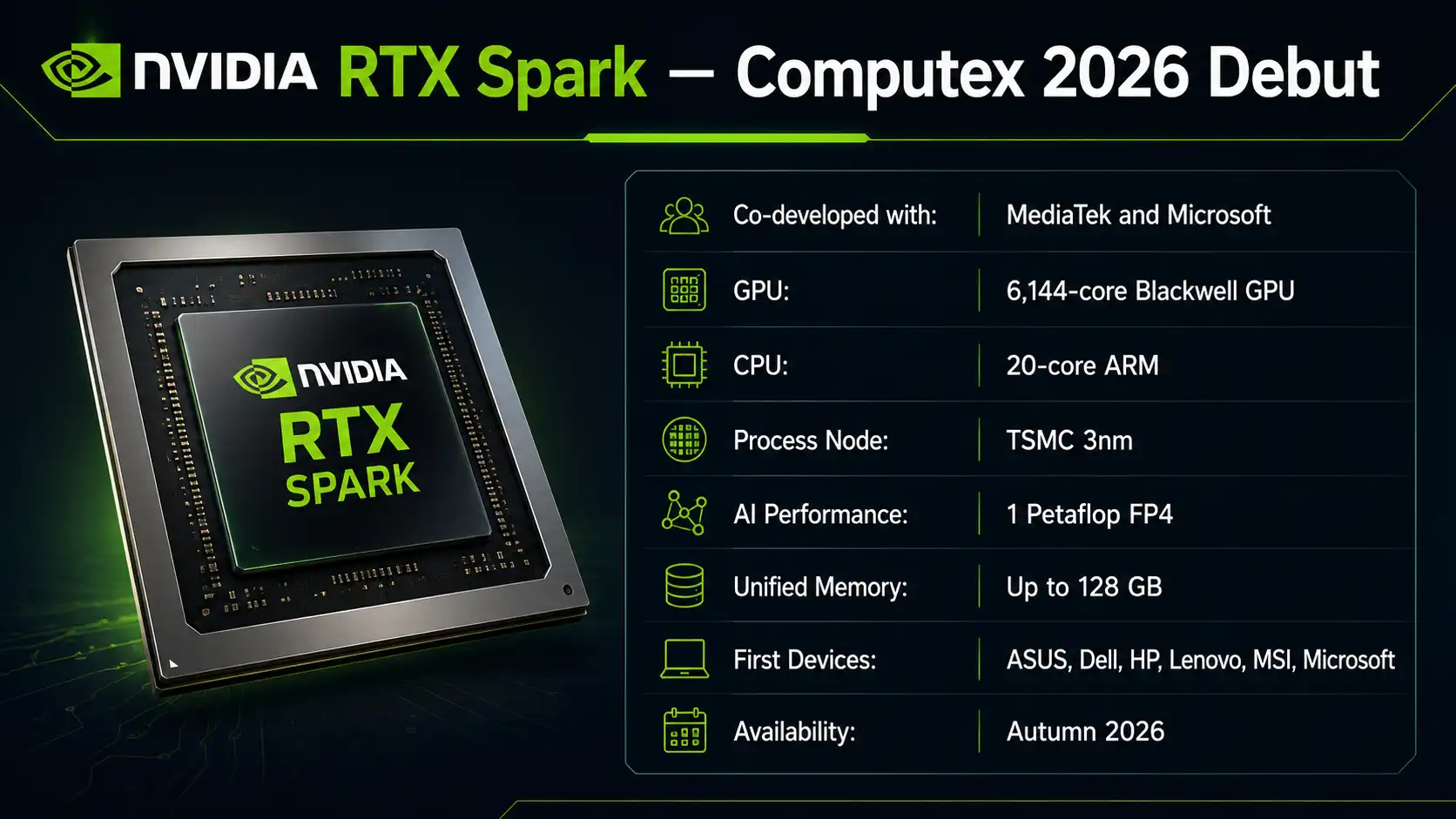
The RTX Spark is a two-chiplet system-on-chip co-developed with MediaTek and Microsoft. It combines a 6,144-core Blackwell GPU with a 20-core ARM CPU, all built on TSMC’s 3-nanometer process node. The chip delivers one petaflop of FP4 AI performance and supports up to 128 GB of unified memory, a memory configuration that only Apple’s M-series chips had previously offered in consumer laptop hardware.
For software, NVIDIA partnered with Microsoft to build native Windows security primitives and a proprietary OpenShell runtime that masks personal data before it reaches any external API. Adobe has fully rearchitected Photoshop and Premiere Pro around the RTX Spark platform. The practical implication is that creative professionals working on video editing, 3D rendering, and AI-assisted design workflows gain performance that was previously unavailable outside of dedicated workstations.
Devices from ASUS, Dell, HP, Lenovo, Microsoft, and MSI are scheduled to ship in autumn 2026. ASUS was among the first to confirm specific products: the ProArt P16 and ProArt P14 laptops, described as the first ASUS creator laptops powered by RTX Spark, deliver what the company calls breakthrough AI performance for personal AI agent workflows. DLSS 4.5 Ray Reconstruction, a second-generation super-resolution transformer model processing 20 percent more parameters with 35 percent more compute, was also announced alongside RTX Spark and is scheduled for August 2026.
AMD’s response to RTX Spark was notably confident. An AMD spokesperson told Tom’s Hardware on the show floor: “I’m really excited that NVIDIA has joined the game.” The competitive framing reflects how seriously AMD views unified memory ARM-based SoC competition in the creator and AI PC segments it has been targeting with its Ryzen AI Max platform. Full Computex 2026 live coverage from the show floor is available at Tom’s Hardware’s Computex 2026 live blog.
Intel’s 18A Process Node Arrives: Clearwater Forest and Core Ultra Series 3
Intel used Computex 2026 to make its most important manufacturing credibility statement in years. The company’s 18A process node, which has been the subject of intense industry scepticism since it was first announced, is now real, shipping, and scaling.
Xeon 6+ Clearwater Forest: 18A in the Data Centre
The Intel Xeon 6+ Clearwater Forest is the first data centre CPU with compute tiles built on Intel’s 18A process node. It is a chiplet design where the compute tiles contain 288 Darkmont E-cores with 576 MB of last-level cache, PCIe Gen5, and Intel SGX and TDX confidential-compute support. The 18A compute tiles are disaggregated from other components which use a different process node in a hybrid packaging arrangement.
A supply caveat applies: Intel has targeted customer sampling for the second half of 2026 with broader availability following thereafter. But the silicon exists, it is on the right process node, and it includes the confidential-compute features that AI data centre customers specifically require for sensitive workload isolation.
Intel Core Ultra Series 3: 18A for Consumer AI PCs
The Core Ultra Series 3 is Intel’s first consumer AI PC platform built entirely on 18A and it powers over 300 PC designs confirmed at the show. Intel’s broader Computex presence also included details on the Crescent Island AI GPU, which the company says features up to 480 GB of LPDDR5X memory, and advance information on Xeon 7 Diamond Rapids CPUs officially launching in 2027 on the Intel 18A-P node. The MSI Claw 8 EX AI+ gaming handheld, which features Intel’s Arc G3 Extreme processor on an 8-inch 120Hz display, was one of the most hands-on demonstrations of 18A’s consumer gaming potential at the show.
AMD at Computex 2026: Platform Longevity and Mid-Range Value
AMD arrived at Computex 2026 with a clear and deliberately positioned message: stability, value, and long-term platform investment. While NVIDIA and Intel debated who had the most ambitious new silicon, AMD made commitments designed to reassure builders and OEMs who have consistently cited platform longevity as a purchasing priority.
AM5 Socket Support Confirmed Through 2029
AMD formally confirmed that AM5 socket support will continue through 2029. For desktop PC builders and system integrators, this confirmation means that a motherboard purchased today will support the next three to four generations of AMD processors. In a competitive environment where Intel has been criticised for frequent socket changes, AMD’s AM5 longevity commitment is a direct and effective differentiator for the builder community.
Ryzen 7 7700X3D and Radeon RX 9070 GRE Go Global
The Ryzen 7 7700X3D, a Zen 4 processor with 104 MB of L3 cache priced at $329, was confirmed as a mid-range AM5 option that performs strongly in gaming benchmarks and undercuts Intel’s Core Ultra 5 lineup on price. The Radeon RX 9070 GRE, previously available only in the Chinese market, went global at Computex with a $549 price tag. The card carries 12 GB of GDDR6 memory with 48 RDNA4 compute units and delivers genuine 1440p gaming performance that brackets the RTX 5060 Ti 16GB.
Ryzen AI Max 400 APUs for Creator Laptops
On the mobile side, AMD unveiled Ryzen AI Max 400 APUs with up to 128 GB of unified memory available in laptop form factors. AMD explicitly positions this against Apple Silicon in the creator market and against NVIDIA RTX Spark in the AI-local compute space. The unified memory configuration is significant because it matches what RTX Spark and Apple M-series chips offer, bringing AMD’s x86 laptop platform into competitive parity on one of the most discussed hardware specifications in creative professional computing.
Qualcomm Snapdragon C: Bringing AI PCs Under $300
One of the most strategically important announcements at Computex 2026 for the global PC market was Qualcomm’s Snapdragon C platform, a new chip tier specifically targeting Windows laptops priced at $300 or below. While NVIDIA and Intel compete for the high-performance AI PC premium segment, Qualcomm is making a direct move to democratise AI PC capability at a price point accessible to students, budget-conscious consumers, and the vast emerging markets where sub-$300 laptops represent the mainstream.
The Snapdragon C platform brings Qualcomm Oryon CPU cores, the Adreno GPU, and the Hexagon NPU to the budget tier, enabling Copilot Plus PC features including on-device AI processing, real-time transcription, and Windows 11 AI experiences without a cloud connection. For education markets and developing economies where the majority of PC purchases happen at this price tier, Snapdragon C is the most impactful Computex 2026 announcement for the broadest possible audience.
ASUS at Computex 2026: From Personal AI Laptops to Petaflop Mini PCs
ASUS delivered the most comprehensive product showcase at Computex 2026, covering everything from consumer AI laptops to enterprise AI infrastructure and gaming hardware. The ASUS booth demonstrated the full vertical extent of what AI computing means in 2026 across every device category simultaneously.
ASUS Ascent GX10: A Petaflop Mini PC for Personal AI
The ASUS Ascent GX10 is powered by the NVIDIA GB10 Grace Blackwell Superchip with 128 GB of unified memory and delivers petaflop-class AI performance in a desktop Mini PC form factor. The GX10 is described as a central “super-brain” for NVIDIA NemoClaw-enabled applications and supports NVIDIA OpenShell for sandboxed deployment with enterprise-grade security. The device won a Computex 2026 Best Choice Award in the AI Computing and Tech category.
ASUS Ascent QN10: World’s First AI Mini PC with 80 TOPS NPU
The ASUS Ascent QN10 is powered by the Qualcomm Snapdragon X2 Elite and described as the world’s first AI Mini PC with an 80 TOPS NPU. It features an 18-core Qualcomm Oryon CPU and integrated Qualcomm Adreno GPU, with Snapdragon Guardian Technology for enterprise security and remote manageability. The QN10 represents ASUS’s first Qualcomm-powered AI PC and extends its enterprise AI product range beyond NVIDIA-exclusive configurations.
ProArt P16 and P14 with RTX Spark
ASUS confirmed the ProArt P16 and P14 as the first ASUS creator laptops powered by NVIDIA RTX Spark, targeting professionals in video production, 3D design, and AI-assisted creative workflows. Both devices will be available in select regions from autumn 2026 alongside ASUS Zenni Claw, a new AI assistant experience designed to simplify agentic AI workflows for everyday work, travel, and lifestyle scenarios.
Consumer Laptops: Zenbook 14 and Vivobook S
The new Zenbook 14 features a 1.1 kg chassis with a Ceraluminum cover in nature-inspired colour options including Arctic Blue and Komodo Coral. It is available with Intel, AMD, or Snapdragon processors making it compatible with Copilot Plus PC features across all three platform options. The Vivobook S series is Snapdragon-exclusive and targets the everyday AI PC mainstream market. Full details of the complete ASUS AI PC lineup are available at the official ASUS Computex 2026 press release.
The AI Robotics Zone: Computex’s Newest and Most Significant New Category
Computex 2026 introduced an inaugural AI Robotics Zone that attracted exhibitors and attention in equal measure. The addition of a dedicated robotics section to the world’s premier computing trade show is a structural statement about where the next wave of AI-driven hardware development is heading.
The AI Robotics Zone featured humanoid robot demonstrations, robotic arm systems integrated with vision AI, and mobility platforms built on the same edge AI chip architectures that power AI PCs and edge computing devices. The zone’s debut reflects the convergence of consumer electronics AI capabilities with robotics hardware that was previously confined to industrial research environments.
ASUS’s enterprise showcases, including the Ascent GX10 petaflop Mini PC and the broader enterprise-to-edge AI portfolio detailed at the ASUS Computex 2026 enterprise AI pressroom, directly interface with the robotic and agentic AI applications the Robotics Zone represented. When a desktop Mini PC delivers petaflop performance and a local AI agent runtime, the gap between consumer AI computing and robotics control computing narrows significantly.
InnoVEX 2026: Startup Innovation Crosses 500 Participants
InnoVEX, Computex’s dedicated startup and innovation platform, crossed 500 participating companies from 23 nations for the first time in 2026. The milestone reflects how the Computex ecosystem has grown beyond established hardware brands into a genuinely global startup forum.
InnoVEX featured startups across AI hardware, AI software, edge computing devices, sustainable technology, and smart manufacturing. The presence of 23 national delegations including significant representation from Southeast Asia, Europe, and the Middle East reflects the globalisation of hardware innovation that has accelerated as AI chip design and edge computing move beyond the traditional Taiwan and US-centric hardware industry.
What Computex 2026 Means for the Broader Tech Industry
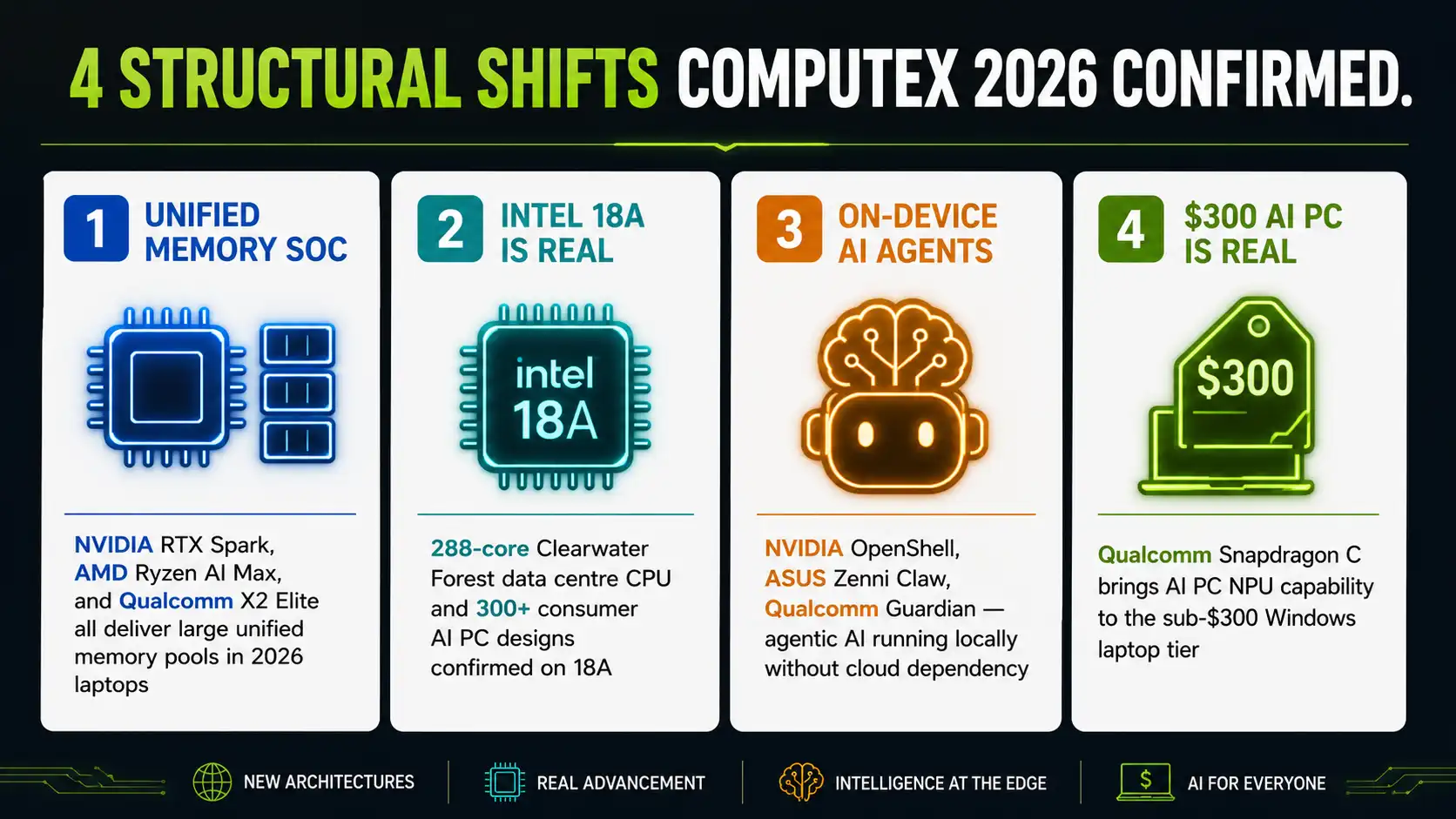
The overarching message from Computex 2026 is that the AI infrastructure buildout has moved from data centres into every device category simultaneously. The show confirmed four specific structural shifts that will define consumer electronics and enterprise computing through the rest of this decade.
First, the unified memory SoC architecture that Apple proved with Apple Silicon is now the target for every major chip maker simultaneously. NVIDIA RTX Spark, AMD Ryzen AI Max, and Qualcomm Snapdragon X2 Elite all deliver large unified memory pools to laptop processors in 2026. The era of separate CPU and GPU memory pools with a narrow bandwidth bottleneck between them is ending.
Second, Intel’s 18A is real and it matters. The process node that the industry had been watching skeptically for three years is now in customer sampling for data centre chips and powering over 300 consumer AI PC designs. Intel’s manufacturing recovery changes the competitive dynamics of the entire chip industry in ways that are still unfolding.
Third, AI agent capabilities are moving from cloud services to on-device hardware. Every major announcement at Computex 2026, from NVIDIA OpenShell to ASUS Zenni Claw to Qualcomm Snapdragon Guardian, is fundamentally about enabling AI agents to run locally, securely, and without cloud dependency. This is the defining capability shift of the current AI hardware cycle.
Fourth and finally, the $300 AI PC is real. Qualcomm Snapdragon C brings AI PC capabilities to a price tier that was previously inaccessible, expanding the addressable market for Windows AI computing by hundreds of millions of potential buyers in emerging markets. For the complete Computex 2026 market analysis from the show floor read the full breakdown at TechTimes’ Computex 2026 record-setting edition analysis.
Frequently Asked Questions About Computex 2026
What was the biggest announcement at Computex 2026?
NVIDIA’s RTX Spark Superchip was the most consequential single announcement at Computex 2026. It is NVIDIA’s first unified SoC for Windows PCs, combining a 6,144-core Blackwell GPU with a 20-core ARM CPU on TSMC’s 3nm process, delivering one petaflop of FP4 AI performance with up to 128 GB of unified memory. Devices from ASUS, Dell, HP, Lenovo, Microsoft, and MSI begin shipping in autumn 2026.
How many people attended Computex 2026?
Computex 2026 set a 45-year attendance record with 111,312 attendees from 152 countries. The previous record for the show was broken by the surge in interest from AI infrastructure companies, robotics manufacturers, and the global technology investment community that converged on Taipei in June 2026.
What did Intel announce at Computex 2026?
Intel made three major announcements at Computex 2026. The Xeon 6+ Clearwater Forest is the first data centre CPU with compute tiles on Intel’s 18A process node, targeting second-half 2026 customer sampling. The Core Ultra Series 3 is the first consumer AI PC platform on 18A powering over 300 PC designs. Intel also detailed the Crescent Island AI GPU with up to 480 GB of LPDDR5X memory and previewed Xeon 7 Diamond Rapids for 2027.
What did AMD announce at Computex 2026?
AMD confirmed AM5 socket support through 2029 and launched the Ryzen 7 7700X3D at $329 and the Radeon RX 9070 GRE globally at $549. On mobile, AMD unveiled the Ryzen AI Max 400 APUs with up to 128 GB of unified memory targeting creator laptops and AI-local computing workloads in direct competition with Apple Silicon and NVIDIA RTX Spark.
What is the ASUS Ascent GX10?
The ASUS Ascent GX10 is a petaflop-class AI Mini PC powered by the NVIDIA GB10 Grace Blackwell Superchip with 128 GB of unified memory. It won a Computex 2026 Best Choice Award in the AI Computing and Tech category. The GX10 is designed as a local AI super-brain for NVIDIA NemoClaw-enabled agentic applications with OpenShell sandboxing and enterprise-grade security.
Computex 2026 Confirmed That AI Has Taken Over the Hardware Industry
The hardware industry bet everything on AI agents at Computex 2026 and the bets are now public, funded, and shipping. NVIDIA entered the consumer SoC market. Intel proved 18A is real. AMD committed to platform stability through 2029. Qualcomm made AI PCs affordable. And ASUS showed what happens when you build every product category around AI agents from the start.
The record attendance of 111,312 people from 152 countries reflects a global technology industry that understands the AI hardware buildout is not a trend cycle. It is a fundamental restructuring of how every computing device is designed, sold, and used. The products announced at Computex 2026 will ship in the next twelve months and when they do, every benchmark comparison, every buying guide, and every productivity workflow will need to be rewritten from scratch.
The next Computex will be even bigger. Between the devices announced this week and the AI agent capabilities they enable, the 2027 show will measure whether this generation of hardware delivered on the promise that 111,312 attendees came to Taipei to witness being made.

Prince Anichi
Founder and Lead Technology Editor at Ortechy. Covering digital economy shifts, tech ecosystems across Africa, cybersecurity intelligence, and emerging software platforms.