In this article29 sections
- 01.New Siri AI Feature One: On-Screen Awareness
- ↳What On-Screen Awareness Actually Means
- 02.New Siri AI Feature Two: Personal Context Awareness
- ↳How Siri Draws on Your Apple Ecosystem
- ↳Privacy Safeguards for Personal Data
- 03.How the New Siri AI Works Across Devices
- ↳iPhone: Dynamic Island and Voice Access
- ↳Mac and iPad: Spotlight Integration
- 04.The Gemini Partnership: What It Means for Apple Users
- ↳A Custom Gemini Model Inside Apple’s Privacy Stack
- ↳Third-Party AI Extensions in iOS 27
- 05.Apple Intelligence Updates Beyond Siri AI
- ↳Photos, Image Playground, and Messages
- ↳Camera Identification
- 06.The History Behind This Launch: Two Years of Delays
- ↳What Was Promised at WWDC 2024
- ↳Why the Reliability Bar Matters at Launch
- 07.How New Siri AI Compares to Google Assistant and Microsoft Copilot
- ↳The Competitive Landscape in 2026
- 08.Which Devices Support the New Siri AI
- ↳Hardware Requirements for iOS 27
- 09.Frequently Asked Questions
- ↳When does the new Siri AI arrive on iPhones?
- ↳Does Siri AI require an internet connection?
- ↳Is Siri AI available on older iPhones?
- ↳Why is Apple using Google Gemini to power Siri?
- ↳Can I use ChatGPT or Claude instead of Siri AI?
- ↳What happened to the Siri AI features promised with iPhone 16?
- 10.The New Siri AI
New Siri AI: Apple Rebuilds Its Assistant From the Ground Up
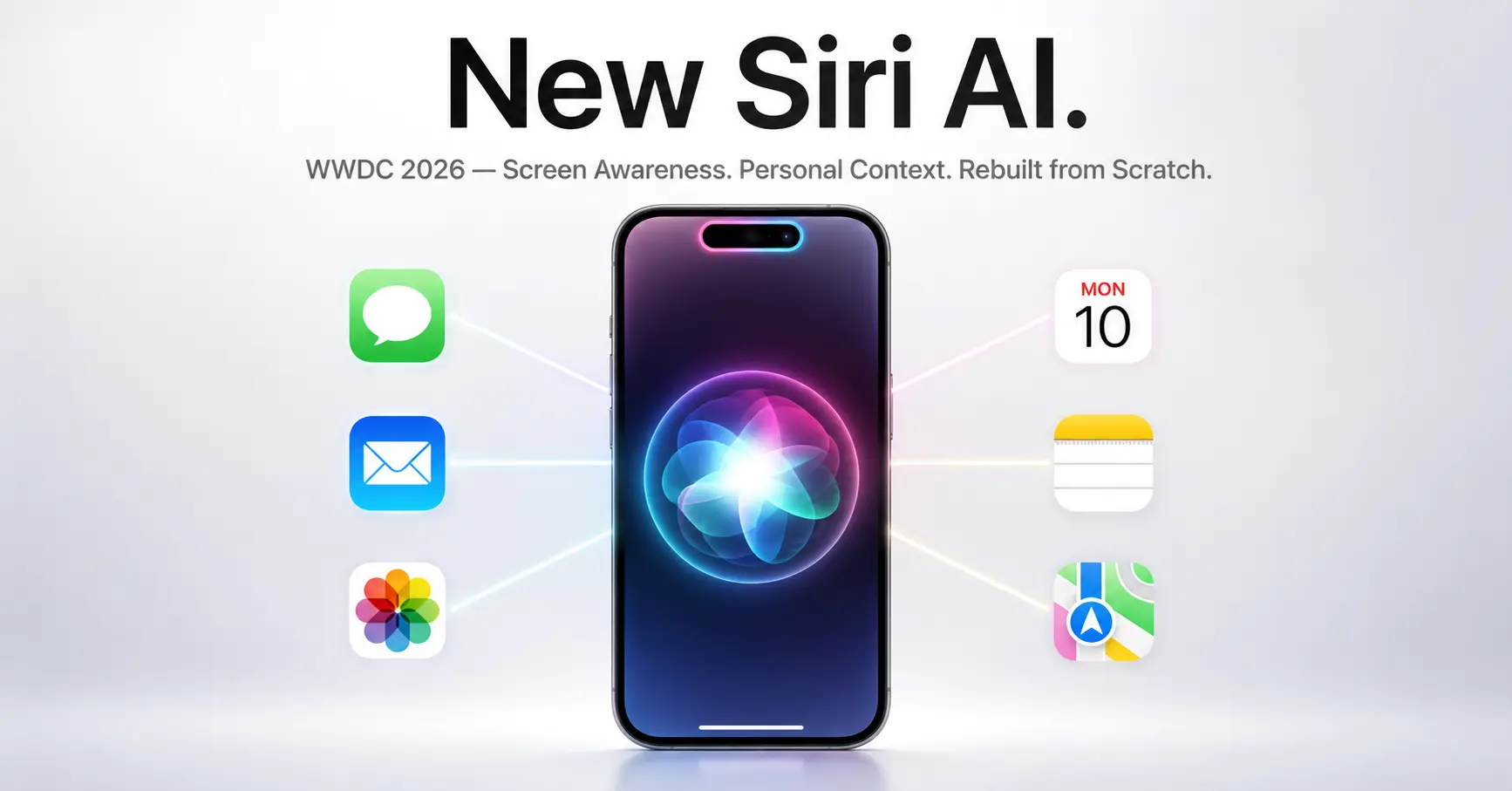
Apple unveiled the new Siri AI at WWDC 2026 on 8 June, and it is the most significant overhaul of the assistant in its 15-year history. Siri AI is a complete rebuild powered by a custom 1.2-trillion-parameter Google Gemini model, running under a multi-year deal reportedly worth around $1 billion annually, according to reporting from Dr. Logic’s WWDC 2026 briefing. The rebuilt assistant arrives as a standalone app on iPhone, iPad, and Mac, and arrives with iOS 27 this autumn. It can read your screen, act across multiple apps in a single request, understand personal context from your messages and emails, and maintain a persistent conversation history synced across all your Apple devices.
This announcement carries particular weight because Apple had promised many of these features two years ago. The personalised Siri capabilities first announced at WWDC 2024 were delayed indefinitely in March 2025. Apple then settled a $250 million consumer class action over marketing those features before they were ready to ship with iPhone 16. WWDC 2026 is, in practical terms, the delivery of features the company had been sued for failing to provide.
This post covers every major capability in the new Siri AI, how the underlying architecture works, which devices support it, how it compares to Google and Microsoft’s assistants, and what genuine limitations remain at launch. Start with the most consequential new feature: on-screen awareness.
New Siri AI Feature One: On-Screen Awareness
What On-Screen Awareness Actually Means
On-screen awareness lets Siri read and respond to whatever is currently displayed on your device without you needing to copy text, switch apps, or describe what you are looking at. Apple calls this capability “onscreen awareness,” and it is central to how the new assistant works differently from every previous version of Siri.
In a demo at WWDC 2026, Apple VP Mike Rockwell showed Siri finding directions to a landmark visible in an Instagram post. The user did not open Maps, copy an address, or search separately. They asked Siri directly about what was on screen, and Siri acted on it. This kind of interaction was impossible in previous versions of Siri, which could not reference the visual content on your display at all.
The feature extends across Apple’s ecosystem. If a friend sends you their address in Messages, you can ask Siri to add it to their contact card without leaving the conversation. If you are reading an email about a meeting, you can ask Siri to add the event to your calendar directly. The content on screen becomes the context for the request, removing the need to manually transfer information between apps, as confirmed in CNBC’s live coverage of the WWDC 2026 keynote.
New Siri AI Feature Two: Personal Context Awareness
How Siri Draws on Your Apple Ecosystem
Personal context awareness is the second defining capability of the new Siri AI. The assistant can now surface relevant information from across your Apple services to answer questions and complete tasks. Specifically, it draws on:
- Messages: finding recommendations, addresses, or information shared by contacts
- Mail: summarising threads, pulling out details, and acting on information in emails
- Photos: identifying people, places, and objects in your photo library
- Calendar: checking availability, adding events, and connecting meeting details
- Notes: retrieving and updating notes without opening the app manually
This means Siri AI can answer questions like “What restaurant did Jamie recommend last month?” by searching your Messages history. Or it can find a photo of your driver’s license and pull the ID number into a web form. The assistant now connects information that previously lived in isolated apps and would have required you to find and copy it yourself.
Privacy Safeguards for Personal Data
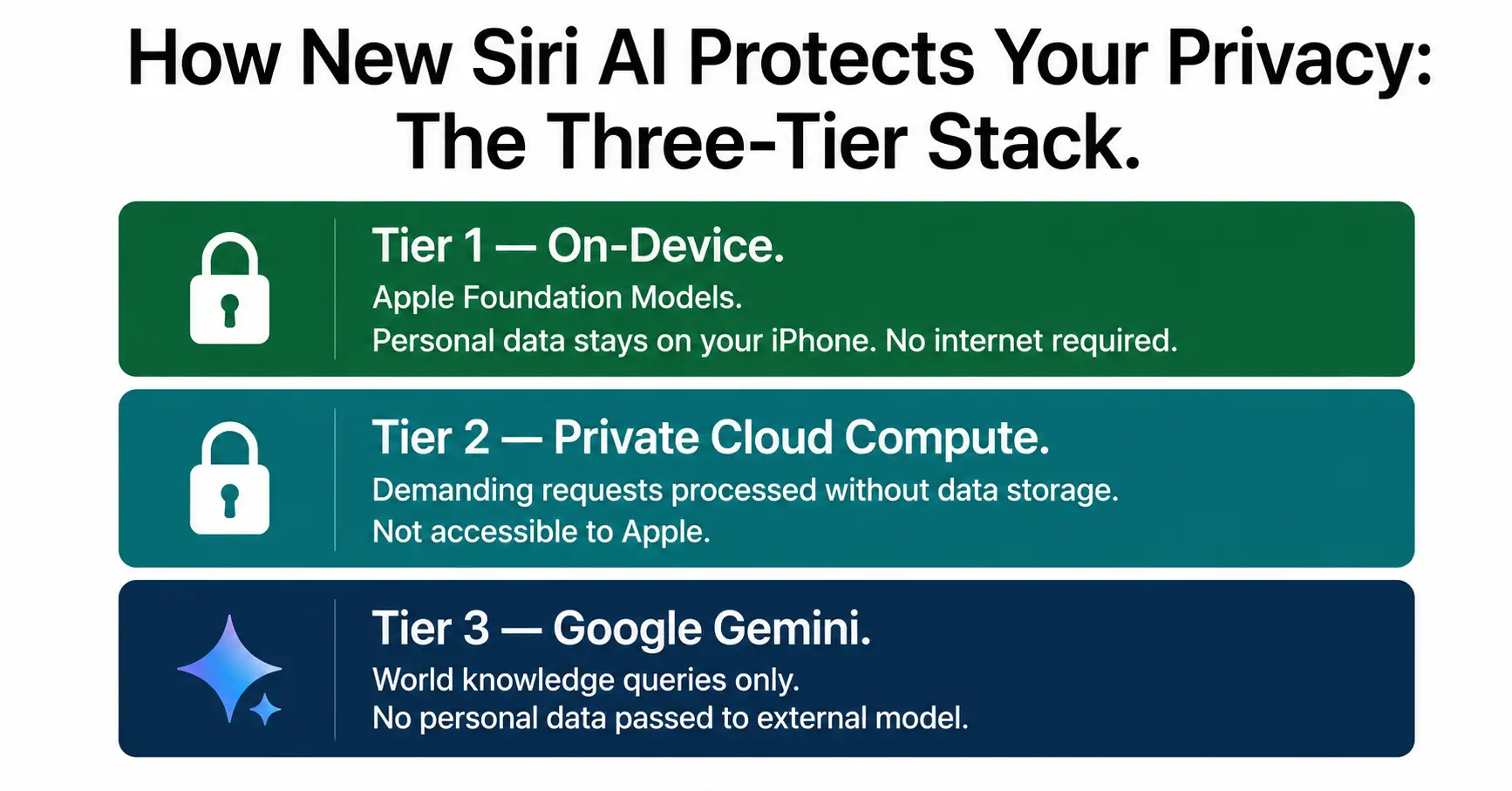
Apple built personal context processing on its three-tier privacy architecture. The first tier handles processing on-device using Apple’s Foundation Models, keeping personal data entirely local. The second tier uses Private Cloud Compute for more demanding requests, where Apple’s servers process the query without storing the data or making it accessible to Apple employees. The third tier connects to external models like Google Gemini for general world knowledge queries, but not for personal data processing.
Additionally, Apple introduced a second generation of its Apple Foundation Models at WWDC 2026, which improves the on-device processing capability for personal context requests. The practical implication is that the most sensitive queries, those involving your messages, emails, and photos, process locally rather than in the cloud. This privacy-first framing is a deliberate contrast to Google Assistant and Microsoft Copilot, which rely more heavily on cloud processing, as noted in coverage by The Next Web’s report on Apple’s WWDC 2026 AI announcements.
How the New Siri AI Works Across Devices
iPhone: Dynamic Island and Voice Access
On iPhone models with a Dynamic Island, Siri AI animates within the Dynamic Island during a request rather than at the bottom of the screen. This is a visual change that makes the interaction feel less like an overlay and more integrated into the device itself. You can still invoke Siri through voice, through the side button, or through a new interaction with the Dynamic Island directly.
The standalone Siri AI app functions as a full conversational chatbot, storing your conversation history and syncing it across your Apple devices through iCloud. This is a meaningful departure from the old Siri, which had no persistent memory between sessions. Now a conversation you started on iPhone continues seamlessly on Mac or iPad without losing context.
Mac and iPad: Spotlight Integration
On Mac and iPad, Siri AI integrates directly into Spotlight, Apple’s system-wide search interface. Invoking Spotlight now surfaces the conversational AI alongside traditional search results. Mac users can access the full capability of Siri AI through the same keyboard shortcut they have used for Spotlight search for years, with no new interface to learn.
The integration is particularly useful on Mac for tasks that previously required switching between multiple applications. Asking Siri to pull a figure from a spreadsheet, draft a reply based on an email thread, or set a reminder based on a document you have open all become single-step actions rather than multi-app workflows.
The Gemini Partnership: What It Means for Apple Users
A Custom Gemini Model Inside Apple’s Privacy Stack
The most architecturally significant decision Apple made with Siri AI is running the assistant on a custom 1.2-trillion-parameter version of Google’s Gemini model. This is an unusual arrangement. Apple is not simply routing queries to Google’s Gemini API. The model is customised for Apple’s specific requirements and operates within Apple’s privacy stack rather than Google’s.
The multi-year deal is reportedly worth around $1 billion per year to Google. For Apple, the arrangement gives Siri AI access to a frontier-scale model without having to build and maintain a competing large language model (LLM) from scratch, a task that has taken OpenAI, Google, and Anthropic years and billions of dollars in infrastructure investment.
Third-Party AI Extensions in iOS 27
Additionally, iOS 27 introduces a new option that lets users set a third-party AI model as their default assistant. Claude from Anthropic, ChatGPT from OpenAI, and other models can sit alongside Siri AI and be invoked through the same system-level interface. This is the first time Apple has opened its assistant layer to third-party AI providers as a first-class, user-configurable option.
The practical implication is that users who prefer a specific AI assistant for certain tasks can route those requests to their preferred model while keeping Siri AI as the default for on-device and personal context queries where privacy and system integration matter most.
Apple Intelligence Updates Beyond Siri AI
Photos, Image Playground, and Messages
Siri AI is the headline feature of Apple Intelligence in iOS 27, but Apple announced several supporting capabilities at WWDC 2026. In Photos, a feature called Spatial Reframing lets users improve composition after a shot is taken by repositioning subjects within the frame. Image Playground, Apple’s on-device image generation tool, now supports photorealistic image generation rather than being limited to stylised illustrations.
In Messages, one-tap suggestions can create notes or reminders directly from conversations without leaving the app. These capabilities extend the Apple Intelligence layer deeper into the apps users interact with most frequently, making AI assistance contextually available rather than requiring a separate AI app interaction.
Camera Identification
Siri AI can now identify real-world objects through the iPhone camera and respond to questions about them. Point your camera at a plant and ask what it is. Show it a menu in a foreign language and ask for a translation. Look at a landmark and ask Siri for its history. This visual query capability works alongside the on-screen awareness feature but operates through the camera rather than the display, as detailed in Apple Headlines’ breakdown of how Siri AI changes iPhone use in 2026.
The History Behind This Launch: Two Years of Delays
What Was Promised at WWDC 2024
To understand the significance of this release, the timeline matters. Apple first announced personal context awareness and on-screen awareness capabilities at WWDC 2024. Those features were marketed as part of Apple Intelligence arriving with iPhone 16. However, when iPhone 16 shipped in September 2024, the personalised Siri features were absent.
At WWDC 2025, Apple’s senior VP Craig Federighi acknowledged publicly that the new Siri experience “did not converge in the way, quality-wise, that we needed it to.” The delayed features were pushed to 2026. In March 2025, Apple officially delayed them indefinitely. Apple then settled a $250 million class action lawsuit in May 2026 over the marketing of unready Siri AI features with iPhone 16.
Why the Reliability Bar Matters at Launch
The delay history creates a specific expectation management challenge for this launch. Apple has now shipped the features it was sued for failing to deliver. The question independent reviewers and users will answer over the weeks following WWDC is whether the features work reliably in real-world use, not just in a controlled keynote demo environment. Federighi’s own 2025 admission that reliability was the reason for the delay sets the standard Apple must now meet in practice.
How New Siri AI Compares to Google Assistant and Microsoft Copilot
The Competitive Landscape in 2026
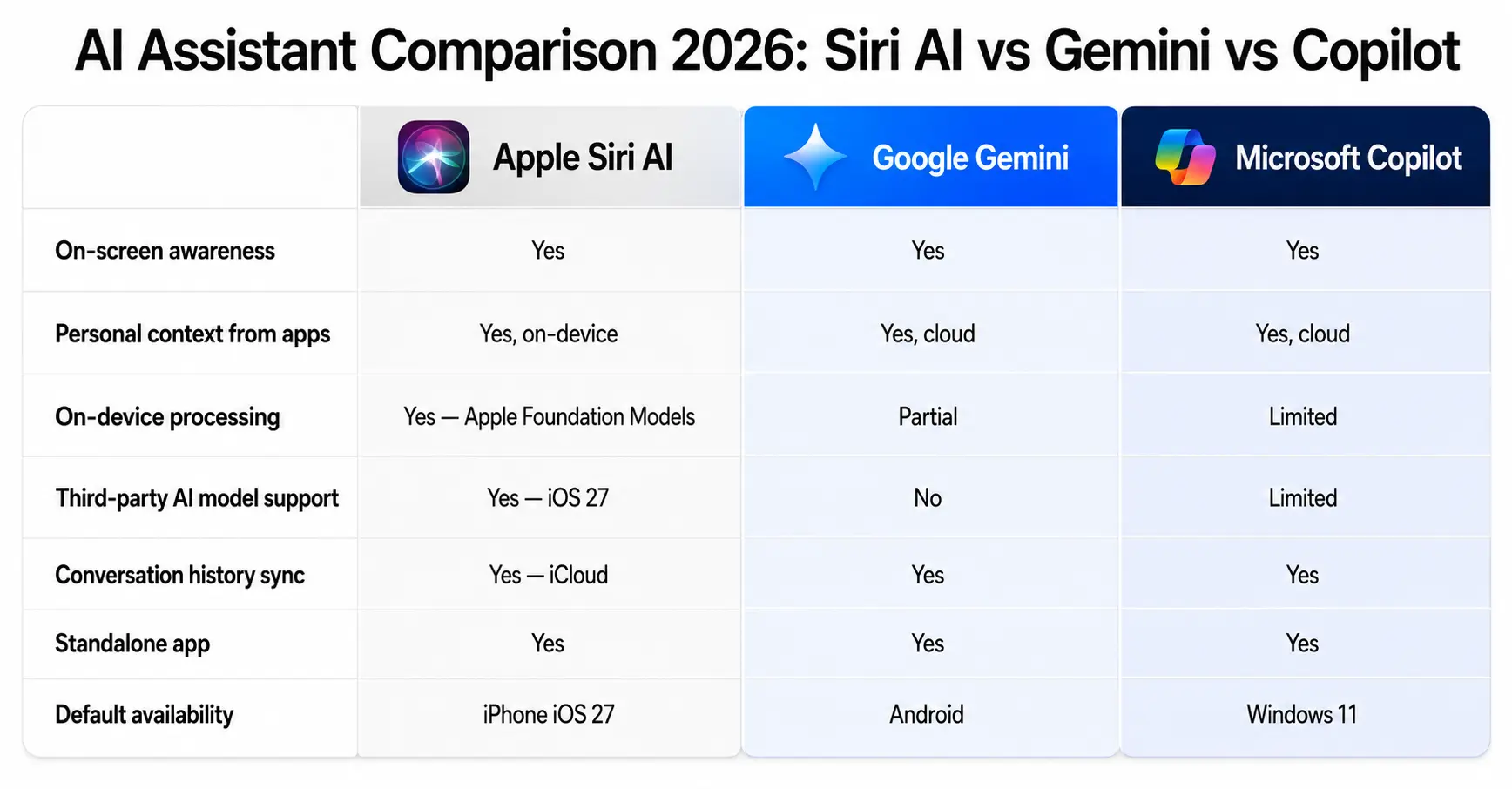
Google Assistant evolved into Google Gemini on Android, which has had on-screen awareness and personal context capabilities through integration with Google Workspace since 2024. Microsoft Copilot is embedded in Windows 11 and Microsoft 365, with deep integration across Word, Excel, Outlook, and Teams. Both have been shipping comparable capabilities for longer than Apple’s new Siri AI.
However, Apple’s differentiation rests on two factors. The first is privacy architecture. Processing personal context on-device through Apple Foundation Models rather than in the cloud is a genuinely distinct approach. The second is hardware integration. On-device awareness that connects Messages, Photos, Calendar, and Mail through a coherent assistant interface is something Android’s fragmented ecosystem cannot replicate at the same level without significant third-party app cooperation.
Apple’s competitive advantage is not that Siri AI arrived first. It is that Siri AI runs deeper into the Apple ecosystem with stronger privacy guarantees than any competing platform can offer on equivalent hardware, as analysed in coverage by TechGenyz’s detailed overview of Siri AI’s WWDC 2026 feature set.
Which Devices Support the New Siri AI
Hardware Requirements for iOS 27
Siri AI arrives with iOS 27, iPadOS 27, and macOS 27 this autumn. Apple has not published a final device compatibility list as of the WWDC 2026 keynote. However, Apple Intelligence features in iOS 26 required iPhone 15 Pro or newer, or any device with an M1 chip or later. The expanded model scale in Siri AI is likely to maintain similar requirements or tighten them slightly.
Older iPhone models will receive iOS 27 but may not support all Siri AI capabilities. The on-device processing tier requires sufficient chip performance to run Apple Foundation Models locally. Devices that cannot meet that threshold will rely more heavily on Private Cloud Compute for requests that their predecessors would have handled locally, which may affect response latency.
Frequently Asked Questions
When does the new Siri AI arrive on iPhones?
Siri AI arrives with iOS 27 this autumn. Apple typically releases its annual iOS update in September alongside new iPhone hardware. Developer betas began immediately after WWDC 2026, and a public beta is expected in July 2026.
Does Siri AI require an internet connection?
Not for all features. Personal context queries using Messages, Mail, Photos, and Calendar process on-device through Apple Foundation Models and work without a connection. World knowledge queries and requests that require external information connect to Google Gemini through Private Cloud Compute and need internet access.
Is Siri AI available on older iPhones?
Full Siri AI capabilities require recent hardware. Apple Intelligence features in the previous iOS generation required iPhone 15 Pro or any device with an M1 chip or later. Siri AI will likely maintain similar or tighter hardware requirements given its expanded model scale. Older devices may receive partial features.
Why is Apple using Google Gemini to power Siri?
Apple partnered with Google to access a frontier-scale language model without building one from scratch. The Gemini model running inside Siri AI is customised for Apple’s requirements and operates within Apple’s privacy stack. The deal is reportedly worth around $1 billion annually to Google and lets Apple compete with AI assistants from Google and Microsoft immediately rather than waiting years to develop a comparable model independently.
Can I use ChatGPT or Claude instead of Siri AI?
Yes. iOS 27 introduces support for third-party AI models as a user-configurable default assistant. Claude from Anthropic, ChatGPT from OpenAI, and other compatible models can be set as the preferred assistant for specific tasks while Siri AI handles on-device and personal context queries where privacy matters most.
What happened to the Siri AI features promised with iPhone 16?
The personalised Siri features announced at WWDC 2024 were not ready when iPhone 16 shipped. They were delayed in March 2025 and Apple settled a $250 million class action lawsuit in May 2026 over the marketing of those unready features. WWDC 2026 marks the actual delivery of the capabilities originally announced two years earlier.
The New Siri AI
The new Siri AI is a fundamentally different product from the assistant Apple has shipped for 15 years. On-screen awareness, personal context search across your Apple ecosystem, multi-step task execution, and persistent conversation history are capabilities that change how the assistant integrates into daily device use. They were promised two years ago, delayed, and then arrived accompanied by a settled lawsuit. That history sets a high reliability bar for the autumn release.
The architecture decisions Apple made are the most interesting part of this story. Running a 1.2-trillion-parameter Gemini model inside Apple’s three-tier privacy stack, processing the most sensitive personal queries on-device, and opening the assistant layer to third-party AI models as user-configurable defaults reflects a pragmatic and privacy-conscious approach to catching up in a space where Google and Microsoft already had head starts.
Whether the new Siri AI delivers in real-world use what it demonstrated in a keynote demo is the only question that actually matters now. Apple has the architecture, the ecosystem integration, and the hardware platform to make this work. The 2024 delay showed that building a reliable AI assistant is significantly harder than building an impressive one. Users will find out in September whether Apple solved reliability or only deferred it again.
For the authoritative source on what Apple announced at WWDC 2026, the Apple iOS 27 preview page covers the full feature list as it becomes available through the developer beta cycle. For anyone following the competitive AI assistant landscape, this launch reshapes a race that Google and Microsoft have been leading for the past two years.

Prince Anichi
Founder and Lead Technology Editor at Ortechy. Covering digital economy shifts, tech ecosystems across Africa, cybersecurity intelligence, and emerging software platforms.